

C0696 on 2004-2011 GMC Yukon XL: Causes for Service Suspension Message
Code C0696 on a GMC Yukon XL usually means a "Service Suspension System" warning due to faulty wiring near the air compressor or a failed compressor itself. The wiring harness is known to chafe against the frame rail on the driver's side. Expect to spend $50 on a wiring repair kit or $200-$450 for a new compressor assembly.
- Code C0696 on your Yukon XL almost always points to a problem with the rear air suspension, specifically the compressor or its wiring.
- Before buying any parts, follow GM's own advice (TSB PIT4954D) and thoroughly inspect the wiring harness going to the air compressor for damage. This is the most common and cheapest fix.
- Symptoms include a "Service Suspension System" message and the rear of the truck sagging.
- If the wiring is good, the next most likely cause is a failed air compressor assembly.
- Do not replace the air shocks to fix this code unless you have separately confirmed they are leaking, as the problem is almost always electrical.
What's Unique About the 2004-2011 Gmc YUKON XL
The GMC Yukon XL of this era, especially those with the Autoride (Z55) suspension, places the air compressor and its wiring underneath the vehicle along the driver's side frame rail. This exposed location makes the wiring harness extremely vulnerable to moisture, corrosion, and physical damage from road debris. A specific GM Technical Service Bulletin (PIT4954D) directly calls out that wiring damage, specifically where the harness can get pinched between the compressor assembly and the frame, is a primary cause for this code. This highlights a common pattern failure for these vehicles that is frequently discussed in owner forums.
Diagnostic Flowchart
Tap your situation to follow the diagnostic path that matches what you're seeing on this vehicle.
Generation note: The 2004-2011 year range covers two generations of the GMC Yukon XL: the GMT800 (2004-2006) and the GMT900 (2007-2011). Both generations offered the Autoride (Z55) air suspension system and are susceptible to the issues described, particularly the wiring and compressor failures noted in TSB PIT4954D, which covers models from 2001-2013.
Symptoms You May Notice
- "Service Suspension System" or "Service Ride Control" message on the dashboard.
- Rear of the vehicle sits too low (sags) or too high.
- Air suspension compressor does not turn on.
- Air suspension compressor runs constantly.
- Harsh, bouncy, or unstable ride quality.
- A loose hose hanging down in the left rear of the vehicle.
- Unusual buzzing or clicking sounds from the compressor area.
- Replacing the air shocks or springs when the 'Service Suspension' message is displayed, without diagnosing the electrical system. The root cause is often the compressor or its wiring.
- Replacing the entire compressor assembly when only the wiring harness is damaged. The TSB specifically advises to repair the wiring first.
Most Likely Causes
- Damaged Wiring to Air Compressor / Pressure Sensor 🔴 High Probability The wiring harness is routed in an exposed location under the vehicle, making it highly susceptible to being pinched, chafed, or corroded, as documented in TSB PIT4954D. The most common failure point is where the harness gets pinched between the compressor bracket and the vehicle frame.
How to confirm: Visually inspect the entire wiring harness leading to the air compressor assembly, which is typically located on the driver's side frame rail. Pay extremely close attention to the point where the harness passes the compressor mounting bracket. Look for breaks, chafing against the frame, or green corrosion on the connector pins.
Typical fix: Repair the damaged section of the wiring harness using heat-shrink butt connectors or replace the pigtail connector. Ensure the repaired harness is rerouted or secured with zip ties to prevent future damage. Some owners add protective wire loom for extra security.
Est. part cost: $15-$50 - Failed Air Suspension Compressor Assembly 🔴 High Probability Normal wear and tear, or being overworked due to leaks in the air springs, can cause the compressor motor to burn out. The aluminum housing is also prone to corrosion and cracking, leading to internal leaks.
How to confirm: After confirming wiring is intact, use a scan tool to command the compressor on. If it doesn't run, check for power and ground at the connector. A common DIY test is to jump the compressor relay in the underhood fuse block to send power directly to the compressor; if it still doesn't run, it has failed.
Typical fix: Replace the entire air compressor assembly. These units typically include the compressor, motor, and dryer. It is highly recommended to replace the compressor relay at the same time.
Est. part cost: $200-$450 - Failed Automatic Level Control (ALC) Pressure Sensor 🟡 Medium Probability The sensor, which is part of the compressor assembly, can fail internally due to moisture intrusion from a saturated dryer or from the same wiring damage that affects the compressor motor.
How to confirm: This is difficult to test directly without a capable scan tool to monitor pressure readings. The code C0696 points directly to a fault in this sensor's circuit. If the wiring to the sensor is confirmed to be good, the sensor itself is the likely culprit.
Typical fix: The sensor is typically not sold separately from the factory. The fix is to replace the air compressor's filter, dryer, and sensor assembly, which is most commonly done by replacing the entire compressor unit.
Est. part cost: $200-$450 - Blown Fuse or Faulty Relay ⚪ Low Probability An electrical surge from a failing or shorted compressor can blow the fuse or damage the relay.
How to confirm: Check the fuses labeled 'RTD' (Real Time Damping) and 'ALC' (Automatic Leveling Control) in the underhood fuse block. For the GMT900 (2007-2014), these are typically fuse #2 (30A) and #54 (30A). For the GMT800 (2004-2006), check the 'RTD' (10A) and 'ELC' (30A) fuses in the underhood fuse block. Test or swap the ALC relay with a known good one (like the horn relay).
Typical fix: Replace the blown fuse or faulty relay. If a new fuse blows immediately, it indicates a short circuit that must be found, likely in the compressor or its wiring.
Est. part cost: $5-$30
Rare But Worth Checking
- Failed Electronic Suspension Control Module (ESCM): This is rare. Before condemning the module, all other possibilities like wiring, fuses, the relay, and the compressor assembly should be exhaustively checked. A no-communication code with the ESCM would be a strong indicator.
- Leaking Air Shocks/Springs: While leaking air springs don't directly cause C0696, they cause the compressor to run excessively, leading to its eventual electrical failure and triggering this code. If the compressor is replaced without fixing the leaks, the new compressor will also fail prematurely. Always check for leaks with soapy water after replacing a compressor.
Diagnosis Steps
- Read codes from the Electronic Suspension Control (ESC) module with a capable scan tool. Confirm C0696 is present.
- Visually inspect the vehicle's rear ride height. Note if it is sagging or stuck high.
- Check the 'ALC'/'ELC' and 'RTD' fuses in the underhood fuse block. For 2007+ models, this is often fuse #2 and #54. For 2004-2006 models, check the 'ELC' and 'RTD' fuses.
- Swap the ALC relay with a known good one (e.g., horn relay) to test its function.
- Following TSB PIT4954D, raise the vehicle and securely support it. Locate the air compressor on the driver's side frame rail.
- Thoroughly inspect the wiring harness going to the compressor for any signs of chafing, pinching, breaks, or corrosion, especially where it runs near the frame and compressor bracket. This is the most likely cause.
- If wiring is damaged, repair it using weatherproof connectors. Clear codes and re-test.
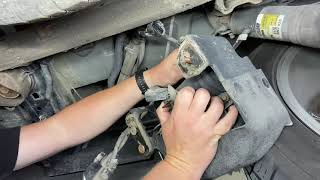
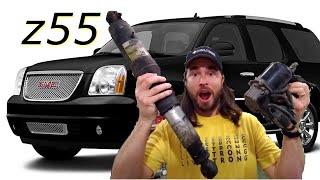
- If wiring is intact, disconnect the compressor connector and test for power (battery voltage) and ground at the appropriate pins while commanding the compressor ON with a scan tool or by jumping the relay. 🎬 Watch: How to troubleshoot and repair the Z55 AutoRide system.
- If power and ground are present but the compressor does not run, the compressor has failed and needs replacement.
- If the compressor runs but the vehicle does not lift, check for major leaks in the air lines or the air springs themselves using soapy water.
Parts You'll Likely Need
- Air Suspension Compressor Assembly
(OEM #15254590, 19299545, 20930288, 22941806)— This is the most common point of failure after wiring. The motor burns out from age or being overworked by leaks. Replacement restores system function.
Trusted brands: ACDelco (GM Original Equipment), Dorman (e.g., 949-000, 949-001, 949-099), Arnott, Vigor
OEM price range: $350-$500
Aftermarket price range: $180-$300 - Air Compressor Wiring Harness Pigtail
(OEM #ACDelco PT2309, GM 12101937)— If the wiring is corroded or broken right at the compressor's connector, a pigtail is needed to make a solid, weatherproof repair.
Trusted brands: Dorman, ACDelco, EFI Connection
OEM price range: $30-$50
Aftermarket price range: $15-$30
Related Codes That Often Appear With This One
- C0711 — This code is for the ALC pressure sensor and is explicitly mentioned alongside C0696 in TSB PIT4954D as being caused by the same wiring and sensor issues. C0711 specifically refers to the sensor performance, while C0696 refers to the circuit.
Technical Service Bulletins (TSBs) & Recalls
- PIT4954D: States that for a 'Service Suspension System' message with DTC C0696 or C0711, the primary cause is often wiring damage near the compressor. It advises removing the compressor to inspect for a pinched harness between the compressor and frame. It also notes that the pressure sensor is not serviced separately and requires replacing the filter/dryer/sensor assembly.
Platform-Specific Known Issues
- TSB PIT4954D specifically identifies that wiring to the automatic level control (ALC) pressure sensor can become shorted to ground or pinched between the compressor assembly and the vehicle frame, causing code C0696 or C0711. The bulletin explicitly states to inspect and repair the wiring before replacing any components.
Mechanic-Grade Diagnostic Values
- ALC Pressure Sensor 5-Volt Reference — expected: 4.8-5.2 Volts with key on, engine off.. Failure: Voltage below 4.75V or above 5.25V indicates a fault in the circuit or ESCM.
- ALC Pressure Sensor Signal Voltage — expected: Varies based on pressure. A common reference value for a similar GM sensor at rest is ~2.5 Volts.. Failure: Voltage less than 0.15V or greater than 4.85V indicates a short or open in the signal circuit.
- Compressor replenishment cycle threshold — expected: The compressor will run at startup if system pressure is below 10 psi (69 kPa).. Failure: If the compressor never runs at startup even after sitting, or runs every time, it indicates a sensor or leak issue.
Scan Tool Commands That Help
- GM Tech2 / GDS2: Compressor Test — After checking fuses and relays, use this bidirectional control to command the compressor on and off to verify its mechanical function and test for power/ground at the connector.
- GM Tech2 / GDS2: Diagnostic Counter Reset — After a repair, use this function to bypass the multi-ignition cycle requirement for re-setting a DTC, allowing for immediate verification that the fault is cleared.
Wiring & Ground Locations
- Electronic Suspension Control Module (ESCM) — Located above the spare tire, slightly to the driver's side, mounted to a frame cross-member. The spare tire must be removed for access.. This module is the brain of the system. It receives inputs from the pressure sensor and controls the compressor relay. All wiring related to C0696 originates from or terminates at this module.
- Compressor Connector (Pressure Sensor Circuit) — On the air compressor assembly, driver's side frame rail.. Code C0696 relates to the pressure sensor circuit. Key wires at this connector are the 5V reference (often Gray), signal (often Dark Green), and low reference/ground (often Tan or Black). These are the wires that must be tested for voltage, continuity, and shorts to ground.
- Frame Grounds (G300 series) — There are multiple critical frame grounds. Key locations for chassis electronics are behind the front wheels on the frame, an area prone to corrosion from tire splash.. A poor ground for the ESCM or compressor can cause erratic voltage readings and trigger various fault codes, including C0696.
Real Owner Repair Stories
- Tahoe Yukon Forum (2008 GMC Yukon XL Denali) — "Service Suspension" message, compressor would not run.
❌ Tried (didn't work) Replaced the compressor assembly., Replaced the 40A fuse and relay., Attempted a system relearn procedure.
✅ What actually fixed it The user was advised to check the wiring harness that connects to the pump for snug and clean connections, as this is a very common issue. While the user did not post a final confirmation, the conversation guided them directly toward the known wiring failure point after multiple parts were replaced unnecessarily.
OEM Part Supersession History
15296756, 15949881, 20837299, 20930288, 25913289→22941806 (current GM PN for GMT900)— Part revisions and consolidation by GM over the model years.
Heads up: These part numbers apply primarily to the GMT900 (2007-2011) generation.10395825, 15056494, 15070878, 15101577, 15254590→19299545 (current GM PN for GMT800)— Part revisions for the earlier generation.
Heads up: These part numbers apply to the GMT800 (2004-2006) generation. The Dorman 949-000 aftermarket part cross-references these numbers.Dorman 949-001→Dorman 949-099— The 949-099 is a more universal kit.
Heads up: Dorman 949-001 is for GMT900 (2007-2014) with a square electrical connector. Dorman 949-099 includes adapters for both round and square connectors to fit a wider range of years (2001-2014), and may include an improved thermal switch.
Model Year Variations Within This Range
- 2004-2006 (GMT800): The underhood fuse block uses different fuse designations. Look for the 'ELC' (30A) fuse for the compressor and the 'RTD' (10A) fuse for the control module. The fuse block is on the driver's side of the instrument panel.
- 2007-2011 (GMT900): The underhood fuse block uses fuse #2 (30A, labeled 'ALC') for the compressor and fuse #54 (30A, also labeled 'ALC' or 'RTD' depending on diagram) for the module. The fuse block is in the engine compartment on the driver's side.
Helpful Videos
We Have This Part in Stock


The information in this article is provided for general reference and educational purposes only. Vehicle specifications, procedures, and part compatibility can vary by production date, trim level, and region. Always consult your vehicle's factory service manual and verify part numbers before purchasing or performing repairs. Safety-critical components such as airbags, seat belts, and braking systems should be installed by a qualified professional.
- Gmc YUKON XL:
- 🎬 Helpful Videos
- 🛍️ Shop This Part
- What's Unique About the 2004-2011 Gmc YUKON XL
- Diagnostic Flowchart
- Symptoms You May Notice
- Most Likely Causes
- Rare But Worth Checking
- Diagnosis Steps
- Parts You'll Likely Need
- Related Codes That Often Appear With This One
- Technical Service Bulletins (TSBs) & Recalls
- Platform-Specific Known Issues
- Mechanic-Grade Diagnostic Values
- Scan Tool Commands That Help
- Wiring & Ground Locations
- Real Owner Repair Stories
- OEM Part Supersession History
- Model Year Variations Within This Range
- 🎟️ Get 5% Off