

C0696 on 2012-2014 Chevrolet Suburban: Service Suspension System Causes and Fixes
On a 2012-2014 Suburban, code C0696 almost always indicates a problem with the Autoride air suspension. The most common cause is damaged wiring to the air compressor assembly, located on the driver's side frame rail. The harness is known to chafe and short out against the frame or compressor bracket. Inspecting and repairing this wiring should be your first step, as explicitly advised by GM Technical Service Bulletin #PIT4954D, before considering replacing any parts.
- Code C0696 on a 2012-2014 Suburban almost certainly points to an electrical fault in the Autoride suspension system, not a mechanical failure of the shocks.
- Before purchasing any parts, you MUST perform a thorough visual inspection of the wiring harness going to the air compressor on the driver's side frame rail, as a pinched or corroded wire is the most common cause.
- GM Technical Service Bulletin PIT4954D was written specifically for this issue and warns technicians NOT to replace the compressor assembly until the wiring has been inspected and repaired.
- If the wiring is confirmed to be intact, the next most likely cause is a failed air compressor assembly, which contains the sensor that triggers the code.
- This is a known issue across the entire GMT900 large SUV line, including the Tahoe, Yukon, and Escalade.
What's Unique About the 2012-2014 Chevrolet SUBURBAN
The GMT900 platform, which includes the 2012-2014 Suburban, Tahoe, Yukon, and Escalade, is well-known for this specific issue. The wiring harness for the air suspension compressor is routed in a vulnerable location on the driver's side frame rail, where it is notoriously prone to getting pinched between the compressor assembly and the frame, chafed, or corroded. This known weakness is so common that General Motors issued a specific Technical Service Bulletin (PIT4954D) advising technicians to inspect and repair the wiring before considering the replacement of more expensive components like the compressor itself. The TSB explicitly states, "Do NOT replace the complete air compressor assembly for this concern."
Diagnostic Flowchart
Tap your situation to follow the diagnostic path that matches what you're seeing on this vehicle.
Symptoms You May Notice
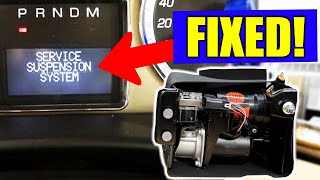
- "Service Suspension System" message on the Driver Information Center (DIC)
- Rear of the vehicle sags or sits too low, especially when loaded
- Incorrect rear suspension ride height
- Bouncy or harsh ride quality
- Air compressor does not run or runs continuously
- Code returns immediately after being cleared, indicating a hard fault
- Replacing the air suspension compressor without first thoroughly inspecting the wiring harness. TSB PIT4954D specifically warns against this, stating to repair the wiring instead.
- Replacing the Electronic Suspension Control Module (ESCM) before ruling out wiring and compressor faults.
- Replacing the rear air shocks when the fault is actually in the compressor's control circuit or the compressor itself. Leaking shocks do not directly cause C0696, which is an electrical fault code.
Most Likely Causes
- Damaged Wiring to Air Compressor Assembly 🔴 High Probability The wiring harness is routed in the rear driver's side wheel well where it is commonly pinched between the compressor assembly and the vehicle frame, causing the 5V reference wire (often gray) to short to ground. This is a well-documented design flaw addressed by TSB PIT4954D.
How to confirm: Visually inspect the entire wiring harness leading to the air compressor on the driver's side frame rail. It is often necessary to unbolt the compressor (typically three 13mm bolts) and lower it to properly inspect the top of the harness for chafed insulation, broken wires, or green corrosion where it passes over the bracket. Check for 5V reference, ground, and signal continuity with a multimeter at the X411 connector.
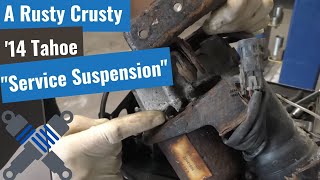
Typical fix: Repair the damaged section of the wire (often the gray 5V reference wire) using solder and heat-shrink tubing. 🎬 Watch: How to find and repair the common pinched wire fault. If damage is at the connector, replace the pigtail (ACDelco PT2647 / GM 13580871). Reroute or add protective loom to the harness to prevent future damage.
Est. part cost: $10-$50 - Failed Air Suspension Compressor Assembly 🟡 Medium Probability The position/pressure sensor is integrated into the compressor's dryer assembly and can fail internally, sometimes due to moisture intrusion as noted in TSB PIT4954D. Also, leaks in the air shocks can cause the compressor to overwork and burn out. Corrosion from its exposed location is also common.
How to confirm: If wiring is confirmed to be good, use a bidirectional scan tool to command the compressor on. If it doesn't run, check for power at the compressor. If it runs but doesn't build pressure, the compressor is worn out. If the code C0696 returns immediately after clearing with good wiring, it points to an internal electrical fault in the compressor/sensor assembly.
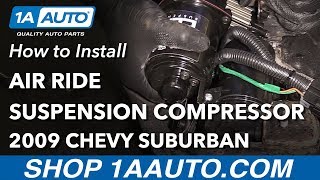
Typical fix: Replace the entire air compressor and dryer assembly. 🎬 See this step-by-step walkthrough for replacing the air compressor assembly. It is often recommended to replace the compressor relay at the same time. Per TSB PIT4954D, the sensor is not serviced separately from the dryer assembly.
Est. part cost: $220-$650
Rare But Worth Checking
- Faulty Electronic Suspension Control Module (ESCM): While rare, the ESCM itself can fail, sometimes shorting the 5-volt reference line internally and mimicking a sensor or wiring fault. This should be considered only after wiring and the compressor assembly have been thoroughly checked. Multiple owners on forums like TahoeYukonForum.com and ScannerDanner have confirmed this failure. The module, located above the spare tire, can suffer from corrosion and water intrusion.
- Blown Fuse or Faulty Relay: A simple blown fuse (often labeled 'ALC' or 'RTD', such as the 40A #58 fuse in the underhood block) or a bad compressor relay can disable the system. A blown fuse is often a symptom of a shorted wire or seized compressor, but it is a simple and inexpensive check to perform early in the diagnostic process.
Diagnosis Steps
- Scan the Electronic Suspension Control (ESC) module for codes. Confirm C0696 is present, often with C0711.
- Check the fuse for the electronic suspension system (e.g., 'RTD' or 'ALC' #58 40A fuse) in the underhood fuse box.
- Swap the air suspension compressor relay with a known good relay of the same type to rule out a relay failure.
- Raise and safely support the vehicle. Locate the air compressor on the driver's side frame rail, behind the rear tire.
- Perform a thorough visual inspection of the wiring harness leading to the air compressor. Unbolt the compressor (typically 3x 13mm bolts) to gain full access to the harness section that passes between the compressor bracket and the frame.
- Look for a pinched, chafed, or broken gray wire (5V reference) or dark green wire (signal).
- If wiring appears intact, use a multimeter to check for 4.8-5.2 Volts on the 5-volt reference wire at the compressor connector with the key on.
- Using a bidirectional scan tool, command the air compressor to turn on. 🎬 Watch: A professional guide to diagnosing GM air suspension problems. Listen for it to run.
- If the compressor does not run but has power and ground, and the wiring is good, the compressor motor or internal sensor has likely failed.
- If the compressor runs but the vehicle does not lift, or if it runs continuously, suspect a worn-out compressor or a leak in the system (air lines or shocks).
- If wiring and the compressor check out, the final step is to diagnose the Electronic Suspension Control Module (ESCM) itself, located above the spare tire, for internal faults or corrosion.
Parts You'll Likely Need
- Air Suspension Compressor Assembly
(OEM #22941806)— This assembly contains the compressor motor, dryer, and the integrated pressure/position sensor that is the source of the C0696 fault. If wiring is good, this entire unit is the most common part to fail. This part number supersedes 15296756, 15949881, 20837299, 20930288, and 25913289.
Trusted brands: ACDelco (OEM), Dorman (e.g., 949-001, or OE FIX 949-099), Arnott Industries (e.g., P-2793)
OEM price range: $560-$960
Aftermarket price range: $170-$500 - Air Compressor Wiring Harness Pigtail
(OEM #ACDelco PT2647 / GM 13580871)— If the wiring is corroded or damaged right at the compressor's electrical connector, replacing the pigtail is the standard repair.
Trusted brands: ACDelco, Dorman
OEM price range: $30-$50
Aftermarket price range: $20-$40
Related Codes That Often Appear With This One
- C0711 — This code also relates to the Automatic Level Control (ALC) system. TSB PIT4954D explicitly states that C0696 and C0711 are often set together due to the same root causes: a pinched wiring harness or an internal sensor fault from moisture.
- C0660 — This code points to a fault in the level control exhaust valve circuit. A wiring issue or a faulty ESCM can sometimes trigger this code along with C0696, as seen in forum discussions where a corroded module was the cause.
Technical Service Bulletins (TSBs) & Recalls
- PIT4954D: Addresses a "Service Suspension System" message with DTC C0696 or C0711. It details two primary causes: 1) Pinched/shorted wiring at the air compressor assembly. 2) An internal pressure
Platform-Specific Known Issues
- Technical Service Bulletin PIT4954D was issued by GM specifically for this problem. It highlights that DTC C0696 is often caused by the wiring to the automatic level control pressure sensor being shorted to ground where it gets pinched between the compressor assembly and the vehicle frame. It explicitly tells technicians NOT to replace the compressor for this issue and to repair the wiring first.
- The same TSB also notes a second possible cause for the related C0711 code: an internal fault in the pressure sensor due to moisture. For this, the fix is to replace the 'air filter, dryer, and sensor assembly' (Part #22964558 for vehicles built before May 2012, which requires a jumper harness).
Mechanic-Grade Diagnostic Values
- 5-Volt Reference Circuit Voltage — expected: 4.75 - 5.25 Volts with key on. Failure: Voltage below 4.75V or above 5.25V for more than one second. A reading near 0V indicates a short to ground.
- Ride Height Position Sensor Signal Voltage — expected: Varies between 0.35 - 4.75 Volts as suspension is jounced. Failure: Voltage is fixed, does not change with movement, or shows spikes/dropouts.
- Low Reference Circuit to Chassis Ground — expected: Less than 5.0 ohms. Failure: Resistance greater than 5.0 ohms indicates a poor ground connection for the sensor.
- Air Compressor Ground Circuit Resistance — expected: Less than 1.0 ohm. Failure: A reading greater than 1.0 ohm between the ground circuit terminal at the compressor connector and a clean chassis ground indicates high resistance in the ground path.
Scan Tool Commands That Help
- GDS2 / Tech2Win: Read Fault Codes from Electronic Suspension Control (ESC) module — This is the first step to confirm C0696 and check for other related codes like C0711 or C0660, which can help pinpoint the fault area.
- GDS2 / Tech2Win: Read Data Stream (Live Data) — To monitor live voltage from the suspension position sensors and the ALC pressure sensor. This allows you to see if a sensor is providing an erratic or stuck signal. For example, watching the voltage change while bouncing the suspension can confirm sensor operation.
- GDS2 / Tech2Win: Bidirectional Control: Command Compressor On/Off — After checking wiring, this command directly tests the compressor motor and relay. If the compressor does not run when commanded, it points to a failure in the compressor motor, relay, or power/ground supply.
- GDS2 / Tech2Win: Module Setup / Calibration — This is required after replacing the Electronic Suspension Control Module (ESCM). The new module must be programmed with the vehicle's VIN and then a suspension level calibration must be performed for the system to function correctly.
Wiring & Ground Locations
- X411 — The main electrical connector on the air compressor assembly, located on the driver's side frame rail near the rear wheel.. This is the primary point of failure. The C0696 code directly relates to the pressure sensor circuit within this harness. The wires, especially the 5V reference, are often pinched or corroded right at this connector. Technicians must test for voltage and continuity at this connector's pins.
- G400 — Left rear body mount.. This is a major chassis ground point for several rear body components, including potentially the Electronic Suspension Control Module (ESCM). A poor or corroded ground here can cause a variety of electrical issues, including erratic sensor readings that could contribute to suspension system faults.
- ESCM (Electronic Suspension Control Module) — Located above the spare tire.. This is the control unit for the entire system. It is susceptible to corrosion and water intrusion due to its location. A failure here can cause C0696 by internally shorting the 5V reference line, or by failing to correctly interpret sensor data.
Real Owner Repair Stories
- Tahoe Yukon Forum user 'bmwme' (2007 Chevrolet Tahoe LTZ with Autoride) — Intermittent 'Service Suspension' message, C0696 code for 'over volt' on the LR ride height sensor after a blown 30A ASC fuse was replaced.
❌ Tried (didn't work) Replacing the 30A fuse (this restored pump operation but the code and message remained).
✅ What actually fixed it The final fix was replacing the Electronic Suspension Control Module (ESCM), which was located above the spare tire. A local shop sourced a used module for $150 and charged one hour of labor for installation, which resolved all issues.
"I Checked Everything" — The Actual Cause
- In the context of this electrical code, the equivalent of a 'smoke test clean' scenario is when the primary suspect—the wiring harness at the compressor—is inspected and found to be intact, yet the code persists. In documented cases, the actual cause was an internal failure of the Electronic Suspension Control Module (ESCM), which shorted the 5-volt reference circuit internally. This mimics a wiring fault perfectly and is often missed if diagnosis stops after checking the external harness and replacing the compressor.
OEM Part Supersession History
15296756, 15949881, 20837299, 20930288, 25913289→22941806— Standard part evolution, design improvements, and consolidation of inventory by GM.
Heads up: While these are direct supersessions, it's important to verify fitment with the vehicle's VIN. Aftermarket versions like Dorman 949-001 are also common replacements.20982305, 22197161→22964558— Updated design for the air filter, dryer, and sensor assembly mentioned in TSB PIT4954D.
Heads up: This part is for vehicles built before May 2012 and may require a jumper harness for installation. It has since been discontinued by GM, making replacement of the entire compressor assembly more common.
Model Year Variations Within This Range
- 2012 (before May): Per TSB PIT4954D, if the cause of a related code C0711 is an internal sensor fault due to moisture, vehicles built before May 2012 require a specific 'air filter, dryer, and sensor assembly' (Part #22964558). This part may require a separate jumper harness to be installed and has been noted as discontinued, often necessitating the replacement of the entire compressor assembly.
Helpful Videos
We Have This Part in Stock


The information in this article is provided for general reference and educational purposes only. Vehicle specifications, procedures, and part compatibility can vary by production date, trim level, and region. Always consult your vehicle's factory service manual and verify part numbers before purchasing or performing repairs. Safety-critical components such as airbags, seat belts, and braking systems should be installed by a qualified professional.
- Chevrolet SUBURBAN:
- 🎬 Helpful Videos
- 🛍️ Shop This Part
- What's Unique About the 2012-2014 Chevrolet SUBURBAN
- Diagnostic Flowchart
- Symptoms You May Notice
- Most Likely Causes
- Rare But Worth Checking
- Diagnosis Steps
- Parts You'll Likely Need
- Related Codes That Often Appear With This One
- Technical Service Bulletins (TSBs) & Recalls
- Platform-Specific Known Issues
- Mechanic-Grade Diagnostic Values
- Scan Tool Commands That Help
- Wiring & Ground Locations
- Real Owner Repair Stories
- "I Checked Everything" — The Actual Cause
- OEM Part Supersession History
- Model Year Variations Within This Range
- 🎟️ Get 5% Off