

C0696 on 2007-2013 Cadillac Escalade EXT: Air Suspension Fault Causes and Fixes
On a 2007-2013 Escalade EXT, code C0696 almost always points to damaged wiring at the air suspension compressor, located behind the driver's side rear wheel. The wiring harness for the pressure sensor chafes against the frame, causing a short circuit. Inspecting and repairing the chafed wires is a low-cost fix; if the compressor itself has failed, expect to pay $200-$400 for a replacement part.
- Code C0696 on a 2007-2013 Escalade EXT is almost always related to the rear air suspension.
- Before buying any parts, you MUST inspect the wiring harness on the air compressor (driver's side, behind rear wheel) for damage, as this is the most common cause documented in a GM service bulletin.
- If the wiring is intact, test the compressor relay before condemning the compressor itself.
- If the compressor has failed, it was likely caused by old, leaking air shocks. It's wise to inspect the shocks for leaks to avoid repeat failure of a new compressor.
What's Unique About the 2007-2013 Cadillac ESCALADE EXT

The GMT900 platform, which underpins this generation of Escalade, is well-known for issues with its Autoride (Z55 RPO code) air suspension system. The primary vulnerability is the placement of the air compressor and its wiring harness on the frame rail behind the driver's rear wheel. General Motors issued a Technical Service Bulletin (PIT4954D) specifically because the wiring to the compressor's pressure sensor is prone to getting pinched or chafed against the frame, causing a short to ground that directly triggers code C0696. This is such a common failure that the TSB explicitly warns technicians *not* to replace the entire compressor assembly for this code until the wiring has been thoroughly inspected.
Diagnostic Flowchart
Tap your situation to follow the diagnostic path that matches what you're seeing on this vehicle.
Symptoms You May Notice
- "Service Suspension System" message on the Driver Information Center (DIC).
- Rear of the vehicle sags or sits lower than the front.
- Air compressor is heard running constantly.
- Air compressor does not turn on when the vehicle is started or loaded.
- A visible, deflated air bag around the rear shock absorber.
- Replacing the entire air compressor assembly when only the wiring harness was damaged. The TSB specifically warns against this.
Most Likely Causes

- Damaged Wiring to Air Compressor Pressure Sensor 🔴 High Probability As documented in GM Technical Service Bulletin #PIT4954D, the wiring harness is frequently pinched or chafed between the air compressor assembly and the vehicle's frame, causing a short circuit. The pressure sensor connector and its wires are positioned in a way that makes them highly susceptible to rubbing against the frame during normal vehicle operation.
How to confirm: Remove the driver's side rear wheel and visually inspect the wiring harness leading to the air compressor assembly for signs of damage, pinching, or corrosion. The chafe point is almost always where the harness passes over the top of the compressor bracket near the frame.
Typical fix: Repair the damaged section of the wire harness using solder and heat shrink tubing. Re-route or wrap the harness with anti-abrasion tape and secure it with zip ties to prevent future contact with the frame.
Est. part cost: $5-$25 for wiring repair supplies. - Failed Air Suspension Compressor Assembly 🟡 Medium Probability The compressor can fail from age or being overworked due to leaks in the air shocks. The integrated pressure sensor can also fail internally from moisture intrusion, which was a separate condition noted in TSB PIT4954C. Road salt and moisture can also corrode the compressor body and electrical connections.
How to confirm: After confirming the wiring and relay are good, supply 12V power directly to the compressor's power terminals by jumping the relay in the underhood fuse box (usually terminals 30 and 87). If it doesn't run, it has failed.
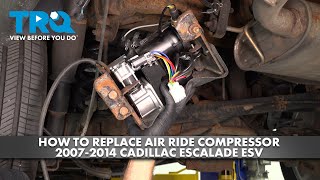
Typical fix: Replace the entire air compressor assembly. 🎬 See this walkthrough for replacing the compressor on GMT900 SUVs. Popular aftermarket brands like Dorman and Arnott often redesign the sensor's position to mitigate the original chafing issue. It is highly recommended to replace the compressor relay at the same time.
Est. part cost: $200-$500 - Leaking Rear Air Shocks 🟡 Medium Probability The rubber air bladders on the factory shocks are prone to dry rot and cracking over time, causing air leaks. This is a common failure point that overworks the compressor, leading to its eventual burnout.
How to confirm: With the system pressurized (if possible), spray the air shocks' rubber bladders and air line connections with soapy water and look for bubbles, which indicate a leak.
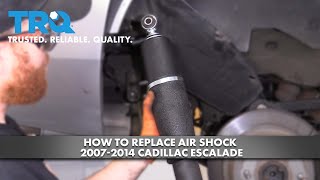
Typical fix: Replace the rear air shocks in pairs. While GM once recommended this, a later bulletin (18-NA-315) states that for newer models, replacing only the single failed shock is acceptable unless both are confirmed to be bad. For this generation, replacement in pairs is still common practice. 🎬 Watch: How to replace the rear air shocks yourself.
Est. part cost: $300-$600 for a pair. - Faulty Air Suspension Relay ⚪ Low Probability
How to confirm: Locate the relay in the underhood fuse box (often labeled 'ALC/COMP'). Swap it with an identical relay from a non-critical system (like the horn) to see if the compressor begins to function.
Typical fix: Replace the relay. It is often recommended to replace the relay whenever replacing the compressor, as a failing compressor can damage the relay contacts.
Est. part cost: $15-$40
Rare But Worth Checking
- Failed Electronic Suspension Control (ESC) Module: This is very uncommon. The ESC module is located behind the rear passenger side interior trim panel. Before replacing the module, all other possibilities, especially wiring, should be exhaustively ruled out. A service manual states to replace the ESC module only if all circuit tests are normal.
- Corroded Compressor Ground Wire: The main ground for the compressor is a separate ring terminal bolted to the frame near the compressor assembly. Corrosion at this point can cause intermittent operation or complete failure, even with a new compressor. This is a known issue on platform-mate forums.
Diagnosis Steps

- Read the trouble codes from the Electronic Suspension Control (ESC) module with a capable scan tool.
- Check the fuses related to the suspension system (often labeled 'ALC' or 'RTD') in the underhood and interior fuse panels.
- Raise the vehicle and remove the driver's side rear wheel for access.
- Carefully inspect the entire wiring harness leading to the air compressor for any signs of chafing, pinching, or corrosion, paying close attention to where it passes near the frame. This is the most likely cause.
- If wiring looks good, test the 5-volt reference circuit. Disconnect the compressor connector. With the ignition on, probe the 5V reference wire (often gray) at the harness connector. You should see 4.75-5.25 volts. If the voltage is low or zero, there is a short to ground or open in the harness.
- If wiring and voltages are good, test the compressor relay. You can swap it with a known-good relay or bypass it by jumping the main power terminals (usually 30 and 87) to send power directly to the compressor. If the compressor runs, the relay may be bad.
- If the compressor does not run when jumped, and the wiring is intact, check the compressor's dedicated ground wire on the frame for corrosion or looseness before condemning the compressor.
- If the compressor runs but the vehicle doesn't lift, or if the compressor runs constantly, check the rear air shocks for leaks using soapy water.
Parts You'll Likely Need

- Air Suspension Compressor Assembly
(OEM #19300045 (Superseded by multiple numbers, including 23316154))— This is the most common part to fail if the issue isn't a simple wiring problem. The assembly includes the motor, dryer, and pressure sensor that triggers the code.
Trusted brands: ACDelco (OEM), Dorman (e.g., 949-001, 949-099), Arnott (e.g., P-3242)
OEM price range: $400-$600
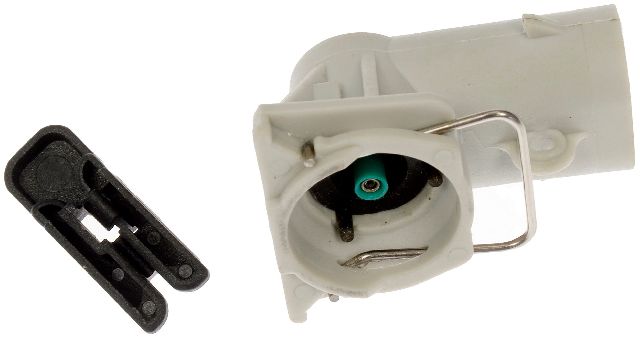
Aftermarket price range: $150-$400 - Air Compressor Wiring Pigtail — If the wiring is corroded or damaged right at the connector, replacing the pigtail is the correct repair. Dorman and ACDelco offer replacements.
Trusted brands: ACDelco, Dorman
OEM price range: $40-$70
Aftermarket price range: $20-$40 - Rear Air Shock Absorber
(OEM #15869656 / 19300045 (GM often bundled parts))— Leaking air shocks are a root cause of compressor failure. If they are leaking, they must be replaced to prevent the new compressor from burning out.
Trusted brands: ACDelco (OEM), Arnott (e.g., AS-2708), Monroe
OEM price range: $500-$700 (pair)
Aftermarket price range: $300-$500 (pair)
Related Codes That Often Appear With This One
- C0711 — This code for 'ALC Pressure Sensor Circuit Malfunction' is frequently set by the exact same wiring issue at the compressor, as noted in TSB PIT4954D. Owners often report seeing C0711 alongside or instead of C0696 for the same root cause.
Technical Service Bulletins (TSBs) & Recalls
- PIT4954D / PIT4954C: Addresses DTCs C0696 or C0711, incorrect ride height, and other compressor-related issues, pointing to chafed wiring near the compressor as a primary cause.
Platform-Specific Known Issues
- A GM Technical Service Bulletin (PIT4954D, which superseded PIT4954C and earlier versions) was issued specifically for DTC C0696 and C0711 on these vehicles, identifying the primary cause as the wiring to the air compressor's pressure
Mechanic-Grade Diagnostic Values
- 5-Volt Reference Circuit Voltage at ALC Pressure Sensor Harness Connector — expected: 4.75-5.25 volts (between terminal H and ground). Failure: Voltage below 4.75V indicates a short to ground or open/high resistance. Voltage above 5.25V indicates a short to voltage.
- Low Reference Circuit Resistance at ALC Pressure Sensor Harness Connector — expected: Less than 2.0 ohms (between terminal F and ground). Failure: Resistance greater than 2.0 ohms indicates an open or high resistance in the low reference circuit.
- ALC Pressure Sensor Operating Range — expected: 30-180 psi. Failure: The sensor provides a corresponding voltage signal to the ESCM within this pressure range.
Scan Tool Commands That Help
- GM Tech2 / GDS2: View All DTCs (in Electronic Suspension Control Module) — Used to confirm C0696 and to see if other related codes, like C0711 (ALC Pressure Sensor Circuit Malfunction) or damper actuator codes (e.g., C0590), are present, which can help pinpoint the fault.
- GM Tech2 / GDS2: Suspension Position Calibration — This procedure should be performed whenever ALC (Automatic Level Control) system components, such as the ESC module or sensors, are repaired or replaced to ensure the system has correct baseline values.
Wiring & Ground Locations

- G400 — Left rear body mount.. This is a primary ground point for the rear of the vehicle, including the Electronic Suspension Control Module. A corroded or loose G400 ground can cause erratic behavior or failure of the suspension control system, potentially contributing to various suspension-related DTCs.
- Electronic Suspension Control Module (ESCM) — Located on the left rear of the frame/chassis.. This is the module that sets code C0696. It supplies the 5V reference to the compressor's pressure sensor and monitors the return signal. All diagnostic wiring tests for this code ultimately lead to or from this module's connectors.
- ALC/COMP Relay — Underhood fuse block.. This relay provides power to the compressor motor. While not directly related to the 5V reference circuit, a faulty relay can cause the compressor to be inoperative, which is a common symptom. Technicians often jump terminals 30 and 87 at this relay's location to test the compressor motor directly.
Real Owner Repair Stories
- Tahoe Yukon Forum (2007-2014 GM SUV (platform mate)) — "Service Suspension System" message on the DIC, rear of vehicle sagging.
❌ Tried (didn't work) Replacing the air shocks., Replacing the air compressor assembly.
✅ What actually fixed it The user finally found the wiring harness for the compressor was rubbed through where it goes over the frame. After repairing the broken wires, the system returned to normal function and the code was cleared. This aligns perfectly with GM TSB PIT4954D.
OEM Part Supersession History
N/A (Sensor was part of compressor)→22964558 (Air filter, dryer, and sensor assembly kit)— GM stopped servicing the pressure sensor separately. This kit was created to replace the sensor and related components.
Heads up: An improved sensor design was implemented in May 2012. Vehicles built before this date require a jumper harness, which is included in kit #22964558. Vehicles built in May 2012 and later use a different kit, #22941807, which does not require the jumper harness.15869656, 19300040, and others→19300045 (Often a kit including shocks and/or compressor)— Part numbers for suspension components are frequently consolidated and updated. 19300045 is a common OEM number associated with the rear air suspension system for this platform.
Model Year Variations Within This Range
- 2007 - April 2012: Vehicles built before May 2012 use an older design for the ALC pressure sensor. If replacing the sensor with the updated design (part of kit 22964558), a specific jumper harness (included in the kit) is required for the new sensor to connect to the existing vehicle harness.
- May 2012 - 2013: Vehicles built from May 2012 onward came from the factory with the improved ALC pressure sensor design. They do not require a jumper harness when replacing the sensor with the correct service part (kit 22941807).
Helpful Videos
Used OEM Parts in Stock


New Aftermarket Parts Available





The information in this article is provided for general reference and educational purposes only. Vehicle specifications, procedures, and part compatibility can vary by production date, trim level, and region. Always consult your vehicle's factory service manual and verify part numbers before purchasing or performing repairs. Safety-critical components such as airbags, seat belts, and braking systems should be installed by a qualified professional.
- Cadillac ESCALADE EXT:
- 🎬 Helpful Videos
- 🛍️ Shop This Part
- What's Unique About the 2007-2013 Cadillac ESCALADE EXT
- Diagnostic Flowchart
- Symptoms You May Notice
- Most Likely Causes
- Rare But Worth Checking
- Diagnosis Steps
- Parts You'll Likely Need
- Related Codes That Often Appear With This One
- Technical Service Bulletins (TSBs) & Recalls
- Platform-Specific Known Issues
- Mechanic-Grade Diagnostic Values
- Scan Tool Commands That Help
- Wiring & Ground Locations
- Real Owner Repair Stories
- OEM Part Supersession History
- Model Year Variations Within This Range
- 🎟️ Get 5% Off