

C0696 on 2011-2014 Cadillac Escalade ESV: Suspension System Causes and Fixes
Code C0696 on a 2011-2014 Escalade ESV most often points to damaged wiring on the air suspension compressor assembly. Inspecting and repairing the wiring harness where it can chafe against the frame is the most common fix. This is a well-documented failure on GM's GMT900 platform SUVs.
- C0696 on your Escalade almost always points to an issue with the rear air suspension system.
- Before buying any parts, thoroughly inspect the wiring harness going to the air compressor on the driver's side frame rail for chafing or damage.
- This wiring issue is so common that GM issued a Technical Service Bulletin (PIT4954D) about it.
- If the wiring is good, the air compressor assembly itself is the next most likely part to have failed.
- Driving with this fault can affect vehicle stability and ride quality, so it should be repaired promptly.
What's Unique About the 2011-2014 Cadillac ESCALADE ESV
The third-generation Escalade (and its GM siblings like the Tahoe and Yukon on the GMT900 platform) places the air suspension compressor on the driver-side frame rail, where its wiring harness is exposed to road debris, moisture, and vibration. This design makes the wiring prone to chafing and shorting out against the top of the frame, a common failure point directly addressed by GM Technical Service Bulletin PIT4954D. While the code definition points to a general circuit issue, on these specific trucks, the problem is very frequently this exact wiring failure, often involving the gray 5-volt reference wire.
Diagnostic Flowchart
Tap your situation to follow the diagnostic path that matches what you're seeing on this vehicle.
Symptoms You May Notice
- "Service Suspension System" or "Service Ride Control" message on the Driver Information Center (DIC).
- Rear of the vehicle sags or sits lower than normal, especially when loaded.
- Incorrect rear suspension ride height.
- Air suspension compressor does not run or runs constantly.
- Code C0696 returns immediately after being cleared with a scan tool, indicating a hard fault.
- Replacing the air shocks/struts when they are not leaking. While air spring leaks can cause the compressor to overwork and eventually fail, they do not directly cause the C0696 electrical fault code.
- Replacing the air compressor assembly without first inspecting the wiring harness. TSB PIT4954D explicitly warns technicians NOT to replace the compressor for this wiring concern, as the original compressor is often functional.
Most Likely Causes
- Damaged or Shorted Air Compressor Wiring Harness 🔴 High Probability The compressor is mounted to the frame, and its wiring harness is frequently routed in a way that allows it to rub against the sharp edge of the frame or the compressor bracket, leading to chafed insulation and short circuits.
How to confirm: Visually inspect the wiring harness leading to the air suspension compressor, which is located on the driver-side frame rail. Look for signs of rubbing, bare wires, or corrosion. As noted in TSB PIT4954D, the compressor may need to be unbolted and lowered from the frame to find where the wiring is pinched between the compressor assembly and the frame. A YouTube video by 'Lsxmatt' shows this exact failure, where the harness chafed through on the bracket, causing a short.
Typical fix: Repair the damaged section of the wiring harness (often the gray 5V reference wire) using solder and heat shrink tubing. Reroute the harness with zip ties to create slack and prevent any future contact with the frame or bracket. In severe cases, a new harness pigtail may be needed.
Est. part cost: $10-$50 - Failed Air Suspension Compressor Assembly 🟡 Medium Probability The compressor contains electrical components, including an exhaust valve and an integrated pressure sensor, that can fail internally from age, moisture intrusion, or being overworked due to leaks in the system. The internal pressure sensor is part of the 5V reference circuit and its failure can trigger C0696.
How to confirm: After confirming the wiring is intact, use a capable scan tool to command the compressor on and off. If the compressor fails to run, or if it runs but does not build pressure, and it has power and ground, the compressor itself has likely failed. 🎬 Watch: How to rebuild your existing air compressor to save money.
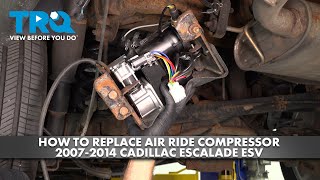
Typical fix: Replace the entire air suspension compressor assembly. 🎬 See this step-by-step walkthrough for replacing the compressor assembly. These are typically sold as a complete unit with the dryer and valves.
Est. part cost: $200-$500 - Faulty Suspension Position Sensor ⚪ Low Probability These sensors are located on the suspension control arms and are exposed to the elements. While durable, they can fail internally or their linkage can break. A short circuit within one of the four position sensors can bring down the entire shared 5V reference circuit, triggering the C0696 code.
How to confirm: With a scan tool, monitor the voltage from each position sensor while bouncing the suspension. The voltage should change smoothly between approximately 0.35-4.75 volts. If one sensor's reading is erratic, stuck, or absent, it is suspect. A more definitive test is to disconnect the main compressor harness (to rule it out), then disconnect each position sensor one at a time. If the C0696 code can be cleared and stays cleared after a specific sensor is disconnected, that sensor is shorted and is the cause.
Typical fix: Replace the faulty suspension position sensor and perform a ride height calibration with a scan tool.
Est. part cost: $50-$150
Rare But Worth Checking
- Faulty Electronic Suspension Control (ESC) Module: This is rare. The module should only be replaced after all other possibilities, including all wiring, the compressor assembly, and all position sensors, have been exhaustively tested and ruled out.
Diagnosis Steps
- Read the trouble codes from the Electronic Suspension Control (ESC) module with a capable scan tool (e.g., GM Tech2). Note if C0696 appears with C0711.
- Attempt to clear the code. If it returns immediately, it indicates a hard electrical fault (like a short to ground), which is common for this issue.
- Raise and safely support the vehicle. Locate the air compressor on the driver-side frame rail.
- Thoroughly inspect the wiring harness connected to the air compressor. Pay extremely close attention to the area where the harness passes over the top of the frame and compressor bracket.
- If the harness appears intact, unbolt the compressor from the frame and carefully lower it to check for hidden damage where the harness may be pinched between the compressor and the frame, as recommended by TSB PIT4954D.
- If damage is found, repair the wires securely and reroute the harness to prevent future damage.
- If no wiring issues are found, disconnect the main connector at the compressor. Use a multimeter to test for 4.75-5.25 volts on the 5-volt reference circuit at one of the position sensor connectors. If voltage returns to normal, the fault is within the compressor assembly (likely the internal pressure sensor).
- If voltage is still low with the compressor disconnected, disconnect the four suspension position sensors one by one. After disconnecting each one, re-check if the C0696 code can be cleared. If the fault disappears after disconnecting a specific sensor, that sensor is internally shorted and must be replaced.
- If all wiring and sensors test good, the ESC module itself may be at fault, but this is the least likely cause.
Parts You'll Likely Need
- Air Suspension Compressor Assembly
(OEM #23316154 (supersedes 22797525, 23232591, 23282712))— This is the most common part to replace if the wiring is confirmed to be good. The internal pressure sensor can fail, or the motor can burn out from overwork.
Trusted brands: ACDelco (OEM), Dorman (P/N: 949-001), Arnott Industries (P/N: P-2793)
OEM price range: $400-$600
Aftermarket price range: $160-$450 - Wiring Pigtail Repair Kit
(OEM #ACDelco PT2784 (GM 13585318))— If the wiring is damaged close to the compressor connector, a pigtail is the most robust repair method. This is an 8-pin rectangular connector.
Trusted brands: ACDelco, Dorman, Duralast (P/N: 1216)
OEM price range: $40-$80
Aftermarket price range: $25-$60
Related Codes That Often Appear With This One
- C0711 — This code is for the 'Automatic Level Control (ALC) Air Pressure Sensor Circuit'. Since C0696 is often caused by a wiring fault to this very sensor, the two codes frequently appear together. GM's TSB PIT4954D groups them as having the same root cause.
- C0660 — This code specifically points to a fault in the Level Control Exhaust Valve Circuit. A short in the main compressor harness can often affect multiple circuits within that harness, triggering both C0696 and C0660 simultaneously.
Technical Service Bulletins (TSBs) & Recalls
- PIT4954D: Addresses DTC C0696 or C0711 with incorrect ride height, pointing to inspection of the air compressor assembly for wire damage. It covers a wide range of GM SUVs from 2001-2014 with Z55 or Z95 suspension.
Platform-Specific Known Issues
- A GM Technical Service Bulletin (PIT4954D) specifically calls out inspecting the air compressor assembly wiring for damage when code C0696 is present. It notes that the wiring can be pinched or shorted between the compressor and the vehicle's frame and explicitly states NOT to replace the compressor for this wiring issue.
Mechanic-Grade Diagnostic Values
- 5-Volt Reference Circuit Voltage — expected: 4.75 - 5.25 Volts. Failure: Voltage below 4.75V or above 5.25V for more than 1 second.
- Ride Height Position Sensor Signal Voltage — expected: Varies between 0.35 - 4.75 Volts as suspension is jounced.. Failure: Voltage is fixed, does not change with movement, or shows spikes/dropouts.
- Low Reference Circuit to Chassis Ground — expected: Less than 5.0 ohms. Failure: Resistance greater than 5.0 ohms indicates a poor ground connection for the sensor.
- Compressor Activation Pressure Threshold — expected: Compressor activates at startup if system pressure is below 10 psi (69 kPa).. Failure: Compressor does not run at startup even when the rear is sagging (and no other faults are present).
Scan Tool Commands That Help
- GM Tech2 / GDS2: Compressor Functional Test / Output Control — Use this to directly command the air compressor on and off. This is the definitive test to determine if the compressor motor has failed after confirming it has power and ground.
- GM Tech2 / GDS2: ALC Exhaust Valve Test — Use this command when the suspension inflates correctly but fails to lower or deflate. This directly tests the exhaust solenoid, bypassing other inputs.
- GM Tech2 / GDS2: Diagnostic Counter Reset — After a repair, this function bypasses the multi-ignition cycle requirement for clearing a history DTC, allowing for immediate verification that the fault is cleared.
Wiring & Ground Locations
- Compressor Connector (ALC Pressure Sensor) — On the air compressor assembly, located on the driver's side frame rail.. This connector contains the pins for the pressure sensor's 5V reference (often Gray wire), signal (often Dark Green wire), and low reference (often Tan or Black wire). The harness leading to this connector is the primary location for the chafing issue described in TSB PIT4954D.
- G400 / G401 — On the left rear body mount, located behind the left rear tire on the frame for the GMT900 platform.. This is a primary ground point for the Electronic Suspension Control (ESC) module. A corroded or loose connection here can cause erratic voltage readings and various electrical faults within the suspension system.
- Electronic Suspension Control Module (ESCM) — Located at the left rear of the frame/chassis, often above the spare tire on long wheelbase models like the Escalade ESV.. This is the module that supplies the 5V reference, monitors all sensors, and sets code C0696. All diagnostic tests for this code ultimately lead to or from this module's connectors.
- G305 — Under the vehicle, to the rear of the left (driver's side) B-pillar, located at the third body mount on the frame.. This is another major chassis ground point for components in the rear half of the vehicle. While not the direct ground for the ESCM, ensuring it's clean and tight is good practice when diagnosing any rear chassis electrical issue.
Real Owner Repair Stories
- YouTube user 'Lsxmatt' (2009 Cadillac Escalade (same GMT900 platform and system)) — 'Service Suspension' message, rear of vehicle not leveling, compressor runs briefly then shuts off, DTC C0711 (often seen with C0696).
❌ Tried (didn't work) Initially suspected a leak in the air shocks.
✅ What actually fixed it The pressure sensor wiring harness had chafed and corroded where it was pinched against the compressor mounting bracket, causing a short. Repairing the damaged wires resolved the code and restored system function. This perfectly aligns with TSB PIT4954D. - Tahoe Yukon Forum user (2007-2014 GM SUV (platform mate)) — 'Service Suspension System' message on the DIC, rear of vehicle sagging.
❌ Tried (didn't work) Replacing the air shocks., Replacing the air compressor assembly.
✅ What actually fixed it The user eventually found the wiring harness for the compressor was rubbed through where it goes over the frame. After repairing the broken wires, the system returned to normal function and the code was cleared.
Helpful Videos
We Have This Part in Stock


The information in this article is provided for general reference and educational purposes only. Vehicle specifications, procedures, and part compatibility can vary by production date, trim level, and region. Always consult your vehicle's factory service manual and verify part numbers before purchasing or performing repairs. Safety-critical components such as airbags, seat belts, and braking systems should be installed by a qualified professional.
- Cadillac ESCALADE ESV:
- 🎬 Helpful Videos
- 🛍️ Shop This Part
- What's Unique About the 2011-2014 Cadillac ESCALADE ESV
- Diagnostic Flowchart
- Symptoms You May Notice
- Most Likely Causes
- Rare But Worth Checking
- Diagnosis Steps
- Parts You'll Likely Need
- Related Codes That Often Appear With This One
- Technical Service Bulletins (TSBs) & Recalls
- Platform-Specific Known Issues
- Mechanic-Grade Diagnostic Values
- Scan Tool Commands That Help
- Wiring & Ground Locations
- Real Owner Repair Stories
- 🎟️ Get 5% Off