

C0696 on 2002-2009 Cadillac Escalade: Service Suspension Fixes
This code almost always points to damaged wiring for the air suspension compressor's pressure sensor, often pinched against the frame. Inspect the harness at the compressor first. If the wiring is good, the compressor assembly itself may have failed. A wiring repair is cheap, while a new compressor costs $200-$500.
- C0696 on your Escalade almost always means there is a wiring problem near the air suspension compressor.
- Before buying any parts, you MUST inspect the wiring harness where it runs past the compressor bracket on the driver's side frame rail.
- This issue is covered by GM Technical Service Bulletin PIT4954C, confirming it's a known design flaw.
- If the wiring is fine, the compressor assembly itself is the next most likely failure point.
- Do not ignore this warning; a sagging rear suspension affects safety, handling, and tire wear.
What's Unique About the 2002-2009 Cadillac ESCALADE
The GMT800 and GMT900 platforms, which include this generation of Escalade, mount the air suspension compressor on the frame rail, often exposed to the elements and vibration. The wiring harness is routed in a way that makes it highly susceptible to being pinched between the compressor bracket and the vehicle's frame during installation or from years of vibration. This specific pinched-wire failure, often affecting the gray 5-volt reference wire, is so common that General Motors issued a Technical Service Bulletin (TSB) to address it, making it a well-documented pattern failure for these trucks and their platform mates.
Diagnostic Flowchart
Tap your situation to follow the diagnostic path that matches what you're seeing on this vehicle.
Generation note: This issue affects both the second generation (2002-2006, GMT800 platform) and the third generation (2007-2009, GMT900 platform) Escalade. The design and location of the Autoride air suspension compressor are similar enough that the primary cause—damaged wiring near the compressor—is common to both generations. The TSB PIT4954D and its predecessor PIT4954C cover model years from 2001-2013, confirming the widespread nature of this problem across platforms.
Symptoms You May Notice
- "Service Suspension System" or "Service Ride Control" message on the Driver Information Center (DIC)
- Rear of the vehicle sags and does not raise when loaded
- Air suspension compressor does not run at all
- Air suspension compressor runs constantly without lifting the vehicle (if leaks are also present)
- An audible 'pop' or 'hiss' from the rear of the vehicle if the exhaust valve is stuck open
- Replacing the compressor without checking the wiring first. Many owners replace a perfectly good compressor only to find the C0696 code remains because the true fault was a simple wiring issue. The TSB specifically warns technicians NOT to replace the compressor for this wiring concern.
Most Likely Causes
- Damaged Wiring to Air Compressor Pressure Sensor 🔴 High Probability The wiring harness is frequently pinched between the compressor assembly and the frame rail, causing a short to ground. This is the exact failure mode described in GM Technical Service Bulletin #PIT4954D. The constant vibration of the compressor and engine can cause the harness to rub through its insulation over time.
How to confirm: Visually inspect the entire wiring harness leading to the air compressor, located on the driver's side frame rail. It may be necessary to unbolt and lower the compressor assembly to get a clear view. Pay extremely close attention to the area where the harness can make contact with the compressor bracket or frame. Look for chafed, flattened, or corroded wires, particularly the gray 5-volt reference wire. A multimeter can be used to test for a short to ground on the 5V reference circuit at the disconnected sensor plug.
Typical fix: Repair the damaged section of the wire. This involves cutting out the bad section, splicing in a new piece of automotive-grade wire (e.g., TXL wire), and protecting the repair with heat-shrink tubing. It is critical to reroute the harness to prevent it from being pinched again. Using zip ties to secure the harness away from the frame and bracket is a common practice.
Est. part cost: $5-$20 - Failed Air Suspension Compressor Assembly 🟡 Medium Probability The compressor can fail internally from age, corrosion from road salt and moisture, or being overworked due to leaks in the air springs. The internal pressure sensor or exhaust valve solenoid can also fail, triggering a circuit code. The aluminum housing of the compressor itself can crack from corrosion, causing a major leak.
How to confirm: If the wiring is confirmed to be intact, the fault likely lies within the compressor assembly. A bidirectional scan tool can be used to command the compressor and its exhaust valve on and off to test functionality. If it doesn't respond, and power and ground are present at the connector, the compressor is faulty. You can also directly test the compressor motor by applying 12V power to the large red and black wires at the connector.
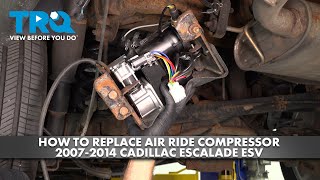
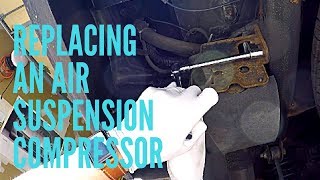
Typical fix: Replace the entire air suspension compressor assembly. These are sold as a complete unit including the motor, dryer, and valve block. 🎬 See this walkthrough on replacing the air suspension compressor. It is highly recommended to fix any air shock leaks at the same time to prevent premature failure of the new compressor.
Est. part cost: $200-$500 - Leaking Rear Air Shocks 🟡 Medium Probability The rubber air bladders on the shocks dry rot and crack over time, causing air leaks. This is not a direct cause of C0696 but is a very common related failure that overworks the compressor, leading to its eventual failure.
How to confirm: With the system aired up (if possible), spray the air springs with soapy water and look for bubbles, indicating a leak. If the compressor won't run, you may see visible cracks or damage on the deflated rubber bladders. Often, the vehicle will be sagging in the rear.
Typical fix: Replace the rear air shocks, usually in pairs. A severe leak can overwork and burn out the compressor, so it's critical to fix leaks promptly.
Est. part cost: $300-$700 for a pair
Rare But Worth Checking
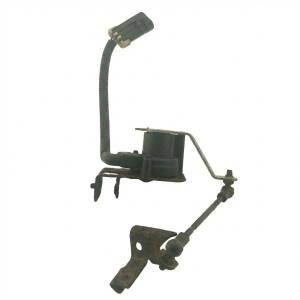
- Failed Ride Height Sensor: The 5-volt reference circuit also powers the ride height sensors. While less common to cause this specific code, a shorted sensor or its wiring, or a broken linkage arm, can also be the root cause.
- Failed Electronic Suspension Control (ESC) Module: If all wiring and sensors test good, the module itself could be faulty, but this should be considered the last resort after all other possibilities are exhausted. These modules are generally robust but can be damaged by water intrusion or voltage spikes.
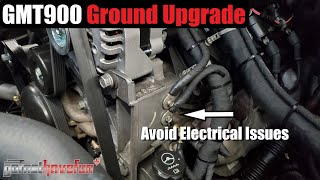
- Poor Ground Connections: The GMT800/900 platforms are known for having potential issues with main body and engine ground points over time due to corrosion. 🎬 Watch: How to fix common GMT900 ground and electrical issues. A poor ground for the ESC module or compressor can cause erratic voltage readings and codes.
Diagnosis Steps
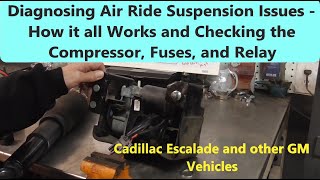
- Read the trouble codes from the Electronic Suspension Control (ESC) module 🎬 Watch: A professional guide to diagnosing the air suspension system. using a capable scan tool.
- Visually inspect the wiring harness connected to the air suspension compressor assembly on the driver-side frame rail. Lowering the spare tire can improve access. Look for any signs of pinching, chafing, or corrosion, especially where the harness passes the compressor mounting bracket.
- If damage is found, repair the wiring. Ensure the repair is sealed against moisture and reroute the harness to prevent future damage. Clear the codes and see if the fault returns.
- If the wiring appears intact, disconnect the compressor connector. With the ignition ON, use a multimeter to check for 4.75-5.25 volts between the 5-volt reference wire (often gray) and a known good ground.
- If the 5V reference is out of range, disconnect other sensors on the circuit (like ride height sensors) one by one to see if the voltage returns to normal, which would indicate a shorted sensor.
- Check the main power and ground connections to the compressor relay (often under the hood) and the compressor itself for corrosion or looseness.
- If possible, use a bidirectional scan tool to command the compressor on. If it does not run but the relay clicks, and power is confirmed at the compressor connector, the compressor motor is likely bad.
- Inspect the rear air shocks for leaks using soapy water. Leaks must be fixed to prevent damage to the new compressor.
Parts You'll Likely Need
- Air Suspension Compressor Assembly
(OEM #15296756, 19299545 (ACDelco))— This is the most common part to be replaced if the wiring is found to be intact. The original units fail from age, corrosion, or being overworked by leaks. Aftermarket versions often feature design improvements like better thermal protection.
Trusted brands: ACDelco, Dorman (e.g., 949-000, 949-099), Arnott Industries
OEM price range: $400-$600
Aftermarket price range: $200-$450
Related Codes That Often Appear With This One
- C0711 — This code is for the 'Automatic Level Control (ALC) Air Pressure Sensor Circuit'. Since the C0696 is often caused by a wiring fault to this very sensor, the two codes frequently appear together. GM's TSB groups them as having the same root cause.
- C0660 — This code points to a 'Level Control Exhaust Valve Circuit Malfunction'. The exhaust valve is part of the compressor assembly. A failure within the compressor (or its wiring) can sometimes trigger both C0660 and C0696.
Technical Service Bulletins (TSBs) & Recalls
- PIT4954D / PIT4954C: Addresses DTCs C0696 or C0711 caused by the wiring to the automatic level control (ALC) pressure sensor being shorted to ground or pinched. This TSB applies to a wide range of GM trucks and SUVs from 2001-2013 with Z55 or Z95 suspension.
Platform-Specific Known Issues
- A GM Technical Service Bulletin (PIT4954D, superseded by PIT4954C) directly addresses code C0696, identifying the cause as wiring to the ALC pressure sensor being shorted to ground where it gets pinched by the compressor bracket. The bulletin explicitly states NOT to replace the compressor assembly for this specific wiring issue.
Mechanic-Grade Diagnostic Values
- 5-Volt Reference Circuit Voltage — expected: 4.75 - 5.25 Volts. Failure: Voltage below 4.75V (short to ground or open) or above 5.25V (short to voltage).
- Ride Height Position Sensor Signal Voltage — expected: Varies between 0.35 - 4.75 Volts as the suspension is jounced.. Failure: Voltage is fixed, does not change with suspension movement, or shows spikes/dropouts.
- ALC System Pressure for Compressor Activation — expected: Compressor activates at startup if pressure is below 10 psi (69 kPa).. Failure: Compressor does not run at startup even when the rear is sagging (assuming no other faults).
Scan Tool Commands That Help
- Tech 2 / GDS2: Functional Tests > Compressor Test — To command the air suspension compressor ON and OFF to verify its mechanical function, independent of the ride height sensors. If the compressor runs with this command but not during normal operation, the issue is more likely with the sensor inputs or module logic.
- Tech 2 / GDS2: Special Functions > RPO Reprogramming — This is an advanced function used to disable the electronic suspension system (RPO Z55) entirely from the Body Control Module (BCM). This is typically done when converting to a passive coil spring suspension to prevent 'Service Suspension' messages without using resistors. This may require calling GM's Techline for a modified calibration.
Wiring & Ground Locations
- G400 / G401 — On the left rear body mount, located behind the left rear tire on the frame (GMT900 platform).. The Electronic Suspension Control (ESC) module is grounded at these points. Corrosion or a loose connection at these grounds can cause erratic behavior and incorrect voltage readings, potentially triggering a C0696 code.
- Compressor Harness Connector — Connected to the air compressor assembly on the driver's side frame rail.. This is the primary location for testing the 5-volt reference circuit. The gray wire is typically the 5V reference, and it can be tested for voltage (4.75-5.25V) against a known good ground with the key on.
- G300 — Under the vehicle at the driver door on a body mount (GMT900 platform).. While not the primary ground for the ESC module, poor body grounds in this area can contribute to intermittent electrical issues across various systems, including suspension controls.
Real Owner Repair Stories
- Forum user reports, consistent with GM TSB PIT4954D (Multiple 2002-2009 Cadillac Escalade, Chevrolet Tahoe, GMC Yukon models) — Service Suspension System message, rear of vehicle sagging, C0696 and C0711 codes present.
❌ Tried (didn't work) Replacing the entire air compressor assembly without first inspecting the wiring harness.
✅ What actually fixed it The definitive fix was locating the wiring harness for the compressor's pressure sensor, finding the section that was pinched or chafed against the vehicle frame or compressor bracket, and repairing the damaged wires (often the gray 5V reference wire). After repairing and rerouting the harness to prevent future contact, the codes were cleared and did not return.
OEM Part Supersession History
15296756→15949881, 22941806, 19299545— Standard part evolution, design updates, and manufacturer changes over a long production run.
Heads up: Some aftermarket replacements like the Dorman 949-099 are designed to be universal for 2001-2014 models and may include adapter harnesses (round and square connectors) to fit different model year breaks.84465134 (Wiring Harness)→84678176, 85586196— Updates to the suspension self-leveling wiring harness.
Model Year Variations Within This Range
- 2007-2009 (GMT900) vs 2002-2006 (GMT800): The GMT900 platform introduced rack-and-pinion steering, which provided a different driving feel compared to the recirculating ball steering on the GMT800s. While the air suspension components and failure modes for C0696 are largely the same, the overall chassis and some wiring locations differ.
- 2009+: Some 2009 and later models received the more robust 6L80 6-speed automatic transmission, compared to the 4-speed (4L60E/4L65E) in earlier models. This does not directly affect the C0696 code but is a significant platform difference within the specified year range.
Helpful Videos
We Have This Part in Stock


The information in this article is provided for general reference and educational purposes only. Vehicle specifications, procedures, and part compatibility can vary by production date, trim level, and region. Always consult your vehicle's factory service manual and verify part numbers before purchasing or performing repairs. Safety-critical components such as airbags, seat belts, and braking systems should be installed by a qualified professional.
- Cadillac ESCALADE:
- 🎬 Helpful Videos
- 🛍️ Shop This Part
- What's Unique About the 2002-2009 Cadillac ESCALADE
- Diagnostic Flowchart
- Symptoms You May Notice
- Most Likely Causes
- Rare But Worth Checking
- Diagnosis Steps
- Parts You'll Likely Need
- Related Codes That Often Appear With This One
- Technical Service Bulletins (TSBs) & Recalls
- Platform-Specific Known Issues
- Mechanic-Grade Diagnostic Values
- Scan Tool Commands That Help
- Wiring & Ground Locations
- Real Owner Repair Stories
- OEM Part Supersession History
- Model Year Variations Within This Range
- 🎟️ Get 5% Off