

OBD-II Code C0597: Brake System Control Module Performance
What C0597 means, why it triggers, and how to fix it
- Code C0597 disables your anti-lock brakes (ABS) and electronic stability control (ESC), increasing stopping distances by over 50% in panic situations.
- Before replacing the $800+ ABS module, test your 12V battery; low voltage below 12.4V is a primary trigger for this code.
- For 2020-2023 Toyota models, a C059746 code requires a $150-$250 dealer software update (TSB T-SB-0078-21), not a module replacement.
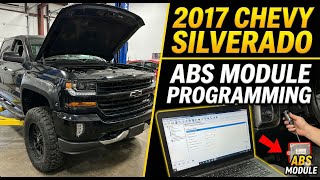
- Replacing the Brake System Control Module is not a DIY repair, as it requires a professional J2534 pass-thru tool for VIN programming and ABS automated bleeding.
What Does C0597 Mean?

Code C0597 means the Brake System Control Module (BSCM)—the 'brain' for your ABS and traction control—has failed an internal self-test, malfunctioned, or lost communication.
Technical definition: SAE/OBD-II defines C0597 as "Brake System Control Module 'A' Performance". It triggers when the module's processor detects an internal malfunction, communication failure, incorrect calibration, or fails a self-test.
Can I Drive With C0597?
Yes, But With Caution. Yes, but your anti-lock brakes (ABS) and electronic stability control (ESC) are disabled. Standard hydraulic brakes function, but stopping distances increase by over 50% in panic situations, and rollover risk is significantly higher. Studies show ESC reduces fatal single-vehicle crashes by 56%. Drive only to a repair shop with extreme caution.
Common Causes

- Corrupted Software or Outdated Firmware (Very Common) — Software bugs or incomplete updates trigger this code. This is the primary cause on many modern Toyota models, requiring a dealer reflash.
- Poor Power or Ground Connection (Common) — The brake module requires a steady 12V supply. A weak battery, 🎬 Watch: How to test ABS module power and ground connections. failing alternator, or corroded ground wires cause voltage drops that force the module offline.
- Internal Brake System Control Module Failure (Common) — Delicate electronics inside the ABS module degrade from heat, vibration, or moisture over time, causing permanent internal circuit damage.
- Broken Wiring Harness or Connectors (Less Common) — Wiring to the module or related components (like electronic parking brake motors) breaks from repeated suspension movement or chafing, causing an open circuit.
- Communication Network (CAN Bus) Error (Less Common) — If the CAN bus wiring is damaged or shorted, the brake module cannot exchange messages with other vehicle computers, setting this fault.
- Faulty Brake Master Cylinder (Rare) — On specific GM models, an internal failure within the brake master cylinder forces the brake control module to set a C0597 code.
- Failed Wheel Speed Sensor (Rare) — While a failed sensor typically sets its own code, an erratic signal is sometimes misinterpreted by the BSCM as an internal performance issue.
Symptoms

- ABS Warning Light On — The Anti-lock Brake System (ABS) dashboard light illuminates immediately.
- Traction/Stability Control Light On — The Electronic Stability Control (ESC) or Vehicle Stability Control (VSC) light illuminates.
- Hard or Spongy Brake Pedal — The brake pedal feels firmer than usual, requiring more effort, or feels spongy if the module intermittently engages.
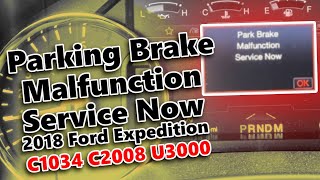
- Parking Brake Malfunction Message — Vehicles with an electronic parking brake display a 'Service Parking Brake' warning on the instrument cluster.
Diagnostic Flowchart

Tap your situation to follow the diagnostic path that matches what you're seeing on this code.
Common Fixes & Costs
- Reprogramming the Brake System Control Module — Parts: $0, Labor: $150-$250, ~1.5 hr book time (Professional)
- Replacing a Faulty 12V Battery — Parts: $150-$250, Labor: $50-$100, ~0.5 hr book time (Beginner)
- Repairing Damaged Wiring or Connectors — Parts: $20-$100, Labor: $150-$300, ~2 hr book time (Intermediate)
- Replacing the Brake System Control Module (ABS Module)
— Parts: $600-$1,200, Labor: $250-$400, ~2.5 hr book time
(Professional)
Toyota RAV4 (2021-2023): OEM 44050-42L90 (Alt: Bosch / Denso)
Chevrolet Silverado (2019): OEM 84256781 (Alt: ACDelco)
Ford Expedition (2018): OEM JL1Z-2C219-A (Alt: Motorcraft) - Replacing the Brake Master Cylinder — Parts: $200-$450, Labor: $600-$1000, ~3 hr book time (Professional)
DIY vs Professional
- Reprogramming the Brake System Control Module — Beginner:
Tools: J2534 Pass-Thru device with a paid manufacturer subscription. - Replacing the Brake System Control Module (ABS Module) — Beginner:
Tools: Advanced scan tool, flare nut wrenches, brake bleeding equipment. - Repairing Damaged Wiring or Connectors — Beginner:
Tools: Multimeter, wire strippers, crimpers, heat shrink tubing. - Replacing a Faulty 12V Battery — Beginner:
Tools: Basic hand tools, memory saver tool.
Used vs. New Parts: Buying Guide
When a used part is worth it: A used ABS module makes sense for older, high-mileage vehicles where a new OEM part exceeds 20% of the car's value, or when new parts are back-ordered.
Donor-vehicle mileage cap: roughly under 100000 miles for the part to have meaningful remaining life.
Donor quality checklist:
- Match the part number exactly. Modules differ based on trim level or options (e.g., AWD vs. FWD).
- Purchase from a reputable salvage yard offering a 30-90 day warranty.
- Ensure the donor vehicle was not involved in a flood or fire.
Decision logic:
- If A TSB indicates a software update is the fix for your vehicle → Do not buy any part; have the dealer perform the reprogram.
- If The vehicle is less than 10 years old and the part is available new → Favor a new OEM or rebuilt module for higher reliability and warranty.
- If Budget is the primary concern and you accept the risks → A used module is viable, but factor in the cost of professional programming.
Warranty tradeoff: Used parts typically have a 30-90 day warranty. Rebuilt modules offer 1-year to lifetime warranties. New OEM parts carry a 1-year warranty.
Worst-case if a used part fails: $300-$500 if the used part is defective, covering repeat labor for installation and programming.
What Happens If You Wait — Timeline
- Immediate: Code C0597 is set. ABS, Traction Control, and Stability Control warning lights illuminate. These safety systems are disabled. (MPG impact: 0%% · Added cost: $0)
- First Panic Stop: Without ABS, wheels lock up during a hard stop, significantly increasing stopping distance and causing a loss of steering control. (MPG impact: 0%% · Added cost: $200-$800 (Cost to replace flat-spotted tires from skidding).)
- First Evasive Maneuver: Without Electronic Stability Control (ESC), the risk of spinning out or a rollover during a sudden swerve is dramatically higher. (MPG impact: 0%% · Added cost: $5,000-$25,000+ (Cost of an accident prevented by functional ESC/ABS).)
- Long-Term (6+ Months): The primary issue remains the ongoing safety risk. A C0597 fault does not cause cascading mechanical damage to the engine or transmission. (MPG impact: 0%% · Added cost: No direct damage, but cumulative safety risk is very high.)
Cost of Not Fixing It
- Immediate: Loss of ABS and Electronic Stability Control (ESC). Increased risk of wheel lock-up, skidding, and loss of control in panic stops. (Added cost: $0 (but significantly increased accident risk))
- 0-6 Months: Continued operation without key safety systems. Potential for flat-spotting tires during a panic stop where wheels lock up. (Added cost: $200-$800 (cost to replace flat-spotted tires))
- 6+ Months: The primary cost remains the elevated safety risk. A C0597 fault does not cause cascading damage to the engine or transmission. (Added cost: Potentially thousands in accident damages.)
Diagnosis Steps
- Read All Trouble Codes
Use an advanced OBD-II scanner to read Chassis (C), Network (U), and Powertrain (P) codes. Communication codes (like U0100) point to a network issue rather than a dead module.
Tools: Advanced OBD-II Scanner (Beginner) - Check for Technical Service Bulletins (TSBs)
Search online for TSBs related to code C0597 for your specific vehicle. Manufacturers frequently issue software updates to fix this exact code.
Tools: Internet access (Beginner) - Perform Battery and Charging System Test
Verify battery voltage is above 12.4V (engine off) and 13.2-14.8V (engine running). Low voltage is a primary cause of module errors.
Tools: Multimeter, Electronic Battery Tester (Beginner) - Inspect Module Connector and Grounds
Locate the BSCM (attached to the ABS block). Disconnect the main connector and inspect for green corrosion or water damage. Ensure the main chassis ground wire is clean and tight.
Tools: Basic hand tools, flashlight, contact cleaner (Intermediate) - Verify Power and Ground at Connector
Using a wiring diagram, check for 12.0V ± 0.5V at the module's power pins. Measure resistance between ground pins and the chassis; it must be below 0.2 Ohms.
Tools: Multimeter, vehicle-specific wiring diagram (Advanced) - Analyze Live Wheel Speed Data
Monitor live data for all four wheel speed sensors while driving straight at low speed. Erratic signals are sometimes misinterpreted by the BSCM as internal faults.
Tools: Advanced OBD-II Scanner (Advanced) - Check CAN Bus Network Integrity
With the battery disconnected, measure resistance between CAN High (Pin 6) and CAN Low (Pin 14) at the OBD-II port. A healthy network reads 60 Ohms.
Tools: Multimeter (Advanced) - Attempt Module Reprogramming
If power, ground, and the CAN network are intact, a professional shop must reprogram the module with the latest factory software.
Tools: J2534 Pass-Thru device (Professional)
When This Code Triggers (Freeze-Frame Conditions)
- System State: Self-Test Active (Triggers during the module's power-on self-test, immediately after starting the vehicle.)
- Vehicle Speed: 0 mph (Typically set at key-on before the vehicle begins moving.)
- Battery Voltage: 11.5-12.5V (Triggered by low or unstable voltage during engine cranking.)
Related Codes
- P25A2 — This code, "Brake System Control Module Requested MIL Illumination," is set by the engine computer when the brake module detects a serious fault. C0597 is the underlying cause.
- U0121 — Means "Lost Communication With Anti-Lock Brake System Control Module." If present alongside C0597, it strongly suggests a major wiring/power issue preventing network communication.
- U0073 — Indicates a total failure of the main communication network. If C0597 is present, the brake module may have shorted internally, bringing the entire network down.
- C059746 — A manufacturer-specific variation where '46' indicates 'Calibration / Parameter Memory Failure'. Common in Toyota vehicles, it points to a software issue requiring a reprogram.
Climate & Environmental Factors
- High Humidity and Road Salt: Moisture and road salt penetrate electrical connectors, causing corrosion and high resistance. This leads to intermittent voltage drops that trigger a C0597 fault.
- Cold Weather and Freeze/Thaw Cycles: A GM service bulletin for 2022-2026 trucks notes C0597 triggers in temperatures below -23°C (-9°F), pointing to a weak battery failing to provide adequate voltage during cold starts.
How to Talk to a Mechanic About This Code
Say this: "I have an ABS light on, and my scanner shows code C0597 for the Brake System Control Module. Can you check for relevant TSBs, test the battery, and inspect the module's wiring and ground connections before recommending a module replacement?"
This directs the technician to follow a logical diagnostic path (software, power, wiring) before jumping to the most expensive conclusion (module replacement), saving you money.
Avoid saying:
- 'My ABS light is on, can you fix it?'
- 'Just replace the ABS module.'
- 'I have a C0597, how much for a new module?'
Questions to ask before authorizing the repair:
- Did you find a Technical Service Bulletin (TSB) for this code on my vehicle?
- What were the results of the battery and charging system test?
- Did you verify good power and ground at the module's connector?
- If the module needs replacement, does the quote include VIN programming and the ABS hydraulic bleed procedure?
- What is the warranty on the new part and the labor?
Where to Take It: Dealer vs Independent vs Chain
- Dealer:
Recommended, especially if a software update is the likely fix. They have guaranteed access to the correct programming tools.
Best for: Vehicles under warranty., Vehicles with a known TSB requiring a software update (like 2020-2023 Toyotas)., Complex electronic issues requiring factory diagnostic tools.
Downsides: Highest labor rates., Unwilling to install or program used parts. (Typical cost: +50% vs. baseline) - Independent Shop:
Good fit, but verify first. Ask: 'Do you have the equipment to program a new ABS module for my make and model?'
Best for: Out-of-warranty vehicles where the cause is likely a wiring or battery issue., Shops that specialize in diagnostics and have J2534 pass-thru programming tools.
Downsides: Not all independent shops have the expensive tools needed for module programming. (Typical cost: +0% vs. baseline) - Chain Shop:
AVOID for diagnosis and repair of C0597. They are not equipped for module-level diagnostics.
Best for: If the diagnosis is confirmed to be only a battery replacement.
Downsides: Technicians lack advanced diagnostic training for complex electronic codes., Unlikely to have module programming or ABS bleeding capabilities. (Typical cost: -10% vs. baseline)
When to Walk Away From the Repair
If the estimated repair cost for the ABS module replacement exceeds 50% of your car's private-party value, carefully consider your options.
- Car worth $5000, fix is $1800: Fix it. The repair cost is significant but below the 50% threshold, and it restores a critical safety system.
- Car worth $3500, fix is $2000: Walk away. The repair cost is over 50% of the car's value.
What Scan Tool You Need for This Code
Minimum: A scanner that reads Anti-Lock Brake System (ABS) codes. A basic engine-only code reader will not see 'C' codes like C0597.
A cheap scanner won't detect this fault. You need a tool that accesses the ABS module to see freeze-frame data and live wheel speed sensor data.
Budget: BlueDriver Pro Scan Tool (~$100) — Reads and clears ABS codes, views freeze-frame data, and graphs live data from wheel speed sensors.
Mid-range: Foxwell NT630 Plus / Innova 5610 (~$150-350) — Adds bidirectional controls to perform the 'ABS Bleed' function, required after replacing the hydraulic unit to purge trapped air.
Professional: Autel MaxiCOM MK808 / MK808BT (~$450-600) — Full bidirectional control, advanced service functions like ABS bleed, and the ability to perform module initializations after replacement.
Rent vs buy: Auto parts stores do NOT rent scanners capable of reading ABS codes. Buying a budget pick like the BlueDriver is a worthwhile investment.
How to Clear the Code After You Fix It
- Reconnect battery if disconnected for repair
- Use an advanced OBD-II scan tool to clear codes from the ABS/Brake module
- Perform required calibration procedures with the scan tool (e.g., steering angle sensor, VIN programming)
- Perform the drive cycle to confirm the fix
Drive cycle (~15 minutes): Start the engine and idle for 2 minutes. Drive straight above 15 mph to verify wheel speed sensor signals. Perform several normal stops from 25-40 mph. If warning lights stay off after 15 minutes, the repair is successful.
Readiness monitors affected: None. This is a chassis code and does not affect emissions readiness monitors.
Watch out for:
- Clearing the code with a basic scanner will not fix the issue; the code returns immediately if the hard fault remains.
- Forgetting post-replacement VIN programming causes the code to persist even with a new part.
- Disconnecting the battery clears the ECU memory but does not resolve internal BSCM failures.
Will This Fail Emissions / State Inspection?
No — by itself this code doesn't fail OBD inspection (but it can keep readiness monitors from setting, which causes a separate fail).
- California: An illuminated ABS light does NOT cause a smog inspection failure. However, salvaged vehicles requiring a VSSI 'Brake and Lamp Inspection' will fail.
- New York: An illuminated ABS warning light is grounds for failure of the annual safety inspection.
- Texas: As of 2025, non-commercial vehicles are exempt from annual safety inspections. Previously, an ABS light was NOT a cause for rejection.
Most Commonly Affected Vehicles
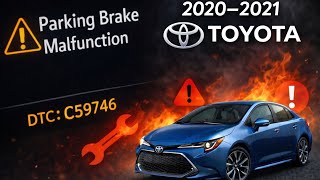
- Toyota RAV4 (2020-2023) — TSB T-SB-0078-21 specifies a software update for DTC C059746. Do not replace the module.
- Toyota Corolla / Corolla Hatchback (2020-2021) — Subject to the same TSB (T-SB-0078-21) requiring a software reprogram to resolve a calibration failure.
- Toyota Prius / Prius Prime (2020-2022) — Software glitches in the complex regenerative braking system trigger this code.
- Chevrolet Silverado (2019-2023) — GM service bulletins link this code to software anomalies, weak batteries in cold weather, or internal master cylinder failures.
- GMC Sierra (2019-2023) — Shares the Silverado platform and is susceptible to identical BSCM software and battery-related faults.
- Ford Expedition / Lincoln Navigator (2018-2020) — The wiring harness for the electronic parking brake motor breaks at a flex point near the rear control arm, triggering brake system faults.
- Chrysler / Dodge Pacifica / Grand Caravan (2017-2021) — Known to experience internal failures of the ABS module itself.
- Hyundai / Kia Sonata / Tucson (2015-2020) — Corroded electronic parking brake switches in the center console lead to communication errors logged by the brake control module.
- BMW / Nissan Various Models (2006-2018) — Widespread online confusion exists between chassis code C0597 (Brake Module) and powertrain code P0597 (Thermostat Heater Control). If you see 'P0597', the issue is your engine thermostat.
Manufacturer-Specific Notes

- Toyota: For 2020-2023 Corolla and RAV4 models, TSB T-SB-0078-21 states code C059746 is a software calibration error. The official repair is to reprogram the module, NOT replace it.
- General Motors (GM): GM bulletin PIT6450 links code C0597 to an internal failure of the brake master cylinder. Another bulletin links it to low voltage from a weak battery in extreme cold.
- Ford: A PCM software update is a common fix for electronic issues. Additionally, recall NHTSA #23V-509 for 2021-2023 F-150s addresses a chafing rear axle wiring harness that damages parking brake circuits.
- Chrysler/Dodge/Jeep: A 'soft reset' temporarily resolves ABS module glitches. Disconnect the negative battery terminal for 30 minutes to discharge module capacitors.
Real Owner Stories
2020 Toyota RAV4 with C059746
Owner experienced a 'Parking Brake Malfunction' message. A scan revealed code C059746.
What they tried:
- The owner took the vehicle to a dealership, concerned about needing a new ABS module.
Outcome: The dealership identified TSB T-SB-0078-21, which specifies a software update. The module was reprogrammed in an hour for $200, and the code did not return.
Lesson: For Toyota vehicles with a C059746 code, the cause is almost certainly a software glitch. Always check for a TSB before agreeing to a module replacement.
2019 Chevrolet Silverado in cold weather
In sub-zero weather, the driver received 'Service Brake System' messages and code C0597.
What they tried:
- The owner disconnected the battery to reset the system, but codes returned on the next cold start.
Outcome: A GM service bulletin suggested the cause was low voltage from a weak battery in extreme cold. Replacing the original battery resolved the issue.
Lesson: On modern GM trucks, intermittent electronic faults in cold weather are often caused by a weak battery. Perform a battery test before diagnosing complex modules.
2020 Toyota Prius Prime with 145k miles
The 'Check Engine' light illuminated during a highway trip with code C0597. There were no noticeable symptoms.
What they tried:
- The owner suspected the code was triggered by rapidly switching driving modes. They cleared the code using a scanner.
Outcome: After clearing the code, the owner drove 500+ miles and the light did not return. It was a one-time software glitch.
Lesson: If code C0597 appears without symptoms and does not return after being cleared, it might be a temporary glitch. If it reappears, proper diagnosis is necessary.
How to Prevent This Code From Triggering
- Perform regular brake fluid flushes (Every 2-3 years) — Brake fluid absorbs moisture over time. This moisture corrodes the delicate internal valves of the ABS module, leading to failure. A flush replaces contaminated fluid.
- Maintain a healthy 12V battery (Test annually after 3 years of service) — The Brake System Control Module relies on stable voltage. A weak battery causes voltage drops, leading to software glitches and performance codes like C0597.
- Periodically clean and protect electrical grounds (Inspect during battery or brake service) — A corroded ground connection increases electrical resistance, causing intermittent faults. Ensuring ground points are clean is crucial for vehicle electronics.
- Use a scan tool to cycle the ABS pump during brake bleeding (Whenever the brake hydraulic system is opened) — A standard brake bleed does not circulate fluid trapped within the ABS module. Activating the ABS pump expels old fluid, preventing internal corrosion.
Frequently Asked Questions
Is it safe to drive with code C0597?
You can drive the vehicle, but it is not recommended. Your anti-lock brakes and stability control are disabled, significantly increasing stopping distances and rollover risk. Get it diagnosed immediately.
Will clearing the code fix the problem?
No. C0597 is a 'hard fault' indicating a real problem. Clearing the code only hides the warning lights temporarily; they return as soon as the module runs its self-test.
I saw online that C0597 means I need a new thermostat. Is that right?
This is a common point of confusion. Code C0597 (with a 'C') is for the Brake System Control Module, while P0597 (with a 'P') is for the Engine Thermostat Heater. If your scanner shows a 'C' code, the problem is with your brakes.
What are common misdiagnosis mistakes for C0597?
A common mistake is replacing the expensive ABS module when the actual cause is a weak battery, poor ground, or outdated software. Always check for TSBs and verify power connections before condemning the module. Assuming the module is bad without testing is a costly error.
Can I replace the ABS module myself?
This is not a recommended DIY job. A new or used module must be programmed to your vehicle's specific VIN using professional software. The procedure also requires a scan tool to cycle the ABS pump and properly bleed air from the hydraulic system.
Why is the repair so expensive?
The Brake System Control Module is a complex, critical safety component. The part itself is costly, and it requires specialized J2534 programming equipment to calibrate it to the vehicle.
What does the '46' mean in code C059746 on my Toyota?
The '46' suffix means 'Calibration / Parameter Memory Failure'. This strongly indicates your vehicle is affected by the software issue described in Toyota's TSB T-SB-0078-21. It requires a software update, not a new module.
My mechanic wants to replace the module, but I found a TSB about a software update. What should I do?
Show the TSB to your mechanic. TSBs are official manufacturer documents outlining known issues and specific repair procedures. If the TSB applies to your vehicle, the software update must be performed first.
Key Takeaways
- Code C0597 disables your anti-lock brakes (ABS) and electronic stability control (ESC), increasing stopping distances by over 50% in panic situations.
- Before replacing the $800+ ABS module, test your 12V battery; low voltage below 12.4V is a primary trigger for this code.
- For 2020-2023 Toyota models, a C059746 code requires a $150-$250 dealer software update (TSB T-SB-0078-21), not a module replacement.
- Replacing the Brake System Control Module is not a DIY repair, as it requires a professional J2534 pass-thru tool for VIN programming and ABS automated bleeding.
Helpful Videos

The information in this article is provided for general reference and educational purposes only. Vehicle specifications, procedures, and part compatibility can vary by production date, trim level, and region. Always consult your vehicle's factory service manual and verify part numbers before purchasing or performing repairs. Safety-critical components such as airbags, seat belts, and braking systems should be installed by a qualified professional.
- 🎬 Helpful Videos
- What Does C0597 Mean?
- Can I Drive With C0597?
- Common Causes
- Symptoms
- Diagnostic Flowchart
- Common Fixes & Costs
- DIY vs Professional
- Used vs. New Parts: Buying Guide
- What Happens If You Wait — Timeline
- Cost of Not Fixing It
- Diagnosis Steps
- When This Code Triggers (Freeze-Frame Conditions)
- Related Codes
- Climate & Environmental Factors
- How to Talk to a Mechanic About This Code
- Where to Take It: Dealer vs Independent vs Chain
- When to Walk Away From the Repair
- What Scan Tool You Need for This Code
- How to Clear the Code After You Fix It
- Will This Fail Emissions / State Inspection?
- Most Commonly Affected Vehicles
- Manufacturer-Specific Notes
- Real Owner Stories
- 2020 Toyota RAV4 with C059746
- 2019 Chevrolet Silverado in cold weather
- 2020 Toyota Prius Prime with 145k miles
- How to Prevent This Code From Triggering
- Frequently Asked Questions
- Is it safe to drive with code C0597?
- Will clearing the code fix the problem?
- I saw online that C0597 means I need a new thermostat. Is that right?
- What are common misdiagnosis mistakes for C0597?
- Can I replace the ABS module myself?
- Why is the repair so expensive?
- What does the '46' mean in code C059746 on my Toyota?
- My mechanic wants to replace the module, but I found a TSB about a software update. What should I do?
- Key Takeaways
- 🎟️ Get 5% Off