

C0561 on 2007-2013 Cadillac Escalade: 'Service Stability' Message Causes and Fixes
This code means the StabiliTrak system has been disabled due to a fault in another system. C0561 is an informational code; the fix is to find and repair the primary trouble code (DTC) that is causing it, often related to engine performance, a steering angle sensor, or a wheel speed sensor. Do not replace the Electronic Brake Control Module (EBCM) for this code alone.
- Code C0561 is an informational code, not the root problem. It means the stability system has been disabled due to a fault elsewhere.
- DO NOT replace the Electronic Brake Control Module (EBCM). This is almost never the fix.
- A scan tool that can read codes from all modules is essential. The true fault is likely an engine, body, or other chassis code.
- Common underlying causes are engine performance issues (like vacuum leaks), a bad steering angle sensor, or a faulty wheel speed sensor.
- The diagnostic strategy is simple: find the other code, fix that problem, and C0561 will be resolved.
What's Unique About the 2007-2013 Cadillac Escalade

The GMT900 platform, which includes this generation of Escalade, has a highly integrated electronic system. The StabiliTrak system relies on dozens of inputs, from engine torque to steering angle. A fault in a seemingly unrelated area, like a lean engine condition (P0171/P0174) or a faulty wheel speed sensor, can trigger this code. GM Technical Service Bulletin #PIT4169F specifically warns technicians not to replace the EBCM for this code, but to find and fix the primary DTC in other modules first, which is the root cause of the problem. The bulletin notes that sometimes the primary code is a Type 'B' code that doesn't even turn on the Check Engine Light, making a full-system scan essential.
Diagnostic Flowchart
Tap your situation to follow the diagnostic path that matches what you're seeing on this vehicle.
Symptoms You May Notice

- "Service Stability Message" or "Service StabiliTrak" on the Driver Information Center (DIC)
- ABS warning light is on
- Traction Control warning light is on
- The vehicle may feel like it has reduced power if the underlying cause is engine-related
- Cruise control may be disabled
- Replacing the Electronic Brake Control Module (EBCM) without finding and fixing the primary trouble code first. This is an expensive mistake that will not fix the issue.
- Clearing the C0561 code without addressing the root cause. The code will almost certainly return.
Most Likely Causes

- Fault Code Stored in Another Module (ECM, BCM, TCM) 🔴 High Probability The EBCM's primary function with this code is to report that another system has a fault. This is by design, as per TSB #PIT4169F.
How to confirm: Use a full-featured scan tool to check for DTCs in all other modules. The presence of codes like P0171/P0174 (lean), P0300 (misfire), or any sensor-related codes confirms this is the path to follow.
Typical fix: Diagnose and repair the primary code first. For example, a P0171/P0174 lean code on this platform is often caused by a cracked PCV hose on the valve cover. Fixing the hose and clearing the codes will resolve the C0561. Another example is a P0307 misfire, which can also trigger the C0561; addressing the misfire (e.g., spark plug, coil) will fix the stability message.
Est. part cost: $10-$500+ - Faulty Steering Angle Sensor (SAS) 🟡 Medium Probability The SAS is a critical input for StabiliTrak. If it sends erratic data or loses calibration, the EBCM will disable the system. This is a known wear item.
How to confirm: Use a scan tool to monitor the live data from the steering angle sensor. The reading should be 0 degrees when the wheel is straight and change smoothly as you turn the wheel. Jumps, no change in value, or a related code like C0710 indicate a problem. A forum user noted their sensor was off by 37º with the wheel straight.
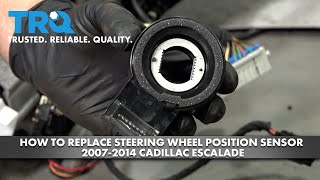
Typical fix: First, attempt to recalibrate the sensor using a bidirectional scan tool like a GM Tech 2 or equivalent. If calibration fails or the sensor data is still erratic, the sensor needs to be replaced. Replacement requires removing the lower dash panels and dropping the steering column. 🎬 See this walkthrough for replacing the steering wheel position sensor.
Est. part cost: $60-$200 - Defective Wheel Speed Sensor (WSS) or Wiring 🟡 Medium Probability Wheel speed sensors and their wiring are exposed to the elements and can fail due to corrosion, damage from road debris, or failure of the magnetic ring in the wheel hub assembly. The wiring harness leading to the sensor is a common point of failure.
How to confirm: Check for wheel speed sensor-specific codes (e.g., C0035-C0050). Use a scan tool to monitor the speed of each wheel while driving. A sensor that reads 0 mph or has an erratic signal compared to the others is faulty. Visually inspect the wiring harness at each wheel for chafing or corrosion. A tech guide suggests testing resistance across the sensor terminals, looking for 850 to 1350 ohms.
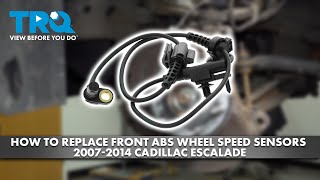
Typical fix: Inspect the sensor and its wiring for damage or corrosion. If the wiring is good, replace the faulty wheel speed sensor. Sometimes the sensor is integrated into the wheel hub assembly, requiring hub replacement. 🎬 Watch: How to replace the front ABS wheel speed sensors. If the wiring is damaged, a new pigtail connector may be needed.
Est. part cost: $25-$150 - Failing Brake Pedal Position (BPP) Sensor ⚪ Low Probability This sensor tells the stability system that you are applying the brakes. A failure can lead to conflicting data, causing the EBCM to shut down StabiliTrak as a precaution.
How to confirm: Check for BPP sensor-specific codes. Use a scan tool to monitor the sensor's status while pressing and releasing the brake pedal. The status should change from 'Inactive' to 'Active' without hesitation or delay.
Typical fix: Replace the brake pedal position sensor located near the top of the brake pedal arm. This is often a simple, inexpensive repair.
Est. part cost: $30-$70
Rare But Worth Checking
- Low System Voltage: A weak or failing battery can cause widespread communication errors between modules, leading to a C0561 code. Always ensure the battery is healthy (testing above 12.5V engine off) and the charging system is working correctly (13.8-14.4V engine on) before diving into more complex diagnostics.
- Faulty Electronic Brake Control Module (EBCM): While possible, this is extremely rare. TSB #PIT4169F explicitly warns against replacing the EBCM as a first step. This should only be considered after all other possible causes and primary DTCs have been ruled out. Some repair shops note that these specific EBCM modules are not repairable and must be replaced if faulty.
- Active Fuel Management (AFM) Issues: Some owners on Chevrolet forums have anecdotally linked the C0561 code to rough idle conditions caused by the AFM system. Fouled spark plugs on AFM cylinders (especially #1 and #7) can cause engine instability that triggers the code. Disabling AFM with a tuner or device reportedly resolved the issue for some.
Diagnosis Steps
- Connect a professional-grade scan tool capable of reading codes from all vehicle modules.
- Scan all systems (ECM, BCM, EBCM, TCM, etc.) for any stored Diagnostic Trouble Codes (DTCs). Note any sub-codes for C0561, such as -71, -72, or -74.
- IGNORE code C0561 for now. Focus on any other active or stored codes. As per TSB #PIT4169F, these are the primary faults.
- Follow the diagnostic procedure for the primary code(s) you found. For example, if you have P0171, begin diagnosing a lean condition by checking for vacuum leaks, especially the PCV hoses on the valve covers.
- If no other codes are present, use the scan tool to monitor live data from key sensors: Steering Angle Sensor, all four Wheel Speed Sensors, and the Brake Pedal Position Sensor.
- Check for erratic or illogical readings from these sensors while operating the vehicle or turning the steering wheel. A WSS reading 0 MPH while others read correctly is a clear indicator.
- Inspect wiring harnesses for key sensors, particularly wheel speed sensors, for chafing, corrosion, or damage.
- Once the primary fault has been identified and repaired (e.g., replaced a faulty sensor, fixed a vacuum leak), clear all DTCs from all modules.
- Perform a test drive, including speeds over 20 MPH, to confirm that the 'Service Stability' message and the C0561 code do not return.
Parts You'll Likely Need

- Steering Angle Sensor
(OEM #13590209)— This sensor is a frequent failure point and is critical for StabiliTrak operation. A faulty sensor will directly cause the EBCM to disable the system.
Trusted brands: ACDelco, Dorman
OEM price range: $80-$150
Aftermarket price range: $60-$120 - Wheel Speed Sensor
(OEM #22810020 (Front Example))— Provides essential wheel speed data to the ABS and traction control systems. A faulty sensor provides invalid data, triggering the shutdown.
Trusted brands: ACDelco, Standard Motor Products, Bosch
OEM price range: $50-$100
Aftermarket price range: $25-$75
Related Codes That Often Appear With This One
- P0171 / P0174 — These engine lean codes often indicate a vacuum leak (like a bad PCV hose) that affects engine stability, causing the ECM to send data that the EBCM flags as invalid.
- P0172 / P0175 — These engine rich codes, sometimes caused by an incorrect fuel alcohol percentage reading, also create engine instability that can trigger a C0561.
- C0710 — This is a specific code for a fault in the steering position signal, a direct cause for the EBCM to set C0561.
- C0035 - C0050 — These codes correspond to faults in the wheel speed sensor circuits, which provide critical data to the EBCM.
- P0300-P0308 — Engine misfire codes, like P0307 (misfire on cylinder 7), can cause enough engine instability for the EBCM to disable StabiliTrak as a precaution.
Technical Service Bulletins (TSBs) & Recalls
- PIT4169F: Explicitly states not to replace the EBCM for a C0561 code and to instead diagnose other DTCs present in the vehicle, even if they don't trigger a CEL.
Platform-Specific Known Issues
- Cracked PCV Hoses Causing Lean Codes: A very common issue on the 6.2L V8 in the Escalade (and its platform mates) is the deterioration of the small rubber PCV hoses and elbows connecting the valve covers to the intake manifold. A crack here creates a vacuum leak, triggering P0171/P0174, which in turn causes the EBCM to set C0561. A visual inspection and replacement with an updated part is a frequent fix.
Mechanic-Grade Diagnostic Values
- GMLAN Bus Resistance — expected: Approximately 60 Ohms (± 5 Ohms) when measured across pins 6 and 14 of the Data Link Connector (DLC) with the battery disconnected.. Failure: A reading of ~120 Ohms indicates an open circuit or a disconnected terminating resistor (one in the ECM, one at the end of the bus). A reading significantly less than 60 Ohms indicates the two data lines are shorted together.
- GMLAN Bus Voltage — expected: Approximately 2.5V on both Pin 6 (CAN High) and Pin 14 (CAN Low) at the DLC when the bus is idle.. Failure: During communication, CAN High should toggle up by about 1V and CAN Low should toggle down by about 1V. A short to ground will pull the voltage to 0V, while a short to power will pull it to battery voltage.
- Wheel Speed Sensor (WSS) Resistance — expected: 850 to 1350 Ohms across the sensor's two terminals.. Failure: A reading outside this range indicates a faulty sensor. An infinite reading (OL) on a multimeter indicates an open circuit within the sensor.
- Wheel Speed Sensor (WSS) AC Voltage Output — expected: A minimum of 100mV AC when spinning the wheel by hand, with voltage and frequency increasing with wheel speed.. Failure: No voltage or an erratic signal indicates a bad sensor or a problem with the magnetic ring on the hub.
Hidden / Shadow Codes Worth Checking
- C0561-71: Invalid Serial Data Received. This is the most common symptom byte and means the EBCM received data it could not validate. It often points to a fault in another module sending bad data. (see via A professional-grade scan tool (like a GM Tech 2 or GDS2) that can read GM-specific symptom bytes. Basic OBD-II readers may only show C0561.)
- C0561-72: Alive Counter Incorrect. The data packet's internal counter isn't incrementing as expected, which can point to a problem with the data bus itself or the sending module failing. (see via A professional-grade scan tool that can read GM-specific symptom bytes.)
- C0561-74: Value of Signal Protection Calculation Incorrect. This is a checksum error, meaning the data arrived but its validation signature is wrong. This can indicate a module needs reprogramming or is failing. (see via A professional-grade scan tool that can read GM-specific symptom bytes.)
- C0561-4B: Calibration Not Learned. This indicates a module learning step was not performed or failed after a component was replaced or reprogrammed. (see via A professional-grade scan tool that can read GM-specific symptom bytes.)
- C0561-59: Component Protection Time Out - Pump Motor Run On. This detects if the ABS pump motor runs continuously for more than 60 seconds, often due to a poor service bleed, a hydraulic leak, or excessive pedal pumping. (see via A professional-grade scan tool that can read GM-specific symptom bytes.)
Scan Tool Commands That Help

- GM Tech 2 / GDS2 or equivalent: Steering Angle Sensor Calibration / Learn — This function must be used after replacing the Steering Angle Sensor, EBCM, or performing a wheel alignment to reset the sensor's zero position. Failure to do so will cause a C0561 or related code. The procedure involves centering the steering wheel and following on-screen prompts.
- GM Tech 2 / GDS2 or equivalent: EBCM Reprogramming — In some cases, a C0561 code can be caused by a software glitch. A TSB for a similar platform mentions reprogramming the EBCM as a fix. This should be done using TIS2000 or GM's modern equivalent service programming system.
Wiring & Ground Locations
- G103 — On the front of the passenger side cylinder head on the GMT900 platform.. This ground point is used by multiple critical modules. While a different document for another GM vehicle shows G103 grounding the BCM and DLC, poor grounds are a common source of communication faults. A loose or corroded G103 can cause intermittent data errors on the GMLAN, leading the EBCM to set a C0561.
- GMLAN Bus Wires — A twisted pair of wires (often green and white or yellow and black) running to all high-speed modules, accessible at the DLC (pins 6 & 14) and at each module connector, including the EBCM.. The integrity of this twisted pair is essential for communication. Chafing or corrosion anywhere along this bus can corrupt data and trigger a C0561. A common failure point is the wiring harness near the EBCM itself or where it passes through the firewall.
- EBCM Connector — The large electrical connector on the Electronic Brake Control Module, which is attached to the ABS hydraulic block in the engine compartment.. Corrosion on the pins or a loose connection can directly cause communication failures and C0561. A forum user reported their issue was finally fixed by finding a chafed wire and a loose pin within this module connector.
Real Owner Repair Stories
- LS1Tech Forum User (Pontiac Montana SV6 (similar GMT platform electronics)) — ABS, Traction Control, and Stabilitrak lights on. Codes C0561, C0242, U0073, U0121, P0575.
❌ Tried (didn't work) Not specified, but the user took the vehicle to a dealer for diagnosis.
✅ What actually fixed it A dealer technician found a loose pin in the EBCM module connector and a chafed wire near the front strut. Repairing the pin and the wire resolved all the codes and warning lights.
OEM Part Supersession History
Unknown→13590209— Part redesign or supplier change.
Heads up: Part number 13590209 is listed for the 2015-2020 Escalade, not the 2007-2013 generation. While it is the correct part for a Steering Angle Sensor, it is for the next generation (K2XX). Buyers must verify the correct part number for their specific 2007-2013 model year, as parts are not interchangeable between generations.
Model Year Variations Within This Range
- 2007-2008 vs 2009-2014: While the C0561 diagnosis remains consistent, the EBCM part numbers may differ. For example, repair estimates show significantly different replacement costs for a 2008 vs. a 2009 model, suggesting a potential change in the hardware or supplier for the EBCM during the production run. Always verify the OEM part number with a VIN.
Helpful Videos
We Have This Part in Stock


The information in this article is provided for general reference and educational purposes only. Vehicle specifications, procedures, and part compatibility can vary by production date, trim level, and region. Always consult your vehicle's factory service manual and verify part numbers before purchasing or performing repairs. Safety-critical components such as airbags, seat belts, and braking systems should be installed by a qualified professional.
- Cadillac ESCALADE:
- 🎬 Helpful Videos
- 🛍️ Shop This Part
- What's Unique About the 2007-2013 Cadillac Escalade
- Diagnostic Flowchart
- Symptoms You May Notice
- Most Likely Causes
- Rare But Worth Checking
- Diagnosis Steps
- Parts You'll Likely Need
- Related Codes That Often Appear With This One
- Technical Service Bulletins (TSBs) & Recalls
- Platform-Specific Known Issues
- Mechanic-Grade Diagnostic Values
- Hidden / Shadow Codes Worth Checking
- Scan Tool Commands That Help
- Wiring & Ground Locations
- Real Owner Repair Stories
- OEM Part Supersession History
- Model Year Variations Within This Range
- 🎟️ Get 5% Off