

OBD-II Code C0542: Brake Pressure Sensor 'B' Circuit Low
The Ultimate 2026 Guide to Meaning, Diagnosis, and Repair
- Code C0542 indicates a low voltage signal in the 'B' brake pressure sensor circuit, immediately disabling your anti-lock brakes (ABS) and electronic stability control (ESC).
- Driving with C0542 increases emergency stopping distances by up to 15%, making it a severe safety risk on wet or icy roads.
- The most frequent cause on 2002-2015 VW, BMW, and Ford vehicles is an internal failure of the ATE MK60 ABS module's pressure sensor.
- Save $800 or more by sending a failed ATE MK60 ABS module to a specialist for a $250-$400 rebuild rather than buying a new $1,200 OEM replacement.
- Always perform a ground circuit voltage drop test before replacing the ABS module; corroded frame grounds are the primary cause of false C0542 codes on modern GM trucks.
What Does C0542 Mean?
Code C0542 means the Anti-lock Brake System (ABS) module receives a weak, erratic, or zero-voltage signal from the second ('B') brake pressure sensor. This sensor converts hydraulic brake pedal pressure into an electrical voltage. When this signal drops below the manufacturer's threshold (typically 0.0-0.3 volts), the computer cannot determine your braking intent, triggering a failsafe that disables ABS and traction control.
Technical definition: The SAE/OBD-II definition for C0542 is "Brake Pressure Sensor 'B' Circuit Low". The brake control module detects the voltage signal from the 'B' brake pressure sensor remains below the specified minimum range. This abnormally low voltage indicates an open circuit, a short to ground, or an internal sensor failure.
Can I Drive With C0542?
Yes, But With Caution. Yes, you can still drive, but with extreme caution. Your main hydraulic brakes function, but critical safety features like the Anti-lock Braking System (ABS) and Electronic Stability Control (ESC) are disabled. Research shows a vehicle without ABS takes over 15% longer to stop, turning a close call into a collision. Have the vehicle repaired immediately.
Common Causes
- Failed Brake Pressure Sensor (Internal) (Very Common) — The sensor fails internally due to age, vibration, or a ruptured diaphragm. On most vehicles built after 2002, this sensor is integrated directly into the ABS hydraulic control unit and cannot be replaced separately, requiring a full module repair or replacement.
- Damaged or Corroded Wiring/Connectors (Very Common) — The wiring harness leading to the ABS module is exposed to road debris and elements. Wires fray or chafe, and connectors fill with moisture, causing corrosion. This creates high resistance or a short to ground, dropping the signal voltage to zero.
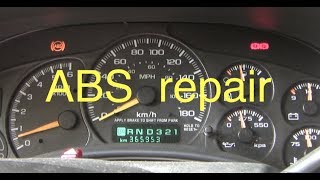
- Poor Ground Connection for ABS Module (Common) — The ABS module requires a clean, solid ground connection to the vehicle's chassis. A rusty or loose ground strap causes unstable voltage, triggering false sensor codes. This is the leading cause of C0542 on modern GM trucks. 🎬 Watch: How to fix common ABS issues on GM vehicles.
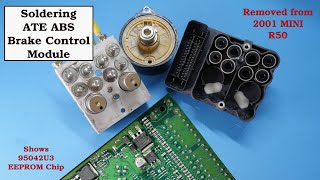
- Faulty ABS Control Module (Common) — The ABS module's internal circuit board burns out or develops cracked solder joints. 🎬 See how to repair and solder an ABS control module. The input stage that reads the sensor's signal fails, causing the code even if the sensor and wiring are perfect.
- Low System Voltage (Less Common) — A weak battery or failing alternator causes low voltage across the entire vehicle. Sensitive electronic modules misinterpret this system-wide voltage drop as a specific sensor circuit fault.
- Contaminated Brake Fluid (Rare) — Moisture and debris in old brake fluid corrode the delicate internal pressure sensor, especially in units where the sensor is integrated into the hydraulic block.
- Outdated ABS Module Software (Rare) — Overly sensitive software parameters trigger false codes. Manufacturers release firmware updates to adjust sensor thresholds and resolve this issue.
- CAN Bus Communication Failure (Rare) — A communication breakdown between the ABS module and other computers over the Controller Area Network (CAN bus) is misinterpreted and logged as a sensor-specific code.
Symptoms
- ABS and Traction Control Lights Illuminated — The dashboard warning lights for the Anti-lock Braking System and Electronic Stability Control (a car with squiggly lines) illuminate and stay on permanently.
- Loss of ABS and Traction Control Function — During a hard stop, the wheels lock up and skid. In slippery conditions, the car fails to automatically correct itself during a slide.
- Brake Pedal Feels Spongy or Hard — The brake pedal feels mushy, requires more travel to engage, or suddenly becomes hard, especially at low speeds.
- Erratic Brake Light Operation — In brake-by-wire systems, a pressure sensor fault interferes with brake light operation, causing them to stay on or fail to illuminate when the pedal is pressed.
Diagnostic Flowchart
Tap your situation to follow the diagnostic path that matches what you're seeing on this code.
Common Fixes & Costs
- Sending the original ABS module for repair
— Parts: $250-$400, Labor: $150-$300 (for removal, reinstallation, and bleeding), ~2 hr book time
(Intermediate)
ATE MK60 (Common Unit): OEM N/A (Repair Service) (Alt: Module Master (Repair Service), UpFix (Repair Service), XeMODeX (Repair Service)) - Repairing damaged wiring or cleaning connectors — Parts: $10-$50, Labor: $150-$300, ~1.5 hr book time (Intermediate)
- Replacing the entire ABS Control Module/Hydraulic Unit
— Parts: $400-$1200, Labor: $300-$500 (Includes installation, brake bleeding, and programming), ~2.5 hr book time
(Professional)
VW Jetta/Golf (2010-2014): OEM 1K0907375AH, 1K0614517EB (Alt: Bosch 0265951750 (Reman))
Ford Focus (2012-2014): OEM BV6Z2C405E, BV61-2C405-AE (Alt: Cardone 12-4017 (Reman)) - Replacing a failing battery or alternator — Parts: $150-$450, Labor: $50-$100, ~0.8 hr book time (DIY)
- Updating ABS Module Software — Parts: $0, Labor: $100-$200 (Dealer service fee), ~1 hr book time (Professional)
Used vs. New Parts: Buying Guide
When a used part is worth it: A used ABS module is a high-risk option. It makes sense only if the budget is extremely tight and the part includes a warranty. A professional 'Repair Service' for your original module is a vastly superior value.
Donor-vehicle mileage cap: roughly under 50000 miles for the part to have meaningful remaining life.
Donor quality checklist:
- Verify the exact part number on the module; identical-looking units are often incompatible.
- Avoid used parts for ATE MK60 internal sensor failures, as the donor part contains the exact same design flaw.
- Ensure the donor vehicle avoided front-end collisions that damage the hydraulic block.
- Factor in programming costs; used modules require VIN coding or PROXI alignment to function.
Decision logic:
- If The fault is a known design flaw (e.g., ATE MK60 pressure sensor) → Choose a 'Repair Service' for your original module. This is the most reliable and cost-effective solution.
- If A repair service is unavailable and the vehicle is over 10 years old → Purchase a 'Remanufactured' unit with a lifetime warranty. Use a salvage part only as a last resort.
- If The vehicle is newer, under warranty, or requires complex dealer programming → Buy a new OEM part.
Warranty tradeoff: Used parts offer 30-90 day warranties. Remanufactured units and repair services provide 1-year to lifetime warranties. New OEM parts carry 1-2 year warranties.
Worst-case if a used part fails: $500-$1000 if a used module fails, requiring repeat labor for removal, brake bleeding, and purchasing another unit.
What Happens If You Wait — Timeline
- Immediate: ABS, ESC, and Traction Control warning lights illuminate. The vehicle's safety systems are immediately disabled. (MPG impact: 0%% · Added cost: $0, but stopping distances in emergencies increase significantly.)
- 1-6 months: The vehicle automatically fails the safety portion of state vehicle inspections, making it illegal to drive. (MPG impact: 0%% · Added cost: $50-$250 in potential fines.)
- 6-12 months: If caused by an internal module short, a parasitic battery drain develops, causing no-start conditions and straining the alternator. (MPG impact: 0%% · Added cost: $150-$450 for a new battery.)
- Long-term: The primary risk remains constant: the potential for an accident due to the lack of ABS/ESC functionality. (MPG impact: 0%% · Added cost: The potential cost of an at-fault collision.)
Cost of Not Fixing It
- Immediate: Loss of ABS and Electronic Stability Control (ESC). Increased risk of skidding and loss of control during emergency braking or on slippery surfaces. (Added cost: Potential cost of an at-fault collision.)
- 0-12 months: Automatic failure of state safety inspections. The vehicle becomes legally un-drivable until repaired. (Added cost: Fines for expired inspection, plus the eventual repair cost.)
- Long-term: A faulty ABS module develops a parasitic battery drain, causing dead batteries and straining the alternator. (Added cost: $150-$250 for premature battery replacement.)
Diagnosis Steps
- Read Codes and Review Live Data
Use an ABS-capable OBD-II scanner. Confirm C0542 is present. Navigate to the ABS live data screen and monitor 'Brake Pressure Sensor B' voltage. With your foot off the brake, it should read a stable 0.3-0.5V. Press the pedal; it should increase smoothly towards 4.5V. A reading stuck near 0V confirms the fault.
Tools: ABS-capable OBD-II Scanner (Beginner) - Visually Inspect Wiring and Connectors
Inspect the wiring harness going to the ABS module. Look for cuts, chafing against chassis parts, or green/white corrosion on the connector pins. Unplug the connector and check for bent or water-damaged pins.
Tools: Flashlight, Mirror (Intermediate) - [PRO TIP] Perform a Harness 'Wiggle Test'
With the scanner displaying live data for the Brake Pressure Sensor B, have a helper gently wiggle the wiring harness between the firewall and the ABS module. If the voltage reading jumps, you have pinpointed an internal wire break or loose connection.
Tools: ABS-capable OBD-II Scanner (Intermediate) - Check Battery and Charging System
Rule out power issues. Use a multimeter to verify the battery has at least 12.4V with the engine off. Start the engine; voltage must rise to 13.5-14.5V. A weak system causes false codes.
Tools: Multimeter (Beginner) - [PRO TIP] Perform a Ground Circuit Voltage Drop Test
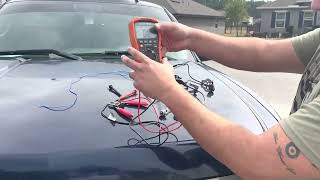
With the ignition on, place the red multimeter lead on the negative battery terminal and the black lead on the ground pin at the ABS module connector. A reading above 0.1V (100mV) indicates excessive resistance in the ground circuit that must be fixed.
Tools: Multimeter, Vehicle-specific wiring diagram (Advanced) - Check for Power and Ground at the Sensor/Module
Identify the 5V reference wire, signal wire, and ground wire at the ABS module connector. Check for 5V on the reference pin and near 0V on the ground pin. A missing reference voltage points to a module failure.
Tools: Multimeter, Vehicle-specific wiring diagram (Advanced) - [ADVANCED] Verify Sensor Voltage Thresholds
Backprobe the sensor's signal wire. A healthy sensor outputs 0.5V with no brake pressure and rises to 4.5V under full pedal application. A reading consistently stuck below 0.3V confirms a 'Circuit Low' condition.
Tools: Multimeter, Backprobe Pins (Advanced) - Test Signal Wire Continuity
Disconnect the ABS module connector. Set your multimeter to Ohms. Check for continuity on the signal wire; the reading should be <1 Ohm. Check for a short by testing resistance between the signal wire and ground; the reading should be infinite (OL).
Tools: Multimeter, Vehicle-specific wiring diagram (Advanced) - [ADVANCED] Check Live Data Pressure PID
Observe the live data parameter for 'Brake Pressure'. With the ignition on and brake pedal released, pressure should read near 0 bar. An erratic reading or a value stuck at a high number indicates a sensor or module fault.
Tools: ABS-capable OBD-II Scanner (Advanced) - [PRO TIP] Analyze the Signal with an Oscilloscope
Backprobe the sensor's signal wire. A good sensor produces a clean DC voltage line that rises with pedal pressure. A faulty sensor shows a flat line at 0V, a noisy signal, or sudden dropouts.
Tools: Oscilloscope, Wiring diagram (Professional)
When This Code Triggers (Freeze-Frame Conditions)
- Vehicle Speed: 10-20 mph (The ABS module performs a self-test upon startup and as the vehicle begins to move. The code logs when the self-test fails as the vehicle exceeds a low-speed threshold.)
- System Voltage: 11.5-14.5V (The code sets during key-on or while driving if the module's power supply voltage is stable but the sensor circuit voltage drops.)
- Brake Pedal Status: Not Applied (The module detects the 'Circuit Low' condition (near 0V) even when the brake is not pressed, as it expects a baseline voltage of approximately 0.5V.)
- Time Since Ignition On: 1-5 seconds (The ABS module runs an initial self-check immediately after ignition. A permanent 'Circuit Low' fault logs instantly, illuminating the warning light before the vehicle moves.)
Related Codes
- C0543 — This means 'Brake Pressure Sensor B Circuit High'. Diagnosis is similar, but you look for a voltage signal stuck high (e.g., at 5.0V) caused by a short to power.
- C053E / C053F — These codes are for 'Brake Pressure Sensor A Circuit Low' and 'Circuit High'. The diagnostic process is identical, but testing focuses on the 'A' sensor circuit.
- C0131 — A general code for 'Pressure Sensor Circuit Malfunction'. Seeing C0131 with C0542 strongly points to an internal module failure on ATE MK60 systems.
- U0418 — Code for 'Invalid Data Received From Brake System Control Module'. This confirms the ABS module is broadcasting bad data and is the source of the network problem.
Climate & Environmental Factors
- High Humidity / Road Salt (Rust Belt): Moisture and salt accelerate corrosion on wiring connectors, module pins, and chassis ground points. GM issued service bulletins regarding frame corrosion on trucks compromising critical ground locations.
- Extreme Heat: Repeated heat cycles cause solder joints on the internal ABS circuit board to crack, leading to intermittent or permanent faults.
- Extreme Cold: Cold weather makes aging wiring harnesses brittle and prone to cracking. It also reduces battery efficiency, causing low-voltage situations that trigger spurious electronic fault codes.
How to Talk to a Mechanic About This Code
Say this: "I have an ABS light on and my scanner shows code C0542, for the 'Brake Pressure Sensor B Circuit Low'. I'd like to schedule a diagnostic appointment. Please start by checking the sensor circuit wiring, connectors, and the main module ground for corrosion or damage before recommending a new ABS module."
This directs the shop to perform a logical, step-by-step diagnosis—checking for simple failures like wiring or grounds first—rather than immediately quoting the most expensive repair.
Avoid saying:
- 'My ABS light is on, can you fix it?'
- 'The car feels weird when I brake.'
- 'Just do whatever it takes to get the light off.'
Questions to ask before authorizing the repair:
- What was the brake pressure sensor voltage reading on the scan tool's live data?
- Did you perform a wiggle test on the wiring harness?
- Did you test the power and ground circuits at the ABS module connector, and what were the voltage drop readings?
- If the module needs to be replaced, is a repair service or a remanufactured unit an option, and what is the warranty on each?
Where to Take It: Dealer vs Independent vs Chain
- Dealer:
Best for: Vehicles under warranty., Newer vehicles requiring proprietary software updates or programming (e.g., 'PROXI Alignment' on FCA vehicles)., Complex, brand-specific electrical issues where technical service bulletins (TSBs) are key.
Downsides: Highest labor rates, often 1.5-2x more than independent shops., More likely to recommend replacement of the entire expensive module assembly rather than investigating component repair. (Typical cost: +50% vs. baseline) - Independent Shop:
Best fit for most situations. A well-equipped independent shop with ASE-certified technicians provides a dealership-level diagnosis for less money.
Best for: Out-of-warranty vehicles where cost is a major factor., Diagnosing common, well-documented failures (like ATE MK60 module faults or GM truck ground issues)., Vehicles older than 5 years.
Downsides: Diagnostic capabilities vary greatly; ensure the shop has modern, ABS-capable scan tools., May not have access to the very latest manufacturer software updates. (Typical cost: +0% vs. baseline) - Chain Shop:
AVOID for C0542 diagnosis. They typically lack the advanced tools and training to accurately diagnose the root cause, leading to wasted money.
Best for: Simple brake jobs (pads/rotors), tire changes, and oil services.
Downsides: Generally not equipped for complex electrical or module-level diagnostics., Technician skill and experience can be inconsistent., High pressure to meet sales targets leads to misdiagnosis or upselling. (Typical cost: -10% vs. baseline)
When to Walk Away From the Repair
If the estimated repair cost for the C0542 fault exceeds 40-50% of your car's private-party market value, it's time to seriously consider not fixing it and pursuing other options.
- Car worth $4000, fix is $1800: Walk away. The repair cost is a significant percentage of the car's value. The risk of other age-related repairs is high.
- Car worth $12000, fix is $1800: Fix it. The repair cost is well under the threshold, and fixing it restores a critical safety feature and the vehicle's full value.
- Car worth $2500, fix is $1200: Borderline. Get a second opinion. If the fix is a simple wiring issue for a few hundred dollars, do it. If it truly needs a $1200 module, it's likely time to sell.
What Scan Tool You Need for This Code
Minimum: An OBD-II reader that accesses the Anti-lock Braking System (ABS) module to read 'C' (Chassis) codes and view live sensor data.
A standard $20 engine code reader cannot communicate with the ABS module. It shows 'no codes' even when the ABS light is on, making it useless for diagnosing C0542.
Budget: BlueDriver Pro or Foxwell NT510 Elite (~$99) — Connects to your smartphone via Bluetooth. It reads ABS codes, clears them, and displays live data for the brake pressure sensor voltage to see if the sensor is dead or wiring is intermittent.
Mid-range: Autel MaxiCheck Pro or Foxwell NT630 Plus (~$200) — Dedicated handheld units offering broader vehicle compatibility and bidirectional controls. The key feature is the 'Automated Bleed' function, required after replacing the hydraulic module.
Professional: Autel MaxiCOM MK808 / MK906BT or Launch X431 series (~$500-1200) — Offers full bidirectional control, module coding, and programming. Performs advanced functions like the 'PROXI Alignment' needed for newer Jeep/Chrysler vehicles after module replacement.
How to Clear the Code After You Fix It
- Fix the underlying issue (e.g., repair wiring, replace module).
- Use an ABS-capable OBD-II scan tool to access the 'Anti-lock Braking System' module.
- Select the option to 'Clear Codes' or 'Erase DTCs'.
- Perform a short drive cycle to confirm the repair and ensure the warning light remains off.
Drive cycle (~15 minutes): After clearing the code, perform a 10-15 minute test drive including city stop-and-go and steady-speed driving above 25 mph. Include several turns and normal brake applications. The ABS module runs its self-tests during this drive to verify sensor circuit operation.
Readiness monitors affected: Not applicable. Emissions readiness monitors are part of the Engine Control Module (ECM), not the ABS module.
Watch out for:
- Using a basic OBD-II scanner that only reads engine codes; an advanced scanner communicating with the ABS module is mandatory.
- Disconnecting the battery fails to clear the code from the ABS module's non-volatile memory.
- The code returns immediately if the root electrical fault remains unaddressed.
Will This Fail Emissions / State Inspection?
No — by itself this code doesn't fail OBD inspection (but it can keep readiness monitors from setting, which causes a separate fail).
- California: An ABS light passes the emissions-only Smog Check but fails the comprehensive 'Brake and Lamp' inspection required for salvaged titles.
- New York: An illuminated ABS warning light is an automatic failure for the annual safety inspection.
- Texas: An illuminated ABS warning light passes the standard safety inspection. The inspector notes it, but it is not a rejection criterion.
Most Commonly Affected Vehicles
- Audi, VW, Skoda, Seat A3, TT, Golf, Jetta, Octavia, Leon (2002-2015) — These vehicles use the ATE MK60 ABS system, notorious for internal brake pressure sensor failures. Repair involves sending the module to a specialist.
- Ford Focus, Fiesta, C-Max, Mondeo (2002-2015) — Equipped with the failure-prone ATE MK60 ABS system, exhibiting the same internal sensor failure as VW Group cars.
- BMW 1 Series, 3 Series, Z4 (2002-2015) — Frequently used the ATE MK60 ABS system, known to have brake pressure sensor faults requiring module repair.
- Volvo C30, C70, S40, V50 (2004-2013) — Fitted with the ATE MK60 ABS system, making them susceptible to this specific code due to internal sensor failure.
- Jeep Cherokee, Grand Cherokee (2018-2022) — The sensor is integrated into the ABS module. Replacement requires a 'PROXI Alignment' procedure. Costs exceed $850.
- Chevrolet / GMC Silverado, Sierra (2019-2024) — A bad ground connection is a common underlying cause for various electronic issues. GM TSB 19-NA-255 addresses frame corrosion compromising ground points.
- Subaru Outback, Forester, Legacy (2010-2020) — A C0542 code is often an early symptom of a failing battery or poor ground connection before being a module failure.
- Hyundai / Kia Santa Fe, Sorento, Optima (2013-2022) — Diagnosis must carefully check wiring and connectors for issues before condemning the expensive ABS module.
Manufacturer-Specific Notes
- ATE (Supplier for VW, Audi, BMW, Ford, Volvo): The ATE MK60 ABS unit (2002-2015) has a design flaw where the internal brake pressure sensor fails. Third-party companies offer a cost-effective repair service for the entire module.
- Jeep / Chrysler / Dodge / Fiat: Replacing the ABS module requires a 'PROXI Alignment' programming procedure to sync with the vehicle's VIN. Failure to do this causes a flashing odometer and system errors.
- General Motors: The primary ABS module ground is located on the frame rail below the driver's door, highly susceptible to corrosion. TSB 19-NA-255 addresses cleaning and repairing these ground points.
- Subaru: Subaru vehicles are highly sensitive to battery health. An aging battery causes seemingly unrelated electrical codes, including ABS faults. Always perform a battery test first.
Real Owner Stories
2013 VW Golf TDI at 115K miles with ATE MK60 module
ABS and ESC warning lights illuminated suddenly. VCDS scan tool showed code 01435 (Brake Pressure Sensor 1) and C0542. A local shop quoted $1,800 for a new ABS module.
Outcome: The owner removed the ABS module and sent it to a specialist repair service for $280. After re-installing and bleeding the brakes, the codes cleared permanently.
Lesson: If your 2002-2015 VW, Audi, BMW, or Ford shows a brake pressure sensor code, it is likely the known ATE MK60 internal failure. A repair service is the most cost-effective solution.
2019 GMC Sierra 1500 at 45K miles
Intermittent 'Service ESC' and 'Service Power Steering' messages appeared with the ABS light, especially in wet weather.
Outcome: The owner found a severely corroded braided ground strap on the frame rail under the driver's side door. Cleaning the contact surfaces to bare metal and installing a new bolt permanently resolved all warnings for under $10.
Lesson: On late-model GM trucks, intermittent ABS faults are often caused by a poor chassis ground. Always inspect main ground points before authorizing module replacements.
2019 Jeep Cherokee Latitude at 60K miles
ABS and Traction Control lights stayed on. A parts store scanned code C0542.
Outcome: The repair required a new $850 OEM ABS module. The shop performed a mandatory 'PROXI Alignment' procedure with a high-end scan tool to sync the new module. Total cost was $1,250.
Lesson: Replacing the ABS module on newer Fiat-Chrysler vehicles requires a mandatory 'PROXI Alignment' programming step, making it a job for a well-equipped shop.
How to Prevent This Code From Triggering
- Perform regular brake fluid flushes (Every 2-3 years or 30,000 miles) — Brake fluid absorbs moisture from the air. This moisture corrodes the delicate internal valves and sensors within the ABS module.
- Inspect and protect main chassis ground points (Every 1-2 years, especially in rust-belt regions) — Corrosion on main ground connections creates electrical resistance, causing low voltage and triggering false sensor codes. Cleaning the connection to bare metal prevents this.
- Maintain a healthy battery and charging system (Test annually, especially before winter) — A weak battery provides insufficient voltage to sensitive electronics. The ABS module misinterprets this system-wide voltage drop as a specific sensor circuit fault.
- Visually inspect the ABS wiring harness (During any under-hood maintenance) — Catching chafed or melted insulation early prevents a short circuit that leads to code C0542.
Frequently Asked Questions
Can I just replace the brake pressure sensor?
Almost never on modern cars. On most vehicles built after 2002, the sensor is integrated directly into the ABS hydraulic unit and cannot be replaced individually. You must repair or replace the entire ABS module assembly.
Is it safe to drive with the C0542 code?
No. While your standard hydraulic brakes still function, your ABS and stability control are completely disabled. This increases emergency stopping distances by over 15% and causes loss of steering control during a skid.
Will clearing the code fix the problem?
No. Clearing the code only erases the fault record temporarily. The ABS module performs a self-check every time you start the car, and the warning lights will return immediately if the electrical fault persists.
How much does it cost to fix code C0542?
A simple wiring or ground repair costs $150-$350 at a shop. Rebuilding a failed ABS module through a specialist costs $400-$750 including labor. A full replacement with a new OEM module at a dealership ranges from $1,000 to over $2,000.
What is the ATE MK60 and why does it matter for C0542?
The ATE MK60 is a widely used ABS unit found in many 2002-2015 VW, Ford, BMW, and Volvo models. It suffers from a notorious design flaw where the internal brake pressure sensor fails, making it the leading cause of code C0542 on these vehicles.
What is a 'PROXI Alignment' and when is it needed?
A PROXI Alignment is a mandatory programming procedure for Fiat-Chrysler vehicles (Jeep, Dodge, Ram) after replacing the ABS module. It syncs the new module with the vehicle's network. Skipping this step results in a flashing odometer and persistent error codes.
Can a bad ground wire really cause this ABS code?
Absolutely. A corroded ground connection creates electrical resistance, dropping the voltage supplied to the ABS module. The module misinterprets this low voltage as a failed pressure sensor, triggering a false C0542 code.
What are common misdiagnosis mistakes for C0542?
The most expensive mistake is replacing the ABS module without testing the wiring harness and chassis grounds first. Mechanics frequently condemn a $1,200 module when the actual culprit is a $10 corroded ground bolt on the vehicle's frame.
Key Takeaways
- Code C0542 indicates a low voltage signal in the 'B' brake pressure sensor circuit, immediately disabling your anti-lock brakes (ABS) and electronic stability control (ESC).
- Driving with C0542 increases emergency stopping distances by up to 15%, making it a severe safety risk on wet or icy roads.
- The most frequent cause on 2002-2015 VW, BMW, and Ford vehicles is an internal failure of the ATE MK60 ABS module's pressure sensor.
- Save $800 or more by sending a failed ATE MK60 ABS module to a specialist for a $250-$400 rebuild rather than buying a new $1,200 OEM replacement.
- Always perform a ground circuit voltage drop test before replacing the ABS module; corroded frame grounds are the primary cause of false C0542 codes on modern GM trucks.
Helpful Videos


The information in this article is provided for general reference and educational purposes only. Vehicle specifications, procedures, and part compatibility can vary by production date, trim level, and region. Always consult your vehicle's factory service manual and verify part numbers before purchasing or performing repairs. Safety-critical components such as airbags, seat belts, and braking systems should be installed by a qualified professional.
- 🎬 Helpful Videos
- What Does C0542 Mean?
- Can I Drive With C0542?
- Common Causes
- Symptoms
- Diagnostic Flowchart
- Common Fixes & Costs
- Used vs. New Parts: Buying Guide
- What Happens If You Wait — Timeline
- Cost of Not Fixing It
- Diagnosis Steps
- When This Code Triggers (Freeze-Frame Conditions)
- Related Codes
- Climate & Environmental Factors
- How to Talk to a Mechanic About This Code
- Where to Take It: Dealer vs Independent vs Chain
- When to Walk Away From the Repair
- What Scan Tool You Need for This Code
- How to Clear the Code After You Fix It
- Will This Fail Emissions / State Inspection?
- Most Commonly Affected Vehicles
- Manufacturer-Specific Notes
- Real Owner Stories
- 2013 VW Golf TDI at 115K miles with ATE MK60 module
- 2019 GMC Sierra 1500 at 45K miles
- 2019 Jeep Cherokee Latitude at 60K miles
- How to Prevent This Code From Triggering
- Frequently Asked Questions
- Can I just replace the brake pressure sensor?
- Is it safe to drive with the C0542 code?
- Will clearing the code fix the problem?
- How much does it cost to fix code C0542?
- What is the ATE MK60 and why does it matter for C0542?
- What is a 'PROXI Alignment' and when is it needed?
- Can a bad ground wire really cause this ABS code?
- What are common misdiagnosis mistakes for C0542?
- Key Takeaways
- 🎟️ Get 5% Off