

C0513 on 2017-2018 Jeep Compass: Right Rear Wheel Speed Rationality Fault & Fixes
This code indicates a problem with the right rear wheel speed sensor signal. The most common fix is replacing the faulty sensor for about $25-$75. However, the issue can also be a damaged wheel bearing/hub assembly or a software glitch requiring a dealer update, as noted in several Technical Service Bulletins (TSBs). In many cases, a software update is the first recommended step before replacing hardware.
- C0513 means your Jeep's ABS and stability control systems are offline due to a fault with the right rear wheel speed signal.
- The most common cause is a failed right rear wheel speed sensor, which is a relatively affordable part.
- Before replacing parts, inspect the wiring and the tone ring on the wheel hub for damage.
- Be aware that multiple TSBs exist for this code. If a new sensor doesn't fix the problem, the issue is likely a software glitch that requires a dealer to update the vehicle's control modules.
What's Unique About the 2017-2018 Jeep COMPASS
For the second-generation (MP) Jeep Compass, built on the FCA Small Wide 4x4 platform, code C0513 is frequently linked to software issues, not just hardware failure. Multiple Technical Service Bulletins (TSBs) have been issued by the manufacturer acknowledging that this code, along with other wheel speed and powertrain codes, can be set erroneously. These TSBs specifically call for reprogramming the Powertrain Control Module (PCM) to fix diagnostic sensitivity issues. In these cases, the fix is not to replace the sensor but to have a dealer reprogram the PCM with updated software, which often resolves a host of other potential codes at the same time.
Diagnostic Flowchart
Tap your situation to follow the diagnostic path that matches what you're seeing on this vehicle.
Generation note: The 2017 model year was a transition. The first generation (MK) was sold alongside the new second generation (MP). This guide and the cited TSBs primarily apply to the 2017-2018 second-generation (MP) Jeep Compass, which shares its platform with the Jeep Renegade and Fiat 500X.
Symptoms You May Notice
- ABS warning light is on
- Traction Control or Electronic Stability Control (ESC) light is on
- "Service 4WD System" message may appear
- Cruise control is disabled
- Brake pedal may pulse at low speeds
- Hill Start Assist may be disabled
- "Service Electronic Parking Brake" message may appear
- Vehicle may enter limp mode, refusing to shift out of a low gear
- Replacing the wheel speed sensor when the actual fault is a damaged tone ring on the wheel bearing, or a software issue that requires a dealer update.
- Replacing the wheel hub/bearing when the sensor wiring is chafed or the connector is corroded.
- Assuming a hardware fault exists at all, when TSBs indicate a PCM software update is the primary recommended fix.
Most Likely Causes
- Control Module Software Glitch 🔴 High Probability Manufacturer TSBs #18-082-22, #18-077-20, and #18-075-20 confirm that various software issues can cause this and other rationality codes to be set incorrectly. The fix is a PCM reflash to improve the diagnostic logic for the wheel speed sensors.
How to confirm: If a new sensor and hub assembly do not resolve the code, the issue is likely software-related. This must be confirmed by a dealer or a shop with access to Jeep's service information and a wiTECH scan tool to check the current software version against the latest available updates specified in the TSBs.
Typical fix: Reprogram the Powertrain Control Module (PCM) with the latest software version per the relevant TSB.
Est. part cost: $0 (if under warranty) or $150-$250 for a dealer reflash - Faulty Right Rear Wheel Speed Sensor 🟡 Medium Probability Wheel speed sensors are exposed to road debris, water, and heat from the brakes, making them a common failure point on most vehicles. Corrosion can build up on the sensor tip or connector pins, disrupting the signal.
How to confirm: Use an OBD-II scanner capable of reading ABS live data to monitor the speed of all four wheels while driving. If the right rear sensor reads erratically or drops to zero while the others are reporting speed, the sensor is suspect. Visually inspect the sensor and its connector for damage or corrosion. Test the sensor's resistance and compare it to the left rear sensor.
Typical fix: Replace the right rear wheel speed sensor. 🎬 Watch: This DIY walkthrough shows how to replace the sensor.
Est. part cost: $25-$75 - Damaged or Failing Wheel Hub / Bearing Assembly 🟡 Medium Probability The magnetic tone ring, which the speed sensor reads, is integrated into the wheel hub assembly. Corrosion can cause the tone ring to swell or delaminate, or a worn bearing can introduce excessive play (wobble), both of which will cause an erratic signal that the sensor reads as a fault.
How to confirm: After confirming the sensor is good, inspect the tone ring for rust, cracks, or missing magnetic segments. Safely raise the vehicle and check the wheel for any play by trying to wiggle it from the top and bottom. Spin the wheel by hand and listen for grinding or rumbling noises indicative of a bad bearing.
Typical fix: Replace the entire rear wheel hub and bearing assembly. 🎬 See how to replace the rear wheel bearing on newer models.
Est. part cost: $100-$210 - Damaged Wiring or Connector ⚪ Low Probability The harness runs along the suspension and is susceptible to damage from road debris, corrosion, or improper repairs. The connector pins can also corrode, causing a poor connection.
How to confirm: Visually inspect the entire length of the wiring from the sensor to the main harness for any cuts, abrasions, or corrosion at the connector. Unplug the sensor and check for bent or corroded pins. Perform a continuity and resistance test on the wiring with a multimeter.
Typical fix: Repair the damaged section of wire or replace the connector pigtail.
Est. part cost: $15-$40
Rare But Worth Checking
- Failing ABS Control Module: This is rare and should only be considered after all other possibilities (sensor, wiring, hub, and software) have been ruled out. An internal module fault, such as a corrupted memory chip or failed processor, can cause it to misinterpret a good sensor signal.
- Weak or Dying Vehicle Battery: On modern FCA vehicles, low system voltage during startup can cause a cascade of communication errors between modules, leading to spurious fault codes like C0513. One owner on Reddit reported a host of ABS/ESC errors that were ultimately resolved by replacing a failing battery.
Diagnosis Steps
- Read Codes: Use an ABS-capable OBD-II scanner to confirm C0513 is the primary code and note any other codes present. Pay close attention to other wheel speed rationality codes.
- Check for TSBs: This is a critical first step for this specific vehicle and code. Check with a dealer or online service database (like ALLDATA) for TSBs #18-082-22, #18-077-20, and #18-075-20 for your specific VIN. The recommended repair may be a PCM software update.
- Live Data Analysis: Use a scan tool to monitor the live data stream from all four wheel speed sensors while driving. A healthy sensor should show a smooth, consistent increase in speed that matches the other wheels. 🎬 Watch: A real-world example of diagnosing ABS light issues. Look for dropouts, erratic readings, or a zero reading from the right rear sensor.
- Visual Inspection: Inspect the right rear wheel speed sensor, its connector, and wiring for any obvious signs of damage, corrosion, or loose connections. Follow the harness as far back as possible, looking for chafing or breaks.
- Inspect Wheel Hub/Tone Ring: Safely raise the vehicle and remove the right rear wheel. Inspect the magnetic tone ring on the hub assembly for rust buildup, swelling, cracks, or debris. Check for any play in the wheel bearing by attempting to rock the wheel top-to-bottom and side-to-side. A grinding noise when spinning the wheel also indicates a bad bearing.
- Sensor Swap (Optional): If accessible and parts are identical, you can swap the right rear sensor with the left rear sensor. Clear the codes and drive the vehicle. If the code changes to C050D (Left Rear Rationality), it confirms the sensor itself is faulty.
- Replace Parts: If the sensor is confirmed bad, replace it. If the tone ring is damaged or the bearing has play, replace the wheel hub assembly.
- Software Update: If parts replacement does not fix the issue, or if a TSB directs it as the primary fix, the vehicle needs a software update from a Jeep dealership or qualified shop with a wiTECH tool.
Parts You'll Likely Need
- Right Rear ABS Wheel Speed Sensor
(OEM #68354224AC)— This is a common hardware failure for code C0513. It is an exposed electronic component that fails over time due to heat and environmental factors. However, it should only be replaced after confirming it is the fault and not a software issue.
Trusted brands: Mopar, Duralast, Standard Motor Products
Related Codes That Often Appear With This One
- C0501 — Wheel Speed Signal Left Front Rationality. Often set together due to a systemic software issue as noted in TSBs #18-082-22 and #18-075-20.
- C0507 — Wheel Speed Signal Right Front Rationality. Often set together due to a systemic software issue as noted in TSBs #18-082-22, #18-077-20, and #18-075-20.
- C050D — Wheel Speed Signal Left Rear Rationality. Often set together due to a systemic software issue as noted in TSBs #18-082-22, #18-077-20, and #18-075-20.
- P1DD2 — Torque Request Signal From TCM Denied. The Transmission Control Module may limit performance (limp mode) when it receives conflicting wheel speed data, as mentioned in TSB #18-082-22.
Technical Service Bulletins (TSBs) & Recalls
- 18-082-22: For 2018 models, addresses C0513 along with other wheel speed codes and P1DD2 (Torque Request Signal From TCM Denied), which can cause limp mode. Recommends a PCM software update.
- 18-077-20: For 2017 models, addresses C0513 and other wheel speed codes, along with symptoms like poor shift quality or lack of vehicle speed. Recommends a PCM software update.
- 18-075-20: For 2018 models (specifically for APAC and EMEA markets), addresses C0513 and other wheel speed codes. Recommends a PCM software update.
Platform-Specific Known Issues
- The 2017-2018 Compass is subject to several TSBs that group C0513 with other wheel speed and powertrain codes, indicating a known pattern of software-related faults that can mimic a hardware failure. (TSB #18-082-22, #18-077-20, #18-075-20)
- Owners on forums frequently report a dashboard lit up with multiple warnings (ABS, ESC, Hill Holder, etc.) all stemming from a single wheel speed sensor fault or the underlying software issue.
Mechanic-Grade Diagnostic Values
- Active Wheel Speed Sensor Signal (Oscilloscope) — expected: A clean, pulsed square wave switching between approximately 0V and 5V or 0V and 12V, with frequency increasing smoothly with wheel speed.. Failure: A noisy signal, low amplitude, missing signal, or intermittent dropouts.
- Voltage at Sensor Harness (Key On, Sensor Unplugged) — expected: Approximately battery voltage (11-12V) on the signal wire.. Failure: Low or no voltage suggests a wiring problem or an issue with the ABS module's power supply.
- Wiring Harness Continuity (Sensor to ABS Module) — expected: Less than 1.0 Ω.. Failure: Resistance greater than 1.0 Ω indicates corrosion or a break in the wire.
- Sensor Resistance (Ohm Test) — expected: Not applicable/Not reliable. The 2017+ Compass uses 'Active' Hall-effect sensors which are electronic and cannot be accurately tested for resistance with a standard multimeter.. Failure: An ohmmeter test is not a valid diagnostic procedure and may give misleading results. Diagnosis should be done via live data or oscilloscope.
Scan Tool Commands That Help
- wiTECH: Proxi Alignment Procedure — This is a mandatory procedure after replacing or reprogramming the ABS control module to ensure the new module is synchronized with the vehicle's other computers.
- wiTECH: Brake Pedal Calibration — This routine should be performed after flashing the ABS module software to ensure correct brake system operation.
- wiTECH: Longitudinal G-Sensor Calibration — Another post-flash routine required to calibrate the vehicle's dynamics sensors, which are part of the ESC system.
- wiTECH: ABS Initialization — Used to initialize a new or reprogrammed ABS module. Service information may require waiting 5 minutes after the procedure and then clearing DTCs.
Wiring & Ground Locations
- ABS Control Module — Located in the engine compartment, typically mounted to the hydraulic control unit.. This is the module that receives the signal from the right rear wheel speed sensor, interprets it, and sets code C0513. All wiring from the sensor terminates here.
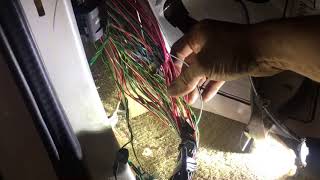
- Right Rear Wheel Speed Sensor Wiring — The harness runs from the wheel hub, along the suspension, through a connector behind the fender liner, and then through the firewall to the ABS module.. This harness is exposed and can be damaged. A technician in a repair video traced a fault by testing for voltage drops along this path, from the ABS module connector, to a bulk connector near the fender, to behind the kick panel, and finally to the sensor itself.
- G304 — Under the driver's seat.. A wiring diagram shows this as a primary ground point for the ABS system. A poor ground here could cause erratic behavior and fault codes for the entire system.
Real Owner Repair Stories
- YouTube channel 'Ivan's Garage' (Jeep (model not specified, but diagnostic process is relevant)) — Persistent ABS sensor circuit code.
❌ Tried (didn't work) Replaced wheel speed sensor, Replaced wheel hub, Replaced with an OEM wheel speed sensor
✅ What actually fixed it An open in the signal wire was found. The technician diagnosed it by 'poking holes' in the wiring at various points (ABS module, bulk connector at fender, behind kick panel) to find where the battery voltage signal from the module was being lost. The voltage was present at the module but dropped significantly by the time it reached the sensor connector, indicating a break in the wire somewhere along the harness route.
Helpful Videos
We Have This Part in Stock


The information in this article is provided for general reference and educational purposes only. Vehicle specifications, procedures, and part compatibility can vary by production date, trim level, and region. Always consult your vehicle's factory service manual and verify part numbers before purchasing or performing repairs. Safety-critical components such as airbags, seat belts, and braking systems should be installed by a qualified professional.
- Jeep COMPASS:
- 🎬 Helpful Videos
- 🛍️ Shop This Part
- What's Unique About the 2017-2018 Jeep COMPASS
- Diagnostic Flowchart
- Symptoms You May Notice
- Most Likely Causes
- Rare But Worth Checking
- Diagnosis Steps
- Parts You'll Likely Need
- Related Codes That Often Appear With This One
- Technical Service Bulletins (TSBs) & Recalls
- Platform-Specific Known Issues
- Mechanic-Grade Diagnostic Values
- Scan Tool Commands That Help
- Wiring & Ground Locations
- Real Owner Repair Stories
- 🎟️ Get 5% Off