

OBD-II Code C0508: Right Front Wheel Speed Sensor Circuit Low
What C0508 means, why it triggers, and how to fix it
- Code C0508 indicates a low voltage signal from the right front wheel speed sensor, immediately disabling your ABS and traction control.
- Over 80% of C0508 codes stem from a damaged wiring harness, a dead sensor, or rust buildup pushing the sensor away from the tone ring.
- Driving is permitted, but expect stopping distances to increase by 10-30% during hard braking due to disabled anti-lock brakes.
- Verify the fault using a scanner's live data stream at 5-10 mph before spending $150+ on a new sensor, as wiring shorts mimic sensor failure.
What Does C0508 Mean?

Trouble code C0508 means the Engine Control Unit (ECU) or ABS module detects a low or missing voltage signal from the right front wheel speed sensor. This fault instantly disables the ABS and traction control systems, as they require accurate speed data from all four wheels to function.
Technical definition: The SAE/ISO definition for C0508 is "Right Front Wheel Speed Sensor A Circuit Low". This indicates the voltage from the right front wheel speed sensor circuit is below the specified threshold (typically under 0.2V AC for passive sensors). This condition signals a short to ground, an open circuit, or a faulty sensor unable to generate a sufficient magnetic signal.
Can I Drive With C0508?
Yes, But With Caution. Yes, you can drive, but your Anti-lock Braking System (ABS) and Traction Control (TCS) are disabled. Your wheels will lock up during hard braking, increasing stopping distances by 10-30% and elevating the risk of skidding. Exercise extreme caution, increase your following distance, and avoid hard braking in wet or slippery conditions.
Common Causes

- Damaged Wiring Harness or Connector (Very Common) — Wires leading to the wheel speed sensor are exposed to moisture, road salt, and vibrations. Over time, wires fray, break, or short to the chassis. Additionally, the electrical connector fills with dirt or water, increasing resistance and dropping the voltage.
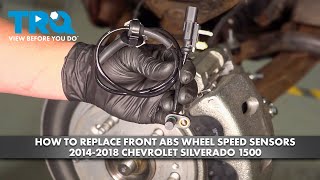
- Failed Right Front Wheel Speed Sensor 🎬 See this step-by-step guide on replacing the front sensor (Common) — The sensor fails internally due to damage to its internal coil or a loss of magnetism, preventing it from generating the correct voltage signal as the wheel spins.
- Excessive Air Gap / Sensor Misalignment (Common) — Rust and corrosion build up on the hub or knuckle where the sensor mounts. This buildup physically pushes the sensor further away from the tone ring, widening the air gap and weakening the magnetic field.
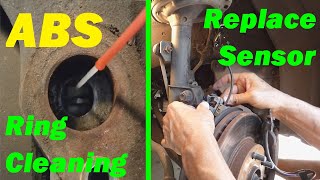
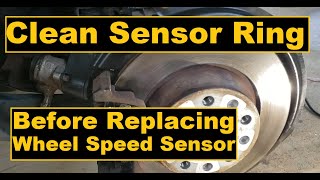
- Contaminated or Damaged Tone Ring 🎬 Watch: How to clean a dirty ABS sensor ring (Common) — The sensor reads a notched ring (tone ring) that spins with the wheel. If this ring cracks, loses teeth, or gets covered in rust and metallic debris, the sensor cannot capture an accurate reading.
- Incorrect Wheel Bearing Installation (Less Common) — Many modern vehicles integrate the magnetic encoder into the wheel bearing's seal. If a mechanic installs a new wheel bearing backward, the encoder faces away from the sensor, resulting in zero signal.
- Faulty ABS Control Module (Rare) — An internal fault in the ABS control module, such as a burned trace or software glitch, prevents the module from correctly reading the signal from a perfectly functional sensor.
- Incorrect Tire Pressure or Size (Rare) — Significantly low tire pressure or mismatched tire sizes cause one wheel to rotate at a different speed. Some ABS systems misinterpret this speed variance as a sensor circuit fault.
Symptoms

- ABS and Traction Control Disabled — During hard braking, the wheels lock up and skid. The brake pedal feels "soft" or standard because the ABS is not modulating the brake pressure.
- Intermittent ABS Activation at Low Speeds — The ABS activates unnecessarily at low speeds (under 10 mph), causing a grinding or pulsing sensation in the brake pedal. This is a classic sign of a dirty tone ring or excessive air gap.
- ABS Warning Light On (also visible on scanner) — The ABS light on your dashboard illuminates and stays on continuously.
- Traction Control/Stability Control Light On (also visible on scanner) — The Traction Control System (TCS) or Electronic Stability Control (ESC) light turns on, as these systems rely on wheel speed data.
- Speedometer Malfunction or Limp Mode (also visible on scanner) — If the right front wheel speed sensor is the primary input for vehicle speed, the speedometer behaves erratically or the vehicle enters 'limp mode'.
Diagnostic Flowchart
Tap your situation to follow the diagnostic path that matches what you're seeing on this code.
Common Fixes & Costs
- Replace Right Front Wheel Speed Sensor — Parts: $40-$150, Labor: $100-$200, ~1.2 hr book time (DIY)
- Repair or Replace Wiring Harness — Parts: $20-$100, Labor: $100-$250, ~1.8 hr book time (Intermediate)
- Clean Tone Ring and Sensor Mounting Surface — Parts: $5-$15, Labor: $50-$150, ~0.8 hr book time (DIY)
- Replace Wheel Hub Assembly — Parts: $150-$400, Labor: $150-$300, ~2.1 hr book time (Intermediate)
- Replace ABS Control Module — Parts: $200-$900, Labor: $150-$250, ~2.5 hr book time (Professional)
Used vs. New Parts: Buying Guide
When a used part is worth it: Used sensors are generally not recommended due to their electronic nature and exposure to harsh conditions. Buy used only for older, low-value cars if the part comes from a low-mileage donor.
Donor-vehicle mileage cap: roughly under 50000 miles for the part to have meaningful remaining life.
Donor quality checklist:
- Verify the part number matches exactly.
- Inspect the wiring and connector for brittleness, cracking, or corrosion.
- Avoid parts from rust-belt regions due to high corrosion risk.
Decision logic:
- If The part is a complete wheel hub assembly with an integrated sensor. → Buy new. The bearing is a wear item with unknown remaining life.
- If The vehicle is a modern European brand like Mercedes or BMW. → Buy new OEM. These vehicles are highly sensitive to precise signals.
- If The cost of a new aftermarket sensor is under $50. → Buy new. Small savings do not justify the risk of premature failure.
Warranty tradeoff: Used parts carry a 30-90 day warranty. Aftermarket new parts offer 1-year to lifetime warranties. OEM new parts carry a 12-month manufacturer warranty.
Worst-case if a used part fails: $150-$300 if a used part fails, requiring repeat labor for diagnosis and replacement.
What Happens If You Wait — Timeline
- Immediate: ABS and Traction/Stability Control warning lights illuminate. The systems are disabled. Standard hydraulic brakes remain functional. (MPG impact: 0%% · Added cost: $0)
- 0-2 months: Increased risk of skidding and longer stopping distances in panic stops. A failing sensor causes intermittent, incorrect ABS activation at low speeds. (MPG impact: 0%% · Added cost: Potential cost of an accident due to disabled safety features.)
- 2-6 months: No direct mechanical damage occurs. The vehicle fails state safety inspections in many jurisdictions. (MPG impact: 0%% · Added cost: Cost of a failed safety inspection and re-test.)
- 6+ months: The risk profile remains the same. A C0508 fault does not cause cascading mechanical failures in the engine or transmission. (MPG impact: 0%% · Added cost: The cumulative risk of an accident increases over time.)
Cost of Not Fixing It
- Immediate: ABS and Traction Control are disabled, increasing the risk of skidding and extending stopping distances in emergency situations. (Added cost: Potential cost of an accident.)
- 1-6 months: Continued driving with disabled safety systems increases liability in the event of a crash. The vehicle will fail state safety inspections. (Added cost: 0 (unless an accident occurs))
- 6+ months: The primary cost remains the elevated safety risk. A faulty wheel speed sensor does not cause cascading damage to the engine, transmission, or brakes. (Added cost: 0 (unless an accident occurs))
Diagnosis Steps

- Read the Codes and Live Data
Use an ABS-capable OBD-II scanner to confirm C0508. Access the 'Live Data' stream to view the speed from all four wheel sensors. Drive slowly (5-10 mph); the faulty right front sensor will read 0 mph or display an erratic value compared to the others.
Tools: ABS-capable OBD-II Scanner (Beginner) - Visual Inspection
Safely raise the front of the vehicle. Inspect the entire length of the right front wheel speed sensor wiring harness. Look for cuts, chafing, melting, or green corrosion on the connector pins.
Tools: Jack, Jack Stands, Flashlight (Beginner) - Inspect the Tone Ring and Sensor Mounting Surface
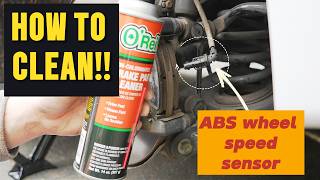
Remove the wheel and inspect the tone ring on the axle or wheel hub for rust buildup, debris, cracks, or missing teeth. Check the sensor's mounting surface on the knuckle for rust that increases the air gap.
Tools: Flashlight, Brake Cleaner, Wire Brush (Intermediate) - Test Sensor Resistance (Passive Sensors)
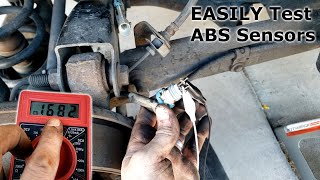
Unplug the sensor and use a multimeter set to Ohms (Ω) to measure resistance across its two pins. A typical passive sensor reads between 800 and 2,500 ohms. Infinite resistance (OL) means an open circuit; near zero ohms means a short circuit. Both require sensor replacement.
Tools: Multimeter, Vehicle Service Manual (Intermediate) - Test Sensor Voltage Output (Passive Sensors)
Reconnect the sensor. Set the multimeter to AC Volts (V~) and back-probe the connector. Spin the wheel by hand at one revolution per second. You must see at least 200mV (0.2V AC). A reading consistently below 0.2V confirms a bad sensor, excessive air gap, or tone ring issue.
Tools: Multimeter with back-probe pins (Intermediate) - Check for Reference Voltage (Active Sensors)
For 3-wire active (Hall effect) sensors, unplug the sensor and turn the ignition ON. Use a multimeter to verify a reference voltage (typically 5V or 12V) and a solid ground on the harness-side connector. If missing, the fault is in the wiring or ABS module.
Tools: Multimeter (Advanced) - Check for a Short to Ground
Disconnect the sensor harness from the ABS module. Use a multimeter set to continuity. Check for continuity between the signal wire at the wheel end and a chassis ground. Continuity (under 10 Ohms) confirms the wire is shorted to ground in the harness.
Tools: Multimeter (Advanced) - Analyze the Waveform with an Oscilloscope
Connect an oscilloscope to the sensor's signal and ground wires. A passive sensor produces a clean AC sine wave; an active sensor produces a digital square wave. A distorted or low-amplitude pattern pinpoints a sensor, tone ring, or air gap failure.
Tools: Oscilloscope (Advanced)
When This Code Triggers (Freeze-Frame Conditions)
- Vehicle Speed: 15-45 mph (Steady city or highway driving when the module expects a consistent signal.)
- Engine RPM: 1200-2500 RPM (Corresponds to steady cruising speed.)
- ABS/TCS Status: System Active/Monitoring (Fault logs during the initial system self-test or while driving.)
- Brake Pedal Status: Not Applied (The fault sets during normal driving, not necessarily during a braking event.)
Related Codes
- C0040 — The generic SAE code for 'Right Front Wheel Speed Sensor Circuit Malfunction'. C0508 is more specific, indicating the signal voltage is 'low'.
- C0041 — The opposite of C0508, meaning 'Right Front Wheel Speed Sensor Circuit High'. It points to a short to voltage rather than a short to ground.
- C0507 — The identical fault as C0508, but for the Left Front Wheel. Seeing both codes together points to a systemic issue like a faulty ABS module.
- C0035 — The generic code for a 'Left Front Wheel Speed Sensor Circuit Malfunction'. It often appears alongside C0508 if front axle wiring is damaged.
Climate & Environmental Factors
- Road Salt / High Humidity: Saltwater accelerates the degradation of wiring insulation, connector pins, and the sensor body. It causes rust buildup on the hub, increasing the sensor's air gap.
- Extreme Cold: Wiring becomes brittle and susceptible to cracking from vibration. Moisture freezes around the sensor, temporarily blocking the signal.
- High Vibration / Rough Roads: Constant vibration causes wiring to chafe against suspension components, wearing through insulation and causing a short to ground.
How to Talk to a Mechanic About This Code
Say this: "I have an ABS light on and my scanner shows a C0508 code for the right front wheel speed sensor circuit. I'd like to book a diagnostic appointment. Please check the sensor, wiring, and tone ring before recommending a part replacement."
This directs the shop to perform a proper diagnosis instead of blindly replacing the most likely part. It shows you understand the cause could be wiring or rust, preventing unnecessary parts replacement.
Avoid saying:
- 'My ABS light is on, can you fix it?' (Too vague; invites parts-cannon repairs.)
- 'Just replace the right front wheel speed sensor.' (Prevents the mechanic from diagnosing a simple wiring issue, leading you to pay for unneeded parts.)
- 'Do whatever you think is best.' (Gives the shop a blank check and leads to upselling.)
Questions to ask before authorizing the repair:
- What was the result of the live data test for the right front wheel speed sensor?
- Did you visually inspect the wiring harness and connector for damage or corrosion?
- Did you check the tone ring and the sensor's mounting surface for rust or debris?
- If the sensor needs replacement, what is the warranty on the part and labor?
- Can you show me the old part?
Where to Take It: Dealer vs Independent vs Chain
- Dealer:
A good option if you suspect a software or module issue, but the most expensive for a simple sensor or wiring fix.
Best for: Vehicles under warranty., Complex manufacturer-specific electrical issues or software glitches., Newer vehicles requiring specific ABS module programming.
Downsides: Highest labor rates and part costs., More inclined to replace an entire assembly (like a wheel hub) rather than a smaller component. (Typical cost: +50% vs. baseline) - Independent Shop:
Best fit for most C0508 repairs. An experienced independent mechanic diagnoses and fixes sensor, wiring, or hub issues effectively at a reasonable cost.
Best for: Out-of-warranty vehicles where cost is a factor., Common repairs like sensor replacement and wiring diagnostics.
Downsides: Quality and diagnostic capabilities vary. Look for ASE-certified technicians., May lack the latest manufacturer-specific diagnostic tools for very new vehicles. (Typical cost: +0% vs. baseline) - Chain Shop:
Acceptable for a straightforward sensor replacement, but avoid if the problem is intermittent or complex.
Best for: Simple, straightforward part replacements if the diagnosis is already certain.
Downsides: Technician skill and diagnostic equipment are inconsistent., High pressure to upsell services., Lacks expertise for in-depth electrical diagnostics if the problem isn't a simple sensor swap. (Typical cost: -10% vs. baseline)
When to Walk Away From the Repair
If the estimated repair cost exceeds 40-50% of the car's private-party value, pause and carefully consider your options.
- Car worth $4000, fix is $450: Fix it. This repair is well below the threshold and restores a critical safety feature.
- Car worth $12000, fix is $900: Fix it. The repair cost is a small fraction of the vehicle's value.
- Car worth $2500, fix is $1500: Walk away. The repair cost is over 50% of the car's value. Consider selling the car as a 'mechanic special'.
What Scan Tool You Need for This Code

Minimum: An OBD-II scanner that reads and clears Anti-lock Braking System (ABS) codes and displays live sensor data.
A basic code reader only shows engine-related codes (P-codes) and cannot communicate with the ABS module to see the C0508 code.
Budget: Autel AutoLink AL619 / ML619 (~$70) — Reads and clears ABS codes, shows live data for wheel speed sensors, and identifies the failing sensor.
Mid-range: BlueDriver Pro or Foxwell NT510 Elite (~$100-180) — Offers robust live data graphing to easily compare all four wheel speed sensors in real-time. The Foxwell NT510 also offers bi-directional controls.
Professional: Autel MaxiCOM MK808 / MaxiCheck Pro (~$450-600) — Offers full bidirectional control to test the ABS module directly. Performs automated bleeding procedures after module replacement.
Rent vs buy: Auto parts stores read engine codes for free, but rarely cover ABS codes. For a one-time repair, pay a mechanic a one-hour diagnostic fee. Buy a scanner only if you perform regular DIY maintenance.
How to Clear the Code After You Fix It
- Use an ABS-capable OBD-II scan tool to erase the C0508 trouble code.
- Turn the ignition off, then start the vehicle.
- Drive the vehicle in a straight line above 15 mph to allow the ABS module to self-test.
Drive cycle (~10 minutes): Start the vehicle and drive it in a straight line, exceeding 15 mph. This allows the ABS module to compare signals from all four wheels. The ABS light extinguishes within the first few minutes if the repair is successful.
Readiness monitors affected: This code does not affect emissions-related readiness monitors., It relates strictly to the ABS/Traction Control system self-test protocol.
Watch out for:
- Disconnecting the battery will not clear an ABS code on modern vehicles; a capable scan tool is mandatory.
- The code returns immediately if the root electrical problem remains unfixed.
- Forgetting to clear the code leaves warning lights on until the system completes multiple successful self-tests.
Will This Fail Emissions / State Inspection?
No — by itself this code doesn't fail OBD inspection (but it can keep readiness monitors from setting, which causes a separate fail).
- California: An illuminated ABS light fails the safety portion of the inspection, preventing vehicle registration.
- New York: An illuminated ABS warning light is grounds for failing the state safety inspection.
- Texas: An illuminated ABS light does NOT cause a failure of the state safety inspection, but a red 'BRAKE' warning light will.
Most Commonly Affected Vehicles
- GMC Yukon / Denali / Sierra (2015-2021) — Prone to wiring harness issues where wires rub through and short to the frame.
- Chevrolet Silverado / Suburban / Tahoe (2014-2019) — Shares the GMC platform, making it equally susceptible to wiring or sensor faults.
- Ford F-150 (2015-2020) — Frequently experiences C0508 due to faulty TCS/ABS control modules requiring replacement and software updates.
- Dodge Ram 1500 (2014-2019) — Commonly affected by sensor failures and wiring harness damage in the wheel well area.
- Hyundai Sonata / Elantra (2015-2020) — Commonly affected by wiring harness damage and internal sensor failures.
- BMW X3 (F25) (2011-2017) — Throws a C0508 equivalent code (48071B) due to short circuits in the sensor wiring.
- Nissan Altima / Maxima (2013-2018) — Susceptible to sensor failure in climates where road salt accelerates connector corrosion.
- Honda Accord / Civic (2013-2017) — Rust buildup under the sensor is frequently misdiagnosed as a sensor failure. Cleaning the mounting surface is the primary fix.
Manufacturer-Specific Notes
- General Motors (GMC, Chevrolet): A software glitch in the ABS module causes it to misinterpret a normal sensor signal as low. A module re-flash often fixes the code without parts replacement.
- Honda / Acura: Rust builds up on the steering knuckle directly underneath the sensor mount, lifting the sensor and increasing the air gap. Cleaning the rust resolves the issue.
- Ford: On F-150 models, this code frequently traces back to an internal failure of the ABS/TCS control module, even when sensor and wiring tests pass.
Real Owner Stories
2015 GMC Yukon Denali with intermittent ABS/Stabilitrak lights
The owner experienced random activation of ABS and Stabilitrak lights, accompanied by total vehicle power loss while driving.
Outcome: A fourth dealership diagnosed a faulty ground battery cable and an internal ECM problem. Replacing both resolved the warning lights and power loss.
Lesson: Multiple, seemingly unrelated warning lights point to a foundational electrical issue like a bad ground or failing control module, rather than individual sensor failures.
2018 Honda CR-V with multiple warning lights after wheel bearing replacement
Immediately after a mechanic replaced the front wheel bearings, the ABS, brake, and power steering lights illuminated.
Outcome: The new wheel bearing, containing an integrated magnetic reluctor ring, was installed backward. The non-magnetic side faced the sensor, resulting in no signal. The bearing was reinstalled correctly.
Lesson: If C0508 appears immediately after a wheel bearing replacement, the bearing was likely installed backward. Verify orientation before pressing in a new bearing.
Chevy Silverado with low-speed ABS activation
The ABS activated unnecessarily at speeds under 5 mph, causing a grinding sensation in the brake pedal. No ABS light was on.
Outcome: Excessive rust buildup on the hub mounting surface increased the air gap between the sensor and tone ring. Cleaning the rust off the mounting surface fixed the problem.
Lesson: Intermittent ABS activation at low speeds without a code is a classic symptom of an excessive air gap. Clean the mounting surface before replacing the sensor.
How to Prevent This Code From Triggering
- Apply Dielectric Grease to Connectors (During any brake job or wheel-related service) — Dielectric grease blocks moisture and oxygen from reaching the metal pins, preventing corrosion that causes high resistance and low voltage signals.
- Clean Wheel Wells and Suspension Components (Seasonally, especially after winter in salt-belt regions) — Washing the undercarriage removes corrosive road salt that degrades wiring insulation and causes rust buildup on sensor mounting surfaces.
- Inspect Wiring Harness During Tire Rotations (Every 5,000-7,500 miles) — Visual inspections catch early signs of wiring harness chafing, allowing for a simple repair before the wire breaks or shorts out.
- Use Protective Wire Loom or Tubing (When replacing a sensor or repairing a harness) — Adding split-loom tubing provides an extra layer of defense against abrasion, road debris, and moisture.
Frequently Asked Questions
Can I just clear the C0508 code?
You can clear the code with a scanner, but it returns immediately if the underlying electrical fault remains. The ABS system performs a self-test every time the vehicle starts. You must fix the root cause before the code stays cleared.
Will the C0508 code clear itself?
No, the ABS light stays on as long as the fault is present. Even if the problem is intermittent, the code stores in the module's history. The light turns off only after fixing the problem and passing multiple consecutive self-tests.
How much does it cost to fix code C0508?
Costs depend on the root cause. A professional sensor replacement ranges from $150 to $350, while a wiring repair costs $120 to $250. Replacing a wheel hub assembly or ABS module pushes the bill to $400-$1,000+.
What are common misdiagnosis mistakes for C0508?
A common mistake is replacing the wheel speed sensor without testing the circuit. Technicians often overlook a simple wiring short, a corroded connector, or rust buildup under the sensor. Always verify the sensor's signal with a scanner before buying parts.
Can a bad wheel bearing cause a C0508 code?
Yes, a failing wheel bearing alters the distance to the sensor and causes a weak signal. Many modern vehicles integrate the magnetic tone ring into the wheel bearing assembly. If a new bearing is installed backward, the magnetic ring won't face the sensor, triggering the code.
Can low tire pressure cause a C0508 code?
While not the primary cause, a significantly underinflated tire has a smaller rolling diameter and spins faster than the others. Some ABS systems misinterpret this speed difference as a sensor fault. Always verify correct tire pressures before starting complex electrical diagnostics.
Why did the ABS and traction control lights come on at the same time?
Both systems depend on accurate data from all four wheel speed sensors to function. When one sensor fails, the computer cannot reliably determine if a wheel is slipping or locking up. As a safety precaution, it disables both systems and illuminates their warning lights.
Key Takeaways
- Code C0508 indicates a low voltage signal from the right front wheel speed sensor, immediately disabling your ABS and traction control.
- Over 80% of C0508 codes stem from a damaged wiring harness, a dead sensor, or rust buildup pushing the sensor away from the tone ring.
- Driving is permitted, but expect stopping distances to increase by 10-30% during hard braking due to disabled anti-lock brakes.
- Verify the fault using a scanner's live data stream at 5-10 mph before spending $150+ on a new sensor, as wiring shorts mimic sensor failure.
Helpful Videos

The information in this article is provided for general reference and educational purposes only. Vehicle specifications, procedures, and part compatibility can vary by production date, trim level, and region. Always consult your vehicle's factory service manual and verify part numbers before purchasing or performing repairs. Safety-critical components such as airbags, seat belts, and braking systems should be installed by a qualified professional.
- 🎬 Helpful Videos
- What Does C0508 Mean?
- Can I Drive With C0508?
- Common Causes
- Symptoms
- Diagnostic Flowchart
- Common Fixes & Costs
- Used vs. New Parts: Buying Guide
- What Happens If You Wait — Timeline
- Cost of Not Fixing It
- Diagnosis Steps
- When This Code Triggers (Freeze-Frame Conditions)
- Related Codes
- Climate & Environmental Factors
- How to Talk to a Mechanic About This Code
- Where to Take It: Dealer vs Independent vs Chain
- When to Walk Away From the Repair
- What Scan Tool You Need for This Code
- How to Clear the Code After You Fix It
- Will This Fail Emissions / State Inspection?
- Most Commonly Affected Vehicles
- Manufacturer-Specific Notes
- Real Owner Stories
- 2015 GMC Yukon Denali with intermittent ABS/Stabilitrak lights
- 2018 Honda CR-V with multiple warning lights after wheel bearing replacement
- Chevy Silverado with low-speed ABS activation
- How to Prevent This Code From Triggering
- Frequently Asked Questions
- Can I just clear the C0508 code?
- Will the C0508 code clear itself?
- How much does it cost to fix code C0508?
- What are common misdiagnosis mistakes for C0508?
- Can a bad wheel bearing cause a C0508 code?
- Can low tire pressure cause a C0508 code?
- Why did the ABS and traction control lights come on at the same time?
- Key Takeaways
- 🎟️ Get 5% Off