

OBD-II Code C0268: ABS Pump Motor Circuit Shorted
The Ultimate 2026 Guide: What C0268 means, why it triggers, and how to fix it for good.
- Code C0268 disables your Anti-lock Brake System (ABS) due to a detected short circuit in the ABS pump motor.
- Clean the main ABS ground wire on the vehicle frame first, as this $0 fix resolves the code in nearly 30% of GM truck cases.
- Test the ABS pump motor resistance (target: 0.1 to 1.0 ohms) before replacing the EBCM to prevent a shorted pump from instantly destroying the new $300 module.
- Choose a mail-in EBCM repair service for $150-$250 instead of buying a new $1,000 dealer part to save money and avoid mandatory VIN reprogramming.
- Driving with C0268 increases emergency stopping distances by up to 25% on wet surfaces, making immediate repair critical for safety.
What Does C0268 Mean?

Code C0268 means your Electronic Brake Control Module (EBCM) detected a short circuit in the electric motor for the anti-lock brakes. The EBCM performs a self-test when the vehicle first exceeds 4-5 mph. When it detects this electrical fault, it shuts down the Anti-lock Braking System (ABS), traction control, and stability control as a safety precaution.
Technical definition: The official SAE/ISO definition is "Pump Motor Circuit Shorted." The EBCM controls the ABS pump motor by supplying the ground connection and monitors a feedback circuit on this ground side. When the pump is off, the EBCM expects high voltage on the feedback circuit. When commanded on and then off, it expects the voltage to drop as the motor winds down. Code C0268 sets when the EBCM detects an unexpected path to ground (a short) in the pump motor's windings, the wiring, or the internal driver circuit within the EBCM itself.
Can I Drive With C0268?
Yes, But With Caution. Yes, but with extreme caution and only for short distances to a repair shop. Your normal hydraulic brakes function, but without ABS, your wheels lock during a hard stop. This increases stopping distances by 25% or more on wet or loose surfaces and leads to a complete loss of steering control while braking. The financial risk is the significantly increased probability of an at-fault accident.
Common Causes

- Failed Electronic Brake Control Module (EBCM) (Very Common) — The EBCM is the computer controlling the ABS. Internal electronic components, particularly the power relay for the pump motor and its circuit board solder joints, crack or fail over time. This leads the module to incorrectly report a pump motor fault. 🎬 Watch: How to tear down and repair the EBCM unit.
- Corroded or Loose ABS Module Ground Wire (Very Common) — The ABS unit requires a solid ground connection to the vehicle's frame. This ground point rusts and corrodes from road salt, creating high resistance that the EBCM misinterprets as a circuit fault. This is a simple, highly frequent point of failure on GM trucks. 🎬 Watch: How to fix common ABS ground wire issues on GM vehicles.
- Shorted ABS Pump Motor / Brake Pressure Modulator Valve (BPMV) (Common) — The electric motor that pressurizes the brake fluid develops an internal short circuit in its windings or seizes mechanically due to internal hydraulic blockages. A seized motor draws excessive current, which the EBCM interprets as a short. A shorted pump motor instantly destroys a new EBCM upon installation.
- Corroded Wiring Harness or Connectors (Common) — The wiring harness running to the ABS module suffers damage from road debris, engine heat, or chafing. The main electrical connector to the EBCM or the 2-pin connector to the pump motor fills with moisture and corrodes, causing a short or creating high resistance under load.
- Blown ABS Pump Motor Fuse (Rare) — A shorted pump motor draws excessive current and blows the high-amperage fuse (typically 30A-60A) for the ABS pump circuit. This is a symptom of a failed pump or a direct short to ground in the power wire, not the root cause.
- Low Vehicle Battery Voltage (Rare) — A failing battery causes a severe voltage drop during the ABS self-test (especially during engine cranking) that triggers spurious pump circuit codes.
Symptoms
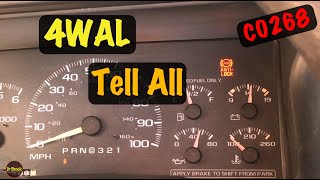
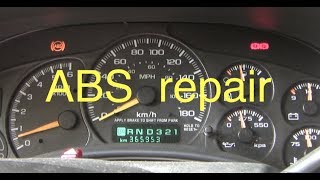
- ABS and Traction Control Lights Illuminated — The primary symptom. The ABS warning light and related traction/stability control lights illuminate on the dashboard because these systems rely on the ABS hardware to function.
- Brake Warning Light On — On many vehicles, particularly GM models, the red 'BRAKE' warning light illuminates alongside the ABS light, even if the base hydraulic brake system is fully functional.
- Wheels Lock Up During Hard Braking — Without ABS, wheels lock and skid during an emergency stop, significantly increasing stopping distance and causing a total loss of steering control.
- ABS Pump Runs Constantly — A critical symptom where a failed EBCM causes the ABS pump motor to run continuously, even with the key off. This creates a loud buzzing from under the hood and drains the battery overnight. Pull the ABS pump fuse immediately if this occurs.
- Pulling to One Side During Braking — A fault within the hydraulic portion of the ABS unit (the BPMV) causes uneven brake pressure application, leading the vehicle to pull sharply left or right during braking.
Diagnostic Flowchart
Tap your situation to follow the diagnostic path that matches what you're seeing on this code.
Common Fixes & Costs
- Clean and Secure the ABS Ground Connection — Parts: $0-$5, Labor: $50-$100, ~0.5 hr book time (DIY)
- Repair the Electronic Brake Control Module (EBCM) — Parts: $130-$250 (repair service), Labor: $100-$150, ~1 hr book time (Intermediate)
- Replace the ABS Pump and Motor Assembly (BPMV) — Parts: $450-$1,050, Labor: $190-$240, ~2 hr book time (Professional)
- Replace the Entire ABS Modulator Assembly (EBCM and Pump) — Parts: $600-$2,200, Labor: $200-$400, ~2.5 hr book time (Professional)
- ABS Light Diagnostic Check — Parts: $0, Labor: $95-$150, ~1 hr book time (Professional)
Used vs. New Parts: Buying Guide
When a used part is worth it: A used ABS assembly from a low-mileage donor is a cost-effective option for older vehicles where budget is the primary concern. However, repairing the original EBCM via a mail-in service is the superior and most common solution.
Donor-vehicle mileage cap: roughly under 100000 miles for the part to have meaningful remaining life.
Donor quality checklist:
- Verify the part number matches exactly.
- Source from a reputable recycler with a warranty and return policy.
- Avoid parts from 'Rust Belt' regions due to high corrosion risk.
- Factor in the cost of professional VIN reprogramming for the used module.
Decision logic:
- If The fault is the EBCM and a mail-in repair service is available → Repair the original module. This is the most reliable option and avoids VIN programming issues.
- If The entire ABS assembly (pump and module) requires replacement on a tight budget → Buy a tested, used assembly from a low-mileage donor, but budget for professional programming.
- If The vehicle is newer or a remanufactured part is reasonably priced → Buy remanufactured to secure a longer warranty and avoid used-part risks.
Warranty tradeoff: Used parts carry a 30-90 day warranty. Remanufactured parts offer 1-year to lifetime warranties. Mail-in repair services often include a lifetime warranty on the repair.
Worst-case if a used part fails: $300-$600 if a used part is dead on arrival, requiring repeat labor and another part.
What Happens If You Wait — Timeline
- Immediate: Code C0268 sets. ABS, Traction Control, and Stability Control warning lights illuminate. The ABS system is completely disabled. (MPG impact: 0%% · Added cost: $0)
- 0-1 month (if pump runs constantly): If the failure causes the ABS pump to run continuously, the battery drains overnight. Allowing the pump to run for hours burns out the pump motor. (MPG impact: 0%% · Added cost: $150-$650 (Cost of a new battery and/or replacement ABS pump motor).)
- Ongoing: The vehicle operates with standard brakes only. In a panic stop, wheels lock, leading to loss of steering control and significantly longer stopping distances. (MPG impact: 0%% · Added cost: $2500+ (Potential cost of an at-fault accident).)
- At next safety inspection: The vehicle fails state-mandated safety inspections due to the illuminated ABS warning light, preventing legal road use. (MPG impact: 0%% · Added cost: $100-$150 (Diagnostic fee to begin repairs).)
Cost of Not Fixing It
- Immediate: Loss of anti-lock braking function. In a panic stop, wheels lock, leading to skidding and a complete loss of steering control. Stopping distances increase significantly. (Added cost: $0 (mechanical), High (accident risk))
- Short-Term (0-3 months): Failure of state safety inspection. If the pump runs constantly due to the short, the battery drains overnight and the pump motor burns out. (Added cost: $150-$500 (for a new battery and/or pump motor damage))
- Long-Term (3+ months): Continuous and significant safety risk of driving without a key safety system. The financial risk is an at-fault accident. (Added cost: $2500+ (cost of an at-fault collision))
Diagnosis Steps

- Confirm Code with ABS-Capable Scanner
Use an OBD-II scanner that reads Chassis ('C') codes to confirm C0268 is active. Basic engine code readers cannot see this fault. Note if codes like C0265 or C0267 are present.
Tools: ABS-capable OBD-II Scanner (Beginner) - Inspect and Clean the Main Ground
Locate the ABS module assembly under the hood. Find the main ground wire bolted to the vehicle's frame nearby. Unbolt the wire, use sandpaper to clean the terminal, bolt, and frame contact point to shiny bare metal, and re-attach securely.
Tools: Wrench/socket set, sandpaper or wire brush (Beginner) - Inspect ABS Fuses
Check the owner's manual for two ABS fuses: a low-amperage fuse (5-10A) for the EBCM, and a high-amperage cartridge fuse (30-60A) for the pump motor. Visually inspect both for blown filaments.
Tools: Fuse puller or needle-nose pliers (Beginner) - Inspect Wiring and Connectors
Visually inspect the wiring harness leading to the EBCM for chafing or melting. Unplug the main EBCM connector (battery disconnected) and check for green/white corrosion. Inspect the smaller 2-pin connector going to the pump motor.
Tools: Flashlight, socket set (Intermediate) - [PRO TIP] Measure Pump Motor Resistance
Disconnect the 2-pin connector at the ABS pump motor. Set a multimeter to the lowest Ohms setting. Measure resistance between the two pump motor pins. A good motor reads between 0.1 and 1.0 ohms. 'OL' indicates an open circuit (C0267). 0.0 ohms indicates a dead short. This test is mandatory before replacing the EBCM.
Tools: Digital Multimeter (Advanced) - Activate Pump with a Bi-Directional Scan Tool
Command the ABS pump motor ON using a bi-directional scan tool. If it runs, the motor is good, and the problem is intermittent or within the EBCM's feedback circuit. If it fails to run, the fault is the EBCM, wiring, or pump.
Tools: Bi-directional scan tool (Advanced) - [PRO TIP] Perform a Voltage Drop Test
Connect a multimeter to the EBCM's main power and ground pins. Command the pump ON. Voltage on the power wire must not drop more than 0.5V below battery voltage. Ground wire voltage must not rise above 0.2V. Larger changes indicate high resistance requiring repair.
Tools: Bi-directional scan tool, Digital Multimeter, wiring diagram (Advanced) - Check EBCM Feedback Circuit
Identify the pump motor feedback circuit wire at the EBCM connector. With the pump OFF, this circuit reads near battery voltage. Command the pump ON then OFF; voltage must drop near 0V as the motor winds down. A constant low voltage confirms a short to ground in the wiring or EBCM.
Tools: Digital Multimeter, wiring diagram, bi-directional scan tool (Advanced)
When This Code Triggers (Freeze-Frame Conditions)
- Vehicle Speed: 4-6 mph (The code sets almost exclusively when the vehicle first exceeds a low speed. This is when the EBCM performs its startup self-test and detects the pump motor circuit fault.)
- Ignition Status: ON / RUN (The code sets during an active ignition cycle after the engine starts and the vehicle begins to move.)
- System Voltage: 12.6 - 14.8V (Normal operating voltage. The fault is an underlying circuit failure, not a voltage spike or drop.)
- ABS/TCS/Stab Ctrl Lights: ON (The freeze frame shows the ABS and related warning lights commanded ON as a direct result of the fault.)
Related Codes
- C0267 — Indicates 'Pump Motor Circuit Open'. An 'open' means a break in the circuit, while a 'short' (C0268) means electricity escapes to ground. They share identical diagnostic steps. A multimeter test showing infinite resistance ('OL') points directly to C0267.
- C0265 — Indicates 'EBCM Relay Circuit Malfunction'. Getting C0265 alongside C0268 is a definitive sign that the EBCM itself has failed internally and requires repair or replacement.
- C0110 — A generic code for 'Pump Motor Circuit Malfunction'. It points to the same problems but lacks the specificity of C0267 or C0268.
- C0281 — Indicates 'Brake Switch Circuit' fault. A faulty brake light switch sends conflicting signals to the EBCM during its self-test, contributing to ABS faults. Fix C0281 first if present.
Climate & Environmental Factors
- Road Salt and Humidity: The largest environmental contributor. Salt spray dramatically accelerates corrosion, attacking the main ABS ground point on the frame and seeping into electrical connectors to cause shorts.
- Freeze-Thaw Cycles: Melting and refreezing allows water to penetrate wiring harnesses. Freezing water expands, damaging wires or interrupting electrical signals long enough to set a fault code.
- Extreme Cold: Cold temperatures make aging electronic components and solder joints brittle, leading to intermittent failures during cold starts.
How to Talk to a Mechanic About This Code
Say this: "I need to book a diagnostic appointment for an ABS light showing code C0268. Based on my research, the most common issues are the EBCM, the main ground connection, or the pump motor itself. Please start by inspecting the ground and testing the pump motor's resistance before quoting a full module replacement."
This signals you are an informed customer. It directs the shop to perform the cheapest diagnostic steps first, preventing a premature recommendation to replace the entire ABS assembly.
Avoid saying:
- My ABS light is on, can you just fix it?
- I think I need a new ABS module.
- Just do whatever you think is necessary.
Questions to ask before authorizing the repair:
- What was the resistance reading of the pump motor? Was it within the typical 0.1 to 1.0 ohm range?
- Did you inspect the main ground connection on the frame? Was it corroded, and did you clean it?
- Did you perform a voltage drop test on the power and ground circuits while activating the pump?
- If you recommend a new EBCM, is repairing my original module an option to save money and avoid VIN programming?
- What is the warranty on the recommended parts and labor?
Where to Take It: Dealer vs Independent vs Chain
- Dealer:
Use only if the vehicle is under warranty. They will not suggest a cost-effective module repair service.
Best for: Vehicles still under warranty, Very new models with complex, integrated systems, Complex diagnostics requiring manufacturer-specific tools
Downsides: Highest labor rates, typically 50-100% higher than independent shops., Highly likely to recommend replacing the entire expensive ABS assembly rather than repairing the module., Zero flexibility on using non-OEM parts or mail-in repair services. (Typical cost: +50% vs. baseline) - Independent Shop:
Best fit for most situations. A reputable independent shop handles C0268 correctly and is open to cost-effective solutions like cleaning grounds or using a module repair service.
Best for: Out-of-warranty vehicles, especially common models like GM trucks., Cost-conscious owners seeking good value., Owners who want to explore mail-in EBCM rebuild services.
Downsides: Quality varies widely; vetting the shop's electrical diagnostic reputation is crucial., May lack the latest manufacturer-specific diagnostic tools for obscure models. (Typical cost: +0% vs. baseline) - Chain Shop:
AVOID for diagnosing C0268. They are generally not equipped for the systematic electrical testing required, increasing the risk of an expensive and incorrect repair.
Best for: Routine maintenance like oil changes and basic brake pad replacement.
Downsides: Technician skill is highly variable., Lack the in-depth diagnostic tools and training for complex electrical codes like C0268., High potential for misdiagnosis, leading to unnecessary replacement of the entire ABS unit. (Typical cost: -10% vs. baseline)
When to Walk Away From the Repair
Walk away if the estimated repair cost exceeds 40% of the vehicle's Kelley Blue Book (KBB) private-party value.
- Car worth $5000, fix is $2200: Walk away. The repair cost is nearly half the vehicle's value. The faulty ABS system makes it difficult to sell privately without a significant discount.
- Car worth $15000, fix is $1800: Fix it. The repair cost is well below the threshold and restores a critical safety system, preserving the vehicle's value.
- Car worth $3000, fix is $250: Fix it. If the issue is a simple ground cleaning or a mail-in EBCM repair, the cost is low enough to be a worthwhile investment even on an older vehicle.
What Scan Tool You Need for This Code

Minimum: A scanner that reads and clears Anti-lock Brake System (ABS) codes. Basic engine-only code readers will NOT work.
A standard $20 engine code reader cannot communicate with the ABS module. It shows 'No Codes Found' even when the ABS light is on. You need a tool that explicitly supports reading 'C' (Chassis) codes.
Budget: BlueDriver Pro (~$100) — Reads and clears ABS codes, shows freeze-frame data, and provides live data from the ABS module. Confirms C0268 and rules out simple sensor issues before going to a shop.
Mid-range: Foxwell NT510 Elite / NT630 Plus (~$150) — Includes bi-directional control. Allows you to command the ABS pump motor ON and OFF directly from the tool. Essential for testing the motor, wiring, and EBCM command circuit during DIY diagnosis.
Professional: Autel MaxiCOM MK808 / XTOOL D7 (~$400-600) — Provides full bi-directional control, including automated ABS bleed procedures required after replacing the hydraulic unit. Offers advanced live data graphing and OEM-level diagnostic functions.
Rent vs buy: AutoZone and O'Reilly Auto Parts offer loaner tool programs. Rent an ABS-capable scanner for free by leaving a refundable deposit. Buy a scanner only if you perform diagnostics regularly.
How to Clear the Code After You Fix It
- Perform the required repair (e.g., replace EBCM, clean ground).
- Reconnect the battery if disconnected.
- Use an ABS-capable OBD-II scan tool to clear the C0268 code from the EBCM's memory.
- Perform the drive cycle to confirm the fix.
Drive cycle (~5 minutes): After clearing the code, start the vehicle and drive forward until the speed exceeds 10 mph. If the repair is successful, the ABS light remains off. No complex drive cycle is required.
Readiness monitors affected: This is a chassis code ('C') and does not affect emissions readiness monitors like the Catalyst or O2 sensor monitors.
Watch out for:
- Using a basic engine code reader that cannot access the ABS module to clear the code.
- Failing to fix the root cause. The code returns immediately at 5 mph if the short circuit still exists.
- Disconnecting the battery, which fails to clear the code from the ABS module's non-volatile memory.
Will This Fail Emissions / State Inspection?
No — by itself this code doesn't fail OBD inspection (but it can keep readiness monitors from setting, which causes a separate fail).
- General: An illuminated ABS warning light is a safety issue. In nearly all states with a safety inspection program, this results in an automatic failure.
- California: Not part of the Smog Check, but California's Vehicle Safety Systems Inspection for salvaged vehicles fails a car with an illuminated ABS light.
- New York: Current NYS DMV regulations state an illuminated ABS warning light is an advisory item, not a cause for rejection. Proposed legislation aims to change this to a failure item.
- Texas: An illuminated ABS lamp does NOT cause a failure of the Texas state safety inspection. The inspector checks the base brake system, but the ABS light itself is not a rejection criterion.
Most Commonly Affected Vehicles
- Chevrolet / GMC Silverado, Sierra, Tahoe, Yukon, Suburban (1999-2007) — Extremely common on GMT800 trucks. The fault is almost always the EBCM (Kelsey-Hayes 325 units) or the frame ground wire located below the driver's door.
- Ford F-150, Explorer (2000-2008) — Known for ABS control module failures. On the F-150, water intrusion into harness connectors in the driver-side kick panel causes this code.
- Dodge Ram 1500/2500/3500 (2002-2008) — Prone to ABS module failures triggering pump circuit faults. The module is located on the driver's side frame rail and is highly susceptible to corrosion.
- Volkswagen Jetta, Golf, Passat (2008-2015) — ABS module failure is very common. This failure also causes the speedometer to stop working and disables power steering assist.
- BMW E39, E46, E60, X3, X5 (1998-2010) — Experience frequent failures of the Bosch DSC/ABS module. Manifests as pump circuit faults, often accompanied by codes for the DSC pre-charge pump.
Manufacturer-Specific Notes
- General Motors (GM): The ABS light remains off at startup but illuminates as soon as speed exceeds 4-5 mph. The EBCM performs its mandatory startup self-test, fails immediately, and disables the system.
- General Motors (GM): A shorted ABS pump motor draws excessive current that permanently destroys the driver circuit inside a replacement EBCM. You must test the pump motor's resistance before installing a new EBCM.
- Volkswagen / Audi: The ABS module processes wheel speed data for other systems. When the module fails with a pump circuit fault, it disables the speedometer and electric power steering assist.
- General: If the ABS pump runs constantly with the key off, pull the main ABS fuse immediately to prevent the pump motor from burning out and draining the battery.
Real Owner Stories
2002 GMC Sierra 2500HD at 198k miles
ABS and red 'BRAKE' light stayed on with Code C0268 present.
What they tried:
- Replaced both front wheel hub assemblies (no effect).
- Re-soldered joints on the original EBCM (fixed for two weeks).
- Replaced EBCM with a remanufactured Dorman unit (turned off 'BRAKE' light, but ABS light and C0268 persisted).
Outcome: Final diagnosis pointed to a failed ABS pump motor/BPMV. The new EBCM did not resolve the pump circuit code because the pump itself was shorted.
Lesson: Never assume the EBCM is the only fix. Always test the pump motor's resistance before replacing the EBCM to avoid wasting money on modules destroyed by a shorted pump.
2002 Chevy Silverado 2500HD
ABS and 'BRAKE' warning lights illuminated simultaneously with no braking performance issues.
What they tried:
- Cleaned the main ABS ground connections before buying parts.
Outcome: The owner cleaned two heavily corroded ground points on the frame under the driver's side to bare metal. The lights went off permanently. The fix cost $0.
Lesson: Always check and clean the main ground wire for the ABS module first. It is a free, highly common fix that saves hundreds in unnecessary parts.
1998 Chevrolet K2500 Truck
ABS light on with code C0268. Truck pulled sharply to one side during hard braking.
What they tried:
- Tested ABS pump motor resistance (passed at 0.5 ohms).
- Performed voltage and ground circuit tests on the EBCM connector (passed).
Outcome: Because all external components tested correctly, the fault was isolated to the EBCM. Replacing the EBCM cleared C0268. The pulling symptom was a separate internal failure of the BPMV hydraulic unit.
Lesson: A systematic diagnostic approach prevents misdiagnosis. Even if the pump motor is perfect, the EBCM's internal driver circuit fails and falsely reports a pump problem.
How to Prevent This Code From Triggering
- Periodically Clean and Protect the Main ABS Ground Connection (Every 2-3 years (Annually in the Rust Belt)) — Corrosion at the frame ground point causes C0268. Cleaning contact surfaces to bare metal and applying dielectric grease prevents high resistance.
- Flush Brake Fluid per Manufacturer's Schedule (Every 2-3 years) — Brake fluid absorbs moisture, causing internal corrosion within the ABS hydraulic unit (BPMV). This seizes valves or pump components, mimicking a motor short.
- Inspect and Clean ABS Module Connectors (Whenever working in the area) — Moisture and dirt enter the main EBCM electrical connector, causing shorts between pins. Cleaning with electrical contact cleaner prevents these issues.
Frequently Asked Questions
Is it safe to drive with code C0268?
You can drive the vehicle, but it is unsafe in an emergency. Your standard brakes work, but the anti-lock function is disabled. In a panic stop, your wheels lock up, increasing stopping distance and causing a loss of steering control.
Will C0268 cause my car to fail an inspection?
Yes, in virtually all regions with vehicle safety inspections, an illuminated ABS warning light is an automatic failure.
Why did my ABS light turn off but then come right back on?
The ABS system performs a self-test every time you start driving. As soon as it detects the short circuit again (usually above 5 mph), the light comes back on. This is the expected behavior for this code.
What's the difference between the EBCM, BPMV, and ABS Module?
The 'ABS Module' is the complete unit. It consists of the EBCM (the electronic computer) and the BPMV (the hydraulic block containing the pump motor). Code C0268 triggers from a failure in either part.
What are the biggest mistakes when diagnosing C0268?
The most costly mistake is replacing the EBCM without testing the ABS pump motor for a short, which instantly destroys the new EBCM. The second mistake is failing to perform a voltage drop test under load to find corroded wires.
I replaced the EBCM and the C0268 code came back. What's next?
The fault is almost certainly the ABS pump motor or the wiring harness between the two. Perform a resistance test and a voltage drop test on the pump motor circuit to isolate the failure.
Should I repair my EBCM or buy a new one?
Having your original EBCM repaired by a specialist is the best option. It is significantly cheaper than a new assembly and avoids expensive VIN programming upon reinstallation.
Key Takeaways
- Code C0268 disables your Anti-lock Brake System (ABS) due to a detected short circuit in the ABS pump motor.
- Clean the main ABS ground wire on the vehicle frame first, as this $0 fix resolves the code in nearly 30% of GM truck cases.
- Test the ABS pump motor resistance (target: 0.1 to 1.0 ohms) before replacing the EBCM to prevent a shorted pump from instantly destroying the new $300 module.
- Choose a mail-in EBCM repair service for $150-$250 instead of buying a new $1,000 dealer part to save money and avoid mandatory VIN reprogramming.
- Driving with C0268 increases emergency stopping distances by up to 25% on wet surfaces, making immediate repair critical for safety.
Helpful Videos

The information in this article is provided for general reference and educational purposes only. Vehicle specifications, procedures, and part compatibility can vary by production date, trim level, and region. Always consult your vehicle's factory service manual and verify part numbers before purchasing or performing repairs. Safety-critical components such as airbags, seat belts, and braking systems should be installed by a qualified professional.
- 🎬 Helpful Videos
- What Does C0268 Mean?
- Can I Drive With C0268?
- Common Causes
- Symptoms
- Diagnostic Flowchart
- Common Fixes & Costs
- Used vs. New Parts: Buying Guide
- What Happens If You Wait — Timeline
- Cost of Not Fixing It
- Diagnosis Steps
- When This Code Triggers (Freeze-Frame Conditions)
- Related Codes
- Climate & Environmental Factors
- How to Talk to a Mechanic About This Code
- Where to Take It: Dealer vs Independent vs Chain
- When to Walk Away From the Repair
- What Scan Tool You Need for This Code
- How to Clear the Code After You Fix It
- Will This Fail Emissions / State Inspection?
- Most Commonly Affected Vehicles
- Manufacturer-Specific Notes
- Real Owner Stories
- 2002 GMC Sierra 2500HD at 198k miles
- 2002 Chevy Silverado 2500HD
- 1998 Chevrolet K2500 Truck
- How to Prevent This Code From Triggering
- Frequently Asked Questions
- Is it safe to drive with code C0268?
- Will C0268 cause my car to fail an inspection?
- Why did my ABS light turn off but then come right back on?
- What's the difference between the EBCM, BPMV, and ABS Module?
- What are the biggest mistakes when diagnosing C0268?
- I replaced the EBCM and the C0268 code came back. What's next?
- Should I repair my EBCM or buy a new one?
- Key Takeaways
- 🎟️ Get 5% Off