

Ultimate Guide to OBD-II Code C0267: ABS Pump Motor Circuit Open
The Definitive Resource for Diagnosing and Fixing C0267
- C0267 indicates an open circuit in the ABS pump motor, immediately disabling ABS, traction control, and stability control systems.
- Before replacing a $1,500 ABS module on GM trucks, inspect the frame-mounted EBCM connector and G110 ground for green corrosion.
- If the ABS pump runs continuously with the key off, pull the 60A ABS fuse immediately to prevent battery drain and pump burnout.
- Always test the ABS pump motor resistance; a healthy motor reads between 0.3 and 1.0 Ohms, while an 'OL' reading confirms internal failure.
- A blown 40A-60A ABS fuse is the easiest fix, but if a replacement blows immediately, the pump motor is shorted internally.
What Does C0267 Mean?

C0267 signifies the Electronic Brake Control Module (EBCM) detected an open electrical circuit for the ABS pump motor. The pump rapidly modulates brake pressure to prevent wheel lock during heavy braking. The code triggers when the EBCM commands the pump motor ON during a startup self-test but fails to detect the expected electrical response, indicating a broken power or ground path.
Technical definition: The SAE/ISO definition for C0267 is "Pump Motor Circuit Open". The EBCM sets this diagnostic trouble code (DTC) when it commands the ABS pump motor ON but does not observe the corresponding electrical feedback signal. The EBCM monitors a feedback circuit from the low side of the pump motor; a C0267 logs when the feedback voltage remains high after the pump is commanded on, confirming an open circuit prevents activation.
🎬 Watch: Step-by-step guide to fixing a C0267 pump motor circuitCan I Drive With C0267?
Yes, But With Caution. Yes, but your primary hydraulic brakes will lack Anti-lock Braking System (ABS), Traction Control (TC), and Electronic Stability Control (ESC) support. Stopping distances on wet or loose surfaces increase by 25% or more, and wheels will lock up during panic stops. Deactivated ESC significantly increases the risk of a spin-out or rollover in trucks and SUVs during emergency maneuvers.
Common Causes

- Blown ABS Pump Motor Fuse (Common) — The ABS pump motor requires a high-amperage fuse (typically 40A to 60A). A blown fuse causes an immediate open circuit and is the easiest component to check.
- Corroded or Damaged EBCM Connector (Very Common) — Moisture wicks into the main EBCM connector, causing severe corrosion on the large-gauge power and ground pins. This is the leading cause on GM trucks and SUVs, detailed in TSB PIT5499B.
- Corroded or Loose Chassis Ground (Common) — The EBCM requires a robust ground connection to the vehicle's frame. Corrosion at ground points (like G110 on GM vehicles) creates high resistance, preventing the pump from running.
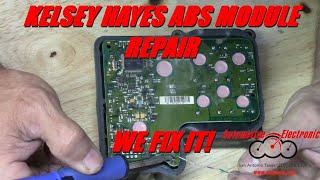
- Internally Failed EBCM (Common) — The internal driver circuit (MOSFET) or a solder joint on the EBCM circuit board breaks, falsely reporting an open circuit or causing the pump to run continuously. This is a hallmark failure on Ford and BMW models. 🎬 See how to repair a faulty ABS module circuit board
- Failed ABS Pump Motor (Common) — The internal windings of the electric motor within the ABS pump assembly burn out or break. Diagnose this by measuring the motor's resistance; an 'OL' reading confirms internal failure.
- Faulty ABS Pump Motor Relay (Less Common) — The EBCM uses a relay to switch high current to the pump motor. Internal relay failure prevents power delivery, which the EBCM interprets as an open circuit.
- Damaged Wiring Harness (Less Common) — Wires providing power or ground to the ABS module break due to road debris, improper repairs, or chafing against the frame.
Symptoms

- Dashboard Warning Lights Illuminated — The ABS, Traction Control, and Stability Control (e.g., StabiliTrak) indicators on the instrument cluster illuminate and remain on.
- Wheels Lock Up During Hard Braking — During a panic stop or on slippery surfaces, the wheels lock and the vehicle skids. The characteristic ABS pulsing sensation in the brake pedal is absent.
- ABS Pump Runs Continuously — The ABS pump runs constantly, even with the key off. This drains the battery and requires immediately pulling the ABS fuse to prevent pump burnout.
- Lack of Initial Self-Test Sound — Most vehicles perform a brief ABS self-test at startup, creating a noticeable buzz for one second. The absence of this sound indicates a pump circuit failure.
- Service Trailer Brake System Message — Trucks with integrated trailer brake controllers display this warning message when an ABS fault disables the system.
Diagnostic Flowchart

Tap your situation to follow the diagnostic path that matches what you're seeing on this code.
Common Fixes & Costs
- Replace ABS Fuse or Relay — Parts: $5-$25, Labor: $0-$50, ~0.1 hr book time (DIY)
- Clean or Replace Chassis Ground Connection — Parts: $1-$10, Labor: $50-$150, ~0.8 hr book time (DIY)
- Repair EBCM Connector and Wiring Pigtail — Parts: $30-$80, Labor: $150-$350, ~2.5 hr book time (Intermediate)
- Repair or Remanufacture EBCM — Parts: $150-$400, Labor: $150-$300, ~1.5 hr book time (Professional)
- Replace ABS Pump and Module Assembly — Parts: $900-$2500, Labor: $300-$800, ~2.5 hr book time (Professional)
Used vs. New Parts: Buying Guide
When a used part is worth it: A used ABS pump/module assembly makes sense for older, high-mileage vehicles where the cost of a new part is prohibitive. It is viable if sourced from a reputable seller with a warranty.
Donor-vehicle mileage cap: roughly under 100000 miles for the part to have meaningful remaining life.
Donor quality checklist:
- Match the part number exactly. Do not rely on visual similarity.
- Purchase from a seller that provides the donor vehicle's VIN to verify compatibility.
- Prefer sellers who test the part and offer at least a 90-day warranty.
- Avoid parts from vehicles in heavily corroded (rust-belt) regions.
Decision logic:
- If The problem is diagnosed as an internal EBCM failure (e.g., pump runs constantly) → Favor repairing your original module. This is cheaper than new, avoids programming issues, and often comes with a lifetime warranty.
- If The vehicle is less than 10 years old and you plan to keep it long-term → Buy a new OEM or high-quality remanufactured part. The higher initial cost is justified by reliability and a longer warranty.
- If A used part is the only option (part is discontinued) → Verify the programming requirements. Most used modules require VIN programming by a capable independent shop or dealer to function correctly.
Warranty tradeoff: Used parts typically have a 30-90 day warranty. Remanufactured modules often offer a 1-year to lifetime warranty. New OEM parts carry a 1-2 year warranty.
Worst-case if a used part fails: $300-$600. If a used module is dead on arrival, you pay for the diagnostic and installation labor again, plus the cost of another part.
What Happens If You Wait — Timeline
- Immediate: Code C0267 is set. ABS, Traction Control, and Stability Control warning lights illuminate. All related safety systems are disabled. (MPG impact: 0%% · Added cost: $0)
- 0-2 weeks (if pump runs constantly): If the failure is a shorted EBCM, the ABS pump runs continuously. This drains the battery overnight. Repeated jump-starts will not solve the underlying problem. (MPG impact: 0%% · Added cost: $200 (for a new battery if drained completely) + $50 (for service calls/towing))
- 2 weeks - 2 months (if pump runs constantly): The ABS pump motor overheats and burns out. The humming noise stops, but the open circuit remains. A $300 module repair now requires a full pump/module assembly replacement. (MPG impact: 0%% · Added cost: $1,200 - $3,000 (for a new ABS assembly and labor))
- 3+ months (if cause is corrosion): Continued exposure to moisture allows corrosion to creep from the connector pins into the EBCM itself. This damages the circuit board beyond repair, forcing a full module replacement. (MPG impact: 0%% · Added cost: $1,000 - $2,500 (Difference between a wiring repair and a full module replacement))
Cost of Not Fixing It
- Immediate: Loss of ABS, Traction Control, and Stability Control. This results in an immediate and significant increase in the risk of skidding and loss of control in emergency maneuvers. (Added cost: Cost of an insurance deductible or total loss of the vehicle in an accident.)
- Short Term (0-3 months): If the cause is a continuously running pump motor, the battery drains completely, and the ABS pump motor burns out from constant use, requiring a more expensive replacement. (Added cost: $200 (for a new battery) + $900-$2500 (for a new ABS assembly).)
- Long Term (3+ months): Continued exposure of a corroded connector to moisture allows damage to spread to the EBCM itself, turning a simple wiring repair into an expensive module replacement. (Added cost: $1200-$3000 (for ABS assembly replacement).)
Diagnosis Steps
- Scan and Document All DTCs
Use an ABS-capable OBD-II scanner to document all codes. Clear the codes and drive above 5 mph to see if C0267 immediately returns, confirming a hard fault.
Tools: OBD-II Scan Tool (ABS capable) (Beginner) - Inspect ABS Fuse and Relay
Locate the 40A-60A ABS pump fuse in the under-hood fuse box. Visually inspect it and use a multimeter to confirm continuity. Swap the ABS relay with an identical non-critical relay to test its function.
Tools: Fuse puller, Multimeter (Beginner) - Visually Inspect EBCM Connector and Chassis Ground
Disconnect the battery and unplug the main EBCM connector. Look for green or white corrosion and backed-out pins. Trace the main ground wire to the chassis and inspect for tightness and rust.
Tools: Flashlight, Socket set (Intermediate) - Perform a Voltage Drop Test on Power and Ground
Reconnect the EBCM. With the key on and commanding the pump via scan tool, back-probe the ground and power pins. A reading above 0.2V on the ground or 0.5V on the power side indicates excessive resistance.
Tools: Multimeter with back-probe pins, Bi-directional scan tool (Advanced) - Test Pump Motor Resistance
Identify the two large-gauge pins in the EBCM connector leading to the pump motor. A healthy motor reads between 0.3 and 1.0 Ohms. An 'OL' reading confirms an internally open motor.
Tools: Multimeter, Vehicle-specific wiring diagram (Intermediate) - Command Pump Activation and Monitor Feedback
Use a bi-directional scan tool to command the ABS pump ON. If the pump does not run despite confirmed power, ground, and motor resistance, the EBCM has failed internally.
Tools: Bi-directional OBD-II scan tool, Multimeter (Advanced)
When This Code Triggers (Freeze-Frame Conditions)
- Vehicle Speed: > 4 mph (6 km/h) (The EBCM runs the pump motor self-test once the vehicle is in motion.)
- Ignition Status: ON (The system must be powered on for the diagnostic to run.)
- Battery Voltage: 12.0 - 14.8V (Normal operating voltage. The code triggers during low voltage at startup in cold weather with a weak battery.)
- Engine State: Running (The self-test typically occurs shortly after starting the engine and beginning to drive.)
Related Codes
- C0268 — Means 'Pump Motor Circuit Shorted.' If C0267 is an open wire, C0268 is a wire touching ground. A resistance test shows infinite (OL) for C0267 and near-zero for C0268.
- C0265 — Means 'EBCM Relay Circuit.' If the relay's control circuit fails, the pump gets no power, logging a C0267. Always diagnose C0265 first if both are present.
- U0121 — Means 'Lost Communication With ABS Module.' The entire module is offline due to catastrophic power/ground failure or internal EBCM failure.
- C0040, C0045 — Wheel speed sensor codes. If present with C0267, it strongly suggests the EBCM itself is failing or has a bad main power/ground connection.
Climate & Environmental Factors
- Road Salt and Humidity: Salt spray and high humidity accelerate corrosion on frame-mounted EBCM connectors and chassis grounds, directly causing the open circuit condition.
- Cold Weather: Corroded connections contract in the cold, turning high-resistance connections into full open circuits. Weak batteries also cause voltage drops during startup self-tests, confusing the EBCM.
How to Talk to a Mechanic About This Code
Say this: "I have an ABS light on and code C0267. Before quoting a new ABS module, please inspect the EBCM connector for corrosion and perform a voltage drop test on the main power and ground wires."
This language signals that you are an informed consumer. It directs the mechanic to perform specific, conclusive tests rather than just reading the code and replacing the most expensive part.
Avoid saying:
- 'My ABS light is on, can you fix it?'
- 'Just replace the ABS pump.'
- 'Do whatever you think is necessary.'
Questions to ask before authorizing the repair:
- Did you find corrosion on the connector or the chassis ground?
- What were the results of the voltage drop test on the power and ground circuits for the EBCM?
- What was the resistance reading of the pump motor itself?
- If you are recommending a full ABS module replacement, can you confirm that you've ruled out a wiring issue, a bad ground, or a faulty relay first?
- Does the recommended repair come with a warranty on both parts and labor?
Where to Take It: Dealer vs Independent vs Chain
- Dealer:
Recommended only if the vehicle is under warranty or if a new module needs to be programmed. Otherwise, an independent shop is more cost-effective.
Best for: Vehicles under warranty, Complex, brand-specific electronic issues, Repairs requiring proprietary software for programming new modules
Downsides: Highest labor rates, More likely to replace an entire assembly rather than repair a simpler underlying cause like wiring. (Typical cost: +50% vs. baseline) - Independent Shop:
Best fit. A good independent shop with strong electrical diagnostic skills is perfectly suited to trace this fault and save you from an expensive, unnecessary module replacement.
Best for: Out-of-warranty vehicles, Diagnosing common electrical faults like C0267, Vehicles with well-documented issues (like GM trucks with this code)
Downsides: Quality and diagnostic skill vary; look for ASE certification and good reviews., May not have the latest manufacturer-specific programming tools. (Typical cost: +0% vs. baseline) - Chain Shop:
AVOID. This code requires specific electrical diagnostic procedures, not just code reading. A chain shop is highly likely to misdiagnose the issue.
Best for: Simple, routine maintenance like oil changes and tire rotations.
Downsides: Technicians lack the advanced electrical diagnostic skills needed for C0267., Often incentivized to sell parts rather than perform detailed diagnostics. (Typical cost: -10% vs. baseline)
When to Walk Away From the Repair
If the estimated repair cost for the ABS system exceeds 50% of the vehicle's current private-party market value, consider alternatives.
- Car worth $5000, fix is $2500: Walk away. A $2,500 quote for a full ABS module replacement on a $5,000 truck is not a sound investment.
- Car worth $15000, fix is $450: Fix it. A $450 repair for a corroded connector or ground wire is well below the threshold and restores a critical safety system.
- Car worth $3000, fix is $1800: Walk away. The repair cost is 60% of the car's value. It is not economical to proceed with this repair.
What Scan Tool You Need for This Code
Minimum: A scanner that reads and clears 'C' (Chassis/ABS) codes. A basic engine-only code reader will not see code C0267.
A simple code reader that only pulls engine codes is useless for this problem. You need a tool that communicates with the ABS module.
Budget: BlueDriver Pro, Autel AL619 (~$60-120) — Reads and clears ABS codes, provides freeze-frame data, and allows you to see live data from wheel speed sensors.
Mid-range: Foxwell NT630 Plus, XTOOL A30 Pro, Launch CRP129X (~$130-350) — Offers bi-directional control for the ABS system. This allows you to command the ABS pump motor ON and OFF directly, which is a critical diagnostic step.
Professional: Autel MaxiCOM MK808/MK906BT, Launch X431 Series (~$400-1200) — Provides full, dealer-level bi-directional control. You can actuate individual solenoids, view manufacturer-specific data, and perform programming after a module replacement.
Rent vs buy: Most auto parts stores offer free loaner tools, but they are often basic models that CANNOT read ABS codes. For C0267, purchase at least a budget-level ABS-capable scanner. Given the importance of a bi-directional tool for this code, a mid-range model is a wise investment.
How to Clear the Code After You Fix It
- Reconnect the battery if it was disconnected for the repair.
- Use an ABS-capable OBD-II scan tool to clear the Diagnostic Trouble Codes (DTCs) from the EBCM.
- Perform the ABS initialization or automated bleed procedure with the scan tool if the hydraulic unit was replaced.
- Conduct a test drive that includes accelerating above the self-test speed threshold (typically 4-10 mph) to allow the EBCM to verify the repair.
Drive cycle (~10 minutes): After clearing the code, start the vehicle and drive it, ensuring you exceed 10 mph. The ABS light remains off if the repair was successful. The EBCM performs a self-test at each start-up once a minimum speed is reached.
Readiness monitors affected: This is a Chassis ('C') code and does not directly affect powertrain emissions readiness monitors.
Watch out for:
- Clearing the code with a scanner will not fix the problem; the light returns immediately upon the next self-test if the physical fault isn't repaired.
- Simply disconnecting the battery will not clear the code from the EBCM's memory.
- Failing to perform the 'automated bleed' procedure with a scan tool after replacing the hydraulic unit leaves air in the system, resulting in a spongy pedal.
Will This Fail Emissions / State Inspection?
No — by itself this code doesn't fail OBD inspection (but it can keep readiness monitors from setting, which causes a separate fail).
- California: An illuminated ABS light is cause for a safety inspection failure. While it won't fail the OBD-II emissions portion, the technician fails the visual/functional part of the inspection.
- New York: An illuminated ABS warning light causes the vehicle to fail the annual safety inspection. The light must be off to pass.
- Texas: An illuminated ABS light is a reason for rejection during the annual safety inspection. The system must be functional with no warning lights.
Most Commonly Affected Vehicles
- Chevrolet Silverado (2004-2016) — Extremely common issue caused by corrosion in the EBCM connector on the driver-side frame rail (TSB PIT5499B). The G110 ground point is also a frequent culprit.
- GMC Sierra (2004-2016) — Suffers from the exact same EBCM connector corrosion and ground issues as the Silverado.
- Ford F-150 (2009-2014) — Known for internal EBCM failure where the pump motor driver shorts, causing the pump to run continuously with the key off. Requires pulling the ABS fuse immediately.
- Chevrolet / GMC Tahoe, Suburban, Yukon, Escalade (2002-2013) — These SUVs share the problematic EBCM design and placement as the trucks, making them highly susceptible to connector corrosion.
- Honda CR-V, Pilot, Odyssey (2002-2009) — Known for internal failures of the ABS/VSA modulator, setting pump circuit faults inside the electronic portion of the module.
- BMW 3-Series (E90), X5 (E70) (2006-2013) — ABS/DSC modules frequently fail internally. Diagnosis requires BMW-specific tools (ISTA), and repair involves rebuilding the original module.
- Toyota / Lexus Prius, Highlander, RX series (2004-2012) — C0267 is triggered by a failing pump motor or internal leaks in the accumulator assembly causing the pump to run excessively and fail.
- Dodge / Ram Ram 1500/2500 (2006-2012) — Susceptible to failures of the integrated power module (fuse box) or wiring damage near the ABS module in the engine bay.
Manufacturer-Specific Notes
- General Motors (Chevrolet/GMC/Cadillac): The overwhelming cause is corrosion in the frame-mounted EBCM connector. Per TSB PIT5499B, inspect this connector and the G110/G400 grounds before replacing any parts.
- Ford: A burned-out MOSFET driver inside the EBCM causes the ABS pump to run continuously with the key off. Pull the ABS fuse to save the battery and pump motor.
- Pontiac / Hummer / Older GM: On specific older models, C0267 maps to 'Low Brake Fluid Indicated.' Always check the brake fluid level and sensor circuit first on these vehicles.
- Toyota / Lexus: On hybrid models, C0267 is often a secondary code resulting from a failing brake accumulator that causes the pump to run excessively and overheat.
Real Owner Stories
2008 Chevy Silverado 1500 at 145K miles
ABS and Stabilitrak warning lights came on. Code C0267 was present. Lived in a 'rust belt' state.
What they tried:
- Initially suspected a bad ABS module/pump assembly.
- Inspected the main EBCM connector on the driver-side frame rail.
- Found significant green and white corrosion on the power and ground pins.
Outcome: Cleaned the connector pins thoroughly with a small brush and electrical contact cleaner. Applied dielectric grease to prevent future moisture intrusion. Cleared the codes, and the lights did not return. The cost was under $10, avoiding a $1,500+ repair.
Lesson: On GM trucks, always inspect the frame-mounted EBCM connector and the G110 ground for corrosion before condemning the expensive ABS module.
2011 Ford F-150 at 110K miles
Came out one morning to a dead battery. After jump-starting, heard a loud humming noise from the engine bay that wouldn't stop even with the key removed. ABS light was on.
What they tried:
- Identified the noise as the ABS pump motor running continuously.
- Pulled the 60A ABS fuse in the under-hood fuse box to stop the pump.
- Scanned for codes and found C0267.
Outcome: Diagnosed as a classic internal failure of the EBCM. The owner removed the electronic module part of the assembly, sent it to a mail-in repair service for around $300. After reinstalling it, the problem was solved. No programming was needed.
Lesson: If your ABS pump runs constantly, immediately pull the fuse to prevent battery drain and pump destruction. This points to a repairable internal EBCM fault.
2007 GMC Yukon at 160K miles
ABS light was on with code C0267. A mechanic replaced the entire ABS pump and module assembly for $2,200, but the code returned within a day.
What they tried:
- Took it to a second shop specializing in electrical diagnostics.
- The mechanic performed a voltage drop test on the main ground wire for the EBCM (the G110 ground point).
Outcome: The voltage drop test showed high resistance. The mechanic removed the ground bolt, found heavy rust, cleaned both surfaces to bare metal, and re-secured the connection. The C0267 code cleared and never returned. The initial $2,200 repair was unnecessary.
Lesson: Misdiagnosis is the most expensive part of a C0267 repair. Replacing parts without verifying the integrity of the power and ground circuits first is a costly mistake.
2008 Buick Lucerne at 120K miles
ABS and Brake warning lights illuminated. Scan tool showed code C0267.
What they tried:
- Owner prepared to diagnose the ABS pump motor circuit.
- Consulted the specific service manual for their vehicle.
Outcome: The service manual revealed that C0267 is defined as 'Low Brake Fluid Indicated' for this specific platform. The owner checked the brake fluid reservoir and found it below the 'MIN' line. After topping off the fluid, the lights stayed off.
Lesson: Always verify the specific code definition for your exact vehicle year and model. On some older GM cars, C0267 points to the brake fluid level sensor.
How to Prevent This Code From Triggering
- Flush Brake Fluid (Every 2 years or 30,000 miles) — Brake fluid absorbs moisture from the air. This moisture leads to internal corrosion of sensitive ABS components, causing them to seize or fail.
- Clean and Protect EBCM Connector (Once, or every few years in rust-belt regions) — For vehicles with frame-mounted modules, disconnecting the connector, cleaning the pins, and applying dielectric grease seals it from moisture and road salt.
- Inspect and Treat Chassis Grounds (During any under-vehicle service) — Key ground points are prone to rust. Periodically remove the bolt, clean the contact surfaces to bare metal, and apply a conductive protectant to prevent high resistance.
- Wash Vehicle Undercarriage (Regularly, especially during winter in snowy climates) — Road salt and de-icing chemicals are extremely corrosive to the EBCM, its connector, and wiring. Washing the undercarriage removes these corrosive agents.
Frequently Asked Questions
My ABS pump runs constantly, even with the key off. Is this C0267?
Yes, this is a classic symptom of a failed Electronic Brake Control Module (EBCM), often seen on Ford vehicles. A shorted internal transistor provides constant power to the pump. Immediately pull the 40A-60A ABS fuse to prevent battery drain and pump burnout.
Can I just replace the electronic module instead of the whole pump?
Yes, in most cases. The EBCM unbolts from the hydraulic control unit, allowing you to send the module for repair or buy a remanufactured one. This avoids opening the hydraulic brake lines, though an ABS bleed procedure is sometimes required after reinstallation.
What is the most common misdiagnosis for C0267?
The most common mistake is replacing the entire ABS pump assembly without inspecting fuses, relays, EBCM connectors, and chassis grounds. Spending 15 minutes cleaning a corroded ground point saves you from a $2,000 repair bill.
Is it safe to drive with code C0267?
While the vehicle stops using its base hydraulic brakes, driving without ABS, traction control, or stability control is unsafe long-term. This significantly increases your risk of skidding and losing control during emergency braking or on slippery roads. Have the system repaired promptly.
How much does it really cost to fix C0267 in 2024?
A DIY fuse replacement costs under $20, while cleaning a ground point is nearly free. A mail-in EBCM repair service costs $150-$400 plus labor. A complete ABS assembly replacement at a dealership easily exceeds $2,500.
Can a bad battery cause C0267?
A failing battery rarely causes C0267 directly. However, severe voltage drops during cranking with a weak battery confuse the EBCM during its self-test, potentially setting the code erroneously.
Will clearing the C0267 code make it go away?
No, clearing the code with a scanner only turns the light off temporarily. C0267 indicates a hard physical fault in the circuit. The EBCM detects the open circuit again during its next self-test, and the warning lights return immediately.
Key Takeaways
- C0267 indicates an open circuit in the ABS pump motor, immediately disabling ABS, traction control, and stability control systems.
- Before replacing a $1,500 ABS module on GM trucks, inspect the frame-mounted EBCM connector and G110 ground for green corrosion.
- If the ABS pump runs continuously with the key off, pull the 60A ABS fuse immediately to prevent battery drain and pump burnout.
- Always test the ABS pump motor resistance; a healthy motor reads between 0.3 and 1.0 Ohms, while an 'OL' reading confirms internal failure.
- A blown 40A-60A ABS fuse is the easiest fix, but if a replacement blows immediately, the pump motor is shorted internally.
Helpful Videos

The information in this article is provided for general reference and educational purposes only. Vehicle specifications, procedures, and part compatibility can vary by production date, trim level, and region. Always consult your vehicle's factory service manual and verify part numbers before purchasing or performing repairs. Safety-critical components such as airbags, seat belts, and braking systems should be installed by a qualified professional.
- 🎬 Helpful Videos
- What Does C0267 Mean?
- Can I Drive With C0267?
- Common Causes
- Symptoms
- Diagnostic Flowchart
- Common Fixes & Costs
- Used vs. New Parts: Buying Guide
- What Happens If You Wait — Timeline
- Cost of Not Fixing It
- Diagnosis Steps
- When This Code Triggers (Freeze-Frame Conditions)
- Related Codes
- Climate & Environmental Factors
- How to Talk to a Mechanic About This Code
- Where to Take It: Dealer vs Independent vs Chain
- When to Walk Away From the Repair
- What Scan Tool You Need for This Code
- How to Clear the Code After You Fix It
- Will This Fail Emissions / State Inspection?
- Most Commonly Affected Vehicles
- Manufacturer-Specific Notes
- Real Owner Stories
- 2008 Chevy Silverado 1500 at 145K miles
- 2011 Ford F-150 at 110K miles
- 2007 GMC Yukon at 160K miles
- 2008 Buick Lucerne at 120K miles
- How to Prevent This Code From Triggering
- Frequently Asked Questions
- My ABS pump runs constantly, even with the key off. Is this C0267?
- Can I just replace the electronic module instead of the whole pump?
- What is the most common misdiagnosis for C0267?
- Is it safe to drive with code C0267?
- How much does it really cost to fix C0267 in 2024?
- Can a bad battery cause C0267?
- Will clearing the C0267 code make it go away?
- Key Takeaways
- 🎟️ Get 5% Off