

C0251 on 2010-2014 Subaru Outback: Electronic Parking Brake Failure Causes and Fixes
On a 2010-2014 Outback, code C0251 almost always means the Electronic Parking Brake (EPB) actuator has failed. This is a known issue covered by a safety recall for manual transmission models and a 15-year warranty extension for automatic models. The primary fix is a replacement actuator, which is a costly part, but may be covered by Subaru. A loose electrical connector is a less common but possible cause.
- C0251 on a 2010-2014 Outback is a very specific code pointing to the Electronic Parking Brake (EPB) actuator.
- Before paying for any repairs, check with a Subaru dealer if your vehicle is covered by the safety recall (manual transmission) or the 15-year warranty extension (automatic transmission), as this is a very common and well-documented failure.
- The same issue and coverage apply to the 2010-2014 Subaru Legacy.
- If not covered by warranty, check the actuator's electrical connector for looseness before replacing the expensive actuator assembly, as a simple zip tie can sometimes resolve the issue.
What's Unique About the 2010-2014 Subaru OUTBACK

The fourth-generation Outback (2010-2014) and its platform-mate, the Subaru Legacy, were among the first to feature an Electronic Parking Brake (EPB) instead of a traditional hand lever. This new system proved to have reliability issues, specifically with the actuator assembly. Due to improper manufacturing, a capacitor on the internal circuit board or the actuator stroke sensor's magnetic ring could crack over time. This defect prompted Subaru to issue safety recall WTV-81 for manual transmission models and a generous 15-year/unlimited-mileage warranty extension (TSB 06-71-19R) for automatic transmission models to cover the faulty EPB actuator assembly. This history means that for many owners, this potentially expensive repair may be covered by Subaru.
Diagnostic Flowchart
Tap your situation to follow the diagnostic path that matches what you're seeing on this vehicle.
Symptoms You May Notice
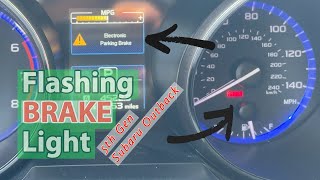
- Flashing 'BRAKE' light on the dashboard.
- Electronic Parking Brake system warning message in the instrument cluster.
- Inability to set or release the parking brake.
- Parking brake engages unexpectedly at low speeds. [ODI #11408183]
- Audible clicking, whirring, or grinding from the rear of the vehicle for an extended period (e.g., 30 seconds) when trying to operate the EPB.
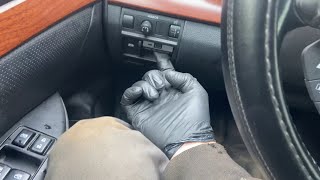
- Replacing the EPB switch on the center console. The switch is rarely the cause of code C0251; the fault is almost always at the actuator assembly in the rear of the vehicle. Resistance of the switch can be tested to rule it out.
Most Likely Causes

- Failed Electronic Parking Brake (EPB) Actuator Assembly 🔴 High Probability The original actuators were prone to internal failures due to improper manufacturing. Specifically, a capacitor on the circuit board and/or the actuator stroke sensor magnetic ring were susceptible to cracking over time, leading Subaru to issue a recall and a warranty extension.
How to confirm: After confirming power/ground to the unit and that the connector is secure, if the code C0251 persists and the actuator fails to respond to scan tool commands or makes prolonged noises without engaging/disengaging, the actuator itself is condemned. 🎬 Watch: A mechanic's guide to troubleshooting the parking brake system.
Typical fix: Replace the EPB actuator assembly with the updated part and perform the 'Force Sensor Calibration Mode' with a compatible scan tool. This is often covered under recall or warranty extension.
Est. part cost: $750-$1150 - Loose or Damaged EPB Actuator Connector 🟡 Medium Probability The locking tab on the electrical connector for the EPB actuator can become brittle and break, especially during other rear brake service. This leads to a poor connection that can trigger faults. This is a known issue across multiple Subaru generations, with a TSB (06-87-22R) issued for later models.
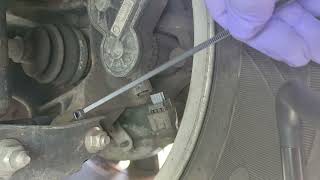
How to confirm: Visually inspect the actuator's electrical connector, located under the rear of the vehicle. Wiggle the connector to see if it is loose. If the connection is not secure, this is likely the cause.
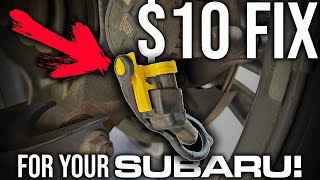
Typical fix: Secure the connector. If the locking tab is broken, a common and effective DIY fix is to use a heavy-duty zip tie to hold the connector firmly in place. 🎬 See this quick DIY fix for a loose actuator connector. For a more official repair, Subaru offers a retaining clip kit (Part # X9904AL110) for some models. If the connector or wiring is damaged, it will need to be repaired or replaced.
Est. part cost: $0-$25
Rare But Worth Checking
- Faulty EPB Control Module: While possible, the control module is far less likely to fail than the actuator itself. The actuator should always be ruled out first.
- Damaged Wiring Harness: Corrosion or physical damage to the wiring between the control module and the actuator can cause this code, but it's less common than actuator failure or a loose connector at the actuator itself.
Diagnosis Steps
- Check for Recalls and Warranty Extensions: Before any diagnosis, contact a Subaru dealer or use the Vehicle Coverage Inquiry on subarunet.com with your VIN to see if your vehicle is covered by recall WTV-81 (manual transmission) or the 15-year warranty extension (TSB 06-71-19R for automatic transmission). This step can save you significant time and money.
- Scan for Codes: Use an advanced OBD-II scanner capable of reading the Chassis/ABS module to confirm C0251 is the primary code stored in the EPB control module.
- Inspect the Actuator Connector: Safely raise the vehicle and locate the EPB actuator, mounted centrally under the rear. Check if the electrical connector is loose or damaged. Attempt to re-secure it, using a zip tie if the locking tab is broken.
- Clear Codes and Test: If the connector was loose, secure it, clear the codes, and test the EPB operation. If the problem is resolved, no further action is needed.
- Test Power and Ground: If the code returns, use a multimeter to verify that the actuator is receiving proper power and ground at the connector pins.
- Replace Actuator Assembly: If the wiring and connector are good, the EPB actuator assembly has likely failed and must be replaced.
- Perform Calibration: After installing the new actuator, use a Subaru-compatible scan tool to perform the mandatory 'Force Sensor Calibration Mode' to finalize the repair. If calibration fails, the parking brake shoes may require manual adjustment before repeating the procedure.
Parts You'll Likely Need

- Electronic Parking Brake Actuator Assembly
(OEM #26002AJ01E (supersedes 26002AJ01D, etc. for 2010-2012) or 26002AJ02D (supersedes 26002AJ02C, etc. for 2013-2014))— This is the component that fails, causing code C0251. Subaru released multiple updated versions to correct the original design flaws.
Trusted brands: Subaru (Genuine)
OEM price range: $750-$1120
Aftermarket price range: $300-$600 - Self-Locking Nut
(OEM #023508000)— The TSB specifies that four of these one-time-use nuts, which hold the fuel tank protector, must be replaced when servicing the EPB actuator.
Trusted brands: Subaru (Genuine)
OEM price range: $2-$5 each
Aftermarket price range: $1-$3 each
Related Codes That Often Appear With This One
- C0271: This code will appear after an actuator is replaced and indicates that the mandatory 'Force Sensor Calibration' has not been completed.
Technical Service Bulletins (TSBs) & Recalls
- Bulletin #06-58-17R: Announces a new replacement EPB actuator assembly to address DTC C0251 due to calibration function issues and provides the updated part numbers.
- Bulletin #WTV-81R: Details the safety recall for manual transmission models (Outback and Legacy) due to a defect in the EPB actuator.
- Bulletin #06-71-19R: Details the 15-year/unlimited-mile warranty extension for the EPB assembly on automatic transmission models (Outback and Legacy).
Platform-Specific Known Issues
- Recall WTV-81: Affects 2010-2014 Outback and Legacy models with a manual transmission for a defective EPB actuator that may not engage, creating a rollaway risk.
- Warranty Extension (TSB 06-71-19R): Affects 2010-2014 Outback and Legacy models with an automatic (CVT or 5AT) transmission, extending the warranty on the EPB assembly to 15 years with unlimited mileage due to the same potential defect.
Mechanic-Grade Diagnostic Values
- EPB Control Module Power Supply Voltage — expected: 10 - 15 V. Failure: Voltage below 10V indicates a power supply circuit issue.
- EPB Control Module Ground Circuit Resistance — expected: Less than 10 Ω. Failure: Resistance above 10 Ω indicates a faulty ground circuit.
- EPB Switch Continuity (Pulled) — expected: Continuity to ground should be present.. Failure: No continuity when the switch is pulled indicates a faulty switch.
- EPB Switch Continuity (Released) — expected: No continuity to ground.. Failure: Continuity is present when the switch is released, indicating a shorted switch.
Scan Tool Commands That Help

- Subaru Select Monitor (or compatible): Force Sensor Calibration Mode — This is mandatory after replacing the EPB actuator assembly to calibrate the new unit's force sensor. Failure to perform this will set code C0271.
- Subaru Select Monitor (or compatible): Parking Brake Removal Mode — This function electronically retracts the parking brake cables to the service position, creating slack needed for disassembly of the rear brake components (shoes, actuator).
- Subaru Select Monitor (or compatible): Break-in Parking Brake Drive Mode — Used after replacing the parking brake shoes to properly bed them in. After running this mode, the shoe clearance must be re-adjusted, and then the Force Sensor Calibration must be performed.
- Subaru Select Monitor (or compatible): Clear Memory Mode — Used to clear stored DTCs from the EPB control module after a repair is completed.
Wiring & Ground Locations

- R355 — The main electrical connector at the Electronic Parking Brake Control Module, located under the vehicle near the actuator.. This is the primary connector to test for power (Pins 17 & 18) and ground (Pin 6) for the entire EPB system. A fault here can mimic a failed actuator.
- EPB Actuator Connector — The electrical connector that plugs directly into the EPB actuator assembly under the rear of the vehicle.. This connector's locking tab is prone to breaking, leading to a loose connection and intermittent C0251 codes. It's the most common point of failure after the actuator itself.
- Emergency Release Port — Under the vehicle, near the right rear wheel, covered by a plastic cap.. If the actuator fails and the brake is stuck ON, this port allows for manual release using a special tool found in the trunk. It requires turning the tool clockwise approximately 200-250 rotations.
Real Owner Repair Stories
- YouTube user 'PZPal' (2013 Subaru Outback) — Flashing brake light, unable to release the parking brake after engaging it. Scan tool showed C0251.
❌ Tried (didn't work) Replacing the EPB switch on the center console., Checking fuses., Checking power and ground at the EPB control module (they were good)., Checking continuity of wiring between the switch and the control module (it was good)., Attempting to run 'Force Sensor Calibration' with a scan tool, which repeatedly aborted.
✅ What actually fixed it After replacing the EPB actuator, the 'Force Sensor Calibration' still failed. The final fix was to manually adjust the parking brake shoes to be slightly tighter, then re-running the 'Force Sensor Calibration' with the scan tool, which then completed successfully.
OEM Part Supersession History
26002AJ01A, 26002AJ01B, 26002AJ01C, 26002AJ01D→26002AJ01E— Updated design to address internal component failures causing C0251.
Heads up: These earlier parts have been fully replaced by 26002AJ01E.26002AJ02A, 26002AJ02B, 26002AJ02C→26002AJ02D— Updated design to address internal component failures causing C0251.
Heads up: These earlier parts have been fully replaced by 26002AJ02D.
Model Year Variations Within This Range
- 2010-2012 vs 2013-2014: The EPB actuator assembly uses a different part number. 2010-2012 models use the 26002AJ01x series, while 2013-2014 models use the 26002AJ02x series. The parts are not interchangeable.
Helpful Videos
We Have This Part in Stock



The information in this article is provided for general reference and educational purposes only. Vehicle specifications, procedures, and part compatibility can vary by production date, trim level, and region. Always consult your vehicle's factory service manual and verify part numbers before purchasing or performing repairs. Safety-critical components such as airbags, seat belts, and braking systems should be installed by a qualified professional.
- Subaru OUTBACK:
- 🎬 Helpful Videos
- 🛍️ Shop This Part
- What's Unique About the 2010-2014 Subaru OUTBACK
- Diagnostic Flowchart
- Symptoms You May Notice
- Most Likely Causes
- Rare But Worth Checking
- Diagnosis Steps
- Parts You'll Likely Need
- Related Codes That Often Appear With This One
- Technical Service Bulletins (TSBs) & Recalls
- Platform-Specific Known Issues
- Mechanic-Grade Diagnostic Values
- Scan Tool Commands That Help
- Wiring & Ground Locations
- Real Owner Repair Stories
- OEM Part Supersession History
- Model Year Variations Within This Range
- 🎟️ Get 5% Off