

OBD-II Code C0210: Right Rear Wheel Speed Sensor Circuit Malfunction
The Ultimate 2026 Guide to Diagnosing and Fixing C0210
- Code C0210 disables your ABS and traction control due to a signal failure specifically at the right rear wheel speed sensor.
- Inspect the right rear wheel bearing for play before buying parts; a failing bearing leaks grease and metal shavings that blind the sensor.
- Test the wiring harness for proper voltage and ground before replacing the sensor, as corroded connectors cause over 30% of these faults.
- On Toyota trucks like the Tundra and Tacoma, C0210 is a notorious indicator of a leaking rear axle seal that requires immediate mechanical repair.
What Does C0210 Mean?

C0210 means the Engine Control Unit (ECU) or ABS module detects an electrical circuit fault in the right rear wheel speed sensor. This sensor reports the rotational speed of that specific wheel to the vehicle's safety systems. When the signal is lost or erratic, the computer disables ABS and Traction Control, illuminates warning lights, and logs C0210.
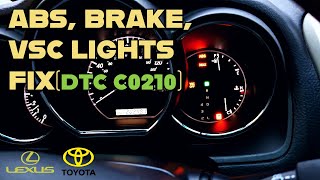
Technical definition: The official SAE/ISO definition for C0210 is "Right Rear Wheel Speed Sensor Circuit Malfunction." 🎬 Watch: DIY fix for C0210 on Toyota and Lexus vehicles The skid control ECU detects failure conditions such as: missing signal pulses for several seconds above 6 mph, intermittent signal dropouts, an open or short circuit, or excessive signal noise.
Can I Drive With C0210?
Yes, But With Caution. You can drive, but exercise extreme caution. Your Anti-lock Braking System (ABS) and Traction/Stability Control Systems are disabled, meaning your wheels lock up during hard braking and increase stopping distance. Do not drive with this fault long-term; it masks progressing mechanical failures like a bad wheel bearing that leads to wheel separation.
Common Causes

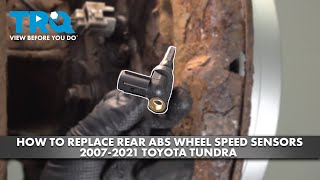
- Dirty or Contaminated Wheel Speed Sensor (Very Common) — The magnetic tip of the sensor collects metallic debris, grease, or road grime. This thick paste blocks the sensor from accurately reading the tone ring, causing a signal failure. On trucks like the Toyota Tundra, a leaking axle seal is the primary root cause of this contamination. 🎬 Watch this step-by-step Toyota Tundra rear ABS sensor replacement
- Failing Wheel Bearing or Hub Assembly (Very Common) — A worn-out wheel bearing creates excessive movement (play), physically damaging the sensor or tone ring. More frequently, the bearing's seal fails and leaks grease, contaminating the sensor tip. Bearing failure does not always produce an audible humming noise, especially with large tires.
- Failed Right Rear Wheel Speed Sensor (Very Common) — The sensor fails internally due to age, heat cycles, vibration, or internal corrosion from moisture intrusion. The internal electronics or coil windings break down, preventing it from generating a valid signal.
- Damaged Wiring or Corroded Connector (Common) — The wire leading to the sensor is physically damaged (cut, chafed, or stretched), or the connector pins are corroded from moisture and road salt. This creates an open, short, or high-resistance condition in the circuit.
- Damaged, Cracked, or Swollen ABS Tone Ring (Less Common) — The tone ring (or reluctor ring) is cracked, missing teeth, or swollen with rust. This provides an erratic or nonexistent signal to the sensor.
- Improper Installation or Aftermarket Parts Issues (Less Common) — Following a recent repair, the sensor was installed incorrectly (leaving an air gap), or a low-quality aftermarket wheel bearing was used. Some aftermarket hubs feature incompatible tone rings that fail prematurely.
- Low Vehicle Battery Voltage (Rare) — A weak 12V battery causes a multitude of electronic issues. The ABS control module is highly sensitive to low voltage and sets fault codes when it lacks expected power.
- Failed ABS/VSC Control Module (Rare) — The main computer processing the wheel speed sensor signals has failed. Consider this only after exhaustively testing the sensor, wiring, and hub assembly.
Symptoms

- ABS Warning Light On — The primary symptom. The Anti-lock Braking System dashboard light illuminates and stays on.
- Traction/Stability Control (TCS/VSC) Light On — Because traction and stability control systems rely on the same wheel speed sensors, their warning lights also illuminate.
- ABS and Traction Control are Inoperative — During a hard stop, the wheels lock up and skid. In slippery conditions, the wheels spin freely as traction control fails to activate.
- Brake Warning Light On — The general red brake system warning light illuminates alongside the ABS and TCS lights, indicating a loss of electronic brake-force distribution.
- Cruise Control Inoperative — Cruise control requires data from all wheel speed sensors. A fault in one sensor disables the system as a safety precaution.
- Erratic Speedometer or Transmission Behavior — On vehicles using rear wheel speed sensors for vehicle speed readings, the speedometer fluctuates or drops to zero, and the transmission shifts harshly.
- Flashing 4WD/4x4 Lights — On certain 4-wheel-drive trucks, a wheel speed sensor fault causes the '4HI' and '4LO' indicator lights to flash.
- Wheel Speed PID Reading is 0 or Erratic (scan-tool only — no driver-felt sign) — When viewing live data on a scan tool, the Right Rear Wheel Speed reads 0 MPH or shows erratic values while the other three wheels report accurately.
Diagnostic Flowchart
Tap your situation to follow the diagnostic path that matches what you're seeing on this code.
Common Fixes & Costs

- Clean Sensor Tip and Tone Ring — Parts: $0-$15, Labor: $60-$120, ~0.8 hr book time (DIY)
- Replace Right Rear Wheel Speed Sensor — Parts: $30-$160, Labor: $110-$150, ~1 hr book time (DIY)
- Replace Rear Wheel Bearing/Hub Assembly — Parts: $120-$350, Labor: $250-$550, ~2.5 hr book time (Professional)
- Repair or Replace Damaged Wiring/Connector — Parts: $15-$60, Labor: $125-$250, ~1.5 hr book time (Intermediate)
- Replace/Repair ABS Control Module — Parts: $400-$1200, Labor: $150-$250, ~1.8 hr book time (Professional)
DIY vs Professional
- Clean Sensor Tip and Tone Ring — Beginner: Yes
Tools: Jack, jack stands, basic socket/wrench set, brake cleaner, rags. - Replace Right Rear Wheel Speed Sensor — Beginner: Yes
Tools: Jack, jack stands, socket/wrench set (often 10mm), torque wrench. - Repair or Replace Damaged Wiring/Connector — Beginner: No
Tools: Multimeter, wire strippers, crimpers, heat shrink tubing, soldering iron, replacement pigtail connector. - Replace Rear Wheel Bearing/Hub Assembly — Beginner: No
Tools: Large breaker bar, high-torque impact wrench, large axle nut socket, torque wrench, hydraulic press or specialized puller tools.
Used vs. New Parts: Buying Guide
When a used part is worth it: For a simple wheel speed sensor, a used OEM part from a reputable salvage yard is a cost-effective alternative to cheap aftermarket brands. For a wheel hub/bearing assembly, buying used is never recommended.
Donor-vehicle mileage cap: roughly under 60000 miles for the part to have meaningful remaining life.
Donor quality checklist:
- Verify the donor vehicle was not scrapped due to a major collision on the same corner.
- Ensure the wiring and connector are intact with no corrosion.
- Match the OEM part number exactly.
Decision logic:
- If The part is a complete wheel hub/bearing assembly. → Buy new. The labor to replace it is too high to risk installing a part with unknown remaining life.
- If The part is a sensor and a new OEM sensor is very expensive (> $150). → A used OEM sensor or a high-quality aftermarket brand (Bosch, Denso, NTK) is a reasonable choice.
- If The vehicle is old and has high mileage. → A used OEM or quality aftermarket sensor is a practical repair to keep the vehicle safe without over-investing.
Warranty tradeoff: Used parts typically have a 30-90 day warranty. New aftermarket parts range from 1 year to a limited lifetime warranty. New OEM parts carry a 1-year warranty.
Worst-case if a used part fails: $150-$250 if a used or cheap aftermarket part fails, requiring repeat labor for diagnosis and replacement.
What Happens If You Wait — Timeline
- 0-1 month: Code C0210 sets, ABS and traction control lights are on. Safety systems are disabled, but there are no other drivability symptoms. (MPG impact: 0%% · Added cost: $0)
- 1-4 months (if caused by a bad bearing): A faint humming or growling noise begins, most noticeable at speeds over 40 mph. The bearing is actively wearing out. (MPG impact: 0-1%% · Added cost: $0, but the necessary repair (wheel bearing replacement, $370-$900) is now confirmed.)
- 4-8 months (if caused by a bad bearing): The bearing noise becomes a loud grinding, and a vibration is felt. The wheel develops noticeable play, causing uneven tire wear. (MPG impact: 1-3%% · Added cost: $200-$800. Severe wobble damages the hub or steering knuckle, requiring a much more expensive repair.)
- Potentially at any time after Stage 3: Catastrophic bearing failure. The bearing seizes or disintegrates, causing the wheel to lock up or completely detach from the vehicle. (MPG impact: N/A% · Added cost: $2,500+. This totals the vehicle and carries an extreme risk of personal injury.)
Cost of Not Fixing It
- Immediate: Loss of ABS, traction control, and stability control. Increased risk of skidding and longer stopping distances. (Added cost: N/A (Safety Risk))
- 1-6 months: If the root cause is a failing wheel bearing, continued driving causes further wear, leading to a humming noise and damage to the axle spindle or hub knuckle. (Added cost: $500-$1500 (If spindle/knuckle is damaged))
- 6+ months: Catastrophic failure of a neglected wheel bearing leads to the wheel separating from the vehicle while driving, causing a complete loss of control. (Added cost: $2000+ (Plus potential for injury/totaling the vehicle))
Diagnosis Steps

- Read Codes with an ABS-Capable Scanner
Use an OBD-II scanner that reads Chassis (C-prefix) codes. Confirm C0210 is active and check for related codes (like C1238 or C1223) to pinpoint the problem.
Tools: ABS-Capable OBD-II Scanner (Beginner) - View Live Data (Scan Tool PIDs)
View the live data stream for all four wheel speed sensors while driving slowly (5-10 mph). A reading of 0 MPH, or one significantly different from the others, confirms a fault in the right rear circuit.
Tools: Advanced OBD-II Scanner (Beginner) - Check for Wheel Bearing Play
With the wheel on and the vehicle safely raised, grasp the tire at 12 and 6 o'clock and wiggle it in and out. Any play, movement, or clunking noise confirms a bad wheel bearing, which is often the root cause of the sensor failure.
Tools: Jack, Jack Stands, Hands (Intermediate) - Visually Inspect the Sensor, Wiring, and Connector
Locate the right rear wheel speed sensor. Inspect the wiring harness for cuts, melting, or stretching. Unplug the connector and inspect the pins for green/white corrosion, moisture, or bent pins.
Tools: Flashlight (Beginner) - Clean and Inspect the Wheel Speed Sensor Tip
Unbolt and remove the wheel speed sensor. Clean the magnetic tip thoroughly with a rag and brake cleaner. Heavy contamination strongly indicates a failing wheel bearing or axle seal.
Tools: Socket/Wrench Set, Brake Cleaner, Rag (Beginner) - Inspect the ABS Tone Ring
With the sensor removed, shine a flashlight inside the mounting hole. Rotate the hub and look for heavy rust buildup, cracks, or missing teeth on the tone ring.
Tools: Flashlight (Intermediate) - Test Sensor Resistance with a Multimeter
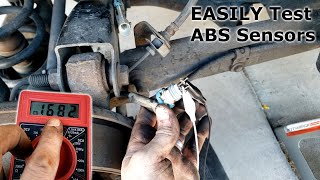
For passive (2-wire) sensors, measure the resistance between the two pins. Compare to vehicle specifications (typically 900-1300 Ohms). Infinite ohms (OL) indicates an open circuit; near zero indicates a short.
Tools: Multimeter, Vehicle-Specific Repair Manual (Advanced) - Test Sensor AC Voltage Output (Passive Sensors)
Switch the multimeter to low AC Voltage. Reconnect the probes to the sensor pins and spin the wheel by hand at one revolution per second. A healthy sensor produces a minimum of 100-200mV AC.
Tools: Multimeter (Advanced) - Test Harness for Voltage and Ground (Active Sensors)
For active (3-wire) sensors, disconnect the sensor and turn the ignition on. Check for the correct reference voltage (5V/12V) on the power wire and a solid ground on the ground wire at the harness connector.
Tools: Multimeter, Vehicle-Specific Wiring Diagram (Advanced) - Analyze the Waveform with an Oscilloscope
Back-probe the sensor connector. As you spin the wheel, look for a clean, consistent sine wave (passive) or square wave (active). A missing or noisy waveform definitively indicates a sensor, tone ring, or wiring problem.
Tools: Oscilloscope, Probing Kit (Advanced)
When This Code Triggers (Freeze-Frame Conditions)
- Vehicle Speed: 6-20 mph (The code triggers at low speeds shortly after starting to drive, as the ABS module performs its self-test and looks for valid signals.)
- Braking Status: Not Braking (The fault is a circuit malfunction detected during normal driving when the ABS module expects a constant signal, not necessarily during braking.)
- System Voltage: 12.5-14.5V (The fault sets under normal battery voltage. If the voltage is low (<11V), it triggers this and other codes.)
- Time Duration: 3-30 seconds (The ECU sets the code after failing to receive a valid signal from the sensor for a predetermined amount of time while in motion.)
Related Codes
- C0215 — Identical code but for the Left Rear Wheel Speed Sensor. If both C0210 and C0215 are active, it strongly suggests a problem with a shared component, such as the wiring harness or low voltage from the ABS module.
- C1238 — A Toyota-specific code for 'Foreign Matter is Attached to Tip of Right Rear Speed Sensor'. If you have C1238 alongside C0210, cleaning the sensor is the definitive first step.
- C1223 — A general 'ABS Control System Malfunction' code that appears alongside C0210. Resolving the C0210 issue clears C1223 automatically.
- C0200 — Code for the Right Front Wheel Speed Sensor. Diagnostically, having codes for sensors on opposite corners increases the suspicion of a failing central ABS control module.
- C1241 — Indicates a 'Low or High Power Supply Voltage Malfunction' to the ABS module. If present, diagnose the vehicle's charging system before replacing any ABS components.
Climate & Environmental Factors
- Road Salt and Humidity: Salt and moisture accelerate corrosion of the wiring harness connectors and the sensor's internal components, creating high resistance or open circuits.
- Snow and Ice Buildup: Snow and ice pack into the wheel well and physically cover the sensor or tone ring, blocking the magnetic signal. This often resolves itself after the vehicle thaws.
- Extreme Cold: Low temperatures make plastic insulation on sensor wiring brittle and prone to cracking. It also causes intermittent electrical connections as metal contacts contract.
- Mud and Debris: For off-road vehicles, mud and dirt cake onto the sensor and tone ring, blocking the signal and causing a fault.
How to Talk to a Mechanic About This Code
Say this: "I have an ABS light on and my scanner shows code C0210 for the right rear wheel speed sensor circuit. I'd like to book a diagnostic appointment to confirm the root cause. Please check the sensor, the wiring harness, and the right rear wheel bearing for play before recommending a part replacement."
This signals that you understand the common causes and prevents a shop from simply replacing the sensor without checking for a root cause like a bad bearing or wiring.
Avoid saying:
- 'My ABS light is on, can you fix it?' (Too vague, invites a simple part swap without full diagnosis)
- 'Just replace the right rear ABS sensor.' (You replace a perfectly good part if the problem is the wiring or bearing)
- 'Whatever you think is best.' (Gives up control and leads to upselling)
Questions to ask before authorizing the repair:
- What was the result of the diagnostic? Did the sensor itself test bad, was the wiring damaged, or is the wheel bearing failing?
- If the sensor was just dirty, what is the source of the contamination? Did you check the wheel bearing for play?
- Can you show me the failed part or the photos from the digital inspection?
- What is the warranty on the parts and labor for this specific repair?
Where to Take It: Dealer vs Independent vs Chain
- Dealer:
Recommended if you suspect a complex module or TSB-related issue. Otherwise, it's the most expensive option.
Best for: Vehicles still under warranty, Complex issues involving the ABS control module, Known manufacturer-specific issues covered by a Technical Service Bulletin (TSB)
Downsides: Highest labor rates and parts costs, Recommends replacing a whole assembly when a smaller component could be fixed (Typical cost: +50% vs. baseline) - Independent Shop:
Best fit for most cases. An experienced independent mechanic easily diagnoses and repairs the common causes of C0210 at a fair price.
Best for: Out-of-warranty vehicles, Standard diagnosis and repair of sensors, wiring, and wheel bearings, Building a long-term relationship with a trusted mechanic
Downsides: Quality and diagnostic capabilities vary greatly; vet shops by reviews and ASE certifications., Lacks the latest manufacturer-specific diagnostic tools for very new cars. (Typical cost: +0% vs. baseline) - Chain Shop:
Use with caution. Acceptable if you are certain it's just a bad sensor. AVOID for initial diagnosis, as they miss bad wheel bearings or wiring issues.
Best for: Simple, clear-cut part replacements if the diagnosis is already certain.
Downsides: Technician skill varies widely., Business model encourages upselling unnecessary services., Less equipped for in-depth electrical diagnosis beyond replacing the most obvious part. (Typical cost: -10% vs. baseline)
When to Walk Away From the Repair
If the estimated repair cost exceeds 40-50% of the car's private-party value, seriously consider selling or trading it in instead of repairing.
- Car worth $4000, fix is $2000: Walk away. A repair costing 50% of the car's value is rarely a good investment.
- Car worth $12000, fix is $900: Fix it. The repair cost is well below the threshold and restores a critical safety system.
- Car worth $2500, fix is $1500: Walk away. The repair cost is 60% of the car's value; it's not financially sound.
What Scan Tool You Need for This Code
Minimum: A scanner that reads and clears Anti-lock Braking System (ABS) codes. A basic engine-only code reader will NOT see C-prefix codes like C0210.
A basic $20 scanner only reads engine and emissions codes (P-codes). It cannot communicate with the ABS module, reporting 'No Codes Found' even when the ABS light is on.
Budget: Innova 5210 or BlueDriver Pro (~$100) — Reads and clears ABS codes. The BlueDriver app displays live data, allowing you to watch the wheel speed sensor readings from all four wheels in real-time.
Mid-range: Foxwell NT630 Plus or Autel MaxiCOM MK808 (~$150-350) — Provides full-system diagnostics, including ABS live data and graphing. Advanced models offer bi-directional controls to perform active tests on the ABS pump.
Professional: Autel MK808BT Pro or XTOOL D8S (~$450-800) — Offers full bi-directional control, ABS brake bleeding, wireless connectivity, and comprehensive diagnostic routines that quickly pinpoint if the fault is the sensor, wiring, or module.
Rent vs buy: Auto parts stores offer free scanning services that read ABS codes. This is a good first step. If you plan to diagnose yourself, buying a budget-tier scanner pays for itself quickly.
How to Clear the Code After You Fix It
- Use an ABS-capable OBD-II scan tool to clear the fault code from the ABS module.
- Perform a short test drive reaching speeds above 15 mph to allow the system to confirm the repair.
Drive cycle (~10 minutes): After clearing the code, drive for 5-10 minutes, ensuring you reach at least 15-20 mph. If the repair was successful, the ABS light remains off.
Readiness monitors affected: Not applicable
Watch out for:
- Using a basic OBD-II scanner that cannot read or clear ABS (Chassis) codes.
- Not fixing the root cause of the problem, leading the code to return immediately.
- Assuming disconnecting the battery clears the code; this is unreliable for ABS faults.
Will This Fail Emissions / State Inspection?
No — by itself this code doesn't fail OBD inspection (but it can keep readiness monitors from setting, which causes a separate fail).
- California: An illuminated ABS light is not an automatic failure for the smog check, but a technician may refuse to inspect the vehicle on safety grounds. It fails a separate brake inspection.
- New York: An illuminated ABS warning light causes the vehicle to fail its annual safety inspection.
- Texas: An illuminated ABS light is NOT a cause for rejection during the state safety inspection. However, if the standard red 'Brake' warning light is also on, it fails.
Most Commonly Affected Vehicles
- Toyota Tundra (2007-2021) — Extremely common due to leaking rear axle seals that contaminate the sensor and tone ring with gear oil and metal shavings. A failing wheel bearing is also a primary cause.
- Toyota Tacoma (2005-2015) — Often caused by a failing rear wheel bearing which leads to sensor contamination or damage. A frayed wire in a connector is also a specific cause.
- Toyota Prius (2004-2015) — Prone to sensor failure, wiring issues, and problems with the wheel bearing hub assembly which integrates the sensor and tone ring.
- Toyota Sienna (2004-2010) — General ABS sensor circuit faults are a known issue, often related to corrosion in the wiring harness or internal sensor failure.
- Toyota Yaris (2006-2018) — Known to have issues where the wiring harness connector to the sensor corrodes and fails, requiring harness replacement.
- Chevrolet / GMC Silverado / Sierra (2007-2013) — Known for wheel speed sensor issues caused by corrosion of the wiring harness connectors and failures of the hub bearing assembly.
- Ford F-150 / Explorer (2004-2014) — Issues are often related to a failed sensor integrated into the hub bearing assembly or damage to the wiring leading to the sensor.
- Volkswagen Golf / Jetta (2009-2016) — Frequently caused by the failure of the sensor itself or corrosion in the electrical connector. The plastic sensor housing becomes brittle and cracks.
Manufacturer-Specific Notes
- Toyota: On Tundra and Tacoma trucks, the primary suspect for C0210 is a leaking rear axle seal. Pull the sensor and check for gear oil or a thick paste of metal shavings; if present, the axle seal and wheel bearing must be replaced.
- Toyota: For 2009 Corolla and Matrix models, Toyota issued TSB T-SB-0205-09 for C0210/C0215 caused by water intrusion and rust in the sensor connector. The fix is replacing the sensor and wiring harness with updated parts.
- Toyota: Some models were covered under Customer Support Program ZJ1 for ABS actuator issues presenting with wheel speed sensor codes. Check with a dealer for active warranty extensions.
- General Motors (GM): On many GM trucks and SUVs, the wiring harness leading to the wheel speed sensor is routed in a way that makes it highly susceptible to damage and corrosion at the connector.
- Ford: On F-150 and Explorer models, the wiring pigtail connecting to the hub becomes brittle from heat and weather exposure, breaking internally even if it looks fine externally.
Real Owner Stories
2013 Toyota Tundra at ~100K miles
ABS, traction control, and flashing 4HI/4LO lights appeared. Scan showed code C0210. No other symptoms like noise or vibration.
Outcome: The owner replaced the right rear wheel bearing assembly. During repair, it was confirmed the bearing had failed and contaminated the sensor area. Replacing the assembly fixed the code.
Lesson: On Toyota trucks, C0210 is frequently a symptom of a failing wheel bearing. Always check for bearing play and contamination before replacing the sensor.
2008 Toyota Prius at 170K miles
Intermittent ABS, VSC, and BRAKE lights on the dashboard.
Outcome: After inspecting the wiring, the owner cleaned the shared connectors with electronic cleaner, cleared the codes, and the problem was resolved.
Lesson: If you have codes for both rear sensors simultaneously, suspect a common point of failure, like a shared wiring harness or ground, before assuming multiple parts failed.
2009 Toyota Corolla at 141K miles
ABS light came on a few weeks after having a single new tire installed on the right rear.
Outcome: The C1238 code specifically suggested debris on the sensor. The cause was debris kicked up during the tire change, and the new tire was a coincidence.
Lesson: While mismatched tires cause ABS issues, a specific sensor code combined with a 'foreign matter' code points directly to contamination at the sensor itself.
How to Prevent This Code From Triggering
- Apply Dielectric Grease to Connectors (Whenever a connector is disconnected for service) — Applying dielectric grease to the weather seal of the sensor connector keeps moisture and road salt out, preventing corrosion.
- Regular Underbody Washes in Winter (Monthly during winter in 'salt belt' regions) — Washing the undercarriage removes corrosive road salt that damages wiring harnesses and sensor connectors.
- Periodic Wheel Bearing Checks (Every 15,000-30,000 miles or during tire rotation) — Manually checking for wheel play helps detect a failing wheel bearing early, before it contaminates or damages the speed sensor.
- Inspect Wiring During Brake Service (Whenever brake pads or rotors are replaced) — Visually inspect the wheel speed sensor wiring for chafing, cracking, or heat damage, ensuring it is secured away from moving parts.
Frequently Asked Questions
Can I just clean the sensor instead of replacing it?
Yes, if the cause is contamination from road grime or metallic debris, cleaning the sensor tip and tone ring is a permanent fix. If the code returns after cleaning, the sensor has failed internally or a bad wheel bearing is continuously shedding debris.
Why did my traction control, brake, and cruise control lights also turn on?
The ABS, Traction Control, Stability Control, and Cruise Control systems all require accurate data from all four wheel speed sensors. When one sensor fails, the computer disables these dependent systems as a safety precaution and illuminates their warning lights.
I replaced the sensor, but the C0210 code came back. What now?
If a new sensor fails to clear the code, the problem lies elsewhere in the circuit or mechanical assembly. The most likely culprits are a bad wheel bearing, a damaged tone ring, or a wiring break. You must perform a full circuit diagnosis rather than guessing.
What is the difference between the wheel speed sensor and the ABS tone ring?
The tone ring is a toothed metal ring that rotates with the wheel axle or hub. The wheel speed sensor is a stationary magnetic probe that counts the teeth as they pass by to measure wheel speed.
How does a bad wheel bearing cause a C0210 code?
As a wheel bearing wears out, its internal seals fail, leaking grease and metal particles that contaminate the magnetic speed sensor. Additionally, a worn bearing allows excessive hub movement, altering the critical air gap between the sensor and tone ring.
Can a weak car battery cause a C0210 code?
Yes, a weak 12-volt battery causes low voltage conditions across the vehicle's electrical system. The ABS control module is highly sensitive to voltage drops and logs wheel speed sensor faults when it lacks adequate power.
How urgent is it to fix code C0210?
Fixing C0210 is moderately urgent because you lose the safety net of ABS, traction control, and stability control. This significantly increases your risk of skidding and extends stopping distances during emergency braking or on slippery surfaces.
Can I reset the ABS light without a scanner?
Generally, no. Disconnecting the battery rarely clears ABS codes because they are stored in a separate non-volatile memory module. You must use an ABS-capable OBD-II scanner to clear the code after completing the repair.
Key Takeaways
- Code C0210 disables your ABS and traction control due to a signal failure specifically at the right rear wheel speed sensor.
- Inspect the right rear wheel bearing for play before buying parts; a failing bearing leaks grease and metal shavings that blind the sensor.
- Test the wiring harness for proper voltage and ground before replacing the sensor, as corroded connectors cause over 30% of these faults.
- On Toyota trucks like the Tundra and Tacoma, C0210 is a notorious indicator of a leaking rear axle seal that requires immediate mechanical repair.
Helpful Videos

The information in this article is provided for general reference and educational purposes only. Vehicle specifications, procedures, and part compatibility can vary by production date, trim level, and region. Always consult your vehicle's factory service manual and verify part numbers before purchasing or performing repairs. Safety-critical components such as airbags, seat belts, and braking systems should be installed by a qualified professional.
- 🎬 Helpful Videos
- What Does C0210 Mean?
- Can I Drive With C0210?
- Common Causes
- Symptoms
- Diagnostic Flowchart
- Common Fixes & Costs
- DIY vs Professional
- Used vs. New Parts: Buying Guide
- What Happens If You Wait — Timeline
- Cost of Not Fixing It
- Diagnosis Steps
- When This Code Triggers (Freeze-Frame Conditions)
- Related Codes
- Climate & Environmental Factors
- How to Talk to a Mechanic About This Code
- Where to Take It: Dealer vs Independent vs Chain
- When to Walk Away From the Repair
- What Scan Tool You Need for This Code
- How to Clear the Code After You Fix It
- Will This Fail Emissions / State Inspection?
- Most Commonly Affected Vehicles
- Manufacturer-Specific Notes
- Real Owner Stories
- 2013 Toyota Tundra at ~100K miles
- 2008 Toyota Prius at 170K miles
- 2009 Toyota Corolla at 141K miles
- How to Prevent This Code From Triggering
- Frequently Asked Questions
- Can I just clean the sensor instead of replacing it?
- Why did my traction control, brake, and cruise control lights also turn on?
- I replaced the sensor, but the C0210 code came back. What now?
- What is the difference between the wheel speed sensor and the ABS tone ring?
- How does a bad wheel bearing cause a C0210 code?
- Can a weak car battery cause a C0210 code?
- How urgent is it to fix code C0210?
- Can I reset the ABS light without a scanner?
- Key Takeaways
- 🎟️ Get 5% Off