

OBD-II Code C0200: Right Front Wheel Speed Sensor Circuit Malfunction
The Ultimate 2026 Guide to Diagnosing and Fixing C0200
- Code C0200 disables your ABS and traction control by flagging a dead or erratic signal from the right front wheel speed sensor.
- Do not blindly replace the sensor; broken wiring harnesses account for a massive percentage of C0200 codes, especially on 2005-2015 Toyota Tacomas.
- Diagnose the root cause in 30 minutes by swapping the right and left front sensors to see if the code changes to C0205 (Left Front).
- Expect to pay between $140 and $350 for a professional sensor replacement, or up to $800 if the integrated wheel hub bearing has failed.
What Does C0200 Mean?

Code C0200 means your car's Anti-lock Brake System (ABS) control module detects a fault in the right front wheel speed sensor's electrical circuit. This sensor reports wheel rotational speed to the computer. When this signal drops out, the computer cannot calculate wheel slip, so it disables ABS and traction control and illuminates the warning lights.
Technical definition: The SAE/ISO definition is 🎬 Watch: Real-world diagnostic testing for code C0200 "Right Front Wheel Speed Sensor Circuit Malfunction." The ABS control module detects an open circuit, a short to ground, a short to power, or an implausible signal from the right front sensor while the vehicle is moving.
Can I Drive With C0200?
Yes, But With Caution. Yes, but with significant caution. Your primary hydraulic brakes function normally, but your Anti-lock Braking System (ABS), Traction Control (TCS), and Vehicle Stability Control (VSC) are disabled. In a panic stop, your wheels will lock up, increasing stopping distance and eliminating steering control. Fix this promptly to restore these critical safety systems.
Common Causes

- Damaged or Corroded Sensor Wiring (Very Common) — The sensor's wiring harness is exposed to water, road salt, and constant suspension flexing. This causes chafed insulation, internal wire breaks (especially near the connector) 🎬 See how to repair a damaged wheel speed sensor cable, and corroded connector pins that interrupt the signal.
- Failed Right Front Wheel Speed Sensor (Very Common) — Internal electronic components fail due to age, heat cycles, and vibration, causing the sensor to stop generating a signal even with perfect wiring.
- Failing Wheel Hub Bearing (Common) — A worn-out wheel bearing introduces excessive play or 'wobble' in the hub. This movement alters the critical air gap between the sensor and the tone ring, leading to a weak or inconsistent signal. On many modern cars, a bad bearing directly damages the integrated tone ring.
- Contaminated or Damaged Tone Ring (Common) — The sensor reads a toothed tone ring (reluctor ring). If this ring is cracked, missing teeth, or coated with metallic brake dust and heavy rust, it produces an erratic signal that the ABS module flags as a fault.
- Improper Installation or Collateral Damage (Uncommon) — Recent brake, suspension, or axle work often damages the sensor or wiring. Common mistakes include stretching the wire, pinching it during reassembly, or failing to route it correctly in its retaining clips.
- Failed ABS Control Module (Rare) — The ABS module rarely fails for just a single sensor circuit. Consider this a last resort after exhausting all other possibilities. A failing module typically sets codes for multiple sensors or communication faults.
Symptoms

- ABS, Traction, and Stability Warning Lights Illuminated — The primary symptom. The amber ABS light, Traction Control (TCS), and Vehicle Stability Control (VSC) lights turn on simultaneously because all three systems rely on wheel speed data.
- Disabled Anti-lock Brakes — During hard braking, the wheels lock up and skid. You will not feel the characteristic pulsing of the brake pedal that indicates active ABS.
- Unwanted ABS Activation at Low Speeds — An erratic signal tricks the ABS module into thinking a wheel is locking up during slow, normal braking. This causes the ABS pump to activate, creating a grinding noise and a pulsating brake pedal when unneeded.
- Intermittent Warning Lights — If the problem is a loose connection or an internal wire break, the warning lights turn on and off intermittently, triggered by bumps, sharp turns, or temperature changes.
- Erratic Speedometer Behavior — On vehicles that use wheel speed sensor data to calculate vehicle speed, a fault in the right front sensor causes the speedometer to behave erratically or drop to zero intermittently.
Diagnostic Flowchart
Tap your situation to follow the diagnostic path that matches what you're seeing on this code.
Common Fixes & Costs
- Replacing the Right Front Wheel Speed Sensor — Parts: $40-$150, Labor: $100-$200, ~1.1 hr book time (DIY)
- Repairing Damaged Wiring or Replacing Connector Pigtail — Parts: $20-$50, Labor: $150-$250, ~1.5 hr book time (Intermediate)
- Replacing the Wheel Hub Bearing Assembly — Parts: $150-$400, Labor: $200-$400, ~2.2 hr book time (Professional)
- Cleaning the Sensor Tip and Tone Ring — Parts: $5, Labor: $70-$120, ~0.8 hr book time (DIY)
- Replacing the ABS Control Module — Parts: $200-$900, Labor: $150-$300, ~1.8 hr book time (Professional)
Used vs. New Parts: Buying Guide
When a used part is worth it: Buying a used bolt-on wheel speed sensor rarely makes sense due to low new part costs and high failure rates. A used OEM wheel hub assembly from a low-mileage donor is a viable alternative to a cheap aftermarket hub, but carries risk.
Donor-vehicle mileage cap: roughly under 60000 miles for the part to have meaningful remaining life.
Donor quality checklist:
- Verify donor vehicle mileage is low.
- Avoid parts from rust-belt donors, as corrosion is a primary cause of failure.
- Match the part number exactly; sensors and hubs are specific to year, model, and drivetrain.
Decision logic:
- If The fix is a bolt-on sensor → Buy a new, quality aftermarket (e.g., Denso, Delphi, Bosch) or OEM sensor. Avoid the cheapest options.
- If The fix is a complete wheel hub assembly → A new, quality aftermarket (e.g., MOOG, Timken, SKF) or OEM hub is the most reliable choice.
- If Your vehicle is over 150K miles and the budget is very tight → A used part is a gamble, but serves as a temporary solution. Expect a significantly shorter lifespan.
Warranty tradeoff: Used parts typically have a 30-90 day warranty, which does not cover labor costs. Quality new aftermarket parts offer 1-year to limited lifetime warranties.
Worst-case if a used part fails: $200-$400 if a used sensor or hub fails after installation, requiring repeat labor and a new part.
What Happens If You Wait — Timeline
- Immediate: Code C0200 sets, and the ABS, Traction Control (TCS), and Vehicle Stability Control (VSC) warning lights illuminate. These safety systems are disabled. (MPG impact: 0%% · Added cost: $0)
- 0-3 months: Driving risk increases in emergency stops or poor weather. Vehicles experience unwanted, brief ABS activation at low speeds if the sensor signal is erratic. Causes an immediate failed state safety inspection. (MPG impact: 0%% · Added cost: $100-$300 in potential inspection/re-inspection fees or fines.)
- 3-9 months (If caused by a bad wheel bearing): If the root cause is a failing wheel bearing, the bearing noise gets progressively louder. Excessive play worsens, leading to uneven tire wear. (MPG impact: 0-1%% · Added cost: $200-$400 for a new tire if wear is severe, plus the inevitable cost of the hub replacement.)
- 9+ months (If a bad wheel bearing is ignored): Catastrophic failure of the wheel bearing becomes a high risk. The hub separates or seizes, causing the wheel to lock up or detach from the vehicle while driving. Damages the steering knuckle or CV axle. (MPG impact: 0-2%% · Added cost: $1500-$2500+ for replacement of the hub, knuckle, and potentially axle, plus towing.)
Cost of Not Fixing It
- Immediate: Loss of ABS, traction control, and stability control. Significantly increases the risk of wheel lock-up and skidding during emergency braking or on slippery surfaces. (Added cost: Potential cost of an accident.)
- 0-6 months: Failed state safety inspection. Many states fail a vehicle for an illuminated ABS warning light, preventing legal registration. (Added cost: $100-$300 in failed inspection fees, fines, and re-inspection costs.)
- 6+ months: A faulty wheel speed signal sends incorrect data to the transmission control module, causing harsh shifting or incorrect gear selection, contributing to premature transmission wear. (Added cost: $2000-$5000+ if transmission issues are accelerated or misdiagnosed.)
Diagnosis Steps

- Confirm Code & Analyze Live Data
Use an ABS-capable OBD-II scanner to verify C0200 is the active fault. Access the live data stream for all four wheel speed sensors and drive slowly. A reading stuck at 0 MPH confirms a dead sensor or open circuit. An erratic reading suggests a damaged tone ring or wiring issue.
Tools: OBD-II Scanner (ABS capable) (Beginner) - Visual Inspection & Harness Wiggle Test
Raise the front right of the vehicle. Inspect the entire wheel speed sensor wire for cuts, chafing, or stretching. With the scanner graphing live data, systematically wiggle and bend the wiring harness. A sudden signal drop-out pinpoints an internal wire break.
Tools: Jack, Jack Stands, Flashlight, OBD-II Scanner (Intermediate) - Swap Sensors Side-to-Side
If the left and right front sensors are identical, swap them. Clear the codes and drive. If the code changes to C0205 (Left Front), the sensor is faulty. If C0200 returns, the problem is in the wiring, tone ring, or hub on the right side.
Tools: Basic Hand Tools, OBD-II Scanner (Intermediate) - Check for Wheel Bearing Play
Grasp the raised wheel/tire at the 12 and 6 o'clock positions and attempt to rock it back and forth. Any perceptible clunking or movement indicates a worn wheel bearing, which causes the tone ring to move out of alignment with the sensor.
Tools: Jack, Jack Stands (Intermediate) - Clean and Inspect Sensor and Tone Ring
Remove the sensor from the steering knuckle. Clean the magnetic tip with brake cleaner. Peer into the mounting hole to inspect the tone ring for broken teeth, cracks, or heavy rust buildup.
Tools: Socket Set, Brake Cleaner, Rags (Intermediate) - Test Sensor Resistance (Passive 2-Wire Sensors)
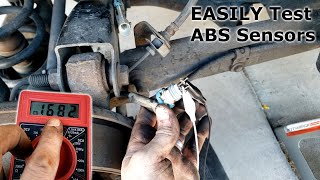
Disconnect the sensor and set your multimeter to Ohms (Ω). Measure the resistance across the sensor's two pins. A common specification is 800-1,700 Ohms. An 'OL' (Open Loop) or 0 Ohms reading indicates a failed sensor.
Tools: Multimeter, Vehicle-Specific Resistance Specs (Advanced) - Test Sensor Voltage Output
Reconnect the sensor. Set your multimeter to AC Volts (mV AC). Back-probe the two wires at the sensor connector and spin the wheel by hand. A healthy passive sensor generates a small AC voltage (100-500mV) that increases with speed. No voltage indicates a failed sensor or tone ring.
Tools: Multimeter, Back-probe pins (Advanced) - Analyze Waveform with an Oscilloscope
Connect an oscilloscope to the sensor's signal and ground wires. Spinning the wheel produces a clean, consistent waveform. A missing or noisy waveform condemns the sensor or tone ring, while a good waveform at the sensor but a bad one at the ABS module proves a wiring issue.
Tools: Oscilloscope (Professional)
When This Code Triggers (Freeze-Frame Conditions)
- Vehicle Speed: 5-15 mph (Sets during the initial ABS self-test when the vehicle first starts moving. The module expects a signal from the right front wheel but receives none.)
- Right Front Wheel Speed: 0 mph (The ABS module sees other wheels turning but the right front sensor reports zero speed, triggering the fault.)
- System Voltage: 13.5-14.5 V (Occurs under normal charging conditions with the engine running.)
- Engine RPM: 800-2000 RPM (Occurs at low engine speeds consistent with initial acceleration.)
Related Codes
- C0205 — The identical fault for the Left Front Wheel Speed Sensor. Swapping sensors side-to-side changes C0200 to C0205 if the sensor is the culprit.
- C0210 / C0215 — Correspond to the Right Rear and Left Rear wheel speed sensors. Multiple codes for different corners point toward a systemic issue like a failing ABS module or wiring harness.
- C1223 / C1235 — C1223 is a generic code indicating the ABS module shut down. C1235 is a Toyota-specific code for 'Foreign Object is Attached on Tip of Front Speed Sensor RH'. They are secondary codes triggered by the primary C0200 fault.
- C0278 — Indicates a problem with the ABS relay. An electrical short in the sensor harness causes broader electrical issues within the ABS module, leading to multiple codes.
Climate & Environmental Factors
- Cold Weather / Snow and Ice: Extreme cold makes wiring insulation brittle and prone to cracking. Packed snow and ice build up in the wheel well, physically damaging the wire or blocking the sensor's view of the tone ring. The light often turns off after the ice melts.
- Road Salt / High Humidity: In regions using road salt, corrosion is a primary cause of failure. Saltwater attacks the wiring harness and connector pins, causing high resistance or short circuits, and causes the sensor body to seize in the steering knuckle.
How to Talk to a Mechanic About This Code
Say this: "I have an ABS light on and my scanner shows code C0200 for the right front wheel speed sensor circuit. I'd like to book a diagnostic to confirm the cause. Please check the live data from all four sensors and inspect the wiring harness for damage before recommending a new sensor."
Shows you understand the problem is often the wiring, tone ring, or hub, not just the sensor. Guides the technician toward proper diagnosis and away from blindly replacing parts.
Avoid saying:
- 'My ABS light is on, can you fix it?'
- 'Just replace the right front ABS sensor.'
- 'Do whatever you think is best.'
Questions to ask before authorizing the repair:
- Did you see the right front wheel speed drop to zero or act erratically on the live data scan?
- Did you perform a 'wiggle test' on the wiring harness to check for an intermittent break?
- Did you inspect the tone ring for damage or debris?
- If the wheel bearing/hub needs replacement, are you using a quality OEM or equivalent part like Timken or MOOG?
- What is the warranty on the parts and labor for this repair?
Where to Take It: Dealer vs Independent vs Chain
- Dealer:
Recommended if the vehicle is under warranty or if it's a brand known for complex electronics. Otherwise, not the most cost-effective choice.
Best for: Vehicles still under warranty, Complex electrical issues or when multiple unrelated codes are present, Vehicles with known manufacturer-specific quirks
Downsides: Highest labor rates, Recommends expensive assembly replacements when a smaller component repair is possible (Typical cost: +50% vs. baseline) - Independent Shop:
Best fit for most situations. A reputable independent shop has the tools and experience to diagnose a C0200 code correctly at a fair price.
Best for: Most out-of-warranty vehicles, Diagnosing common codes like C0200, Building a long-term relationship with a trusted mechanic
Downsides: Quality and diagnostic skill vary widely. Look for ASE certifications and good reviews. (Typical cost: +0% vs. baseline) - Chain Shop:
Use with caution. Acceptable if you are certain it's a simple sensor swap. AVOID for initial diagnosis, as they default to replacing parts without confirming the root cause.
Best for: Simple, straightforward repairs where the diagnosis is certain.
Downsides: Technician skill varies dramatically., High pressure to upsell services., Lacks advanced diagnostic tools for tricky wiring or module-related faults. (Typical cost: -10% vs. baseline)
When to Walk Away From the Repair
If the estimated repair cost exceeds 40-50% of the car's private-party value, seriously consider selling or trading it in instead of repairing.
- Car worth $5000, fix is $800: Fix it. The repair cost is well below the threshold and restores a critical safety system, preserving the car's value.
- Car worth $3500, fix is $1500: Borderline. This repair is nearly half the car's value. Get a second opinion to ensure the diagnosis is correct before proceeding.
- Car worth $2000, fix is $900: Walk away. The repair cost is too high relative to the vehicle's value. Put that money toward a replacement vehicle.
What Scan Tool You Need for This Code

Minimum: An OBD-II scanner that reads Chassis (C) codes for the ABS and views live data for all four wheel speed sensors.
A basic $20 code reader only reads Powertrain (P) codes and won't see the C0200 code. You MUST access the ABS module and watch the live speed data from each wheel to confirm which sensor is failing.
Budget: BlueDriver Pro (~$99) — Connects via Bluetooth to your smartphone. Reads and clears ABS codes and graphs live data from all four wheel speed sensors simultaneously, making it easy to spot the failing sensor.
Mid-range: Foxwell NT510 Elite (~$180) — A dedicated handheld unit providing full system diagnostics, including reading/clearing ABS codes and viewing live data. Offers limited bidirectional tests for the ABS module.
Professional: Autel MaxiCOM MK808 (~$500) — A professional-level tablet scanner offering comprehensive diagnostics, live data graphing, and service functions. Provides fast access to the ABS module and bidirectional controls to test the ABS pump.
Rent vs buy: Auto parts stores offer free scanning services that read ABS codes, a great first step to confirm the code. However, their tools rarely offer live data viewing for the customer. Buying a budget pick like the BlueDriver is a worthwhile investment for DIY diagnosis.
How to Clear the Code After You Fix It
- Use an ABS-capable OBD-II scan tool to erase the C0200 code from the ABS module.
- Turn the ignition off, then start the vehicle.
- Drive the vehicle, accelerating to at least 15-20 mph to allow the ABS module to perform its self-test and verify the new signal.
Drive cycle (~10 minutes): Start the car and drive for 5-10 minutes, ensuring vehicle speed exceeds 15 mph. The ABS module performs a self-test and, upon seeing a valid signal from all four wheels, keeps the warning lights off.
Readiness monitors affected: None directly. C0200 is a chassis code and does not affect emissions readiness monitors. However, disconnecting the battery resets all emissions monitors.
Watch out for:
- Using a basic code reader that cannot access or clear Chassis ('C') codes.
- Disconnecting the battery erases all learned data and emissions readiness monitors, causing an automatic emissions test failure.
- The code returns immediately because the underlying issue (wiring, tone ring, hub) was not fixed.
Will This Fail Emissions / State Inspection?
No — by itself this code doesn't fail OBD inspection (but it can keep readiness monitors from setting, which causes a separate fail).
- California: An illuminated ABS light is not an emissions-related failure and does not fail a Smog Check. The primary concern is safety, not emissions.
- Texas: An illuminated ABS light does NOT cause a failure of the Texas state safety inspection. The regular braking system must be functional, but non-working ABS is not a cause for rejection.
- New York: An illuminated ABS warning light IS grounds for failing the state safety inspection under updated regulations.
Most Commonly Affected Vehicles
- Toyota Tacoma (2005-2015) — Extremely common due to wiring harness design. The wire stretches and breaks internally from suspension travel, especially on lifted trucks. The break is rarely visible externally.
- Toyota Tundra (2007-2021) — Prone to intermittent faults from wiring harness issues, causing a cascade of VSC, ABS, and 4WD warning lights.
- Chevrolet / GMC Silverado / Sierra 1500 (2007-2018) — The wheel speed sensor is integrated into the sealed wheel hub bearing assembly. A C0200 code typically requires replacing the entire front right hub.
- Ford Edge, Mustang, F-150 (2007-2014) — Frequently experience this code due to sensor failure or damage to the wiring harness where it passes through the fender well.
- Volkswagen / Audi Golf, Jetta, A4 (2010-2018) — Use 'active' sensors powered by the ABS module. Diagnosis requires checking for 5V or 12V reference at the connector with the key on.
- Subaru Impreza, Forester, Outback (2008-2016) — Failures link directly to corrosion. Road salt causes the sensor to seize in the steering knuckle and corrodes the harness connector pins.
- Toyota Sienna (2004-2010) — The front sensor wiring harness is a weak point. Specified sensor resistance is typically between 0.9 and 1.3 kΩ.
- Lexus IS, ES, RX models (2006-2015) — Shares the vulnerable wiring harness design of Toyota models. The wire frays or breaks internally right at the connector from repeated suspension movement.
Manufacturer-Specific Notes
- Toyota / Lexus: The number one cause is an internal break in the wiring harness within 2-3 inches of the sensor connector, with no visible external damage. Technicians perform a 'wiggle test' on the harness while watching live data to confirm.
- General Motors (Chevrolet / GMC): The sensor is non-serviceable and integrated into the wheel hub bearing assembly. The entire hub must be replaced, turning a small repair into a significant one.
- Subaru: Corrosion is a major factor. The sensor body rusts and seizes inside the steering knuckle, requiring destructive removal. Applying anti-seize compound during installation is critical.
- Volkswagen / Audi: Use active (Hall effect) sensors which are 3-wire and cannot be tested for resistance. Diagnosis requires checking for power and ground at the connector, then using an oscilloscope to verify the square wave signal.
Real Owner Stories
2007 Toyota Tundra with intermittent ABS/VSC lights
ABS, VSC, and 4HI lights came on intermittently. After a reset, they stayed off until driving for a minute, then returned. Owner experienced premature ABS activation when stopping.
What they tried:
- Replaced the right front wheel speed sensor and wiring harness a few months prior.
- Reset codes, providing a temporary fix.
- Disconnected the sensor to verify it triggered an open circuit code.
Outcome: The problem was an intermittent failure in the newly installed wiring harness. The signal dropped out after the initial system self-check.
Lesson: Even new parts fail. An intermittent C0200 code appearing shortly after driving points to a component failing during the self-test, often a faulty new sensor or harness.
2005 Toyota Tacoma with 6-inch lift kit
ABS light came on, scanner showed C0200. Live data confirmed the Right Front (FR) wheel speed was 0 MPH while others read correctly.
What they tried:
- Checked continuity on the wiring harness from the sensor to the wheel well.
- Swapped the right front sensor with the right rear sensor.
- Cleared codes and test drove. Code C0200 returned.
Outcome: Because the sensor worked on another corner, the issue was traced to a faulty magnetic encoder ring on the wheel bearing. The entire wheel hub assembly required replacement.
Lesson: Swapping sensors is a definitive diagnostic step. If the code does not follow the sensor, the problem lies with the wiring, hub, or tone ring on that specific corner.
2007 Prius in Upstate NY with 137k miles
ABS and brake warning lights came on. Mechanic replaced front wheel speed sensors with aftermarket parts, but C0200 returned.
What they tried:
- Replaced both front wheel speed sensors with aftermarket units.
- Used a scan tool to graph live data and saw the right front wheel speed signal dropping to zero intermittently.
Outcome: The root cause was an intermittent open circuit from corroded pins in the connector, common in rust-belt vehicles. The aftermarket sensors failed to fix the underlying circuit issue.
Lesson: In rust-prone areas, always suspect corrosion in the connectors or wiring harness before condemning the sensor. Graphing live data is more powerful than just reading a code.
2005 Toyota Tacoma after CV axle replacement
Immediately after replacing both front CV axles, the ABS light came on.
What they tried:
- Visually inspected the right front sensor area and found it covered in grease squeezed out from the new axle.
- Checked the wiring and connector.
Outcome: The owner cleaned the excess grease from the sensor and hub area. The thick grease blocked the sensor from reading the tone ring. After cleaning, the ABS light turned off permanently.
Lesson: If the code appears immediately after a repair, the cause is almost always related to that repair. Inspect for knocked sensors, stretched wires, or contamination before buying parts.
How to Prevent This Code From Triggering
- Clean Sensor and Hub Area During Brake Service (Every time brakes are replaced or tires are rotated.) — Wiping down the sensor tip and using brake cleaner to spray out debris from the tone ring prevents the buildup of metallic dust that disrupts the magnetic signal.
- Inspect Wiring Harness During Oil Changes (Every 5,000-7,500 miles.) — Inspect the visible portion of the ABS sensor wire for chafing, improper routing, or contact with suspension parts. Securing a loose wire with a zip tie prevents a future break.
- Apply Dielectric Grease to Connectors (When replacing a sensor or unplugging a connector.) — Applying a small amount of dielectric grease to the inside of the connector seal prevents water intrusion, a common cause of circuit faults in wet or salty climates.
- Apply Anti-Seize to Sensor Body on Installation (Only when installing a new sensor.) — Galvanic corrosion causes the plastic sensor body to seize inside the metal steering knuckle. Applying a thin layer of anti-seize compound to the sensor body allows for easy removal years later.
Frequently Asked Questions
I replaced the sensor but the C0200 code came back. What now?
Stop replacing parts and diagnose the circuit. The problem is an unseen internal break in the wiring harness, a damaged tone ring, or a failing wheel bearing. Test the wiring for continuity and inspect the hub components to isolate the fault.
Can a bad battery or alternator cause a C0200 code?
No. A low voltage condition from a failing battery or alternator causes multiple, random electronic module errors across the vehicle. It does not trigger a fault code for a single, specific sensor circuit.
What is the difference between C0200 and C0201?
C0200 is a general circuit malfunction code, meaning the signal is completely lost or electrically implausible. C0201 is a range/performance code, meaning the sensor produces a signal, but it is erratic or noisy. C0201 points more directly to a dirty tone ring or failing wheel bearing.
Can I just clear the code to fix it?
No. The ABS module performs a self-test every time you start the car and exceed 15 mph. As soon as it detects the circuit fault, it logs the code again and illuminates the warning lights.
Is it safe to drive with the ABS light on and code C0200?
Your primary hydraulic brakes remain fully functional, allowing you to stop normally in dry conditions. However, you lose ABS, traction control, and stability control, which increases stopping distances and skid risk in emergencies. Repair this promptly to restore these critical safety systems.
How much does it cost to fix code C0200?
Costs range from $5 for a DIY sensor cleaning to $800 for a professional wheel hub assembly replacement. A standard sensor replacement at a shop typically costs $140 to $350. Diagnosing the exact cause prevents wasting money on the wrong parts.
Can I replace a wheel speed sensor myself?
Yes, replacing a wheel speed sensor takes about an hour and requires basic hand tools like a 10mm socket and a jack. The main challenge is extracting an old sensor rusted into the steering knuckle. Always apply anti-seize to the new sensor body during installation to prevent future seizing.
Why did my traction control and VSC lights come on with the ABS light?
Traction control and VSC rely on the same four wheel speed sensors to function. When the ABS module loses the right front wheel signal, it cannot calculate wheel slip. It shuts down all dependent systems and turns on their warning lights simultaneously.
Key Takeaways
- Code C0200 disables your ABS and traction control by flagging a dead or erratic signal from the right front wheel speed sensor.
- Do not blindly replace the sensor; broken wiring harnesses account for a massive percentage of C0200 codes, especially on 2005-2015 Toyota Tacomas.
- Diagnose the root cause in 30 minutes by swapping the right and left front sensors to see if the code changes to C0205 (Left Front).
- Expect to pay between $140 and $350 for a professional sensor replacement, or up to $800 if the integrated wheel hub bearing has failed.
Helpful Videos

The information in this article is provided for general reference and educational purposes only. Vehicle specifications, procedures, and part compatibility can vary by production date, trim level, and region. Always consult your vehicle's factory service manual and verify part numbers before purchasing or performing repairs. Safety-critical components such as airbags, seat belts, and braking systems should be installed by a qualified professional.
- 🎬 Helpful Videos
- What Does C0200 Mean?
- Can I Drive With C0200?
- Common Causes
- Symptoms
- Diagnostic Flowchart
- Common Fixes & Costs
- Used vs. New Parts: Buying Guide
- What Happens If You Wait — Timeline
- Cost of Not Fixing It
- Diagnosis Steps
- When This Code Triggers (Freeze-Frame Conditions)
- Related Codes
- Climate & Environmental Factors
- How to Talk to a Mechanic About This Code
- Where to Take It: Dealer vs Independent vs Chain
- When to Walk Away From the Repair
- What Scan Tool You Need for This Code
- How to Clear the Code After You Fix It
- Will This Fail Emissions / State Inspection?
- Most Commonly Affected Vehicles
- Manufacturer-Specific Notes
- Real Owner Stories
- 2007 Toyota Tundra with intermittent ABS/VSC lights
- 2005 Toyota Tacoma with 6-inch lift kit
- 2007 Prius in Upstate NY with 137k miles
- 2005 Toyota Tacoma after CV axle replacement
- How to Prevent This Code From Triggering
- Frequently Asked Questions
- I replaced the sensor but the C0200 code came back. What now?
- Can a bad battery or alternator cause a C0200 code?
- What is the difference between C0200 and C0201?
- Can I just clear the code to fix it?
- Is it safe to drive with the ABS light on and code C0200?
- How much does it cost to fix code C0200?
- Can I replace a wheel speed sensor myself?
- Why did my traction control and VSC lights come on with the ABS light?
- Key Takeaways
- 🎟️ Get 5% Off