

OBD-II Code C0051: Steering Wheel Position Sensor Fault
The Ultimate Guide to C0051: What it means, why it triggers, and how to fix it for good
- Code C0051 disables your vehicle's Electronic Stability Control (ESC) and traction control, requiring extreme caution during wet or icy driving conditions.
- Do not immediately replace the steering angle sensor; over 70% of C0051 codes are solved by a $150 software update, a $100 sensor calibration, or a standard wheel alignment.
- Search for Technical Service Bulletins (TSBs) before opening the hood, as manufacturers like Ford and GM have issued specific software patches to resolve this exact code.
- Always read the two-digit code suffix (like C0051:54), which explicitly tells you if the system needs a simple recalibration or has suffered a hard physical failure.
What Does C0051 Mean?

The engine computer detected a fault with the Steering Wheel Position Sensor (SAS). This sensor tells the Electronic Stability Control (ESC) and traction control systems the exact direction and speed you are turning the steering wheel. When this signal is lost, incorrect, or conflicts with wheel speed sensor data, code C0051 triggers and disables these safety systems as a precaution.
Technical definition: Code C0051 is defined as "Steering Wheel Position Sensor (Subfault)". It indicates the ABS or ESC module detected an issue with the sensor's circuit, calibration, or signal plausibility compared to other vehicle dynamics sensors. It usually implies a data mismatch or lost calibration rather than a complete hardware failure.
Can I Drive With C0051?
Yes, But With Caution. You can drive, but exercise extreme caution. This code disables critical safety systems like Electronic Stability Control (ESC) and traction control. Without ESC, the vehicle cannot automatically brake individual wheels to help you recover from a skid or prevent a rollover during an emergency swerve. This significantly increases the risk of losing control in adverse weather or during a sudden maneuver. Some vehicles also lose power steering assist, making the wheel difficult to turn. Repair this promptly.
Common Causes

- Steering Angle Sensor (SAS) requires calibration (Very Common) — The sensor's memory of the 'straight-ahead' position is volatile and erases after a wheel alignment, battery replacement, jump-start, or suspension repair. The system requires a recalibration to relearn the center position.
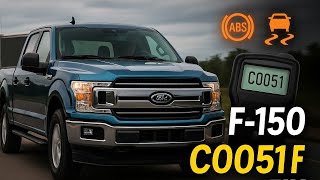
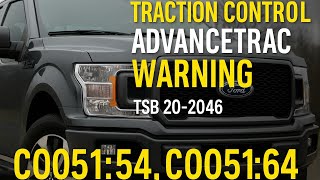
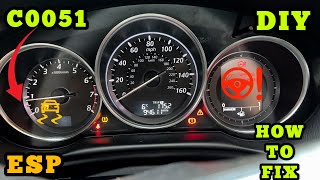
- Control module software glitch (Very Common) — On many modern vehicles (especially Ford, GM, and Ram), overly sensitive ABS or Power Steering 🎬 See how to fix Ford AdvanceTrac warnings and C0051 codes. Control Module (PSCM) parameters falsely trigger a fault during normal events like towing or driving in high winds. A dealer software update is the required fix.
- Poor wheel alignment (Common) — If the wheels do not point straight when the steering wheel is centered, the computer sees a conflict between the steering angle and the vehicle's direction of travel. This frequently occurs after installing lift or leveling kits, or due to worn tie rods.
- Damaged wiring harness or connectors (Common) — The wiring harness for the steering angle sensor or an ABS wheel speed sensor stretches, chafes, or corrodes. Known issues include Ford Escape ABS wires rubbing on the wheel and Chevy Bolt mechanical parts damaging sensor wiring.
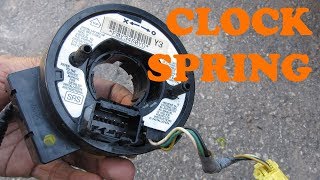
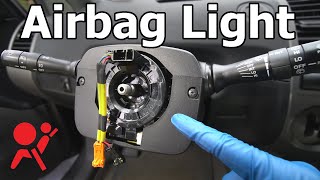
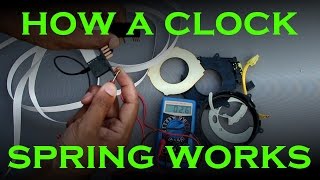
- Failed clockspring assembly (Common) — The steering angle sensor is often integrated into the clockspring assembly. The clockspring ribbon breaks over time, disrupting the electrical connection and signal from the sensor, requiring a complete assembly replacement. 🎬 Watch this step-by-step guide on how to replace a clockspring.
- Low battery voltage (Common) — Consistently low voltage from a weak battery or a failing alternator causes unpredictable communication errors between modules. The sensitive electronics in the ABS and steering modules malfunction, leading to a C0051 code.
- Failed steering angle sensor (Less Common) — While often blamed, the sensor itself failing internally is less common than calibration or software issues. Always rule out alignment, wiring, and software updates before replacing this expensive component.
- Failed ABS or power steering control module (Uncommon) — The Anti-lock Brake System (ABS), Power Steering Control Module (PSCM), or Body Control Module (BCM) fails internally, preventing it from receiving or interpreting the steering angle signal.
- Physical damage to wheel speed sensor (Uncommon) — On vehicles like the 2017-2019 Chevrolet Bolt EV, a fractured front drive shaft washer breaks apart and physically destroys the nearby wheel speed sensor, sending conflicting speed data that triggers C0051.
- CAN bus network failure (Uncommon) — A broken wire or short in the vehicle's communication network (CAN bus) prevents the steering angle signal from reaching the ABS module. This triggers numerous communication-related trouble codes alongside C0051.
Symptoms
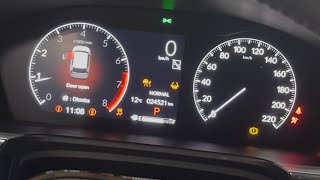
- Traction Control or ESC light is on — The dashboard warning light (often a car with squiggly lines or 'TCS'/'ESC') illuminates continuously.
- ABS warning light is on — The ABS module reports this code, triggering the primary ABS warning light.
- Service AdvanceTrac/ESC message — The instrument cluster displays a specific text warning, such as 'Service AdvanceTrac', 'Service ESC', or 'Service Power Steering'.
- Driver-aid warnings appear — Systems relying on steering angle data, like adaptive cruise control, lane-keeping assist, or automatic emergency braking, disable themselves and display warnings.
- Loss of power steering assist — Vehicles with electric power steering experience intermittent or total loss of assist, making the wheel extremely heavy to turn.
- Airbag light is on — If the clockspring assembly fails, the airbag circuit breaks, triggering the SRS warning light.
Diagnostic Flowchart
Tap your situation to follow the diagnostic path that matches what you're seeing on this code.
Common Fixes & Costs

- Steering Angle Sensor Calibration — Parts: $0, Labor: $100-$150, ~0.8 hr book time (Professional)
- Wheel Alignment — Parts: $0, Labor: $120-$250, ~1.5 hr book time (Professional)
- Control Module Software Update — Parts: $0, Labor: $150-$250 (often covered under warranty), ~1.4 hr book time (Professional)
- Repair Damaged Wiring Harness — Parts: $30-$80 (for pigtail connector), Labor: $150-$300, ~1.6 hr book time (Intermediate)
- Replace ABS Wheel Speed Sensor — Parts: $50-$150, Labor: $100-$200, ~1.2 hr book time (Intermediate)
- Replace Steering Angle Sensor / Clockspring Assembly — Parts: $150-$400, Labor: $200-$500 (includes calibration), ~1.8 hr book time (Professional)
DIY vs Professional
- Control Module Software Update — Beginner:
Tools: Proprietary dealership scan tool and software subscription (e.g., Ford FDRS, GM GDS2). - Steering Angle Sensor Calibration — Beginner:
Tools: A high-level, bi-directional OBD-II scan tool with SAS calibration functionality. - Wheel Alignment — Beginner:
Tools: Professional laser alignment rack and associated equipment. - Repair Damaged Wiring Harness — Beginner:
Tools: Digital multimeter, wiring diagram, wire cutters/strippers, soldering iron, heat shrink tubing. - Replace Steering Angle Sensor / Clockspring Assembly — Beginner:
Tools: Socket set, torque wrench, Torx bit set, trim removal tools, steering wheel puller. - Replace ABS Wheel Speed Sensor — Beginner:
Tools: Jack and jack stands, socket/wrench set, Torx/Allen key set.
Used vs. New Parts: Buying Guide
When a used part is worth it: A used OEM assembly from a low-mileage, accident-free donor vehicle is a cost-effective option for older vehicles. However, this part is critical for airbag function, making the decision risky.
Donor-vehicle mileage cap: roughly under 60000 miles for the part to have meaningful remaining life.
Donor quality checklist:
- Verify the donor vehicle was not involved in a front-end collision.
- Ensure the part number is an exact match for your vehicle's VIN.
- Ask the seller to guarantee the clockspring was 'centered' and locked before removal.
- Avoid parts from regions with high humidity or road salt usage.
Decision logic:
- If The vehicle is less than 10 years old OR the part is for the airbag system → Strongly favor a new OEM part. The risk of a used part failing to deploy an airbag is too high.
- If The budget is extremely tight and the vehicle is over 10 years old → A used OEM part is a possibility, but an aftermarket new part offers a better warranty for a similar price.
- If The failure is a known wear item (like the clockspring ribbon breaking) → Buy new (OEM or reputable aftermarket) for maximum longevity.
Warranty tradeoff: Used parts typically have a 30-90 day warranty. New aftermarket parts offer a 1-year to limited lifetime warranty. New OEM parts carry a 1-2 year warranty. The warranty on a new part provides significant peace of mind.
Worst-case if a used part fails: $300-$700. If a used part fails, you pay for labor again plus the cost of another part. The most severe worst-case scenario is airbag failure during an accident.
What Happens If You Wait — Timeline
- Immediate (0-2 weeks): Code sets, ABS and ESC/Traction Control warning lights illuminate. Critical safety systems are disabled. No physical damage occurs yet. (MPG impact: 0%% · Added cost: $0 (but significant safety risk))
- Short Term (1-3 months): If the root cause is a bad wheel alignment, uneven tire wear begins. The steering wheel remains off-center. A severe misalignment ruins tires in just a few hundred miles. (MPG impact: 0-1%% · Added cost: $50-$400 (premature tire wear))
- Medium Term (3-6 months): Continued driving on a misaligned vehicle causes irreversible wear patterns on tires. If the cause is a faulty clockspring, steering wheel buttons or the horn begin to fail. (MPG impact: 0-2%% · Added cost: $300-$1500 (full set of prematurely worn tires))
- Long Term (6+ months): A complete failure of the clockspring assembly disables the driver's side airbag, creating a severe safety hazard. Ignoring warning lights masks new, serious faults within the brake systems. (MPG impact: 0-2%% · Added cost: Incalculable (airbag failure risk) + tire replacement.)
Cost of Not Fixing It
- Immediate: Electronic Stability Control (ESC) and Traction Control are disabled, significantly increasing the risk of losing control during emergency maneuvers or on slippery surfaces. (Added cost: N/A)
- Short Term (Weeks to Months): If the fault is caused by a poor wheel alignment, continued driving causes accelerated and uneven tire wear, requiring premature tire replacement. (Added cost: $300-$1500)
- Long Term (6+ months): Ignoring the warning light masks other developing issues within the ABS or stability systems. A complete failure of the clockspring leads to a non-functional driver's airbag. (Added cost: Incalculable (Safety Risk))
Diagnosis Steps

- Read the Full Code with Suffix
Use an OBD-II scanner capable of reading Chassis (C-codes) to confirm C0051. Record any two-digit suffix numbers (e.g., C0051:54, C0051:58). These suffixes indicate specific faults like 'Missing Calibration' or 'Performance', directing you to the exact diagnostic path.
Tools: Advanced OBD-II Scanner (Beginner) - Check for Technical Service Bulletins (TSBs)
Search online for TSBs related to code C0051 for your specific vehicle. Manufacturers frequently issue bulletins for known software glitches or wiring problems that cause this code. This is the single most effective time-saving step.
Tools: Internet access (Beginner) - Analyze Live Sensor Data (PID: STEERING_WHEEL_ANGLE)
View live data from the PID 'STEERING_WHEEL_ANGLE'. With the engine running and wheels pointing straight ahead, the reading must be 0° ± 5°. Turn the wheel slowly lock-to-lock; the degree reading must change smoothly without jumps or dropouts. A non-zero reading with the wheels straight points to an alignment or calibration issue.
Tools: Advanced OBD-II Scanner (Intermediate) - Check Wheel Alignment
If live data shows a non-zero angle when the wheels are straight, or if the code appeared after hitting a curb or installing suspension parts, the vehicle has a mechanical alignment issue. A professional wheel alignment is required to center the steering mechanically before performing a software calibration.
Tools: Professional alignment rack (Professional) - Perform Steering Angle Sensor Calibration
After confirming proper alignment, perform the SAS calibration procedure using a compatible scan tool. This writes the new 'straight-ahead' position to the control module's memory. This step alone fixes the majority of C0051 codes.
Tools: Advanced OBD-II Scanner (Intermediate) - Inspect Wiring and Connectors
Visually inspect the wiring harnesses connected to the steering column and at each wheel's ABS sensor. Look for rubbing, chafing, corrosion, or loose pins. Pay special attention to areas where wires pass through the firewall or are exposed in the wheel wells.
Tools: Flashlight, trim removal tools (optional) (Intermediate) - Verify Power, Ground, and Signal Voltage
Using a multimeter and wiring diagram, back-probe the connector at the steering angle sensor. Verify it has the correct reference voltage (typically 5V) and a solid ground. Monitor the signal wire; a healthy analog sensor shows a smooth, linear voltage change (typically ~0.5V to ~4.5V) when turning the wheel. Dropouts indicate a faulty sensor or wiring.
Tools: Digital Multimeter, Wiring Diagram, Back-probe kit (Advanced) - Check CAN Bus Network Integrity
If multiple communication codes are present, test the CAN bus. Disconnect the battery. Measure the resistance between the CAN High (Pin 6) and CAN Low (Pin 14) pins at the OBD-II port. A healthy network reads ~60 ohms. A reading of 120 ohms indicates an open circuit or missing terminating resistor.
Tools: Digital Multimeter, OBD-II port pinout diagram (Advanced)
When This Code Triggers (Freeze-Frame Conditions)
- Vehicle Speed: > 9 mph (Driving straight at low to moderate speed.)
- Steering Angle: > ±15° (The code sets when the sensor reports a significant steering angle while other sensors indicate the vehicle is moving straight.)
- System Voltage: 11-14V (The diagnostic runs continuously when ignition is on and no low voltage codes are present.)
- Event Trigger: N/A (Triggers immediately after startup, after a battery disconnect, or during a turn that conflicts with vehicle dynamics data.)
Related Codes
- C0051:54 — This sub-code means 'Missing Calibration'. It is a direct command to perform the calibration procedure, not a sensor failure. This is very common after a battery replacement or alignment.
- C0051:58 — This GM-specific sub-code means 'Steering Wheel Angle Sensor Performance'. On vehicles like the Chevy Trailblazer, this code is a known software glitch per TSB 21-NA-177 and requires a dealer reprogram.
- C0051:28 — This sub-code means 'Signal Bias Level Out Of Range'. It indicates the sensor's reading is stuck significantly off-center. This is almost always caused by a severe wheel misalignment or an incorrectly installed steering column.
- C0051:67 — This Ford-specific sub-code means 'Signal Incorrect After Event'. It indicates the ABS module received a steering angle signal that conflicts with yaw rate or wheel speed data. This is caused by software or alignment issues.
- C0034 / C0040 — These codes relate to a wheel speed sensor fault. A faulty wheel speed sensor provides conflicting data to the ABS module, triggering C0051. Diagnose and fix these codes first, as they are the root cause.
- U0415 — This code means 'Invalid Data Received From ABS Control Module'. It confirms other computers on the network are rejecting the steering data. Focus diagnosis on the C0051 fault first, as U0415 is a symptom.
- C0051:62 — This sub-code means 'Signal Compare Failure'. The ABS module sets this when the steering angle reported by the sensor doesn't plausibly match the angle calculated by the ESC system.
Climate & Environmental Factors
- High Humidity / Road Salt: Moisture and salt accelerate corrosion on the sensor's electrical connectors and wiring harnesses. This corrosion creates high resistance, leading to intermittent signal loss and triggering code C0051.
- Cold Weather: Extreme cold reduces battery effectiveness, leading to low system voltage during startup. Sensitive electronic modules lose communication during these low-voltage events, falsely setting a C0051 code.
- Physical Contamination: In vehicles where wiring is exposed, the accumulation of dirt or debris causes chafing and eventual failure of the wire's insulation, leading to a short circuit.
How to Talk to a Mechanic About This Code
Say this: "I have a C0051 code and the stability control light is on. I'd like to book a diagnostic appointment. Since this code is often caused by calibration, alignment, or software issues, can you please check for any TSBs and verify the steering angle sensor's live data before recommending a sensor replacement?"
This signals you understand the common, less-expensive causes. It guides the technician to perform a proper diagnosis instead of jumping to the conclusion that an expensive part has failed.
Avoid saying:
- 'My traction control light is on, can you look at it?' (Too vague, invites a lengthy diagnostic process.)
- 'I think I need a new steering angle sensor.' (Don't diagnose it for them; this leads to unnecessary part replacement.)
- 'Just fix whatever is wrong.' (Gives the shop a blank check to perform any repair they see fit.)
Questions to ask before authorizing the repair:
- Did you find a Technical Service Bulletin (TSB) for this issue on my vehicle?
- What did the steering angle sensor's live data show when the wheels were straight? Was it zero?
- If you are recommending a sensor replacement, can you confirm you've ruled out a bad wheel alignment, a software update, and a wiring issue first?
- Does the quoted price include the mandatory steering angle sensor calibration after the part is installed?
- What is the warranty on this specific repair, covering both the part and your labor?
Where to Take It: Dealer vs Independent vs Chain
- Dealer:
Recommended, especially for newer Ford, GM, and Ram vehicles where software updates are a very common fix.
Best for: Vehicles under warranty, as the repair is likely free., Repairs caused by software glitches, which require proprietary manufacturer tools., Complex electrical or network-related issues.
Downsides: Highest labor rates., May be less willing to try a simple calibration if a profitable part replacement is an option. (Typical cost: +50% vs. baseline) - Independent Shop:
Good fit, but verify they have a scan tool capable of performing a Steering Angle Sensor (SAS) calibration for your specific vehicle before booking.
Best for: Out-of-warranty vehicles where the cause is likely mechanical (alignment) or a straightforward part replacement., Building a long-term relationship with a trusted mechanic.
Downsides: Diagnostic capabilities vary. May not have the specific scan tools for SAS calibration on all models., May lack access to manufacturer-specific TSBs or software updates. (Typical cost: +0% vs. baseline) - Chain Shop:
AVOID for initial diagnosis. Use them for the wheel alignment itself, but do not rely on them to diagnose a C0051 code.
Best for: Performing the wheel alignment if that is determined to be the root cause.
Downsides: Not equipped for advanced electronic diagnostics or module programming., High pressure to upsell and may lack the expertise to differentiate between a calibration issue and a failed part. (Typical cost: -10% vs. baseline)
When to Walk Away From the Repair
If the total repair cost exceeds 50% of the vehicle's private-party value (use Kelley Blue Book or Edmunds), consider selling or trading in the vehicle.
- Car worth $4000, fix is $2000: Walk away. A repair costing 50% of the car's value is a poor investment, especially on an older vehicle.
- Car worth $15000, fix is $900: Fix it. The repair cost is only 6% of the vehicle's value and restores critical safety features.
- Car worth $2500, fix is $1200: Borderline, likely walk away. The repair is nearly half the car's value. Get a second opinion, but it's probably time to sell.
What Scan Tool You Need for This Code
Minimum: A scan tool that reads Chassis (C-codes), views live data for the steering angle sensor, and performs the Steering Angle Sensor (SAS) calibration function.
A basic $20 code reader cannot see 'C' codes, view live steering angle data, or perform the mandatory calibration required to complete the fix.
Budget: No reliable option (~$0) — Scanners in this price range cannot perform the required SAS calibration function, making them unhelpful for this issue.
Mid-range: Foxwell NT630 Plus / NT510 Elite (~$150) — Reads and clears ABS/SRS/SAS codes, views live steering angle data, and includes the specific 'Steering Angle Sensor Calibration' function needed to reset the sensor.
Professional: Autel MaxiCOM MK808S / XTOOL D7 (~$400) — Full bi-directional control to test all related systems. Provides OE-level diagnostics, including SAS calibration for a wide range of vehicles, and performs software-related functions.
Rent vs buy: Buying is the better choice. Free rental tools from auto parts stores are basic code readers that lack the necessary SAS calibration function.
How to Clear the Code After You Fix It
- Reconnect battery if disconnected for repair.
- Use a bi-directional scan tool to perform the 'Steering Angle Sensor Calibration' or 'VSA Sensor Neutral Position Memorization' function.
- Use the scan tool to clear all DTCs from the ABS/VSC module.
- Perform a test drive to confirm the warning lights do not return.
Drive cycle (~15 minutes): On some vehicles (notably Honda), a self-calibration drive cycle works. After clearing codes, start the engine and drive straight on a level surface at a steady speed (20-40 mph) for several minutes. For other vehicles, a manual reset of turning the wheel lock-to-lock with the engine on may be attempted. A scan tool-initiated calibration is the most reliable method.
Readiness monitors affected: This is a chassis code (C-code) and does not directly affect emissions readiness monitors like the Catalyst or O2 sensor monitors.
Watch out for:
- Simply clearing the code without performing the calibration causes the code to return immediately.
- If the mechanical alignment is incorrect, calibration repeatedly fails.
- Forgetting to clear the code from the ABS module after the repair leaves the warning light on.
Will This Fail Emissions / State Inspection?
No — by itself this code doesn't fail OBD inspection (but it can keep readiness monitors from setting, which causes a separate fail).
- California: While C0051 doesn't directly cause an emissions failure, the illuminated ABS or stability control warning light results in a failure of the safety inspection portion of the test.
- New York: An illuminated ABS warning light is a cause for inspection failure in New York State.
- Texas: Texas vehicle safety inspections require that the ABS warning light is not illuminated.
Most Commonly Affected Vehicles
- Ford F-150 (2016-2019) — Very often caused by a software glitch (TSB 20-2046) or mechanical issues. SSM 47701 warns against replacing parts prematurely and advises checking alignment first, especially after towing or installing lift kits.
- Ford Escape (2020-2022) — Frequently caused by the front ABS wheel speed sensor harness rubbing through on a wheel, detailed in TSB 20-2323. The fix is a harness repair.
- Chevrolet Trailblazer (2021-2023) — Almost always caused by a software anomaly in the Power Steering Control Module. A 'Service Power Steering' message appears with code C0051 58. The fix is a dealer software update per TSB 21-NA-177.
- Chevrolet Bolt EV (2017-2019) — Often appears with wheel speed sensor codes (C0035/C0040). The root cause is a fractured front drive shaft washer that damages the wheel speed sensor, per TSB 22-NA-089.
- Honda CR-V (2017-2022) — Commonly occurs after a battery disconnect, setting code C0051-54. TSB ATS161223 notes this is normal. Driving straight for a short distance allows the system to self-calibrate.
- Ram 1500 (2021-2026) — Often points to a need for calibration or a fault within the integrated Steering Column Control Module (SCCM). Check for NHTSA recall 23V-799 and recalls 14B/33B/34B/35B/36B, which address defective SCCMs.
- Subaru Outback, Forester, Crosstrek (2014-2020) — Frequently occurs after a battery replacement or jump-start. The fix is typically a recalibration of the sensor using a scan tool. A faulty clockspring assembly is also a common failure point.
- Hyundai / Kia Various (2015-2022) — Commonly requires calibration after a wheel alignment or battery service. Diagnosis must always start with checking calibration and live data before replacing the sensor.
Manufacturer-Specific Notes
- Ford: On newer Fords (F-150, Escape), C0051 is frequently caused by a software glitch (TSB 20-2046) or a wiring issue (TSB 20-2323) rather than a failed sensor. Always check for TSBs and SSMs first.
- General Motors (GM): On Buick and Chevrolet models (Trailblazer, Encore GX), a 'Service Power Steering' message with code C0051 58 is a known software error fixed by a dealer update (TSB 21-NA-177). On the Bolt EV, C0051 is a symptom of a damaged wheel speed sensor (TSB 22-NA-089).
- Honda: C0051-54 ('Learning Incomplete') is a normal code after the battery is disconnected. TSB ATS161223 confirms that driving the vehicle straight for a short distance allows the system to recalibrate itself.
- Ram / Chrysler / Dodge: The Steering Angle Sensor is integrated into the Steering Column Control Module (SCCM). A C0051 code is an early sign of SCCM failure. Check for active safety recalls (NHTSA 23V-799) addressing defective SCCMs.
Real Owner Stories
2017 Honda CR-V with 60K miles
After replacing the car's battery, a cascade of warning lights appeared on the dash, including ABS, VSA, and power steering, along with code C0051-54.
Outcome: Following forum advice, the owner drove the car straight on a level road for a few minutes. The system performed a self-calibration, and all warning lights turned off. No parts or shop visit was needed.
Lesson: On many Hondas, C0051-54 ('Learning Incomplete') is an expected code after power loss. Always try the simple self-calibration drive cycle before seeking repairs.
2018 Ford F-150 after installing a leveling kit
Immediately after installing a 2-inch leveling kit, the 'Service AdvanceTrac' warning light came on with code C0051. The steering wheel was slightly off-center when driving straight.
Outcome: The owner took the truck for a full four-wheel alignment to correct the steering geometry. Immediately after, the shop used a professional scan tool to perform the 'Steering Angle Sensor Calibration'. This cleared the code permanently.
Lesson: Any modification to suspension height changes steering geometry and triggers C0051. A wheel alignment followed by a sensor calibration is a mandatory step after such modifications.
2017 Chevrolet Bolt EV with 75K miles
The driver heard a crunching sound from the front wheel, followed by ABS and Stabilitrak warning lights. The scanner showed C0051 and C0035 (Left Front Wheel Speed Sensor).
Outcome: TSB 22-NA-089 described a fractured front drive shaft washer physically damaging the wheel speed sensor. The owner replaced the inexpensive washer and the damaged wheel speed sensor. The C0051 code disappeared automatically after the real problem was fixed.
Lesson: If C0051 appears alongside a wheel speed sensor code (C003x), diagnose the wheel speed sensor first. It is the root cause, and fixing it resolves the C0051 code.
2021 Chevrolet Trailblazer with 30K miles
The 'Service Power Steering' message appeared, and the steering felt intermittently heavy. The dealer pulled code C0051:58 'Steering Wheel Angle Sensor Performance'.
Outcome: The technician checked TSB 21-NA-177, which states this specific code is caused by a software anomaly in the Power Steering Control Module. A simple software update fixed the issue under warranty. No parts were replaced.
Lesson: On modern GM vehicles, code C0051 with a specific suffix (like :58) is a known software glitch. A TSB search prevents misdiagnosis and unnecessary parts replacement.
How to Prevent This Code From Triggering
- Perform regular wheel alignments (Every 1-2 years or 12,000-20,000 miles) — Ensures the mechanical 'straight-ahead' position matches the steering wheel's center, preventing the data conflict that triggers C0051 and avoiding premature tire wear.
- Maintain battery and charging system health (Test battery annually after 3 years of age) — Low voltage during startup causes temporary communication glitches between modules, falsely setting a C0051 code. A healthy battery ensures stable voltage.
- Lock steering wheel during suspension repairs (During any related DIY or shop repair) — When disconnecting steering shafts, ensure the steering wheel is locked and centered. If replacing a clockspring, ensure the new part is centered before installation to prevent it from snapping on the first turn.
- Inspect wiring harnesses in exposed areas (During tire rotations or brake service) — Visually check ABS wheel speed sensor wires in the wheel wells for rubbing or chafing. Securing a loose harness prevents wiring failures that lead to C0051.
Frequently Asked Questions
Why did replacing the steering angle sensor NOT fix code C0051?
The C0051 code is usually a symptom of another problem, not a failed sensor. Common culprits include a lost calibration, a software glitch requiring a dealer update, a bad wheel alignment, or a wiring fault. Always diagnose these cheaper possibilities before replacing the expensive sensor.
Can a lift kit or suspension modification cause code C0051?
Yes, installing a lift or leveling kit changes the vehicle's suspension and steering geometry, uncentering the steering wheel. The computer detects this mismatch between the steering angle and the vehicle's actual path, triggering the code. A full four-wheel alignment followed immediately by a steering angle sensor calibration is mandatory after these modifications.
Can I calibrate the steering angle sensor myself?
Sometimes, but it is not guaranteed. Some vehicles have a manual procedure involving turning the wheel lock-to-lock, or a self-calibration that occurs by driving straight. However, most modern vehicles require a professional-grade scan tool to perform the 'SAS Relearn' function.
Will replacing the battery cause code C0051?
Yes, this code frequently appears after replacing the battery or jump-starting the vehicle. The sensor's calibration memory is volatile and erases when system power is completely interrupted. A recalibration is required to restore the center position.
How much does it cost to fix C0051?
The cost varies widely based on the root cause. A simple software update or calibration costs $100-$250, while a full wheel alignment and calibration runs $220-$450. If the sensor or clockspring requires replacement, expect to pay $350 to $900 for parts and labor.
Is the Steering Angle Sensor the same as the clockspring?
They are different parts with different jobs, but manufacturers often package them together into a single assembly. The clockspring maintains the electrical connection for the airbag and steering wheel buttons while the wheel turns, whereas the steering angle sensor measures the wheel's position. If one fails, you usually must replace the entire combined assembly.
What is the difference between C0051 and C0052?
Both relate to the steering angle sensor but point to different faults. C0051 is a general subfault indicating a performance, plausibility, or calibration issue where the signal conflicts with other sensors. C0052 specifically points to a hard electrical fault with 'Signal A', suggesting a missing or out-of-range voltage from the sensor itself.
Why is the traction control light still on after fixing the problem?
Even after repairing the underlying fault, the C0051 trouble code remains stored in the ABS module's memory. You must use an OBD-II scanner to clear the diagnostic trouble codes from the module. On many vehicles, a calibration procedure must also be completed before the light turns off.
Can C0051 cause transmission problems?
It is highly unlikely that a C0051 fault directly causes a mechanical transmission problem. However, a severe electrical issue or CAN bus network failure triggering the C0051 code can disrupt communication to the transmission control module, leading to shifting issues.
Key Takeaways
- Code C0051 disables your vehicle's Electronic Stability Control (ESC) and traction control, requiring extreme caution during wet or icy driving conditions.
- Do not immediately replace the steering angle sensor; over 70% of C0051 codes are solved by a $150 software update, a $100 sensor calibration, or a standard wheel alignment.
- Search for Technical Service Bulletins (TSBs) before opening the hood, as manufacturers like Ford and GM have issued specific software patches to resolve this exact code.
- Always read the two-digit code suffix (like C0051:54), which explicitly tells you if the system needs a simple recalibration or has suffered a hard physical failure.
Helpful Videos


The information in this article is provided for general reference and educational purposes only. Vehicle specifications, procedures, and part compatibility can vary by production date, trim level, and region. Always consult your vehicle's factory service manual and verify part numbers before purchasing or performing repairs. Safety-critical components such as airbags, seat belts, and braking systems should be installed by a qualified professional.
- 🎬 Helpful Videos
- What Does C0051 Mean?
- Can I Drive With C0051?
- Common Causes
- Symptoms
- Diagnostic Flowchart
- Common Fixes & Costs
- DIY vs Professional
- Used vs. New Parts: Buying Guide
- What Happens If You Wait — Timeline
- Cost of Not Fixing It
- Diagnosis Steps
- When This Code Triggers (Freeze-Frame Conditions)
- Related Codes
- Climate & Environmental Factors
- How to Talk to a Mechanic About This Code
- Where to Take It: Dealer vs Independent vs Chain
- When to Walk Away From the Repair
- What Scan Tool You Need for This Code
- How to Clear the Code After You Fix It
- Will This Fail Emissions / State Inspection?
- Most Commonly Affected Vehicles
- Manufacturer-Specific Notes
- Real Owner Stories
- 2017 Honda CR-V with 60K miles
- 2018 Ford F-150 after installing a leveling kit
- 2017 Chevrolet Bolt EV with 75K miles
- 2021 Chevrolet Trailblazer with 30K miles
- How to Prevent This Code From Triggering
- Frequently Asked Questions
- Why did replacing the steering angle sensor NOT fix code C0051?
- Can a lift kit or suspension modification cause code C0051?
- Can I calibrate the steering angle sensor myself?
- Will replacing the battery cause code C0051?
- How much does it cost to fix C0051?
- Is the Steering Angle Sensor the same as the clockspring?
- What is the difference between C0051 and C0052?
- Why is the traction control light still on after fixing the problem?
- Can C0051 cause transmission problems?
- Key Takeaways
- 🎟️ Get 5% Off