

C0045 on 2005-2013 Chevrolet Corvette: Left Rear Wheel Speed Circuit Causes and Fixes
On a C6 Corvette, code C0045 means a fault in the left rear wheel speed sensor circuit. This triggers ABS, Traction Control, and Active Handling warnings. Before replacing the expensive hub assembly, thoroughly inspect and clean the wiring connectors between the wheel and the main brake module (EBCM), as corrosion in the intermediate connector (C184) is a very common cause.
- Code C0045 on a C6 Corvette disables ABS, Traction Control, and Active Handling, requiring cautious driving.
- Before replacing the expensive wheel hub, ALWAYS inspect and clean intermediate connector C184 near the battery, as it's a very common point of failure.
- The wheel speed sensor is integrated into the hub; if the sensor is bad, the entire hub assembly must be replaced.
- A scan tool capable of reading ABS live data is essential for confirming the fault is with the left rear wheel.
- There is a significant parts difference between 2005-2008 and 2009-2013 models due to a change in the ABS system; ensure you get the correct hub for your year.
What's Unique About the 2005-2013 Chevrolet Corvette
The 2005-2013 Corvette is known as the C6 generation. On this platform, the wheel speed sensor is not a separate, serviceable part. Instead, it is integrated directly into the wheel hub and bearing assembly. This means that if the sensor itself fails, the entire hub must be replaced. However, C6 owners frequently find that the actual problem is not the hub, but rather corrosion in one of the intermediate wiring connectors between the hub and the EBCM. A specific, well-documented culprit is connector C184, located on the passenger side firewall near the battery. This makes a thorough wiring check essential before buying parts.
Symptoms You May Notice
- "Service ABS" message on the Driver Information Center (DIC)
- "Service Traction Control" message on the DIC
- "Service Active Handling" message on the DIC.
- ABS warning light is on
- Traction Control / StabiliTrak warning light is on
- Cruise control may be disabled
- Immediately replacing the wheel hub assembly without checking the wiring. Many owners have replaced the hub only to find the C0045 code returns because the actual fault was a simple corroded C184 connector.
Most Likely Causes
- Corroded or Loose Intermediate Wiring Connector (C184) 🔴 High Probability The C184 connector, which serves both rear wheel speed sensors, is located on the passenger side firewall near the battery and is susceptible to moisture and corrosion. Forum discussions are filled with owners who replaced the hub only to find this connector was the real problem.
How to confirm: Disconnect the battery. Locate connector C184 on the passenger side firewall, halfway down the side of the battery. Disconnect it and inspect the pins (specifically the Tan and Orange wires for the left rear sensor) for green or white corrosion. Test for continuity through the connector.
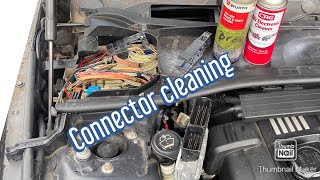
Typical fix: Clean the male and female pins thoroughly with an electrical contact cleaner and a small brush. Apply dielectric grease 🎬 See how to properly clean and protect electrical connectors. to the pins before reconnecting to prevent future moisture intrusion.
Est. part cost: $5-$25 - Failed Left Rear Wheel Hub & Bearing Assembly 🟡 Medium Probability The wheel speed sensor is integrated into the hub assembly. These sensors are exposed to harsh conditions (heat, vibration, moisture) and can fail internally over time. Aftermarket hubs have also been reported to be defective out of the box or fail prematurely.
How to confirm: After confirming all wiring and connectors are good, use a scan tool to monitor live wheel speed data. If the left rear wheel shows 0 MPH or an erratic signal while the others read correctly, the hub assembly is the cause. A multimeter can also be used to check for resistance across the sensor's pins (should be 850-1350 ohms) or for AC voltage output while spinning the wheel (should be >100mV AC).
Typical fix: Replace the entire left rear wheel hub and bearing assembly. Using a quality OEM (ACDelco) or reputable aftermarket (Timken, MOOG, SKF) part is recommended.
Est. part cost: $150-$400 - Damaged Wiring Harness ⚪ Low Probability The harness can be damaged by road debris, improper jacking, or chafing against suspension or frame components, particularly where the loom runs through the torque tube area.
How to confirm: Perform a continuity test on the two wires (typically Tan and Orange) running from the wheel speed sensor connector to the EBCM connector. Check for an open circuit (no continuity) or a short to ground.
Typical fix: Repair the broken or shorted section of wire. In severe cases, a new harness section may be needed.
Est. part cost: $10-$100
Rare But Worth Checking
- Faulty Electronic Brake Control Module (EBCM): This is the computer for the brake system. It's expensive and rarely the cause. It should only 🎬 Watch: How to locate and clean critical Corvette ground points. be considered after all wiring, connectors, and the hub assembly have been ruled out as the problem. Inspecting the main EBCM connector for corrosion is a prerequisite.
- Debris on Magnetic Encoder Ring: Metallic debris can accumulate on the magnetic ring that is part of the hub, interfering with the sensor's reading. While cleaning is possible, the debris often indicates a failing bearing that will soon require hub replacement anyway.
Diagnosis Steps
- Connect an ABS-capable scan tool and confirm C0045 is the active code.
- Use the scan tool's live data function to monitor the speed of all four wheels while driving. Confirm the left rear sensor reads 0 or has an erratic signal compared to the others.
- Raise and secure the vehicle. Remove the left rear wheel.
- Visually inspect the wiring harness leading from the hub. Look for any signs of chafing, melting, or physical damage.
- Disconnect the electrical connector at the hub. Inspect for corrosion, bent pins, or moisture. Clean with electrical contact cleaner and apply dielectric grease.
- Crucial Step: Locate connector C184 on the passenger side firewall, about halfway down the side of the battery. Disconnect the battery, then disconnect C184 and inspect it thoroughly for corrosion. Clean with contact cleaner and apply dielectric grease before reconnecting.
- Locate the EBCM in the front of the engine bay, on the driver's side frame rail below the engine. Disconnect its main harness connector and inspect it for corrosion, cleaning as needed.
- If cleaning connectors does not resolve the issue, perform a continuity test on the two wires (Tan & Orange) between the hub connector and the EBCM connector to check for breaks or shorts to ground. Remember to test through the C184 connector as well.
- If the entire wiring circuit is confirmed to be good, the fault lies within the wheel hub/sensor assembly.
- Replace the left rear wheel hub assembly. 🎬 Watch: Step-by-step guide to replacing the rear wheel hub assembly. Clear the codes and perform a test drive to confirm the repair.
Parts You'll Likely Need
- Rear Wheel Hub and Bearing Assembly
(OEM #ACDelco FW420 (for 2009-2013 Base/Z06), ACDelco 25821961 (for 2005-2008))— The wheel speed sensor is integrated into this assembly on the C6 Corvette. If the sensor fails, the entire unit must be replaced.
Trusted brands: ACDelco, Timken, MOOG, SKF
OEM price range: $250-$400
Aftermarket price range: $150-$250 - Electrical Contact Cleaner — Essential for cleaning corroded connectors, which is a highly common cause of this code before resorting to parts replacement.
Trusted brands: CRC, WD-40 Specialist
OEM price range: $10-$15
Aftermarket price range: $8-$12
Related Codes That Often Appear With This One
- C0050 — This is the code for the Right Rear Wheel Speed Sensor. If both C0045 and C0050 appear together, it strongly suggests a shared problem like a bad EBCM ground, a faulty EBCM, or an issue with the C184 intermediate connector, which both rear sensor circuits pass through.
Platform-Specific Known Issues
- Intermediate Connector C184 Corrosion: The wiring for both rear wheel speed sensors passes through a single intermediate connector, C184, located near the battery on the passenger side firewall. This connector is a known weak point for water intrusion and corrosion, frequently causing C0045 and/or C0050 codes. Many owners have needlessly replaced wheel hubs before discovering the issue was in this connector.
Technical Service Bulletins (TSBs) & Recalls
- Bulletin #PIT5499B: A manufacturer service bulletin notes that technicians may find code C0045 and should inspect the Electronic Brake Control Module connector for water intrusion or corrosion.
- Bulletin #PIT5427B: This bulletin suggests that when C0045 is stored, technicians should inspect the X411 connector for damage, which can lead to hard steering or service suspension messages.
- Bulletin #PIE0533A: This engineering information revision notes that field data collection has concluded regarding wheel speed sensors becoming inoperative with DTC C0045.
Mechanic-Grade Diagnostic Values
- Wheel Speed Sensor Resistance (2005-2008 Passive Sensor) — expected: 850 - 1350 Ohms. Failure: Reading is open (infinite resistance) or far outside the expected range.
- Wheel Speed Sensor AC Voltage Output (2005-2008 Passive Sensor) — expected: >100mV AC, typically around 1.0V AC when spinning the wheel by hand.. Failure: Voltage is less than 0.5V AC or zero, indicating a dead sensor.
- Active Sensor Circuit Integrity Pulse (2009-2013 Active Sensor) — expected: A momentary 12-volt pulse at the sensor connector immediately after the EBCM wakes up (e.g., at key-on).. Failure: No 12-volt pulse is detected. This indicates a wiring issue or, if wiring is good, a faulty EBCM.
- Active Sensor Current Draw (2009-2013 Active Sensor) — expected: The sensor should draw between 4-8 mA in its 'low' state and 11-16 mA in its 'high' state.. Failure: Current draw is outside these ranges, indicating a faulty sensor.
Hidden / Shadow Codes Worth Checking
- C0045 06: Indicates Left Rear Wheel Speed Sensor Circuit Low Voltage/Open. This sub-code points specifically to a wiring break, poor connection, or a short to ground. (see via A professional scan tool like the GM Tech 2 or GDS2 that can read ABS symptom bytes (sub-codes).)
- C0045 0F: Indicates Left Rear Wheel Speed Sensor Circuit Signal Erratic. This sub-code often points to a damaged magnetic encoder ring on the hub, metallic debris on the sensor, or electrical interference. (see via A professional scan tool like the GM Tech 2 or GDS2 that can read ABS symptom bytes (sub-codes).)
Scan Tool Commands That Help
- GM Tech 2 / GDS2: Live Data > EBCM > Wheel Speed Sensors — This is the primary method to confirm the fault. It allows you to view the speed reported by all four sensors in real-time while driving. A reading of 0 MPH or an erratic signal from the left rear wheel, while others read correctly, confirms the location of the problem.
- GM Tech 2 / GDS2: Module Diagnostics > EBCM > Diagnostic Procedures — To follow guided diagnostic steps as outlined in GM service information, including checks for circuit integrity that may involve observing EBCM behavior after clearing codes.
Wiring & Ground Locations
- EBCM Connector Pins A5 & A6 — On the main connector of the Electronic Brake Control Module (EBCM), located on the driver's side frame rail in the engine bay.. These are the specific pins for the Left Rear Wheel Speed Sensor circuit. Pin A5 is the signal wire (Tan) and Pin A6 is the low reference wire (Orange). All continuity and voltage tests for this circuit terminate here.
- Connector C184 — On the passenger side firewall, located about halfway down the side of the battery.. This is the intermediate connector that the wiring for BOTH rear wheel speed sensors passes through. It is a notorious failure point for corrosion, causing C0045 and C0050. The Tan and Orange wires for the left rear sensor must be inspected at this connector.
- Ground G103 — On the frame rail, just below the brake booster on the driver's side.. This is a primary ground point for the EBCM. A poor connection here can cause various erratic ABS faults, including false wheel speed sensor codes. While documented more for the C5, the C6 architecture is similar, making it a valid check point.
- Ground G108 — On the frame rail near the battery, may require battery removal to access.. Another ground point associated with the EBCM system. Like G103, ensuring it is clean and tight is critical for stable EBCM operation.
Real Owner Repair Stories
- CorvetteForum user 'powercorvette' (2005 Chevrolet Corvette) — Service ABS, Service Traction Control, Service Active Handling lights with code C0045.
❌ Tried (didn't work) Cleaning the connector at the wheel speed sensor., Replacing the entire left rear wheel hub assembly with a new MOOG part.
✅ What actually fixed it The code remained after replacing the hub. The final fix was locating and cleaning the intermediate connector (C184) located next to the battery on the passenger side firewall. After spraying the connector with electronic cleaner, the code was cleared and did not return. - NHTSA ODI #11165895 — An owner reported that their service center suggested replacing the L/R hub bearing assembly for code C0045, though they noted that various online references indicate the solution for others can vary significantly.
- NHTSA ODI #11399819 — A report describes a vehicle where multiple fuel level sensors were installed but codes P0463 and C0045 continued to return.
When the Usual Fixes Don't Work
- Multiple owners have reported that replacing the left rear wheel hub assembly—the most direct component related to the code—did not resolve the C0045 fault. In a significant number of these cases, the root cause was later found to be corrosion in the C184 intermediate wiring connector located on the passenger-side firewall. This demonstrates that a 'bad part' is often a 'bad connection' on this platform.
OEM Part Supersession History
ACDelco 25821961 (or equivalent)→ACDelco FW420 (or equivalent)— In 2009, the Corvette's ABS system was changed from a Delphi unit to a Bosch unit. This change also involved switching from passive 2-wire variable reluctance (VR) sensors to active 2-wire magneto-resistive (MR) sensors.
Heads up: The hubs for 2005-2008 and 2009-2013 are NOT interchangeable. Installing a hub from the wrong year range will result in an immediate ABS fault code, as the sensor type is incompatible with the vehicle's EBCM. The connectors may also differ.
Model Year Variations Within This Range
- 2005-2008: These models use a Delphi ABS system with passive wheel speed sensors. Diagnosis involves checking for resistance (850-1350 Ohms) and AC voltage generation while spinning the wheel.
- 2009-2013: These models use a Bosch ABS system with active (powered) wheel speed sensors. Diagnosis is different; instead of resistance, technicians must check for a 12V supply from the EBCM and a specific current draw signal (4-16 mA). The hubs are physically and electronically incompatible with earlier models.
- 2010-2013 (Grand Sport, Z06, ZR1): While the electronic sensor changeover in 2009 is the primary factor for this code, be aware that wide-body models (Grand Sport, Z06, ZR1) may have different axle spline counts than base models, affecting hub compatibility from a mechanical standpoint if more than just the hub is being replaced.
Diagnostic Flowchart
Other Known Issues on This Vehicle
Issues unrelated to this code that are worth knowing about as an owner of this generation:
- Harmonic Balancer Wobble/Failure 🔴 High — Common across all years, especially LS2/LS3 engines. The rubber elastomer bonding the inner and outer rings fails, causing a wobble that can throw the serpentine belt and damage other components. (Ref: TSB #05-06-01-001A was issued for early 2005 models for a loose bolt, but the delamination issue is more widespread.)
- Fuel Sending Unit/Gauge Inaccuracy 🟠 Medium — Very common. The contacts on the fuel level sender inside the tank wear out, causing the fuel gauge to read empty, especially after a fill-up, and triggering codes like P2068. Repair is labor-intensive as it requires dropping the fuel tanks.
- Removable Roof Panel Delamination ('Flying Roof') 🔴 High — Widespread on 2005-2007 coupes with the painted targa top. The adhesive fails, causing the outer roof skin to separate from the frame, potentially detaching at speed. (Ref: GM Recall 090230 (NHTSA #09V432000) was issued to replace the affected roof panels.)
- Service Active Handling System (Steering Position Sensor) 🟠 Medium — Common on 2005-2008 models. The connector for the steering wheel position sensor can become loose, causing the car to mistakenly apply a brake and pull to one side. (Ref: TSB #06-02-35-002B addresses this by having a clip installed on the connector.)
- Shifter Stuck in Park (Automatic Transmission) 🟡 Low — Affects 2005-2007 models with automatic transmissions. A microswitch in the shifter assembly fails, preventing the car from being shifted out of Park.
- LS7 Engine Valve Guide Wear (Z06 models) 🔴 High — A known, serious issue specific to the 7.0L LS7 engine in the Z06. Excessive wear in the valve guides can lead to catastrophic engine failure if not addressed.
Used vs. New Parts: Buying Guide for This Vehicle
When a used part is the smart pick: A used part is a smart choice for wiring components. If the harness is damaged or a connector like C184 is broken, sourcing a used 'pigtail' or harness section from a salvage yard is a cost-effective and reliable repair. A used EBCM can also be an option, but it will likely require programming to the vehicle's VIN.
Donor-vehicle mileage cap: roughly under 100000 miles for the part to have meaningful remaining life.
What to inspect on the donor part:
- For wiring/connectors: Inspect for any signs of corrosion (green or white powder), brittle plastic, or previous repair attempts (e.g., tape, butt connectors).
- Ensure the locking tabs on connectors are intact.
- For a used EBCM: Check for physical damage or heavy corrosion on the case and connector pins. Try to get history on the donor vehicle if possible (e.g., was it a flood car?).
OEM-only on this vehicle (don't cheap out):
- Electronic Brake Control Module (EBCM): While remanufactured units are available, a new OEM or professionally remanufactured unit from a reputable source is highly recommended over a used one due to the component's complexity and safety-critical function.
Aftermarket brands forum-validated for this vehicle:
- Wheel Hub Assembly: Timken, MOOG, SKF, and ACDelco (OEM) are consistently recommended on forums for their quality and reliability.
Brands owners have reported issues with on this vehicle:
- Unbranded or 'white-box' hub assemblies from online marketplaces. Owners report higher rates of premature failure or dead-on-arrival sensors with these cheaper alternatives, leading to doing the job twice.
Real Owner Stories
Aggregated from forums and TSBs cited above. Mileages and costs reflect what owners reported in those sources.
2008 Corvette Base
Symptoms: The owner was experiencing a C0045 code and found that replacing the wheel hub assembly did not resolve the issue.
What fixed it: Investigation of the wiring harness and its connections back to the EBCM.
Source hint: CorvetteForum - 'c0045 on 08 base'
C6 Corvette
Symptoms: Owner replaced the wheel speed sensor/hub but was still getting the C0045 code. The DIC displayed 'Service ABS' and 'Service Traction Control'.
What fixed it: Cleaning the C184 connector on the passenger side firewall near the battery. The pins for the Tan and Orange wires were inspected for corrosion.
Source hint: CorvetteForum - 'Replaced Wheel Speed sensor and Still Getting C0045 code'
Related OBD-II Codes
Frequently Asked Questions
I already replaced the left rear wheel hub on my C6 Corvette, but the C0045 code and 'Service ABS' message won't go away. What else could it be?
Which wires should I check for the left rear wheel speed sensor circuit on my Corvette?
Is there a recall for the 'Service Active Handling' message on my 2005-2008 Corvette?
What are the resistance specifications for a healthy Corvette rear wheel speed sensor?
Can I use an aftermarket wheel hub to fix the C0045 code?
Helpful Videos

We Have This Part in Stock


The information in this article is provided for general reference and educational purposes only. Vehicle specifications, procedures, and part compatibility can vary by production date, trim level, and region. Always consult your vehicle's factory service manual and verify part numbers before purchasing or performing repairs. Safety-critical components such as airbags, seat belts, and braking systems should be installed by a qualified professional.
- Chevrolet Corvette:
- 🎬 Helpful Videos
- 🛍️ Shop This Part
- What's Unique About the 2005-2013 Chevrolet Corvette
- Symptoms You May Notice
- Most Likely Causes
- Rare But Worth Checking
- Diagnosis Steps
- Parts You'll Likely Need
- Related Codes That Often Appear With This One
- Platform-Specific Known Issues
- Technical Service Bulletins (TSBs) & Recalls
- Mechanic-Grade Diagnostic Values
- Hidden / Shadow Codes Worth Checking
- Scan Tool Commands That Help
- Wiring & Ground Locations
- Real Owner Repair Stories
- When the Usual Fixes Don't Work
- OEM Part Supersession History
- Model Year Variations Within This Range
- Diagnostic Flowchart
- Other Known Issues on This Vehicle
- Used vs. New Parts: Buying Guide for This Vehicle
- Real Owner Stories
- 2008 Corvette Base
- C6 Corvette
- Related OBD-II Codes
- Frequently Asked Questions
- 🎟️ Get 5% Off