

C0040 on 2003-2024 GMC Savana: Right Front Wheel Speed Sensor Fixes
Code C0040 on a GMC Savana indicates a problem with the right front wheel speed sensor circuit. This usually means the sensor itself has failed, the wiring to it is damaged, or the wheel hub assembly is worn. The wiring harness is a particularly common failure point. Expect to pay $25-$75 for a new sensor or harness, and $120-$250 for a complete wheel hub assembly, which is the most common and comprehensive repair.
- Code C0040 means there's a fault with the right front wheel speed sensor circuit, which disables your ABS and stability control.
- The most common causes are a failed wheel speed sensor, damaged wiring to the sensor, or a worn-out wheel hub/bearing assembly.
- A proper diagnosis starts with an ABS-capable scan tool to read live data from all four wheels.
- Because this fault affects braking safety systems, it should be addressed promptly.
- On many Savanas, the sensor is part of the wheel hub assembly, so the entire hub is often replaced to fix the issue.
What's Unique About the 2003-2024 GMC Savana
The GMC Savana has had a very long production run on the same basic platform (GMT610), meaning the design of the wheel speed sensor and hub assembly is similar across many model years. These vans are work vehicles, often subjected to harsh conditions, which makes the exposed wiring for the wheel speed sensors particularly vulnerable to damage from road debris, corrosion, and repeated stress from suspension movement and turning. Forum discussions frequently point to the short wiring pigtail between the hub and the frame connector as the primary culprit, often failing internally even when it looks fine externally. Additionally, rust buildup on the sensor mounting surface can increase the air gap to the reluctor ring, causing low-speed ABS activation, a known issue addressed by GM TSB 03-05-25-007D.
Generation note: The 2003-2024 GMC Savana is part of a single generation (GMT610), though there have been powertrain and electronic updates. The fundamental design of the wheel speed sensors and hub assemblies is consistent across this range. Early models may have two-wire passive sensors, while later models may use three-wire active sensors, but the diagnostic principle is the same. The issue is also identical on its platform mate, the Chevrolet Express.
Symptoms You May Notice
- ABS warning light is on
- StabiliTrak or Traction Control warning light is on
- "Service Stability System" or similar message on the driver information center
- ABS system may not activate during hard braking, leading to wheel lockup
- Traction control may not function on slippery surfaces
- Unwanted ABS activation at very low speeds (under 5 mph), sometimes caused by rust buildup.
- Replacing the EBCM before thoroughly testing the sensor and wiring.
- Replacing the wheel speed sensor/hub assembly when the actual problem is a simple, inexpensive wiring pigtail failure.
- Replacing just the sensor when a worn wheel bearing is the root cause of the signal failure.
Most Likely Causes
- Damaged Wiring or Connector 🔴 High Probability The wiring harness that runs from the frame to the wheel hub is constantly flexing and exposed to the elements. Internal wire breakage from metal fatigue is extremely common, even if the outer insulation looks intact. The connector itself can also corrode. This is a widely discussed failure point in owner forums for Savana and Express vans.
How to confirm: Visually inspect the wiring from the back of the wheel hub up into the engine bay. Look for chafed wires, broken insulation, or corrosion. A common failure point is right where the harness flexes. With the connector unplugged, use a multimeter to check for continuity through the wires. A good diagnostic technique is to gently pull on each wire; a broken internal wire will stretch like a rubber band.
Typical fix: Repair the damaged section of wiring or, more reliably, replace the pigtail connector harness. Dorman and ACDelco offer replacement harnesses.
Est. part cost: $15 - $40 for a pigtail connector. - Faulty Right Front Wheel Speed Sensor / Hub Assembly 🔴 High Probability The sensor is integrated into the wheel hub assembly. The sensor's magnetic encoder ring can get contaminated with metallic debris or rust, or the bearing itself can wear out. A worn bearing causes excessive play ('wobble'), which alters the gap between the sensor and the reluctor ring, leading to an erratic or lost signal.
How to confirm: Use an OBD-II scanner with live data to monitor all four wheel speeds while driving. If the right front sensor reads 0 MPH or shows an erratic signal compared to the others, the issue is in that corner. With the front of the vehicle safely raised, grasp the tire at 12 and 6 o'clock and try to rock it. Any noticeable play indicates a bad bearing.
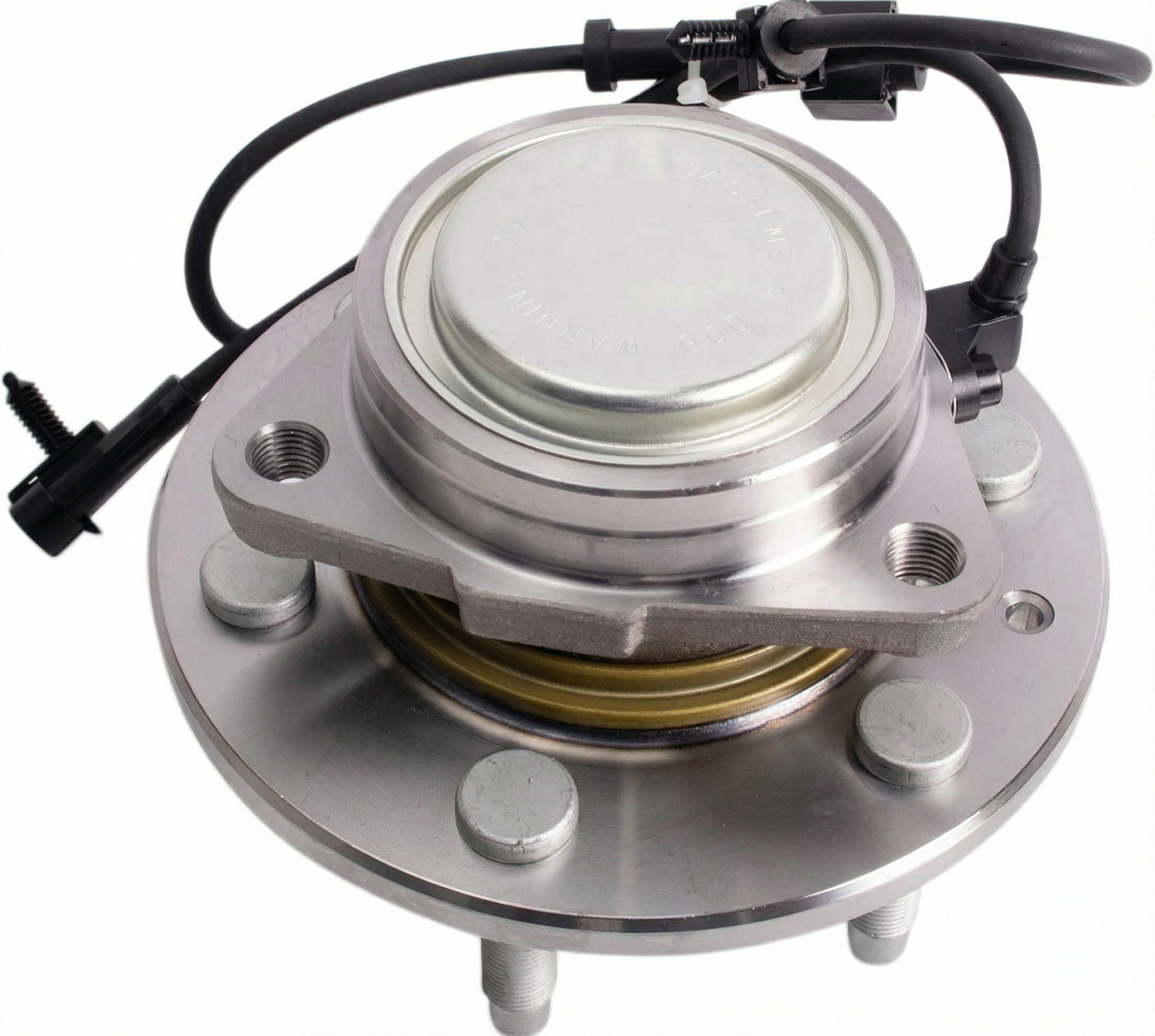
Typical fix: Replace the entire right front wheel hub and bearing assembly. This is the most common and comprehensive repair as it includes a new bearing, sensor, and reluctor ring.
Est. part cost: $120 - $250 for a complete wheel hub assembly. - Rust and Debris Buildup 🟡 Medium Probability As work vehicles exposed to all weather, rust can build up on the hub surface where the wheel speed sensor mounts. This increases the air gap between the sensor and the reluctor ring, weakening the signal. This specific issue is documented in GM TSB 03-05-25-007D.
How to confirm: This issue often presents as unwanted ABS activation at low speeds (under 5 mph) without setting a DTC, but it can also contribute to a C0040 code. The fix is to remove the sensor and thoroughly clean the mounting surface on the hub with a wire brush or emery cloth.
Typical fix: Remove the wheel speed sensor (if separate) and clean its mounting surface on the steering knuckle/hub to restore the correct air gap.
Est. part cost: $0 if DIY, or minimal labor cost.
Rare But Worth Checking
- Faulty Electronic Brake Control Module (EBCM): This is rare and should only be considered after the sensor, wiring, and hub have been ruled out. TSB PIT5499B notes that water intrusion into the EBCM connector can cause this family of codes on other GMC models. If multiple wheel speed sensor codes (e.g., C0035, C0040) are present simultaneously, the EBCM or its ground connection becomes a more likely suspect.
- Metal Debris on Magnetic Encoder: Metal shavings from brake work or bearing wear can stick to the magnetic encoder ring on the wheel bearing, causing an erratic signal. When replacing the sensor or inspecting the hub, carefully clean the encoder surface. Do not use a magnet to clean it, as this can damage the magnetic encoding.
Diagnosis Steps
- Connect an ABS-capable OBD-II scanner to confirm code C0040 is present. Note any sub-codes (e.g., 0F, 18) as they provide more specific information about the fault type.
- Use the scanner's live data feature to monitor the wheel speed of all four wheels while driving slowly. The right front wheel speed should match the others. If it reads 0, is erratic, or lags behind, the issue is in that circuit.
- Safely raise and support the front of the vehicle. Visually inspect the entire wiring harness for the right front wheel speed sensor, from the wheel hub to where it connects to the main harness. Pay close attention to the flexible portion that moves with the steering.
- Gently pull on the individual wires within the harness pigtail. If a wire stretches, it is broken internally and the harness must be repaired or replaced.
- Check the wheel bearing for excessive play by rocking the tire from the 12 and 6 o'clock positions. Any significant movement indicates a worn hub assembly that requires replacement.
- Disconnect the sensor connector. Inspect for corrosion or bent pins. If the wiring looks good, you can test the sensor and circuit with a multimeter following the vehicle's service manual procedures. For older passive sensors, you can check for AC voltage while spinning the wheel.
- If the sensor is removable, take it out and inspect the mounting surface on the hub for rust or debris buildup, as noted in TSB 03-05-25-007D. Clean it thoroughly.
- If a new sensor/hub assembly and confirmed good wiring do not resolve the code, the problem may lie with the Electronic Brake Control Module (EBCM), which requires professional diagnosis.
Parts You'll Likely Need
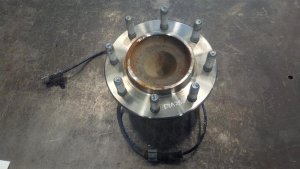
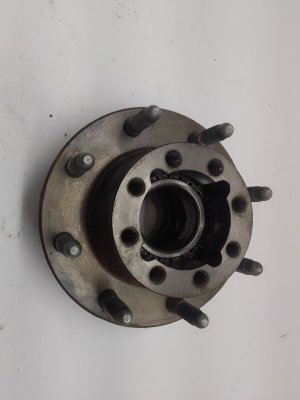
- Front Wheel Hub and Bearing Assembly
(OEM #ACDelco 515036A (fits many 2003-2014 1500/2500 models, verify by VIN))— On most modern vehicles, including the Savana, the wheel speed sensor and/or the magnetic reluctor ring are integrated into the hub assembly. A worn bearing is also a common cause, so replacing the entire hub is often the most effective and long-lasting repair.
Trusted brands: ACDelco, Timken, MOOG, SKF
OEM price range: $200-$300
Aftermarket price range: $120-$250
Related Codes That Often Appear With This One
- C0035 — This is the code for the Left Front Wheel Speed Sensor Circuit. Seeing both C0035 and C0040 could point towards a systemic issue like a problem with the EBCM, its connector, a shared power/ground circuit, or a common wiring harness chafe point.
- U0121 — This code means 'Lost Communication With Anti-Lock Brake System (ABS) Control Module'. It can appear alongside C0040 if the EBCM is failing or has a major electrical issue, as mentioned in TSB PIT5499B.
- C0040 with sub-codes (0F, 18, 5A) — Advanced scanners may show symptom bytes. '0F' indicates an erratic signal (often debris/wiring), '18' means a missing signal (open circuit/bad sensor), and '5A' suggests an implausible signal compared to other sensors. These provide more specific diagnostic clues.
Technical Service Bulletins (TSBs) & Recalls
- 03-05-25-007D: Directly addresses the Savana/Express, noting that rust buildup on the wheel speed sensor mounting surface can cause unwanted ABS activation at low speeds. The fix is to remove the sensor and clean the surface.
- PIT5499B: While for other GMC models, it shows a pattern of C00xx codes being caused by water intrusion in the EBCM connector, which is relevant if the hub and wiring are confirmed good.
- PIT5190: On a different GMC model, this TSB links C0040 directly to a faulty wheel speed sensor requiring inspection and potential replacement.
Platform-Specific Known Issues
- Wiring Harness Failure at Flex Point: Owners on forums like ChevroletForum.com report that the wires inside the pigtail harness break internally from the stress of the wheel turning back and forth. A user with a 2006 van with over 300k miles fixed his recurring ABS codes by replacing both front harnesses. Another video shows that even if the wires look good, they can be broken inside and will stretch when pulled.
- Rust Buildup Causing False ABS Activation: GM TSB 03-05-25-007D specifically calls out the Savana/Express platform for an issue where rust on the sensor mounting surface increases the air gap, causing ABS to engage at low speeds. A complaint filed with the NHTSA describes this exact scenario on a 2005 model, where the owner experienced no stopping power at low speeds due to this issue.
Mechanic-Grade Diagnostic Values
- Passive (2-wire) Wheel Speed Sensor AC Voltage Output — expected: 50mV - 700mV AC (0.05V - 0.7V AC). Failure: No voltage or erratic voltage is produced when spinning the wheel by hand.
- Passive (2-wire) Wheel Speed Sensor Resistance — expected: Approximately 800 - 2,500 Ohms (Varies by manufacturer, comparison with the known-good sensor on the other side is recommended).. Failure: A reading of infinite resistance (Open Loop) or zero resistance (short) indicates a failed sensor.
Hidden / Shadow Codes Worth Checking
- C0040 01: Indicates the EBCM has detected a short to ground in the 5V reference circuit for the right front wheel speed sensor. (see via An ABS-capable scanner, such as a GM Tech 2 or high-end aftermarket tool like a Foxwell or Autel, is required.)
- C0040 05: Indicates the EBCM has detected a short to voltage or an open circuit on the 5V reference or low reference circuit. (see via An ABS-capable scanner, such as a GM Tech 2 or high-end aftermarket tool.)
- C0040 0F: Indicates the EBCM has detected an erratic signal. This often points to a wiring issue, debris on the sensor, or a failing wheel bearing causing excessive movement. (see via An ABS-capable scanner, such as a GM Tech 2 or high-end aftermarket tool.)
- C0040 18: Indicates the signal amplitude from the sensor is below the minimum threshold, often meaning the sensor has failed or the air gap is too large. (see via An ABS-capable scanner, such as a GM Tech 2 or high-end aftermarket tool.)
Scan Tool Commands That Help
- GM GDS2 / Tech 2 or equivalent: Diagnostic Data Display for EBCM — This is the primary function for diagnosing C0040. It allows a technician to view the live data stream from all four wheel speed sensors simultaneously while the vehicle is driven. A faulty sensor will read 0 mph or show erratic values compared to the others.
- High-end bidirectional scanner (Autel, Foxwell, etc.): Active Test / Actuator Test — While not directly testing the sensor input, bidirectional control allows a technician to command the ABS pump and solenoids to activate. This can help confirm the EBCM is capable of functioning, which is useful if the module itself is suspected.
Wiring & Ground Locations
- EBCM (Electronic Brake Control Module) — Bolted to the left frame rail, near the center of the vehicle. It is part of the hydraulic brake pressure modulator valve assembly.. This module receives the signal from the right front wheel speed sensor. The connector at the EBCM is a key place to test the circuit for opens or shorts coming from the sensor.
- G300 — On the left frame rail, near the EBCM.. This is a primary ground point for the EBCM. A loose or corroded G300 can cause a host of ABS-related codes, including C0040, due to an unstable ground reference for the module.
- G103 / G104 — G103 is often on the rear of the passenger side cylinder head. G104 is often on the rear of the driver's side cylinder head. Locations can vary slightly by year and engine.. These are major engine and chassis grounds. While not directly for the WSS, poor grounds at these locations can introduce electrical noise and voltage stability problems that can affect sensitive modules like the EBCM, as noted in GM service bulletins for other electrical issues.
Real Owner Repair Stories
- Car Talk Community Forum (General GM vehicle, applicable to Savana/Express) — ABS code C0040 for the right front sensor circuit.
❌ Tried (didn't work) Initial assumption was the sensor in the wheel hub was bad.
✅ What actually fixed it The problem was identified as the short wiring harness that runs from the wheel bearing to the plug at the fender liner. Testing for continuity on this harness revealed an open circuit (a broken wire).
Model Year Variations Within This Range
- 2003-2004 (pre-StabiliTrak on most models): Early models in this range were primarily equipped with four-wheel ABS only. The wheel speed sensor's only function was for anti-lock braking.
- 2004-2005 and later: StabiliTrak (GM's electronic stability control) became standard on 15-passenger vans starting in late 2003 for the 2004 model year, and on 12-passenger vans for the 2005 model year. For these vehicles, the C0040 code also disables the stability control system, making the fault more critical.
- 2011 and later: By 2011-2012, StabiliTrak was standard on virtually all GM vehicles, including all Savana configurations. The sensor and circuit are more deeply integrated with other vehicle systems. The sensors are more likely to be three-wire active sensors rather than two-wire passive sensors on later models.
Diagnostic Flowchart
Other Known Issues on This Vehicle
Issues unrelated to this code that are worth knowing about as an owner of this generation:
- Fuel Pump Failure 🔴 High — Common across many model years. GM issued Special Coverage Adjustment #14634 for 2010-2014 models due to overheating terminals on the fuel pump module. Other TSBs address failures in extreme heat (#17-NA-335) and cold (#18-NA-103). A service update (N232425850) was also issued for 2023-2024 models for an improperly clipped connector on the fuel pump module. (Ref: 14634, 17-NA-335, 18-NA-103, N232425850)
- Transmission Problems (4L60E/4L65E/8-Speed) 🟠 Medium — Older models with 4L60E/4L65E transmissions are known for issues like getting stuck in 3rd gear or harsh 1-2 shifts. Newer models (2022-2023) with the 8-speed transmission were recalled for software issues causing harsh shifts or wheel lockup. An NHTSA investigation into 8-speed transmission failures was closed without a recall, but problems persist. (Ref: Recall for 2022-2023 8-speed models)
- Active Fuel Management (AFM) Lifter Failure 🔴 High — On V8 models equipped with AFM (Displacement on Demand), lifter failure is a well-documented problem. It is often linked to oil maintenance but can occur even on well-maintained engines. This can lead to misfires, engine noise, and potentially catastrophic engine damage. (Ref: Various GM service bulletins exist regarding valvetrain problems.)
- EVAP System Clogging 🟡 Low — For vehicles frequently driven on gravel or dirt roads, the EVAP canister filter is prone to clogging with dust, which can lead to check engine lights and difficulty filling the fuel tank.
Used vs. New Parts: Buying Guide for This Vehicle
When a used part is the smart pick: A used wiring pigtail from a junkyard can be a cost-effective fix if the failure is confirmed to be the harness and not the hub. It is a simple electrical component that does not wear out mechanically.
Donor-vehicle mileage cap: roughly under 100000 miles for the part to have meaningful remaining life.
What to inspect on the donor part:
- Inspect the donor harness for any signs of cracking, brittleness, or previous repairs.
- Ensure the locking tabs on the connector are intact.
- Check for corrosion on the connector pins.
- Gently pull on the wires to check for internal breaks, which is the most common failure mode.
OEM-only on this vehicle (don't cheap out):
- Electronic Brake Control Module (EBCM) - Used modules often require programming to the vehicle's VIN, which can be problematic. A new or professionally remanufactured unit is a safer bet.
Aftermarket brands forum-validated for this vehicle:
- Timken
- MOOG
- SKF
- ACDelco (Professional or Gold series)
Brands owners have reported issues with on this vehicle:
- No-name, unbranded 'white box' hub assemblies sold on online marketplaces are frequently cited in forums as having high failure rates, either due to poor quality bearings or inaccurate sensor outputs.
Real Owner Stories
Aggregated from forums and TSBs cited above. Mileages and costs reflect what owners reported in those sources.
2006 GMC Savana — 300000 miles
Symptoms: Recurring ABS codes despite the wheel bearings being in good condition.
What fixed it: Replaced both front ABS wire harnesses with Dorman replacements. The owner noted the failure was internal to the wires or connector and not visible externally.
Source hint: Chevrolet Forum: ABS Codes C0040, C0041
2005 GMC Savana
Symptoms: Experienced no stopping power at low speeds due to unwanted ABS engagement.
What fixed it: Cleaning the rust and debris buildup on the sensor mounting surface to restore the correct air gap as per TSB 03-05-25-007D.
Source hint: NHTSA complaint cited in vehicle_specific_issues
Related OBD-II Codes
Frequently Asked Questions
My 2005 GMC Savana is having trouble stopping at low speeds but no light is on; does TSB 03-05-25-007D apply?
The ABS wiring on my Savana looks fine visually. Could it still be the cause of my C0040 code?
What specific replacement parts are recommended for a damaged Savana wheel speed sensor harness?
Can a leveling kit on my GMC truck cause the C0040 code?
If I replace the wheel speed sensor, do I have to replace the whole hub on my Savana?
Is there a way to check if my Savana's wheel bearing is causing the C0040 code?
Helpful Videos

We Have This Part in Stock


The information in this article is provided for general reference and educational purposes only. Vehicle specifications, procedures, and part compatibility can vary by production date, trim level, and region. Always consult your vehicle's factory service manual and verify part numbers before purchasing or performing repairs. Safety-critical components such as airbags, seat belts, and braking systems should be installed by a qualified professional.
- GMC Savana:
- 🎬 Helpful Videos
- 🛍️ Shop This Part
- What's Unique About the 2003-2024 GMC Savana
- Symptoms You May Notice
- Most Likely Causes
- Rare But Worth Checking
- Diagnosis Steps
- Parts You'll Likely Need
- Related Codes That Often Appear With This One
- Technical Service Bulletins (TSBs) & Recalls
- Platform-Specific Known Issues
- Mechanic-Grade Diagnostic Values
- Hidden / Shadow Codes Worth Checking
- Scan Tool Commands That Help
- Wiring & Ground Locations
- Real Owner Repair Stories
- Model Year Variations Within This Range
- Diagnostic Flowchart
- Other Known Issues on This Vehicle
- Used vs. New Parts: Buying Guide for This Vehicle
- Real Owner Stories
- 2006 GMC Savana — 300000 miles
- 2005 GMC Savana
- Related OBD-II Codes
- Frequently Asked Questions
- 🎟️ Get 5% Off