

OBD-II Code C0039: Right Rear Tone Wheel Fault
The Ultimate 2026 Guide to Diagnosing and Fixing C0039
- Code C0039 disables your ABS and traction control, increasing stopping distances and skid risk during emergency braking.
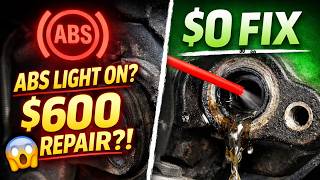
- Cleaning the right rear tone ring and sensor with a $5 can of brake cleaner resolves this code in over 30% of cases.
- Never replace the wheel speed sensor without first checking the wheel bearing for play; a loose bearing alters the sensor air gap and triggers the exact same code.
- Use an OBD-II scanner with live data capabilities to verify if the right rear wheel speed drops to 0 mph or fluctuates erratically before buying parts.
- Inspect the sensor mounting surface for 'rust jacking'—corrosion that pushes the sensor more than 1-2mm away from the tone ring, causing signal loss.
What Does C0039 Mean?

Code C0039 means the ABS control module detects an erratic, incorrect, or missing signal from the right rear tone wheel. The tone wheel (reluctor ring) features teeth or magnetic segments read by the wheel speed sensor to determine speed. This fault disables ABS and traction control because the system cannot accurately monitor the right rear wheel.
Technical definition: The SAE/ISO definition is "Right Rear Tone Wheel (Subfault)". This indicates the ABS module detects a general signal failure, incorrect frequency, or intermittent/missing signal from the right rear tone wheel circuit. Scanners sometimes provide sub-types like 'Mechanical Failure' (cracked ring) or 'General Signal Failure' (erratic signal).
Can I Drive With C0039?
Yes, But With Caution. Yes, but with caution. Your Anti-lock Braking System (ABS) and Traction/Stability Control systems are disabled. Your wheels will lock up during hard braking, increasing skid risk on wet or slippery surfaces. Standard hydraulic brakes function normally, but stopping distances increase. Repair promptly to restore these critical safety systems.
Common Causes

- Damaged or Contaminated Tone Ring (Very Common) — The tone ring's teeth are damaged, cracked, or clogged with rust and metallic debris. On magnetic encoder rings, debris sticks to the surface and corrupts the signal.
- Failed Right Rear Wheel Speed Sensor (Common) — The sensor fails internally due to age, heat, or moisture, or suffers physical damage from road debris.
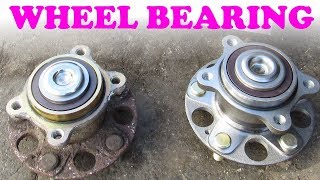
- Worn or Loose Wheel Bearing/Hub Assembly (Common) — A failing wheel bearing causes excessive play in the wheel hub. This alters the critical air gap between the sensor and tone ring, causing signal loss.
- Rust Jacking (Sensor Misalignment) (Less Common) — Corrosion builds up on the hub directly under the sensor mount. This rust physically pushes the sensor away from the tone ring, increasing the air gap and weakening the signal.
- Wiring or Connector Issues (Less Common) — Exposed wiring harnesses chafe, break, or corrode. Connector pins loosen or suffer contamination, interrupting the signal.
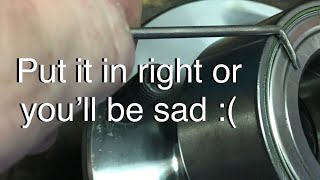
- Improper Service or Installation (Uncommon) — Technicians sometimes route the sensor wire improperly during brake jobs or install a magnetic encoder wheel bearing backward. 🎬 See how to correctly orient a press-in bearing with a magnetic ring.
- Faulty ABS Control Module (Rare) — The ABS module suffers an internal fault and cannot process incoming signals. Consider this only after exhausting all physical and electrical tests.
Symptoms

- ABS Light On — The ABS warning light illuminates and stays on the dashboard.
- Traction/Stability Control Light On — The Traction Control System (TCS) or Electronic Stability Control (ESC) light turns on, as these systems rely on wheel speed data.
- Loss of ABS and Traction Control — Brakes lock up during hard stops. Wheels spin without intervention when accelerating on slippery surfaces.
- Intermittent Warning Lights — Warning lights appear only at certain speeds or after hitting bumps, indicating a loose connection, cracked tone ring, or failing wheel bearing.
- Brake Pedal Pulsation — A faulty signal causes the ABS module to activate incorrectly at low speeds, creating a pulsating feeling in the brake pedal.
- Multiple Unrelated Warning Lights (VW/Audi) — On European vehicles, a single wheel speed sensor fault triggers a cascade of warnings, including ESC, electronic parking brake, and power steering errors.
Diagnostic Flowchart

Tap your situation to follow the diagnostic path that matches what you're seeing on this code.
Common Fixes & Costs
- Clean Tone Ring and Wheel Speed Sensor — Parts: $5-$15, Labor: $100-$150, ~1 hr book time (DIY)
- Replace Right Rear Wheel Speed Sensor
— Parts: $50-$200, Labor: $100-$160, ~1.2 hr book time
(DIY)
Ford F-150 (2021-2023): OEM ML3Z-15K857-A (Alt: Dorman, TRQ (BSA14215))
Ford Escape (2002-2012): OEM 8L8Z-2C190-A (Alt: Duralast (SU3356), Bosch) - Replace Rear Wheel Bearing/Hub Assembly
— Parts: $150-$400, Labor: $250-$500, ~1.8 hr book time
(Professional)
Ford F-150 (2021-2023): OEM ML3Z-1104-L (Alt: MOOG (515166), Timken)
Dodge / Ram 1500 (2019-2024): OEM 68303538AG (Alt: MOOG (515180), Timken) - Replace Tone Ring — Parts: $30-$250, Labor: $150-$250, ~2 hr book time (Intermediate)
- Repair or Replace ABS Module — Parts: $600-$1200, Labor: $200-$300, ~2 hr book time (Professional)
DIY vs Professional
- Clean Tone Ring and Wheel Speed Sensor — Beginner:
Tools: Jack, jack stands, lug wrench, basic socket set, brake cleaner, wire brush, flashlight. - Replace Right Rear Wheel Speed Sensor — Beginner:
Tools: Basic hand tools, socket set, torque wrench. - Replace Tone Ring (if separate) — Beginner:
Tools: Jack, jack stands, socket set, slide hammer or puller, press or bearing driver. - Replace Rear Wheel Bearing/Hub Assembly — Beginner:
Tools: Large breaker bar, axle nut socket, torque wrench, heavy hammer, hydraulic shop press.
Used vs. New Parts: Buying Guide
When a used part is worth it: Buying used parts for a wheel speed sensor or hub assembly is strongly discouraged. These are wear-and-tear items with unknown lifespans, and labor costs are too high to risk early failure.
Donor-vehicle mileage cap: roughly under 20000 miles for the part to have meaningful remaining life.
Donor quality checklist:
- Never buy a used wheel bearing or hub assembly.
- For a wheel speed sensor, only consider a used OEM part from a low-mileage vehicle wrecked for non-related reasons.
- Verify the part number exactly. Aftermarket sensors often fail to communicate with the ABS module.
Decision logic:
- If The fix is a wheel bearing/hub assembly → Always buy a new, high-quality aftermarket (Timken, SKF, MOOG) or OEM part. Avoid cheap, unbranded parts.
- If The fix is the wheel speed sensor → Buy a new OEM or reputable aftermarket (Bosch, NTK) sensor.
- If Vehicle is > 150K miles AND budget is tight → A quality new aftermarket hub assembly is a better value than a high-priced OEM part, and vastly superior to any used part.
Warranty tradeoff: Used parts: 30-90 day warranty. New Aftermarket: 1-year to limited lifetime. New OEM: 1-2 year warranty. Labor is never covered.
Worst-case if a used part fails: $300-$600 if a used part fails prematurely, requiring repeat labor.
What Happens If You Wait — Timeline
- 0-1 month (Code Appears): ABS and Traction Control lights are on. Systems are disabled. Vehicle brakes normally in non-emergency situations, but safety is compromised in slick conditions. (MPG impact: 0%% · Added cost: $0)
- 1-4 months (If Caused by Wheel Bearing): If caused by a failing wheel bearing, a humming or grinding noise begins above 30 mph and changes pitch when turning. (MPG impact: 1-3%% · Added cost: $50 in wasted fuel and potential for uneven tire wear ($150+).)
- 4-8 months (Worsening Bearing Failure): Grinding from the bad bearing becomes loud. The wheel develops noticeable play ('wobble'), causing vibrations and pulling. Risk of damaging the hub or axle spindle increases. (MPG impact: 3-5%% · Added cost: $250-$500 for a standard wheel bearing replacement. Hub damage increases cost to $1,000+.)
- 8+ months (Catastrophic Failure): The bearing seizes, locking up the wheel, or collapses, leading to the wheel and hub assembly separating from the vehicle at speed. (MPG impact: N/A% · Added cost: $1,500-$3,000+ for repairs to the axle, suspension, and brakes.)
Cost of Not Fixing It
- Immediate: ABS and Traction/Stability Control are disabled. Increased risk of skidding and loss of control in emergency braking or slippery conditions. (Added cost: 0 (but significantly increased risk of an accident))
- 1-6 months: Continued accident risk. Potential for uneven tire wear if the underlying issue is a bad wheel bearing. (Added cost: $0 - $250 (for tire wear))
- 6+ months: A complete failure of the associated wheel bearing (if that's the cause) leads to wheel separation from the vehicle. (Added cost: Potentially thousands in accident-related damages.)
Diagnosis Steps
- Read Codes & View Live Data
Use an ABS-capable OBD-II scanner to confirm C0039. View the live data stream for all four wheel speed sensors while driving slowly. The right rear sensor reading dropping to zero, jumping erratically, or not matching the others confirms the fault location.
Tools: ABS-capable OBD-II Scanner (Beginner) - Inspect and Clean Tone Ring & Sensor
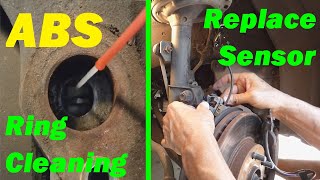
Safely raise the vehicle and remove the right rear wheel. Inspect the tone ring for broken teeth, cracks, or rust buildup. Check the sensor for physical damage and metallic debris. Clean the sensor mounting surface on the hub to remove 'rust jacking'. Clean both components with brake cleaner.
Tools: Jack, Jack Stands, Lug Wrench, Brake Cleaner, Wire Brush, Flashlight (Intermediate) - Check Wheel Bearing Play
Grasp the tire at the top and bottom and rock it back and forth. If you feel significant play or hear a grinding noise when spinning the wheel, the wheel bearing is bad, causing the tone ring to move out of alignment.
Tools: Jack, Jack Stands (Intermediate) - Visually Inspect Wiring
Inspect the sensor wiring for chafing, melting, or breaks from the sensor to where it enters the main harness. Perform a 'wiggle test' on the harness while monitoring live data to find intermittent breaks.
Tools: Flashlight (Beginner) - Test Sensor Wiring and Connector
Disconnect the sensor and check the connector for corrosion or bent pins. Check for continuity between the sensor connector and the ABS module connector if the problem persists.
Tools: Multimeter (Intermediate) - Pro Tip: Test Sensor Resistance/Voltage
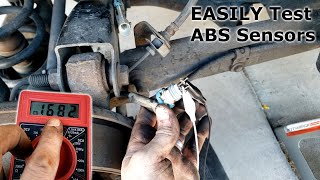
For passive (2-wire) sensors, measure resistance across the pins (typically 800-2,000 Ohms). An 'OL' or 0 Ohm reading indicates a bad sensor. For active (3-wire) sensors, check for a DC reference voltage (1.5V to 5V) from the ABS module with the key on.
Tools: Multimeter, Service Manual (Advanced) - Pro Tip: Analyze Signal with Oscilloscope
Connect an oscilloscope to the sensor's signal and ground wires. Spin the wheel. Gaps, dropouts, noise, or a misshapen waveform provide definitive proof of a fault in the tone ring or sensor.
Tools: Oscilloscope, Back-probe connectors (Advanced) - Final Verification
After repairs, clear the codes. Drive the vehicle above 15 mph to allow the ABS module to self-test. The warning lights should remain off.
Tools: ABS-capable OBD-II Scanner (Beginner)
When This Code Triggers (Freeze-Frame Conditions)
- Vehicle Speed: 40-65 mph (Detected during steady-state highway driving when the signal from one wheel unexpectedly drops out or fluctuates compared to the others.)
- Brake Pedal: Not Applied (Sets during normal driving, not necessarily during a braking event.)
- Engine RPM: 1500-2500 RPM (Typical engine speed during highway cruise when the fault registers.)
- System Voltage: 13.5-14.5 Volts (Occurs when the charging system operates normally, ruling out low voltage as the primary cause.)
Related Codes
- C003A — Points to a fault with the 'Right Rear Wheel Speed Sensor' circuit. C0039 often produces an erratic signal, while C003A shows a complete 'no signal'. They frequently appear together.
- C0037 — The equivalent code for the 'Left Rear Wheel Speed Sensor'. If both appear, check for mismatched tire sizes or a shared wiring harness issue.
- C0038 — Indicates a fault with the 'Left Rear Tone Wheel'. Seeing this alongside C0039 strongly suggests a problem common to both rear wheels, like an ABS module fault.
- C0051 — Code for the 'Steering Wheel Position Sensor'. Part of the same Vehicle Stability Control system and sometimes triggers diagnostic confusion.
Climate & Environmental Factors
- Cold Climates / Road Salt: Road salt accelerates corrosion of the tone ring, causing it to swell or crack. It also causes 'rust jacking' under the sensor mount, creating an air gap fault.
- High Humidity / Coastal Areas: Constant moisture promotes corrosion on the tone ring, sensor, and electrical connector pins, leading to intermittent signals.
- Rough Roads / Off-Road Use: Vibrations lead to wiring damage or fatigue cracks in a brittle tone ring. Road debris physically damages the sensor or packs into the tone ring.
How to Talk to a Mechanic About This Code
Say this: "I have an ABS light on and my scanner shows code C0039 for the right rear tone wheel. I'd like to schedule a diagnostic. Please check the live data from the wheel speed sensors, and perform a physical inspection of the tone ring, sensor, and wheel bearing before recommending part replacements."
This signals you understand common causes and prevents a shop from replacing the sensor without a proper diagnosis. It directs them to look for a cracked ring, debris, or a bad bearing, saving diagnostic time.
Avoid saying:
- 'My ABS light is on, can you fix it?'
- 'I think I need a new wheel speed sensor.'
- 'Just do whatever it takes to turn the light off.'
Questions to ask before authorizing the repair:
- Did you see the right rear wheel speed signal drop out on the live data scan?
- What did the physical inspection of the tone ring show? Are there cracks, debris, or rust buildup?
- Did you check for play in the wheel bearing? Is it tight and quiet?
- If the sensor needs replacement, what is the warranty on the part and labor?
Where to Take It: Dealer vs Independent vs Chain
- Dealer:
Recommended only if the vehicle is under warranty or has a known manufacturer-specific issue. Otherwise, an independent shop is more cost-effective.
Best for: Vehicles still under warranty., Very new models where independent shops lack updated diagnostic software., Complex, brand-specific issues (e.g., a known recall applies).
Downsides: Significantly higher labor rates and parts costs., May recommend replacing an entire hub assembly when only cleaning is needed. (Typical cost: +50% vs. baseline) - Independent Shop:
Best fit for most situations. This is a bread-and-butter repair for any competent independent shop.
Best for: Out-of-warranty vehicles where cost is a factor., Common faults like C0039, which are routine for experienced technicians., Building a relationship with a trusted mechanic.
Downsides: Quality varies; choose a shop with ASE-certified technicians., May lack specialized tools for brand-new models. (Typical cost: +0% vs. baseline) - Chain Shop:
Use with caution. Acceptable if you are certain only the sensor needs replacing. AVOID for initial diagnosis.
Best for: Simple, clear-cut part replacements if you have already diagnosed the issue yourself.
Downsides: Technician skill varies dramatically., High pressure to upsell services., May lack advanced diagnostic tools to differentiate between a bad sensor and a cracked ring. (Typical cost: -10% vs. baseline)
When to Walk Away From the Repair
If the estimated repair cost exceeds 40-50% of your car's private-party value, consider selling or trading it in.
- Car worth $4000, fix is $1800: Walk away. The repair cost is approaching half the car's value.
- Car worth $15000, fix is $800: Fix it. The repair cost is a small fraction of the vehicle's value and restores a critical safety feature.
- Car worth $2500, fix is $600: Borderline. If the car is otherwise in good condition, the repair is worth it. If it has other pending issues, sell as a 'mechanic special'.
What Scan Tool You Need for This Code

Minimum: A scanner that reads and clears ABS codes and displays live data for wheel speed sensors.
A standard $20 engine-only code reader will NOT see 'C' codes like C0039. You need a tool that accesses the ABS module and graphs live data.
Budget: BlueDriver Pro (~$100) — Connects to your smartphone via Bluetooth. Reads/clears ABS codes and graphs live wheel speed data from all four sensors.
Mid-range: Foxwell NT510 Elite (~$180) — A handheld unit offering manufacturer-specific diagnostics. Reads/clears ABS codes, shows live data, and offers bi-directional controls.
Professional: Autel MaxiCOM MK808S/MK808BT (~$450-550) — A professional tablet scanner with comprehensive diagnostics. Provides fast live data graphing, bi-directional control, and access to all vehicle modules.
Rent vs buy: If this is a one-time fix, AutoZone rents out ABS-capable scanners through their Loan-A-Tool program. Buying a budget pick is a good investment for future DIY diagnostics.
How to Clear the Code After You Fix It
- Use an ABS-capable OBD-II scan tool to clear the C0039 fault code.
- Perform a short test drive, exceeding 15 mph to allow the ABS system to run its self-test and confirm the light stays off.
- If the battery was disconnected, a full drive cycle is needed to get emissions readiness monitors to a 'Ready' state.
Drive cycle (~20 minutes): The ABS self-test is quick. Drive for 10-15 minutes at a mix of city and highway speeds, including turns and stops. The light should stay off. For emissions monitors (if battery disconnected): cold start, idle 5 min, 10 min city driving (25-40 mph), 5 min steady highway driving (55-60 mph).
Readiness monitors affected: This code does NOT affect emissions readiness monitors., Disconnecting the battery resets ALL emissions readiness monitors to 'Not Ready'.
Before emissions retest: drive at least 50 miles to fully set monitors.
Watch out for:
- Using a basic OBD-II scanner that cannot read or clear ABS codes.
- Clearing the code without fixing the root cause, causing the light to return immediately.
- Forgetting that disconnecting the battery requires a full drive cycle before passing a state emissions inspection.
Will This Fail Emissions / State Inspection?
No — by itself this code doesn't fail OBD inspection (but it can keep readiness monitors from setting, which causes a separate fail).
- California: Will NOT fail. California's smog check only fails for an illuminated Check Engine Light and emissions-related ('P') codes. An ABS light is ignored.
- New York: Likely to fail. New York considers an illuminated ABS warning light grounds for safety inspection failure. Check with your local station.
- Texas: Will NOT fail. The Texas vehicle safety inspection explicitly states that an illuminated ABS lamp is not a cause for rejection.
Most Commonly Affected Vehicles
- Ford F-150 (2021-2023) — Recall 23S35 addresses rear axle wiring harness chafing, damaging wheel speed sensor wires. On 2022+ models, debris buildup in the sensor bore is a known issue.
- Ford Escape (2002-2012) — Known for thin, brittle factory tone rings prone to cracking in rust-prone areas. A cracked ring is a very common cause for C0039.
- Dodge / Ram 1500 / 2500 / 3500 (2019-2024) — Cracked tone rings and faulty sensors are common. Recall 24V-653 addresses a related ABS module software malfunction.
- Chevrolet / GMC Silverado / Sierra (1999-2007) — Highly susceptible to 'rust jacking' on the hub underneath the wheel speed sensor, pushing it away from the tone ring.
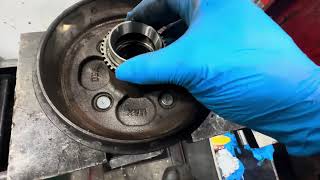
- Honda CR-V / Element (2002-2006) — The tone ring is integrated into the wheel bearing. Sensors notoriously seize in the knuckle, requiring drilling to remove.
- Toyota 4Runner, Tacoma (2003-2015) — Susceptible to corrosion on wiring harness connectors and 'rust jacking' that increases the sensor air gap.
- Hyundai / Kia Elantra, Santa Fe (2011-2018) — Failures commonly trace to the wheel speed sensor itself or damage to exposed wiring from road debris.
- BMW 3-Series, 5-Series (E39) (2000-2012) — A weak battery causes a cascade of electronic faults, including ABS codes. The ABS module is a common failure point due to heat cycles.
- Volkswagen Golf, Jetta, Passat (2010-2018) — A single faulty rear wheel speed sensor triggers multiple dashboard warnings, including ABS, ESC, steering, and electronic park brake.
Manufacturer-Specific Notes
- Ford: The tone ring is a magnetic encoder built into the wheel bearing seal. Installing the bearing backward sets this code immediately.
- General Motors (Chevy/GMC): Particularly susceptible to rust building up on the wheel hub mounting surface directly under the ABS sensor ('rust jacking').
- Dodge / Ram / Chrysler: Tone rings frequently crack and separate from the axle shaft, leading to an immediate signal failure.
- Honda: Integrates the magnetic tone ring into the wheel bearing. Sensors commonly seize in the steering knuckle due to corrosion.
- Subaru: Known for 'rust jacking' under the sensor. An intermittent signal from this issue sometimes puts the vehicle into 'limp mode'.
Real Owner Stories
2022 Ford F-150 Lightning with intermittent ABS light
ABS, parking sensor, and ADAS warning lights came on intermittently at highway speeds. Speedometer dropped to 0. Scan tool showed C0039.
What they tried:
- Monitored live data with FORScan.
- Visually inspected the ABS wiring harness.
- Removed the right rear ABS sensor.
Outcome: The sensor bore was packed with brake dust and rust flakes. Thoroughly cleaning the sensor and tone ring area with brake cleaner resolved the issue permanently.
Lesson: Before replacing parts, clean the sensor and tone ring area. Debris buildup is a frequent, zero-cost fix.
2015 Ford Mustang with multiple warning lights
ABS, stability control, and power steering lights were on. Code C0039 present. Physical inspection showed significant play in both rear wheel bearings.
What they tried:
- Swapped the left and right rear wheel speed sensors to see if the fault code moved.
- The code remained on the right rear, proving the sensor was functional.
Outcome: Excessive play from the bad wheel bearing caused an erratic tone ring signal. Replacing the rear wheel bearings (which contain integrated tone rings) fixed the code.
Lesson: Always check for wheel bearing play by shaking the wheel. C0039 is often a symptom of a failing bearing; replacing the sensor will not fix it.
Ford Escape with erratic signal drop on live data
ABS and traction control lights on. Live data showed the right rear signal intermittently dropping out while other wheels read smoothly.
What they tried:
- Suspected a physical tone ring issue based on the erratic data.
- Removed the wheel and axle to inspect the magnetic tone ring.
Outcome: A small piece of metal debris was stuck to the magnetic surface of the tone ring, disrupting the field. Removing the metal and cleaning the ring fixed the problem.
Lesson: Live data is invaluable. An erratic signal points to a physical problem with the tone ring (debris or crack), not a dead sensor.
How to Prevent This Code From Triggering
- Perform regular undercarriage washes, especially in winter. (Monthly in salt-belt states) — Removes road salt that causes corrosion on the tone ring and 'rust jacking' under the sensor.
- Inspect and clean tone rings during brake jobs or tire rotations. (Every 10,000-15,000 miles) — A quick spray with brake cleaner removes metallic dust from magnetic rings before it disrupts the signal.
- Apply dielectric grease to the wheel speed sensor connector. (Whenever disconnected for service) — Prevents moisture from reaching metal pins, stopping corrosion that causes intermittent signals.
- Address humming or grinding noises from wheels immediately. (As needed) — Humming is the first sign of a failing wheel bearing. Ignoring it leads to a C0039 code and serious safety hazards.
Frequently Asked Questions
Is it safe to drive with code C0039?
You can drive the vehicle, but your anti-lock brakes and traction control are disabled. Exercise extreme caution in wet or slippery conditions, as the wheels will lock up during hard braking. Repair this promptly to restore critical safety systems.
What's the most common mistake when fixing C0039?
The most common mistake is replacing the wheel speed sensor without a full diagnosis. Technicians often fail to inspect the tone ring for cracks, clean rust buildup ('rust jacking'), or check for a worn wheel bearing. Any of these underlying issues cause the code to return immediately.
Will code C0039 clear itself?
If the issue is temporary, like debris that clears away, the code clears itself after a few drive cycles. However, a persistent code points to a hard fault like a cracked ring or bad sensor. Hard faults require physical repair and a manual code reset.
Can a bad wheel bearing cause a C0039 code?
Yes. A worn wheel bearing creates excessive play, altering the gap between the sensor and the tone ring. This movement disrupts the magnetic signal and frequently triggers this code.
Can a weak car battery cause a C0039 code?
Yes, though it is rare. A failing battery provides insufficient voltage to electronic modules, causing them to malfunction and generate false trouble codes. Test the battery if multiple unrelated electronic faults appear simultaneously.
What does the 'Mechanical Failure' sub-type mean for a C0039 code?
Scanners sometimes show a 'Mechanical Failure' sub-type for C0039. This points away from electrical issues and strongly suggests a physical problem with the tone ring. Look for broken teeth, a crack, or excessive wobble.
My C0039 code is intermittent. What's the most likely cause?
Intermittent faults are usually caused by a loose wiring connector, a chafing wire that loses connection on bumps, a hairline crack in the tone ring, or a failing wheel bearing.
Can I replace just the tone ring?
It depends on the vehicle. On older cars, the tone ring is a separate, press-fit part on the axle shaft. On most modern vehicles, it is integrated into the wheel bearing and hub assembly, requiring complete hub replacement.
Key Takeaways
- Code C0039 disables your ABS and traction control, increasing stopping distances and skid risk during emergency braking.
- Cleaning the right rear tone ring and sensor with a $5 can of brake cleaner resolves this code in over 30% of cases.
- Never replace the wheel speed sensor without first checking the wheel bearing for play; a loose bearing alters the sensor air gap and triggers the exact same code.
- Use an OBD-II scanner with live data capabilities to verify if the right rear wheel speed drops to 0 mph or fluctuates erratically before buying parts.
- Inspect the sensor mounting surface for 'rust jacking'—corrosion that pushes the sensor more than 1-2mm away from the tone ring, causing signal loss.
Helpful Videos

The information in this article is provided for general reference and educational purposes only. Vehicle specifications, procedures, and part compatibility can vary by production date, trim level, and region. Always consult your vehicle's factory service manual and verify part numbers before purchasing or performing repairs. Safety-critical components such as airbags, seat belts, and braking systems should be installed by a qualified professional.
- 🎬 Helpful Videos
- What Does C0039 Mean?
- Can I Drive With C0039?
- Common Causes
- Symptoms
- Diagnostic Flowchart
- Common Fixes & Costs
- DIY vs Professional
- Used vs. New Parts: Buying Guide
- What Happens If You Wait — Timeline
- Cost of Not Fixing It
- Diagnosis Steps
- When This Code Triggers (Freeze-Frame Conditions)
- Related Codes
- Climate & Environmental Factors
- How to Talk to a Mechanic About This Code
- Where to Take It: Dealer vs Independent vs Chain
- When to Walk Away From the Repair
- What Scan Tool You Need for This Code
- How to Clear the Code After You Fix It
- Will This Fail Emissions / State Inspection?
- Most Commonly Affected Vehicles
- Manufacturer-Specific Notes
- Real Owner Stories
- 2022 Ford F-150 Lightning with intermittent ABS light
- 2015 Ford Mustang with multiple warning lights
- Ford Escape with erratic signal drop on live data
- How to Prevent This Code From Triggering
- Frequently Asked Questions
- Is it safe to drive with code C0039?
- What's the most common mistake when fixing C0039?
- Will code C0039 clear itself?
- Can a bad wheel bearing cause a C0039 code?
- Can a weak car battery cause a C0039 code?
- What does the 'Mechanical Failure' sub-type mean for a C0039 code?
- My C0039 code is intermittent. What's the most likely cause?
- Can I replace just the tone ring?
- Key Takeaways
- 🎟️ Get 5% Off