

OBD-II Code C0036: Left Rear Wheel Speed Circuit Fault
What C0036 means, why it triggers, and how to fix it
- Scan the ABS module for live data while driving at 10-15 mph to verify if the left rear wheel speed sensor reads 0 mph or drops out erratically.
- Inspect the left rear tone ring for cracks or heavy rust buildup, as this mechanical failure is the root cause in over 50% of C0036 cases, especially on Ford vehicles.
- Test a passive 2-wire wheel speed sensor with a multimeter; a healthy sensor typically reads between 800 and 2,500 Ohms, while an 'OL' reading confirms internal failure.
- Perform a live-data 'wiggle test' on the sensor wiring harness to locate hidden internal wire breaks, which are the primary cause of intermittent C0036 codes.
What Does C0036 Mean?

Code C0036 means the vehicle's Anti-lock Brake System (ABS) control module detects a fault in the left rear wheel speed sensor circuit. The module is not receiving a clear, consistent signal indicating how fast that wheel is turning. Because this data is critical for the ABS and traction/stability control systems, the vehicle disables them as a safety precaution.
Technical definition: The SAE J2012 definition for C0036 is "Left Rear Tone Wheel (Subfault)". This points to a fault related to the toothed ring (tone wheel or reluctor ring) that the wheel speed sensor reads. However, the code represents a general failure within the entire circuit, including the sensor, wiring, connectors, and tone ring. The ABS module sets this code when the signal is missing, erratic, or mismatched against the other wheels.
Can I Drive With C0036?
Yes, But With Caution. Yes, but with compromised safety. Your Anti-lock Braking (ABS), Traction Control (TCS), and Electronic Stability Control (ESC) systems are disabled. This increases the risk of wheel lock-up and skidding during hard braking, especially in wet or icy conditions, leading to longer stopping distances. While your standard hydraulic brakes still function, the loss of these safety systems makes the vehicle unstable in emergency maneuvers. Drive cautiously at lower speeds, maintain extra following distance, and repair the vehicle promptly. Extended driving is not advised.
Common Causes

- Damaged, Rusted, or Debris-Covered Tone Ring (Very Common) — The toothed tone ring, located on the axle or integrated into the wheel hub assembly, is a primary culprit. It cracks, loses teeth, or becomes coated in thick rust and metallic debris. On many vehicles, rust builds up underneath the ring, causing it to swell and increase the air gap with the sensor, destroying the signal.
- Damaged or Corroded Wiring/Connector (Very Common) — The wheel speed sensor wiring harness is exposed to water, road salt, debris, and constant suspension movement. This causes chafed wires, internal corrosion within the insulation, and contaminated connector pins, leading to intermittent or complete signal loss.
- Failed Left Rear Wheel Speed Sensor (Common) — The sensor fails internally from age, heat cycles, or impact from road debris. An internal short or open circuit prevents it from generating or sending a proper signal to the ABS module.
- Worn or Failed Wheel Bearing/Hub Assembly (Common) — On most modern vehicles, the tone ring is integrated into the wheel bearing hub assembly. A loose or failing bearing causes excessive movement, altering the air gap between the tone ring and the sensor or directly damaging the integrated ring.
- Low Battery Voltage or Charging System Faults (Less Common) — ABS modules are highly sensitive to voltage. A weak battery causes voltage drops during startup, leading the ABS module to set false C0036 codes because it lacks the stable power required to function.
- Transfer Case Tone Ring Failure (4WD Vehicles) (Rare) — On some 4WD trucks and SUVs, the rear axle speed signal generates from a tone ring inside the transfer case. Internal component failure allows the tone ring to shift on the output shaft, changing the air gap and triggering this code.
- Failed ABS Control Module (Rare) — In rare instances, the ABS control module suffers an internal circuit failure, preventing it from processing a valid signal from the sensor.
Symptoms

- ABS Light On — The ABS warning light on the instrument cluster illuminates permanently.
- Traction/Stability Control Light On — Because the Traction Control System (TCS) and Electronic Stability Control (ESC) rely on wheel speed data, their warning lights illuminate alongside the ABS light, indicating the systems are disabled.
- Loss of ABS Function — During a hard stop, the wheels lock up and skid. You will not feel the characteristic brake pedal pulsation associated with ABS activation.
- Unpredictable Traction/Stability Control — The traction control system fails to engage on slippery surfaces or activates erratically at low speeds, causing engine stumbling or hesitation.
- Brake Pedal Pulsation at Low Speeds — An erratic signal tricks the ABS module into thinking a wheel is locking up at very low speeds (e.g., pulling into a parking spot), causing unnecessary ABS pump activation and a pulsating pedal.
Diagnostic Flowchart
Tap your situation to follow the diagnostic path that matches what you're seeing on this code.
Common Fixes & Costs
- Cleaning the Tone Ring and Sensor Mounting Surface — Parts: $5-$15, Labor: $80-$160, ~1 hr book time (DIY)
- Replacing the Standalone Wheel Speed Sensor — Parts: $30-$100, Labor: $100-$200, ~1.2 hr book time (DIY)
- Repairing or Replacing the Wiring Harness/Connector — Parts: $20-$60, Labor: $120-$250, ~1.8 hr book time (Intermediate)
- Replacing the Rear Wheel Hub Assembly — Parts: $150-$500, Labor: $200-$450, ~2.2 hr book time (Intermediate)
- Replacing a separate Tone Ring — Parts: $15-$50, Labor: $150-$300, ~2 hr book time (Intermediate)
- Replacing the ABS Control Module — Parts: $600-$1200, Labor: $300-$550, ~1.5 hr book time (Professional)
DIY vs Professional
- Cleaning the Tone Ring and Sensor Mounting Surface — Beginner:
- Replacing the Standalone Wheel Speed Sensor — Beginner:
- Repairing or Replacing the Wiring Harness/Connector — Beginner:
- Replacing the Rear Wheel Hub Assembly — Beginner:
Used vs. New Parts: Buying Guide
When a used part is worth it: For a simple standalone wheel speed sensor or a wiring pigtail on an older vehicle, a used part from a salvage yard is cost-effective. It is never recommended for wheel hub assemblies.
Donor-vehicle mileage cap: roughly under 60000 miles for the part to have meaningful remaining life.
Donor quality checklist:
- Verify the donor vehicle was not scrapped due to a collision involving the wheel the part is from.
- For wiring, inspect carefully for any signs of brittleness, previous repairs, or corrosion.
- Match the part number exactly, as sensors and hubs can be visually identical but electronically different.
Decision logic:
- If The part is a wheel hub assembly. → Buy new. A used hub contains a bearing with unknown wear. The labor to replace it is too high to risk using a used part.
- If The part is a standalone sensor and the vehicle is over 10 years old. → A low-mileage used part is a reasonable budget option, but a new aftermarket part often provides a better warranty for a small additional cost.
- If The part is an ABS control module. → A used module can be an option, but it may require expensive reprogramming by a dealer to match your vehicle's VIN. A professional repair service for your original module is often a better choice.
Warranty tradeoff: Used parts typically offer a 30-90 day warranty at best. New aftermarket parts often come with a 1-year to limited lifetime warranty. New OEM parts carry a manufacturer's warranty, usually 1 year.
Worst-case if a used part fails: $250-$500 if a used sensor or hub fails shortly after installation, as you will have to pay for the labor a second time plus the cost of another part.
What Happens If You Wait — Timeline
- Immediate: Code C0036 is set. The ABS, Traction Control, and Stability Control warning lights illuminate, and all three systems disable immediately. (MPG impact: 0%% · Added cost: $0)
- 0-3 months: The primary consequence is the ongoing safety risk of driving without ABS/TCS/ESC, increasing stopping distances. An erratic signal causes the ABS pump to activate unnecessarily at low speeds, accelerating brake pad wear. (MPG impact: 0%% · Added cost: $50 - $200 in potential accelerated brake wear.)
- 3-12 months: The vehicle fails mandatory state safety inspections due to the illuminated ABS warning light. This is an automatic failure in jurisdictions checking safety systems. (MPG impact: 0%% · Added cost: $50 - $150 for the cost of a failed inspection and re-test fees.)
- Long-Term: Driving with C0036 does not cause progressive mechanical damage to other major components. The most significant cost remains the elevated risk of an accident in poor weather conditions. (MPG impact: 0%% · Added cost: Potential for accident-related costs, which can be thousands of dollars.)
Cost of Not Fixing It
- Immediate: Loss of ABS, traction control, and stability control. This creates a significant safety risk, increasing stopping distances and the chance of skidding. (Added cost: Potential for accident-related costs, which can be thousands of dollars.)
- 0-3 months: An erratic signal causes the ABS to activate unnecessarily at low speeds, causing premature wear on brake pads and rotors. (Added cost: $50-$200 in accelerated brake wear.)
- 3+ months: Failing a mandatory state safety inspection. Continued driving does not cause cascading mechanical damage to other components. (Added cost: Cost of a failed inspection and re-test, plus the original repair cost.)
Diagnosis Steps

- Read Codes and Analyze Live Data
Use an ABS-capable OBD-II scanner to confirm C0036. Access the live data stream and monitor the wheel speed signals while driving slowly in a straight line. A healthy sensor's reading rises smoothly with speed. The left rear sensor will read 0 mph, differ significantly from the others, or drop out intermittently.
Tools: ABS-capable OBD-II Scanner (Beginner) - Perform a Thorough Visual Inspection
Safely raise and support the vehicle, then remove the left rear wheel. Visually inspect the entire wheel speed sensor wiring harness for chafing, melting, or physical damage. Check where the harness clips to the frame and suspension. Inspect the connector for corrosion or backed-out pins.
Tools: Jack, Jack Stands, Lug Wrench, Flashlight (Beginner) - Inspect the Tone Ring
Examine the toothed tone ring on the axle or wheel hub. Look for cracks, missing teeth, heavy rust scale, or metallic debris stuck to the ring or the sensor's magnetic tip. Check for signs of the ring swelling or separating from the hub due to rust.
Tools: Flashlight, Brake Cleaner, Wire Brush (Intermediate) - Check for Wheel Bearing Play
With the wheel off the ground, grasp the tire at the 12 and 6 o'clock positions and attempt to wiggle it. Noticeable play or a grinding noise when spinning the wheel indicates a worn wheel bearing, which destabilizes the tone ring signal.
Tools: Jack, Jack Stands (Intermediate) - Perform a 'Wiggle Test' for Intermittent Faults
If the code is intermittent, reconnect everything and have an assistant monitor live wheel speed data on the scanner. Wiggle the wiring harness at various points between the sensor and the main body. If the signal drops out, you found the internal wire break.
Tools: ABS-capable OBD-II Scanner (Advanced) - Test Passive Sensor with a Multimeter (2-wire sensor)
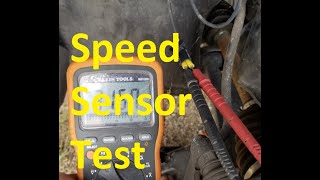
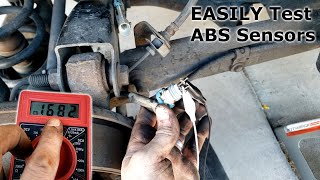
Disconnect the sensor and set a multimeter to measure resistance (Ohms). Connect the probes to the two pins on the sensor side. A good passive sensor typically has 800 to 2,500 Ohms of resistance. An 'OL' reading indicates an open circuit; near-zero indicates a short.
Tools: Multimeter, Vehicle-specific repair information (Advanced) - Test Active Sensor with a Multimeter (3-wire sensor)
Disconnect the sensor and turn the ignition 'ON' (engine off). On the harness-side connector, use a multimeter to check for a reference voltage (typically 5V or 12V) on one pin and a good ground on another. If power and ground are present, the sensor is faulty.
Tools: Multimeter, Vehicle-specific repair information (Advanced) - Test Passive Sensor AC Voltage Output
Set the multimeter to AC Volts. Reconnect the sensor using backprobes. Spin the wheel by hand at one revolution per second. A good passive sensor generates a small AC voltage (0.1-0.2V) that increases with wheel speed. No voltage indicates a failed sensor or tone ring.
Tools: Multimeter (Advanced) - Analyze the Signal with an Oscilloscope
For definitive diagnosis, backprobe the sensor's signal and ground wires with an oscilloscope. A good passive sensor produces a clean sine wave. Gaps, noise, or a missing wave confirm a fault in the sensor, tone ring, or air gap.
Tools: Oscilloscope, Backprobe Pins (Professional)
When This Code Triggers (Freeze-Frame Conditions)
- Vehicle Speed: 15-45 mph (The code sets when the vehicle exceeds a self-test speed (around 10-15 mph) and the ABS module compares wheel speed signals.)
- System Voltage: 12.0-14.5V (Normal operating voltage. A low voltage during startup triggers false ABS codes.)
- Brake Pedal Status: Off (The fault is most often detected during steady driving when the brakes are not applied.)
- Fault Status: Active/Current (Indicates the fault was present at the time the freeze frame data was recorded.)
Related Codes
- C0037 — A specific sub-fault for the Left Rear Wheel Speed Sensor indicating an electrical problem (e.g., 'Circuit Low'). Seeing C0037 alongside C0036 confirms the problem is electrical rather than a mechanical tone ring issue.
- C0035 — Code for the Left Front Wheel Speed Sensor. On some GM FWD vehicles, C0036 is defined as a left front fault, making C0035 the corresponding right front code.
- C0040 — Code for the Right Front Wheel Speed Sensor. Multiple unrelated wheel speed codes increase the likelihood of a central problem like a faulty ABS module or shared ground.
- U0121 — Lost Communication With ABS Control Module. The problem is not at the wheel; the ABS module is offline or its main power supply is compromised.
Climate & Environmental Factors
- Road Salt / High Humidity: Saltwater spray accelerates wiring connector corrosion, penetrates wire insulation causing internal breaks, and creates heavy rust buildup under the tone ring, causing it to crack.
- Extreme Cold: Cold temperatures make wire insulation brittle and susceptible to cracking where the harness flexes with suspension movement, creating intermittent open circuits.
- Off-Road Driving / Debris: Driving on unpaved roads increases the risk of the wiring harness snagging on branches or rocks. Mud and debris pack around the sensor and tone ring, obscuring the signal.
How to Talk to a Mechanic About This Code
Say this: "I have an ABS light on and a C0036 code for the left rear wheel speed sensor circuit. Please check the live data from all four wheel speed sensors and perform a visual inspection of the left rear sensor, wiring, and tone ring."
This signals that you've done basic research and guides the technician toward the most likely causes. It requests specific, logical diagnostic steps (checking live data and visual inspection) rather than just asking them to 'fix the light,' which can prevent them from starting with expensive, unnecessary steps.
Avoid saying:
- 'My ABS light is on, can you just replace the sensor?'
- 'Just fix whatever is wrong with the brakes.'
- 'My car is skidding, I think the ABS is broken.'
Questions to ask before authorizing the repair:
- What did the live data for the left rear wheel speed sensor show compared to the other wheels?
- What was the condition of the wiring harness and the tone ring upon visual inspection?
- If a part needs to be replaced, is it the sensor, the wiring, or the hub assembly?
- Will you be using an OEM or aftermarket part, and what is the warranty on the part and the labor?
Where to Take It: Dealer vs Independent vs Chain
- Dealer:
Recommended only if the initial diagnosis by an independent shop points to a rare issue like a failed ABS module that needs programming.
Best for: Vehicles still under warranty., Complex cases where a manufacturer-specific quirk is suspected (e.g., a known ABS module issue on Subarus)., If the repair requires reprogramming a new ABS module.
Downsides: Highest labor rates and part costs., May be quicker to replace a whole hub assembly rather than a cheaper, separate tone ring. (Typical cost: +50% vs. baseline) - Independent Shop:
Best fit. Most C0036 faults are due to common wheel-end component failures that any competent independent shop can diagnose and repair efficiently.
Best for: Out-of-warranty vehicles., Diagnosing and repairing the most common causes of C0036 (wiring, sensor, hub assembly)., Cost-effective diagnosis and repair.
Downsides: Quality varies, so choose a shop with good reviews and ASE-certified technicians., May lack expensive, specialized tools for module programming if the issue is complex. (Typical cost: +0% vs. baseline) - Chain Shop:
Use with caution. Acceptable if you are certain a simple sensor or hub replacement is needed, but not recommended for initial diagnosis of an intermittent or complex ABS fault.
Best for: Simple, straightforward part replacements where the diagnosis is already certain.
Downsides: Technician skill and diagnostic capability can be inconsistent., May be more inclined to replace parts without a thorough diagnosis, potentially replacing the wrong component. (Typical cost: -10% vs. baseline)
When to Walk Away From the Repair
If the total estimated repair cost exceeds 50% of the vehicle's current private-party market value, consider selling or trading in the vehicle.
- Car worth $3000, fix is $1800: Walk away. The repair cost is 60% of the car's value. It is not economically sensible to proceed.
- Car worth $10000, fix is $600: Fix it. The repair is only 6% of the vehicle's value and restores a critical safety system.
- Car worth $5000, fix is $2500: Borderline. The repair is exactly 50% of the car's value. Get a second opinion, and consider the car's overall condition before deciding.
What Scan Tool You Need for This Code

Minimum: An OBD-II scanner that can read and clear Anti-lock Braking System (ABS) codes and view live wheel speed sensor data. A basic engine-only code reader will not work.
A standard $20 OBD-II scanner only communicates with the engine control module. The C0036 code is stored in the ABS module. Without an ABS-capable scanner, you cannot read the code, clear it, or view the live data from the wheel speed sensors, which is essential for diagnosis.
Budget: BlueDriver Pro or Autel AutoLink AL619 (~$100-120) — Reads and clears ABS codes, and displays live data streams from all four wheel speed sensors to compare the faulty left rear sensor to the working ones.
Mid-range: Foxwell NT510 Elite or Innova 5610 (~$150-250) — Provides all the functions of the budget pick with faster processing, better graphing of live data, and may offer some bidirectional controls to test ABS system components like valves and pumps.
Professional: Autel MaxiCOM MK808 / MK906BT (~$500-1200) — Offers dealership-level diagnostics, including full bidirectional control to actuate any component in the ABS system, advanced coding and programming functions for module replacement, and a more detailed, user-friendly interface.
Rent vs buy: Many auto parts stores (like AutoZone) offer a loaner tool program. You can often borrow an ABS-capable scanner for free with a refundable deposit. This is the best option for a one-time fix. If you plan on doing your own car maintenance regularly, purchasing a budget or midrange scanner is a worthwhile investment.
How to Clear the Code After You Fix It
- Use an ABS-capable OBD-II scan tool to clear the code from the ABS module.
- Perform a visual inspection to ensure all connectors are secure and components are properly installed.
- Perform a test drive to confirm the repair.
Drive cycle (~10 minutes): After clearing the code, drive the vehicle above 15 mph. This allows the ABS module to perform a self-test and verify the signal from the repaired sensor matches the other wheels.
Readiness monitors affected: None
Watch out for:
- Using a standard OBD-II scanner that cannot access or clear codes from the ABS module.
- The code returning immediately because the root cause (e.g., a broken wire) was not fully fixed.
- Forgetting to clear the code after the repair, leaving the ABS light on until the system completes multiple successful self-tests.
Will This Fail Emissions / State Inspection?
No — by itself this code doesn't fail OBD inspection (but it can keep readiness monitors from setting, which causes a separate fail).
- California: An illuminated ABS light is not an automatic failure for the emissions inspection. However, shops refuse to test the vehicle on a dynamometer for safety reasons.
- New York: The annual safety inspection requires the ABS light to illuminate during the bulb check and turn off. An active C0036 code is an automatic failure.
- Texas: The ABS warning light must function correctly. If the light remains illuminated due to code C0036, the vehicle fails the annual safety inspection.
Most Commonly Affected Vehicles
- Ford Focus / Fusion (2012-2018) — Highly prone to rear tone rings that rust, swell, and crack. The C0036:07 sub-code for 'Mechanical Failure' on Fords almost always confirms a bad tone ring.
- Chevrolet / GMC Silverado / Sierra (2007-2018) — Commonly suffer from wiring harness chafing or breaking near the frame rails or suspension mounting points.
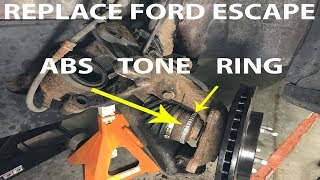
- Ford Escape (2008-2019) — Rear tone rings are a frequent failure point due to rust and cracking. For 2008-2012 models, the tone ring is available as a separate, inexpensive part.
- Chevrolet Uplander / Venture (2005-2009) — On these GM front-wheel-drive vans, code C0036 frequently refers to the Left Front wheel speed sensor circuit, not the rear. Verify the code description on a scan tool.
- Pontiac Grand Prix (2004-2008) — Known for corroded wiring splices in the wheel speed sensor harness, particularly where the harness is exposed near the front A-arm.
- Jeep Grand Cherokee / Wrangler (2007-2017) — The wheel speed sensor wiring is vulnerable to damage from off-road use or chafing against suspension components during normal driving.
- Hyundai / Kia Elantra / Forte (2011-2020) — Susceptible to wiring harness damage behind the wheel well liner or where the harness flexes with suspension travel. Intermittent faults are common.
- Subaru Outback / Forester (2010-2018) — C0036 on some Subaru models points to a fault within the Vehicle Dynamics Control (VDC) module itself, specifically a solenoid valve, rather than a wheel-end component.
Manufacturer-Specific Notes
- Ford: A two-digit failure type code, such as C0036:07, specifies a 'Mechanical Failure.' This almost always means the physical tone ring has cracked or swelled with rust.
- General Motors (GM): On FWD cars and vans like the Chevrolet Uplander and Pontiac Grand Prix, C0036 is defined as the Left Front Wheel Speed Sensor Circuit, not the rear. Verify the code description.
- Subaru: C0036 translates to a fault in the 'Right Rear Outlet Solenoid Valve' within the Vehicle Dynamics Control (VDC) module. This is an internal module fault, not a wheel sensor issue.
- Ram (Dodge): On 2015-2016 Ram 1500 trucks, C0036 is commonly caused by a cracked tone wheel pressed onto the rear axle shaft, requiring replacement of the entire axle shaft.
- Ford: Recall 16C14 for 2015-2017 Edge and MKX vehicles involves ABS Hydraulic Control Units leaking fluid, leading to various ABS faults.
Real Owner Stories
2013 Ford Focus at 110K miles - The Classic Tone Ring Failure
ABS and Traction Control lights illuminated. Scan tool showed C0036:07 ('Mechanical Failure').
Outcome: Replaced the wheel hub assembly for $450. Lesson: On Fords, the ':07' sub-code points directly to a physical tone ring problem.
Lesson: On Ford vehicles, the ':07' sub-code is a huge clue that points directly to a physical problem with the tone ring, not the sensor or wiring.
2015 Ram 1500 at 85K miles - A Misleading Code
ABS light stayed on permanently. Owner replaced the sensor and hub assembly, but the code returned.
Outcome: Dealer replaced the left rear axle shaft for $800. Lesson: Don't assume the tone ring is part of the hub assembly on solid-axle trucks.
Lesson: Don't assume the tone ring is part of the hub assembly. On some vehicles, especially solid-axle trucks, it is a separate part pressed onto the axle shaft.
2008 Chevy Silverado at 150K miles - The Hidden Wiring Break
Intermittent C0036 code triggered by bumps. Replaced sensor and hub with no success.
Outcome: Peeled back the loom to find an internally broken wire. Repaired the wire for $150. Lesson: Intermittent faults are usually wiring breaks found easily with a wiggle test.
Lesson: Intermittent faults are very often caused by wiring. A 'wiggle test' is the most effective way to find a break that isn't visually obvious.
How to Prevent This Code From Triggering
- Apply Dielectric Grease to Connectors (During any brake or wheel-end service) — Applying non-conductive dielectric grease inside the wheel speed sensor connector seals out moisture and road salt, preventing pin corrosion.
- Regularly Wash the Undercarriage (Monthly, especially in winter ('Rust Belt' areas)) — Washing away road salt and mud from the suspension reduces the corrosive environment that damages wiring and tone rings.
- Inspect and Clean Tone Rings During Brake Service (Every time brake pads/rotors are replaced) — When replacing brake pads, use a wire brush and brake cleaner to remove rust scale from the tone ring, ensuring a clean signal path.
- Secure and Inspect Wiring Harnesses (Annually or during tire rotations) — Visually check that the sensor wiring is properly secured in its clips and not rubbing against suspension components to prevent chafing.
Frequently Asked Questions
I replaced the sensor and the hub, but the C0036 code came back. What's next?
This points strongly to a wiring issue. Wires break internally from repeated flexing without visible damage to the insulation. Perform a 'wiggle test' while watching live data, followed by a continuity test on the wires from the sensor to the ABS module.
Can I just clean the ABS sensor to fix code C0036?
Sometimes, yes. If the sensor's magnetic tip is covered in metallic debris and rust, cleaning it with brake cleaner restores a clear signal. However, if the underlying cause is a cracked tone ring, bad wiring, or a failed sensor, cleaning will not fix the problem.
My C0036 code is intermittent. What does that mean?
An intermittent code is almost always caused by a poor electrical connection or a hairline crack in a component. The most likely cause is a wire breaking inside its insulation, making and breaking contact as the suspension moves. It also indicates a corroded connector pin or a cracked tone ring.
Can a low or bad battery cause a C0036 code?
Yes. The ABS control module requires a stable voltage to operate correctly. A weak battery causes a voltage drop during startup, which the module misinterprets as a system fault, leading to false codes.
Do I need to replace the whole wheel hub if the tone ring is bad?
It depends on the vehicle. On many modern cars, the tone ring is integrated into the wheel bearing hub assembly and is not sold separately. On older vehicles or solid-axle trucks, the tone ring is a separate metal ring pressed onto the axle that can be replaced individually.
Why did my ABS, traction control, and stability control lights all come on at once?
All these systems rely on data from the same four wheel speed sensors. When the main ABS module loses the signal from one wheel, it can no longer perform its safety functions reliably. As a fail-safe, the module disables itself and commands the traction and stability control systems to shut down.
Is it hard to replace a wheel speed sensor myself?
Replacing a standalone sensor is often a DIY-friendly job involving removing the wheel, undoing a single bolt, and unplugging a connector. The biggest challenge is that sensors seize in the steering knuckle due to rust and break during removal. Applying penetrating oil beforehand is highly recommended.
Key Takeaways
- Scan the ABS module for live data while driving at 10-15 mph to verify if the left rear wheel speed sensor reads 0 mph or drops out erratically.
- Inspect the left rear tone ring for cracks or heavy rust buildup, as this mechanical failure is the root cause in over 50% of C0036 cases, especially on Ford vehicles.
- Test a passive 2-wire wheel speed sensor with a multimeter; a healthy sensor typically reads between 800 and 2,500 Ohms, while an 'OL' reading confirms internal failure.
- Perform a live-data 'wiggle test' on the sensor wiring harness to locate hidden internal wire breaks, which are the primary cause of intermittent C0036 codes.
Helpful Videos
![Active ABS Wheel Speed Sensor Testing and Wiring Repair [09 Silverado]](https://img.youtube.com/vi/ErbK7RqNhXw/mqdefault.jpg)

The information in this article is provided for general reference and educational purposes only. Vehicle specifications, procedures, and part compatibility can vary by production date, trim level, and region. Always consult your vehicle's factory service manual and verify part numbers before purchasing or performing repairs. Safety-critical components such as airbags, seat belts, and braking systems should be installed by a qualified professional.
- 🎬 Helpful Videos
- What Does C0036 Mean?
- Can I Drive With C0036?
- Common Causes
- Symptoms
- Diagnostic Flowchart
- Common Fixes & Costs
- DIY vs Professional
- Used vs. New Parts: Buying Guide
- What Happens If You Wait — Timeline
- Cost of Not Fixing It
- Diagnosis Steps
- When This Code Triggers (Freeze-Frame Conditions)
- Related Codes
- Climate & Environmental Factors
- How to Talk to a Mechanic About This Code
- Where to Take It: Dealer vs Independent vs Chain
- When to Walk Away From the Repair
- What Scan Tool You Need for This Code
- How to Clear the Code After You Fix It
- Will This Fail Emissions / State Inspection?
- Most Commonly Affected Vehicles
- Manufacturer-Specific Notes
- Real Owner Stories
- 2013 Ford Focus at 110K miles - The Classic Tone Ring Failure
- 2015 Ram 1500 at 85K miles - A Misleading Code
- 2008 Chevy Silverado at 150K miles - The Hidden Wiring Break
- How to Prevent This Code From Triggering
- Frequently Asked Questions
- I replaced the sensor and the hub, but the C0036 code came back. What's next?
- Can I just clean the ABS sensor to fix code C0036?
- My C0036 code is intermittent. What does that mean?
- Can a low or bad battery cause a C0036 code?
- Do I need to replace the whole wheel hub if the tone ring is bad?
- Why did my ABS, traction control, and stability control lights all come on at once?
- Is it hard to replace a wheel speed sensor myself?
- Key Takeaways
- 🎟️ Get 5% Off