

C0035 on 2015-2020 Chevrolet Impala: Causes and Fixes for the Left Front Wheel Speed Sensor Code
Code C0035 on a 2015-2020 Chevy Impala almost always points to a problem with the left front wheel speed sensor circuit. The most common culprits are a damaged wiring harness with an internal break rubbing against the axle, or a failed wheel hub/bearing assembly with a corroded or broken magnetic ring. Expect a repair cost of $150 to $450, depending on the failed part.
- C0035 means there's a problem with the Left Front Wheel Speed Sensor circuit.
- Do not automatically replace the sensor; the wiring harness and wheel hub assembly are more likely culprits on this vehicle.
- A visual inspection is critical. Look for a damaged wire harness first, then check the magnetic ring on the hub for corrosion or cracks.
- Driving with this fault is possible but unsafe, as your ABS and stability control systems will not function.
- The warning lights on the dash will typically clear on their own after the correct repair is completed and the vehicle is driven.
What's Unique About the 2015-2020 Chevrolet IMPALA

On this generation of Chevrolet Impala and its platform mates, the wiring harness for the front wheel speed sensors is a known weak point. As documented in GM Technical Service Bulletin PIC-5992-A, the harness is prone to chafing and internal wire breaks that are not always visible from the outside. The wire often breaks at a flex point from suspension travel and turning, making a simple-looking sensor code a more involved wiring repair.
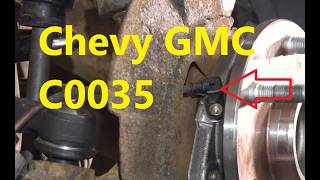
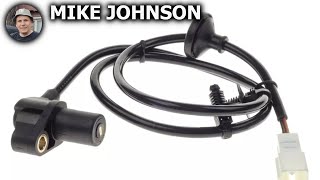
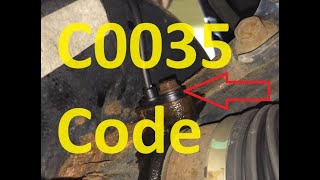
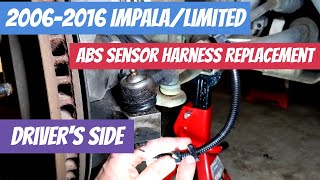
🎬 Watch: Complete diagnosis and repair for the C0035 circuit code.Diagnostic Flowchart

Tap your situation to follow the diagnostic path that matches what you're seeing on this vehicle.
Symptoms You May Notice
- ABS warning light is on
- Traction Control warning light is on
- "Service StabiliTrak" message displayed on the dashboard
- Unwanted or jerky activation of the traction control system, especially at low speeds or during turns.
- Brake pedal may feel different or pulsate unexpectedly at low speeds
- Speedometer may behave erratically or drop to zero.
- Cruise control may not engage.
- Replacing only the wheel speed sensor when the actual fault is in the wiring harness or the wheel hub's magnetic ring. This is a very common mistake that does not resolve the code and leads to repeat repairs.
Most Likely Causes

- Damaged Left Front Wheel Speed Sensor Wiring Harness 🔴 High Probability The harness routing can cause it to rub against the CV axle or flex repeatedly during turns, leading to an internal wire break often with no visible damage to the outer insulation. Corrosion at the connector is also common.
How to confirm: Visually inspect the harness for chafing. The definitive test is the 'wiggle test': with a scan tool monitoring live data, wiggle and bend the harness along its length from the sensor to the main loom. A signal dropout confirms an internal break. You can also back-probe the connector with a multimeter to check for voltage drops while manipulating the wire. TSB PIC-5992-A notes that a simple ohmmeter test may not identify the fault.
Typical fix: Repair the broken wires with solder and heat shrink, or replace the entire harness pigtail. The GM repair harness often comes with solder-filled butt connectors.
Est. part cost: $25-$60 - Failed Left Front Wheel Hub and Bearing Assembly 🔴 High Probability The magnetic reluctor ring (encoder) is integrated into the wheel hub's seal. Corrosion from road salt can cause this ring to crack, break apart, or swell, which disrupts the signal. Ferrous metallic debris can also stick to the magnetic ring and cause an erratic signal, as noted in TSB PIC5428G.
How to confirm: After removing the wheel speed sensor, visually inspect the magnetic ring on the hub for cracks, missing sections, or heavy rust buildup. Check for accumulated metallic debris. If debris is present, cleaning it may resolve the issue without hub replacement.
Typical fix: First, try cleaning the magnetic encoder ring with a soft brush and brake cleaner. If the ring is physically damaged or cleaning doesn't work, replace the entire wheel hub and bearing assembly.
Est. part cost: $100-$250 - Failed Left Front Wheel Speed Sensor 🟡 Medium Probability The sensor itself can fail electronically due to heat cycles and vibration, though it's less common than wiring or hub failure on this model. It is often misdiagnosed as the root cause.
How to confirm: After confirming the wiring and hub are good, test the sensor's resistance with a multimeter to see if it's within spec or open/shorted. The most definitive test is to substitute it with a known good sensor. A lab scope can also show a corrupt or erratic signal pattern.
Typical fix: Replace the wheel speed sensor.
Est. part cost: $30-$80
Rare But Worth Checking
- Faulty Electronic Brake Control Module (EBCM): This is the least likely cause. It should only be considered after the sensor, wiring, and hub assembly have all been ruled out. An EBCM failure usually triggers multiple codes or shows no bias voltage at the harness connector.
Diagnosis Steps
- Connect an OBD-II scanner capable of reading ABS codes to confirm C0035 is present.
- Use the scanner to monitor live data from all four wheel speed sensors while driving or spinning the wheel by hand. Confirm the left front sensor reads 0 or shows an erratic signal compared to the other three.
- Raise and safely support the front of the vehicle. Remove the left front wheel.
- Thoroughly inspect the wheel speed sensor wiring harness. Perform a 'wiggle test' by flexing the harness, especially near the control arm and CV axle, while watching the live data for dropouts.
- Disconnect the sensor and inspect the connector terminals for corrosion or damage.
- Remove the single bolt holding the wheel speed sensor and pull it out of the steering knuckle.
- Inspect the magnetic encoder ring on the face of the wheel hub assembly. Per TSB PIC5428G, look for ferrous debris stuck to the ring. Clean it with a soft brush and cleaner. Also look for physical damage like cracks or missing pieces.
- If the wiring and hub appear intact, test the sensor's internal resistance with a multimeter. Compare the reading to a new sensor or manufacturer specifications.
- If the harness is damaged, repair the wires or replace the harness pigtail. If the hub's ring is damaged or cleaning it doesn't work, replace the entire wheel hub assembly. If both are good, replace the sensor.
- Clear the code. A road test should cause the ABS and StabiliTrak lights to turn off on their own once the EBCM receives a good signal.
Parts You'll Likely Need

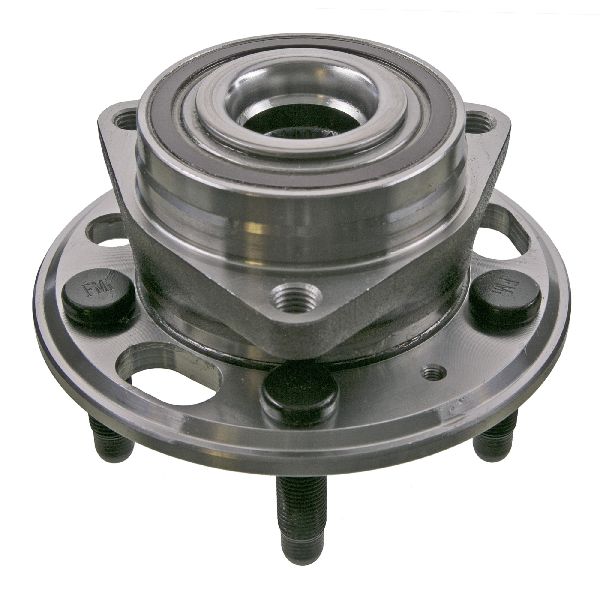
- Front Wheel Hub and Bearing Assembly
(OEM #13589507 (Note: GM may supersede this number, always verify with VIN))— The integrated magnetic encoder ring is a primary point of failure due to corrosion and damage, making hub replacement a very common fix for C0035.
Trusted brands: ACDelco, Timken, MOOG
OEM price range: $180-$250
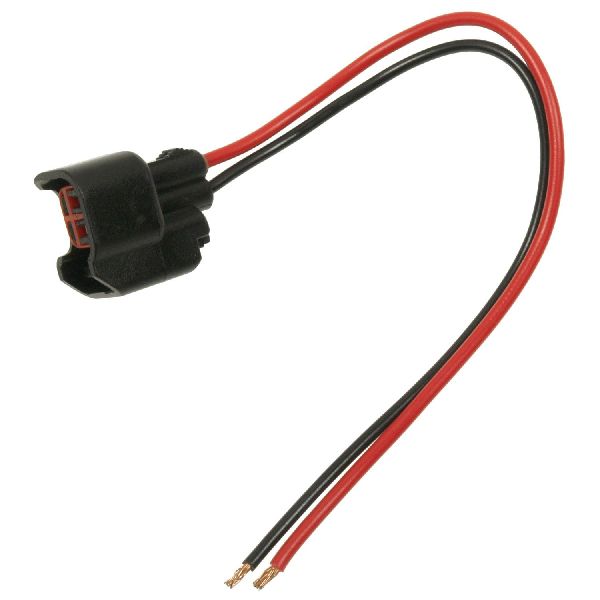
Aftermarket price range: $100-$180 - ABS Wheel Speed Sensor Harness
(OEM #10340316 (Note: GM may supersede this number, e.g. to 84432134. Always verify with VIN))— Due to poor routing, the harness frequently chafes or breaks internally, requiring repair or replacement. This is a known weak point cited in TSBs and numerous owner forums.
Trusted brands: ACDelco, Dorman, Standard Motor Products (SMP)
OEM price range: $40-$60
Aftermarket price range: $25-$45 - Front ABS Wheel Speed Sensor
(OEM #23483145 (Note: GM may supersede this number, always verify with VIN))— While less common than wiring or hub failures, the sensor itself can fail electronically and is often replaced during diagnosis.
Trusted brands: ACDelco, Bosch
OEM price range: $50-$80
Aftermarket price range: $30-$50
Related Codes That Often Appear With This One
- C0040 — This code for the Right Front Wheel Speed Sensor is extremely common to see for the same reasons (harness/hub failure). TSB PIC-5992-A groups C0035 and C0040 together for the same harness inspection procedure.
- C0045 — Code for the Left Rear Wheel Speed Sensor. Seeing multiple wheel speed sensor codes together could point towards a larger issue with the EBCM or a systemic problem like debris contamination mentioned in TSB PIC5428G.
- C0050 — Code for the Right Rear Wheel Speed Sensor. TSB PIE0533A and PIC5428G group C0035, C0040, C0045, and C0050 together, indicating they share a common diagnostic theme related to sensor/hub/wiring faults.
Technical Service Bulletins (TSBs) & Recalls
- PIE0533A: Ends an engineering investigation into inoperative wheel speed sensors causing codes C0035, C0040, C0045, and/or C0055.
- PIC-5992-A: Guides technicians to inspect and repair the wheel speed sensor harness for damage, including internal breaks, when C0035 or C0040 is set.
- PIC5428G: Advises checking for and cleaning debris from the wheel bearing's magnetic encoder ring as a primary repair step for codes C0035-C0050.
Platform-Specific Known Issues
- GM Technical Service Bulletin #PIC-5992-A specifically calls out inspecting the wheel speed sensor harness for damage, noting that the wire can be broken inside the insulation and that the fault is often more easily duplicated while turning.
- GM Technical Service Bulletin #PIC5428G points technicians toward inspecting the wheel bearing when C0035 is present, but crucially advises that cleaning metallic debris from the magnetic encoder ring can often fix the issue without replacing the hub assembly.
- GM Technical Service Bulletin #PIE0533A acknowledges C0035 as a code related to an inoperative wheel speed sensor, ending a period of field data collection on the issue.
Mechanic-Grade Diagnostic Values
- Wheel Speed Sensor Circuit Voltage Supply — expected: Approximately 12V (Battery Voltage) with key on, engine off.. Failure: No voltage present at the sensor harness connector indicates an open circuit between the EBCM and the sensor.
- Wheel Speed Sensor Resistance — expected: 900-2000 Ohms (typical for many passive sensors, but should be compared to the opposing wheel's sensor for best results).. Failure: An open circuit (infinite resistance) or a reading significantly different from the sensor on the other side of the vehicle indicates a failed sensor.
- EBCM Key-On Voltage Pulse — expected: A brief 12V pulse from the EBCM to the sensor circuit immediately after turning the ignition key to the 'ON' position.. Failure: Absence of this pulse can indicate a faulty EBCM or a problem with its power/ground, but its presence confirms the module and wiring up to the test point are likely good.
Hidden / Shadow Codes Worth Checking
- C0035 0F: Signal Erratic. This indicates the EBCM is receiving a signal, but it's unstable, noisy, or inconsistent, often caused by a damaged magnetic encoder ring on the hub or an intermittent wiring break. (see via A professional scan tool like the GM GDS2 or equivalent that can read manufacturer-specific symptom bytes.)
- C0035 5A: Not Plausible. The signal from the sensor does not make sense when compared to other vehicle data (like other wheel speeds). This often points to a wiring issue or a problem with the magnetic ring on the hub. (see via A professional scan tool like the GM GDS2 or equivalent that can read manufacturer-specific symptom bytes.)
- C0035 18: Signal Low Amplitude. This points to a weak signal from the sensor, which could be caused by an excessive air gap between the sensor and the hub's reluctor ring, or internal sensor failure. (see via A professional scan tool like the GM GDS2 or equivalent that can read manufacturer-specific symptom bytes.)
- C0035 06: Low Voltage/Open. This indicates a loss of signal, most commonly due to a complete break in the wiring harness or a failed sensor. (see via A professional scan tool like the GM GDS2 or equivalent that can read manufacturer-specific symptom bytes.)
Scan Tool Commands That Help
- GM GDS2 / Professional Scan Tool: Live Data - Wheel Speed Sensors — This is the primary diagnostic step. Monitor the speeds of all four wheels while driving or spinning the wheel by hand. The faulty sensor will read 0 MPH or show erratic values compared to the others, confirming the location of the fault.
- GM GDS2 / Professional Scan Tool: Clear DTCs — Used after the repair is completed. Unlike some codes, the ABS light will often turn off on its own after a short drive once the EBCM receives a valid signal, but clearing the stored code from memory is still recommended.
Wiring & Ground Locations
- G111 — On the 2014 Impala, this ground is located on the frame rail in the engine compartment. A GM service bulletin regarding power steering issues on this platform highlights its importance and specifies a torque of 9 Y (80 lb in).. While not exclusively for the EBCM, a poor G111 ground can cause a variety of intermittent electrical issues on modules in the engine bay. Ensuring it is clean and tight is a crucial step when diagnosing complex electrical faults.
- WSS Harness Chafe Point — The most common failure point is where the harness flexes during suspension travel and steering, often rubbing directly against the CV axle shaft.. This is the primary cause of C0035 on this platform. The constant movement fatigues the copper wire inside the insulation, leading to a break that is often not visible externally.
- Left Front WSS Connector — The harness connects directly to the wheel speed sensor, which is mounted on the steering knuckle, and runs up into the engine bay. The pigtail repair is typically spliced in the wheel well area.. This connector and the wires leading to it are where voltage and resistance tests are performed. The two pins are for the 12V supply from the EBCM and the signal return.
Real Owner Repair Stories
- YouTube channel 'Chris Arnau' (Chevrolet Impala (generation consistent with 2015-2020 models)) — ABS and Traction Control lights on, with code C0035 or C0040.
❌ Tried (didn't work) The video focuses directly on the known common failure, implying that simply replacing the sensor or hub is often not the correct first step.
✅ What actually fixed it The wiring harness had an internal break at the flex point near the lower control arm. The video demonstrates pulling on the individual wires (yellow and blue) to reveal the broken copper strand inside the intact insulation. The fix was to splice in a new GM repair harness pigtail using solder and heat shrink. - YouTube channel 'Keith Perkins' (2014 Chevrolet Impala) — ABS light on with codes C0035 00 (Left Front Wheel Speed Circuit) and C0035 0F (Signal Erratic).
❌ Tried (didn't work) The vehicle had previously had two wheel bearings, an ABS control module, and a wiring harness repair performed by another shop without fixing the issue long-term.
✅ What actually fixed it The previous wiring repair had failed, and the harness had another internal break. The technician demonstrated that stretching the insulation revealed the broken wire inside. The final fix was to replace the harness pigtail with a new GM repair part.
OEM Part Supersession History
13580135, 13502216→13589507— Standard part evolution and consolidation for the front wheel hub and bearing assembly.
Heads up: While these part numbers are often listed as interchangeable for the front, 13589507 is also used for the rear on some models, so verifying fitment by VIN is critical.10340316→84432134 (example of supersession, always verify)— GM often updates part numbers for harnesses to improve design or change suppliers.
Heads up: The connector is generally standard for the model years, but verifying the latest part number with a dealer via VIN is the best practice to ensure you get the most current revision.
Helpful Videos
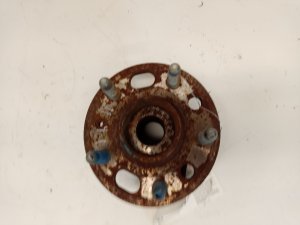
Used OEM Parts in Stock

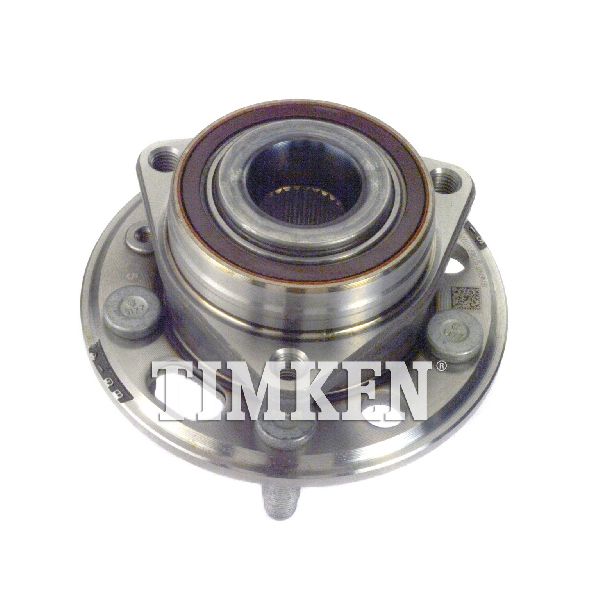
New Aftermarket Parts Available


The information in this article is provided for general reference and educational purposes only. Vehicle specifications, procedures, and part compatibility can vary by production date, trim level, and region. Always consult your vehicle's factory service manual and verify part numbers before purchasing or performing repairs. Safety-critical components such as airbags, seat belts, and braking systems should be installed by a qualified professional.
- Chevrolet IMPALA:
- 🎬 Helpful Videos
- 🛍️ Shop This Part
- What's Unique About the 2015-2020 Chevrolet IMPALA
- Diagnostic Flowchart
- Symptoms You May Notice
- Most Likely Causes
- Rare But Worth Checking
- Diagnosis Steps
- Parts You'll Likely Need
- Related Codes That Often Appear With This One
- Technical Service Bulletins (TSBs) & Recalls
- Platform-Specific Known Issues
- Mechanic-Grade Diagnostic Values
- Hidden / Shadow Codes Worth Checking
- Scan Tool Commands That Help
- Wiring & Ground Locations
- Real Owner Repair Stories
- OEM Part Supersession History
- 🎟️ Get 5% Off