

C0035 on 2007-2016 Audi A5: Left Front Wheel Speed Sensor Causes and Fixes
On a 2007-2016 Audi A5, code C0035 almost always points to a problem with the left front wheel speed sensor circuit. The most common fix is replacing the sensor itself, which costs about $30-$60 for an OEM-quality part like Bosch and is a 1/5 difficulty DIY job. Checking the wiring harness for corrosion or damage is a critical second step, as this is a known issue on the B8 platform.
- C0035 on your A5 means there's a problem with the LEFT front wheel speed sensor circuit.
- The most likely cause is a failed sensor, which is an inexpensive part and relatively easy to replace.
- Before replacing the sensor, always inspect the wiring harness for corrosion or damage, as this is a known weak point on this vehicle.
- Driving with this fault is not recommended as your ABS and stability control are disabled.
- Using a VAG-specific scan tool is highly recommended to accurately diagnose the fault and avoid replacing the wrong parts.
What's Unique About the 2007-2016 Audi A5
While generic OBD-II scanners may only show 'C0035', creating confusion with other manufacturers where this code can mean the right side, Audi-specific diagnostic tools like VCDS confirm it as 'Front Left (G47)'. Furthermore, the B8 platform (which the A5 is built on) has a known issue documented in a Technical Service Bulletin (TSB 2033412/3) where the wiring for the left front sensor can become corroded, making wiring checks just as important as checking the sensor itself. The magnetic tone ring on this platform is also integrated into the wheel bearing's seal, not a separate toothed ring, meaning damage or heavy contamination often requires wheel bearing replacement.
Symptoms You May Notice
- ABS warning light is illuminated on the dashboard
- Electronic Stability Program (ESP) or Traction Control (TC) warning light is on
- Parking Brake Malfunction warning message may appear
- TPMS (Tire Pressure Monitoring System) light may also come on
- Loss of anti-lock braking function (wheels may lock up during hard braking)
- Traction control system is disabled
- Brake pedal may feel different or pulse unexpectedly at low speeds
- Replacing the ABS module when the actual fault is a simple wiring break.
- Replacing the wheel speed sensor without first checking the wiring harness for damage, leading to the new sensor not fixing the problem.
- Replacing the wheel speed sensor when the actual fault is a damaged or debris-covered magnetic encoder on the wheel bearing.
Most Likely Causes
- Failed Left Front Wheel Speed Sensor 🔴 High Probability The sensor is exposed to water, road salt, and debris, which leads to internal failure or corrosion over time. These active sensors are sensitive electronic components that degrade with heat cycles and environmental exposure.
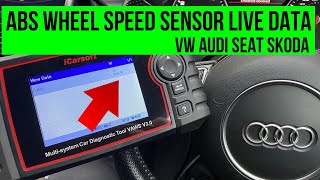
How to confirm: Use a scanner capable of reading live ABS data. Watch the output from all four wheel sensors while driving. The left front sensor 🎬 See how to view live ABS wheel speed data while driving. will likely read 0 mph or have an erratic/inconsistent signal compared to the others. You can also test the sensor's internal resistance with a multimeter; an open circuit or resistance outside of the typical 800-2000Ω range indicates failure.
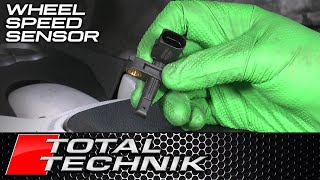
Typical fix: Replace the left front wheel speed sensor. It is held in by a single M6 Allen bolt on the wheel hub/steering knuckle. The sensor can seize in the bore and may require penetrating oil and careful twisting with pliers to remove. 🎬 Watch this walkthrough on how to replace the wheel speed sensor.
Est. part cost: $30-$90 - Damaged Wiring or Connector 🟡 Medium Probability Audi issued a TSB (2033412/3) for potential wire insulation damage in the left front wheel well, leading to corrosion and signal loss. The harness is also susceptible to rubbing against the fender liner or suspension components, or damage from road debris, causing an open or short circuit.
How to confirm: Visually inspect the entire length of the wiring from the sensor to the main harness connection point in the wheel well. Look for chafed/broken wires, green corrosion inside the connector plug, or loose pins. Perform a continuity test on the wires between the sensor connector and the ABS module connector.
Typical fix: Repair the damaged section of wire using a solder and heat-shrink tubing kit or replace the pigtail connector if it's corroded. Secure the harness away from moving parts with zip ties.
Est. part cost: $15-$40 - Contaminated or Damaged Tone Ring (Wheel Bearing) ⚪ Low Probability The magnetic encoder ring is integrated into the wheel bearing seal. An aging or failing wheel bearing can allow metallic debris from brake dust or bearing wear to accumulate on the magnetic surface, obstructing the sensor's reading. A damaged bearing seal can also allow moisture in, causing rust that distorts the signal.
How to confirm: After removing the sensor, visually inspect the magnetic encoder ring on the wheel bearing. Look for rust buildup, cracks, or embedded metallic debris. A failing wheel bearing may also produce a humming or grinding noise that changes with vehicle speed.
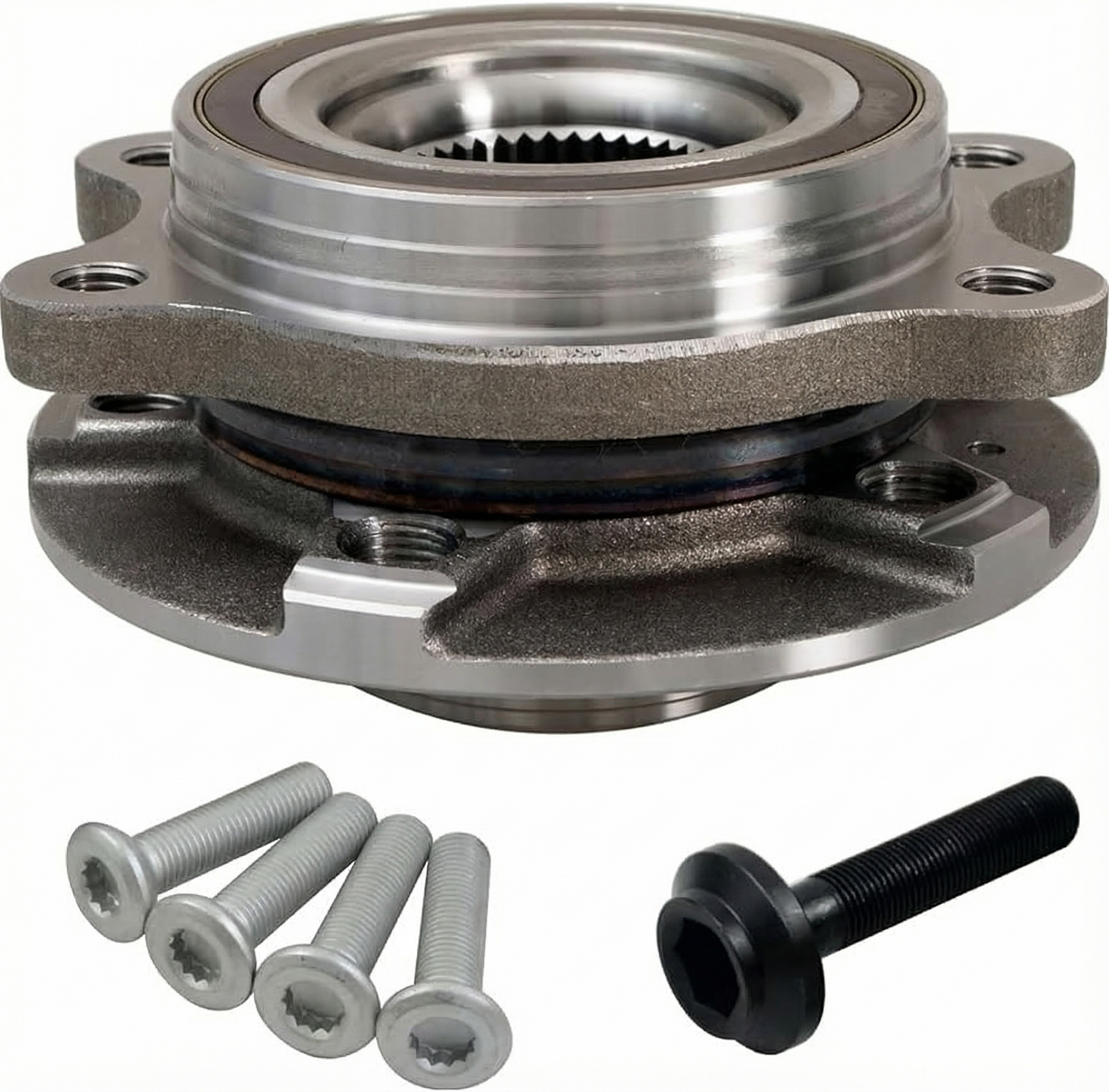
Typical fix: If the magnetic ring is physically damaged or the bearing has failed, the entire front wheel bearing/hub assembly must be replaced. Cleaning is often a temporary fix at best, as the debris will likely return if the bearing seal is compromised.
Est. part cost: $150-$300
Rare But Worth Checking
- Faulty ABS Control Module: This is the least likely cause and should only be considered after the sensor, wiring, and wheel bearing have been thoroughly checked and ruled out. A faulty module will often be accompanied by other communication-related fault codes or a complete loss of communication with the scanner.
Diagnosis Steps
- Scan the ABS module with a VAG-specific tool (like VCDS or a capable Autel/iCarsoft scanner) to confirm the fault is C0035 and points specifically to the Left Front wheel (G47).
- Access the live data stream for all four wheel speed sensors. Drive the vehicle slowly (above 5 mph) and observe the readings. Confirm that the Left Front sensor reads 0 mph or shows a signal that is erratic compared to the other three.
- Raise and secure the front left corner of the vehicle. Remove the wheel.
- Visually inspect the ABS sensor wiring harness from the sensor up into the wheel well where it connects to the main harness. Look for any signs of chafing, breaks, or corrosion, paying close attention to the area mentioned in TSB 2033412/3.
- Disconnect the sensor and inspect the connector pins for corrosion or damage. Clean with electrical contact cleaner if necessary.
- If wiring looks good, remove the single M6 Allen (or sometimes Torx) bolt holding the sensor to the steering knuckle. The sensor may be seized; apply penetrating oil and gently twist back and forth with pliers to work it free. Be careful not to break it off in the hub.
- With the sensor removed, inspect the sensor tip and the magnetic encoder ring on the wheel bearing through the mounting hole. Look for excessive rust or metallic debris. Clean the area with a brush and brake cleaner.
- If no obvious physical damage is found on the wiring or bearing, the sensor itself is the most likely culprit. Replace the sensor with a new one. Ensure the mounting bore is clean before inserting the new sensor.
- Clear the fault codes and test drive the vehicle. The warning lights should extinguish after driving a short distance (usually above 15 mph) as the system self-tests.
Parts You'll Likely Need
- Front Left Wheel Speed Sensor
(OEM #WHT003856 (or WHT003856D))— This is the most common failure point for code C0035. The sensor's electronics fail due to heat and environmental exposure. Note: The left and right front sensors are often different parts; ensure you get the correct one for the left side (WHT003857 is often the corresponding right-side part).
Trusted brands: Bosch, ATE, Hella, NTK, Genuine Audi
OEM price range: $70-$100
Aftermarket price range: $30-$60 - Front Wheel Bearing/Hub Assembly — Needed if the integrated magnetic encoder ring is damaged or if the bearing itself has failed, causing the fault.
Trusted brands: FAG, SKF, Genuine Audi
OEM price range: $200-$300
Aftermarket price range: $100-$180
Related Codes That Often Appear With This One
- 00283 — This is a VAG-specific code for 'ABS Wheel Speed Sensor Front Left (G47)'. It is the more detailed version of the generic C0035 code.
- 00473 — This code relates to the 'Control Module for Elect. Park/Hand Brake (J540)'. It often appears as a secondary fault because the parking brake system relies on data from the ABS module, which is disabled by the C0035 fault.
- 01316 — A general communication fault code indicating 'ABS Control Module - No Communication'. This can appear in other modules (like the ECU or TCU) that rely on the ABS module for speed data, which is unavailable due to the C0035 fault.
Technical Service Bulletins (TSBs) & Recalls
- TSB 2033412/3: Addresses potential damage to the wire insulation for the left front wheel speed sensor, leading to corrosion and signal faults.
- TSB 2072304/1: Notes that dirt, grease, or metal debris on the sensor tip or the wheel bearing's magnetic ring can cause an 'implausible signal' fa
Platform-Specific Known Issues
- A known issue, documented in Audi TSB 2033412/3, involves the potential for the wire insulation on the left front sensor harness to be damaged from the factory, allowing moisture ingress and corrosion. This makes a thorough wiring inspection critical.
- The magnetic encoder ring is integrated into the wheel bearing seal. This design is less prone to damage from large debris than external toothed rings, but is susceptible to signal interference from metallic dust generated by brake or bearing wear.
Mechanic-Grade Diagnostic Values
- Sensor Supply Voltage (Active Sensor) — expected: 4.5V - 5.5V or ~12V (system dependent) with key on, engine off.. Failure: Voltage below 4.0V or absent indicates a wiring or module supply issue.
- Sensor Resistance (Passive Sensor - less common on this platform) — expected: 800 - 2,000 Ω. Failure: An open circuit (infinite resistance) or a direct short (0 Ω) indicates a failed sensor.
- Continuity of Sensor Wiring Harness — expected: Less than 2.0 Ω. Failure: Infinite resistance (OL) indicates a broken wire between the sensor connector and the ABS module connector.
Hidden / Shadow Codes Worth Checking
- 00283: The VAG-specific fault code for 'Front Left ABS Wheel Speed Sensor (G47)'. This is the code a technician will see using tools like VCDS. (see via VCDS (VAG-COM), Autel, or other VAG-compatible diagnostic scanners.)
- 00283 - 012: A sub-code for G47 indicating an 'Electrical fault in circuit'. This points more strongly towards a wiring open/short or a failed sensor electronic component, rather than a signal plausibility issue. (see via VCDS (VAG-COM) or other advanced VAG diagnostic tools.)
- C0035 5A: A sub-code indicating the signal from the sensor is 'Not Plausible'. This could be caused by a sensor reading a fixed speed while stationary, an erratic signal from a damaged tone ring, or heavy contamination. (see via Some advanced OBD-II scanners.)
Scan Tool Commands That Help
- VCDS (VAG-COM) or equivalent: Live Data - Measuring Blocks (Group 001) — This is the primary diagnostic step. A technician will monitor the data from all four wheel speed sensors simultaneously while driving. The faulty sensor will read 0 km/h, lag behind the others, or show an erratic value, confirming the location of the fault without any disassembly.
- VCDS (VAG-COM) or equivalent: ABS Module Coding — This is only required if the ABS control module (J104) itself is replaced. The new module must be coded with a value derived from the vehicle's specific equipment (engine, brakes, transmission) to function correctly.
- VCDS (VAG-COM) or equivalent: Basic Settings - Steering Angle Sensor (G85) Calibration — After replacing and coding a new ABS module, the steering angle sensor must be re-calibrated so the ESP system has a correct 'straight ahead' reference.
Wiring & Ground Locations
- J104 — The ABS Control Module is located in the engine bay, typically under the power steering fluid reservoir on the driver's side.. This module receives and interprets the signal from the G47 sensor. The wiring harness near the module can chafe and short out.
- T38a Connector at J104 — This is the 38-pin main electrical connector on the ABS control module (J104).. This is the termination point for the sensor wiring. Testing for signal/continuity here can confirm if the entire wiring run from the wheel is intact.
- Pins 22 & 34 at T38a — These are the specific pin locations within the 38-pin connector (T38a) for the Front Left Wheel Speed Sensor (G47).. A technician can back-probe these specific pins to test for the sensor's signal directly at the module, definitively isolating the fault to the wiring/sensor or the module itself.
- Ground Point 671 — Located on the front of the left longitudinal member (frame rail) in the engine bay.. This is a primary grounding point for the ABS system. A corroded or loose ground here can cause a variety of difficult-to-diagnose electrical faults in the ABS module, including sensor codes.
Real Owner Repair Stories
- YouTube user @carservicepro (Audi S5 (B8 platform, similar to A5)) — ABS and EPC lights on, VCDS code 00283 - G47 Electrical Malfunction.
❌ Tried (didn't work) The technician tested the sensor itself and confirmed it was good. He also tested continuity on the harness from the sensor connector to a junction point further up the harness, which also tested good.
✅ What actually fixed it The final cause was found to be wiring that had shorted together much further up the harness, close to the ABS module itself, under the power steering reservoir. Repairing this section of the harness resolved the code. - Ross-Tech Forums user 'Souriau' (2012 Audi A5) — Warning lights on dash. Other modules reported 'Check ABS DTCs', but the ABS module itself had no stored fault codes initially.
❌ Tried (didn't work) Initial scan showed no codes in the ABS module, which was confusing.
✅ What actually fixed it Using VCDS Live Data, the technician observed the Front Left wheel speed sensor was reporting a steady, fixed 54 km/h while the car was stationary. The other three sensors correctly read 0 km/h. This implausible signal, while not immediately setting a code, was the clear fault. Disconnecting the faulty sensor and ordering a replacement was the fix.
OEM Part Supersession History
7H0927803→WHT003857 / WHT003857D— Part revision and standardization across VW/Audi platforms.
Heads up: Ensure you are ordering WHT003857 for the front left side. WHT003856 is for the front right side and will not work correctly.
Model Year Variations Within This Range
- 2007-2017 (B8/B8.5 Platform): The B8 platform sensors (e.g., WHT003857) are different from the sensors used on the next generation B9 platform (2018+), which use part numbers like 4M0927803C. The parts are not interchangeable between generations.
Diagnostic Flowchart
Other Known Issues on This Vehicle
Issues unrelated to this code that are worth knowing about as an owner of this generation:
- Excessive Oil Consumption (2.0T TFSI) 🔴 High — Very common on pre-2012 models with the EA888 Gen 2 engine. Can start as early as 30,000-50,000 miles. Caused by faulty piston ring design. (Ref: Subject of a class-action lawsuit and extended warranty programs by Audi for piston/ring replacement.)
- Timing Chain Tensioner Failure (2.0T & 3.0T) 🔴 High — Common on earlier B8 models (approx. before 2013). Failure can occur without warning, often between 60,000-100,000 miles, leading to catastrophic engine damage. (Ref: TSB 2039995/1 acknowledges startup rattle noise but updated tensioner designs were released to fix the core problem.)
- Intake Valve Carbon Buildup (All Direct Injection Engines) 🟠 Medium — An inherent characteristic of GDI engines. Significant buildup causing misfires, rough idle, and power loss is common every 40,000-60,000 miles.
- Water Pump / Thermostat Failure 🟠 Medium — The plastic housing of the water pump/thermostat assembly is prone to cracking and leaking coolant. Failure is common between 50,000-80,000 miles. (Ref: Subject of recalls and extended warranties on some model years and engines within the VW/Audi group.)
Used vs. New Parts: Buying Guide for This Vehicle
When a used part is the smart pick: A used wiring harness pigtail from a junkyard is a smart choice if only your connector is damaged and the donor part's connector is clean and free of corrosion. A complete used sensor is generally not recommended due to its exposure to heat and elements, leading to a short and unpredictable lifespan.
Donor-vehicle mileage cap: roughly under 80000 miles for the part to have meaningful remaining life.
What to inspect on the donor part:
- For a wiring pigtail, inspect for any cracks in the plastic connector.
- Check that the wire insulation is still flexible and not brittle or cracked.
- Look inside the connector for any signs of green or white corrosion on the pins.
- Ensure the locking tab on the connector is intact and functional.
OEM-only on this vehicle (don't cheap out):
- ABS Control Module: Due to complex VIN-specific programming and security integration, a new or professionally remanufactured and programmed module is strongly recommended over a used one from a junkyard, which may not be programmable to your vehicle.
Aftermarket brands forum-validated for this vehicle:
- Bosch
- ATE
- Hella
- Delphi
Brands owners have reported issues with on this vehicle:
- Unnamed, no-brand 'white box' sensors from online marketplaces are a gamble. They may fail prematurely or provide inaccurate readings out of the box, leading to the same fault code returning.
Real Owner Stories
Aggregated from forums and TSBs cited above. Mileages and costs reflect what owners reported in those sources.
Audi A4 (B8)
Symptoms: The dashboard displayed a trifecta of warning lights: ABS, ESP, and Parking Brake.
What fixed it: Replacing the front left sensor (Part # WHT003856) resolved all the issues.
Source hint: Audizine thread titled 'Audi A4 (B8) - ABS/ESP/Parking Brake lights on'
Audi A4 (B8)
Symptoms: ABS and ESP warning lights appeared on the dash.
What fixed it: A VCDS scan confirmed a fault with the front left wheel speed sensor (G47), which was then replaced following a DIY guide.
Source hint: AudiWorld forum thread titled 'ABS/ESP warning lights on dash'
Related OBD-II Codes
Frequently Asked Questions
My Audi A5 has ABS, ESP, and Parking Brake Malfunction lights all on at once. Is this common for code C0035?
Is there a specific Technical Service Bulletin for wiring issues on the A5's left front wheel speed sensor?
What part number do I need to fix the C0035 code on my Audi A5?
Can a bad wheel bearing cause the C0035 code even if the sensor is new?
Why does my brake pedal pulse at low speeds when the ABS light is on?
Does the 2007-2016 Audi A4 share this same sensor issue?
Helpful Videos
We Have This Part in Stock


The information in this article is provided for general reference and educational purposes only. Vehicle specifications, procedures, and part compatibility can vary by production date, trim level, and region. Always consult your vehicle's factory service manual and verify part numbers before purchasing or performing repairs. Safety-critical components such as airbags, seat belts, and braking systems should be installed by a qualified professional.
- Audi A5:
- 🎬 Helpful Videos
- 🛍️ Shop This Part
- What's Unique About the 2007-2016 Audi A5
- Symptoms You May Notice
- Most Likely Causes
- Rare But Worth Checking
- Diagnosis Steps
- Parts You'll Likely Need
- Related Codes That Often Appear With This One
- Technical Service Bulletins (TSBs) & Recalls
- Platform-Specific Known Issues
- Mechanic-Grade Diagnostic Values
- Hidden / Shadow Codes Worth Checking
- Scan Tool Commands That Help
- Wiring & Ground Locations
- Real Owner Repair Stories
- OEM Part Supersession History
- Model Year Variations Within This Range
- Diagnostic Flowchart
- Other Known Issues on This Vehicle
- Used vs. New Parts: Buying Guide for This Vehicle
- Real Owner Stories
- Audi A4 (B8)
- Audi A4 (B8)
- Related OBD-II Codes
- Frequently Asked Questions
- 🎟️ Get 5% Off