

C0031 on 2018-2020 Jeep Renegade: Left Front Wheel Speed Sensor Faults and Fixes
This code indicates a fault with the left front wheel speed sensor or its circuit. On the 2018-2020 Renegade, this is often due to a faulty sensor as noted in Jeep's technical service bulletins. Replacing the sensor is the most common fix, costing around $40-$80 for an aftermarket part. In some cases, a weak battery can also trigger this and other electronic faults.
- Code C0031 on a 2018-2020 Jeep Renegade means there's a problem with the left front wheel speed sensor circuit.
- The most likely cause is a failed wheel speed sensor due to a known issue with water intrusion and oxidation, as confirmed by Jeep TSBs.
- Symptoms include illuminated ABS and traction control lights, and disabled cruise control.
- Diagnosis involves checking for a signal from the sensor with a scanner and inspecting the wiring for damage.
- This is a critical safety issue, as it disables ABS and stability control. While driving is possible, the vehicle's emergency handling is compromised.
What's Unique About the 2018-2020 Jeep RENEGADE
The 2018-2020 Jeep Renegade and its platform-mates (Jeep Compass, Fiat 500X) are known to have issues with their wheel speed sensors. FCA (Jeep's parent company) has released multiple Technical Service Bulletins (TSBs) addressing these failures. The bulletins specifically mention that oxidation or water intrusion into the sensor can cause various fault codes, including C0031, to be set. This indicates a higher-than-average failure rate for this component on this platform, making a faulty sensor the primary suspect when this code appears.
Diagnostic Flowchart
Tap your situation to follow the diagnostic path that matches what you're seeing on this vehicle.
Symptoms You May Notice
- ABS warning light illuminated on the dashboard.
- Traction Control or Electronic Stability Control (ESC) warning light on. 🎬 Watch: What these ABS and traction control lights actually mean.
- "Service Electronic Parking Brake" message may appear, as the system uses wheel speed data.
- Cruise control may be disabled.
- 4WD system warning light or "Service 4WD" message.
- Brake pedal may pulsate briefly at low speeds as the system self-tests.
- Replacing the wheel bearing/hub assembly when only the sensor is bad. Always diagnose the sensor and wiring first before assuming the integrated tone ring is the problem.
- Immediately replacing the sensor without checking the battery. Many owners have fixed a dashboard full of warning lights, including the ABS light, simply by replacing an old battery.
Most Likely Causes
- Failed Left Front Wheel Speed Sensor 🔴 High Probability Jeep TSBs #0500321 and #0500120 explicitly state that wheel speed sensors on these vehicles are prone to failure from oxidation or water intrusion. This is the most common point of failure.
How to confirm: Use a capable OBD-II scanner to read live data from the left front wheel speed sensor while driving or spinning the wheel. A lack of a changing speed signal (stuck at 0 mph or an erratic value) indicates a failed sensor. An oscilloscope can definitively show a missing or distorted signal waveform.
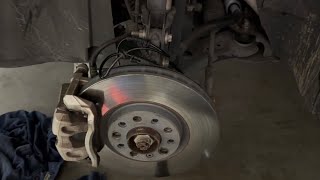
Typical fix: Replace the left front wheel speed sensor. The sensor is held in by a single 10mm bolt on the steering knuckle and the connector is located in the fender liner. 🎬 See this step-by-step walkthrough for replacing the sensor yourself.
Est. part cost: $40-$120 - Damaged Wiring or Connector 🟡 Medium Probability The wiring harness is in the wheel well, making it susceptible to damage from road debris, moisture, and suspension movement. The TSBs mention 'General electrical failure' and 'Circuit Current Out of Range' which are often caused by wiring issues.
How to confirm: Visually inspect the wiring harness from the sensor to its connection point for chafing, breaks, or corrosion in the connector pins. A technician found a Renegade reading 318 MPH on one wheel due to a bad wire, which required running a new wire from the ABS module to the sensor after a new sensor didn't fix it.
Typical fix: Repair the damaged section of wire or replace the connector pigtail. Ensure repairs are sealed against moisture. In severe cases, new wires may need to be run from the ABS module.
Est. part cost: $15-$50 - Failing or Weak Vehicle Battery ⚪ Low Probability Modern Jeeps are highly sensitive to battery voltage. A weak or failing battery can cause a cascade of seemingly unrelated electronic error codes, including ABS and parking brake faults, even if the vehicle still starts.
How to confirm: Test the battery with a proper load tester, not just a voltage check. A battery showing good voltage (e.g., 12.4V) can still fail under load. Many owners on forums report a 'Christmas tree' of dash lights that were all resolved with a new battery.
Typical fix: Replace the vehicle's 12V battery. Ensure the new battery meets or exceeds the original's Cold Cranking Amps (CCA) rating.
Est. part cost: $150-$350 - Damaged or Contaminated Tone Ring ⚪ Low Probability The tone ring, which the sensor reads, is part of the wheel hub assembly. While less common, rust or debris can accumulate on it, or it can be damaged during other suspension work, leading to an erratic signal.
How to confirm: After removing the wheel speed sensor, visually inspect the tone ring inside the hub for rust, debris, or missing/damaged teeth. An oscilloscope may show a distorted or irregular waveform.
Typical fix: The tone ring is integrated into the wheel bearing/hub assembly. If it is damaged, the entire hub assembly must be replaced.
Est. part cost: $150-$300
Rare But Worth Checking
- Faulty ABS Control Module: This is very rare and should only be considered after the sensor, wiring, tone ring, and battery have been confirmed to be in good condition. This failure would likely be accompanied by other trouble codes and communication errors.
Diagnosis Steps
- Connect an OBD-II scanner capable of reading ABS codes to confirm C0031 is present and check for any other codes.
- Use the scanner's live data function to monitor the speed of all four wheels while driving. Confirm that the left front sensor reads 0 mph or a value that is erratic or different from the others.
- Perform a load test on the vehicle's 12V battery. A weak battery is a known cause of multiple electronic faults on this platform.
- Lift the front left corner of the vehicle securely and remove the wheel.
- Visually inspect the wheel speed sensor and its wiring harness for any obvious damage, such as cuts, chafing, or corrosion.
- Disconnect the sensor connector (located in the fender well area) and inspect the pins for corrosion or damage.
- If no visual faults are found, use a multimeter to test for continuity on the wiring between the sensor connector and the ABS module connector. 🎬 Watch: How to properly diagnose and repair damaged sensor wiring. A technician on YouTube demonstrated this process, finding an open wire that a simple sensor replacement couldn't fix.
- If the sensor and wiring test good, inspect the tone ring on the wheel hub for damage or debris.
- If the sensor signal is absent or incorrect and the wiring is intact, replace the wheel speed sensor.
Parts You'll Likely Need
- Left Front Wheel Speed Sensor
(OEM #68430134AA)— This is the most common failure point for code C0031 on this vehicle, as documented by multiple manufacturer TSBs. Some parts listings show this is superseded by or interchangeable with 68563836AA.
Trusted brands: Mopar, Bosch, Delphi, Standard Motor Products (SMP), NTK
OEM price range: $80-$120
Aftermarket price range: $40-$80
Related Codes That Often Appear With This One
- C0034 — This code is for the Right Front Wheel Speed Sensor. The TSBs issued by Jeep often list codes for multiple wheel speed sensors together, as they can fail under similar conditions (water intrusion, oxidation).
- C0037 — This code is for the Left Rear Wheel Speed Sensor. It may appear with C0031 if there is a systemic issue causing multiple sensors to fail, as described in Jeep's TSBs.
- C003A — This code is for the Right Rear Wheel Speed Sensor. Seeing multiple wheel speed sensor codes at once points towards the known sensor failure issue documented in the TSBs.
- C1405-13 — This code for 'Electronic Parking Brake Circuit Open' can be triggered by a loss of valid wheel speed data, causing the system to fault.
Technical Service Bulletins (TSBs) & Recalls
- 05-003-21: Replacement of Front and Rear Wheel Speed Sensors Due to Oxidation or Water Intrusion Setting Diagnostic Trouble Codes (DTCs). Lists C0031-1D and other related codes for Renegade (B1) and Compass (M1/M6) models.
- 05-001-20: Predecessor to TSB 05-003-21, also addressing wheel speed sensor failures and listing codes C0031-01 and C0031-29 for the Renegade (B1).
Platform-Specific Known Issues
- Jeep issued TSB #05-003-21 (which supersedes #05-001-20) for 2018-2020 Renegades (B1) and Compasses (M1/M6), noting that wheel speed sensors may fail due to oxidation or water intrusion, setting codes like C0031-1D, C0031-01, and C0031-29. The recommended repair is to replace the affected sensor(s).
- A weak battery is a very common cause for a 'Christmas tree' effect on the dashboard, where multiple warning lights (ABS, ESC, Parking Brake) appear at once. Owners often solve these issues by replacing the battery, even when it still seems to hold a charge.
Mechanic-Grade Diagnostic Values
- Active Sensor Signal Wire Voltage (Sensor Unplugged) — expected: Battery Voltage (approx. 11-12V). Failure: Low or no voltage suggests an open wire or issue with the ABS module.
- Active Sensor Signal Wire Voltage (Sensor Plugged In) — expected: Slightly less than battery voltage (approx. 10V). Failure: A significant drop or fluctuating voltage can indicate a faulty sensor or wiring issue.
- Wiring Harness Continuity (Resistance) — expected: Less than 1.0 Ohm. Failure: High resistance or an open circuit (>10 kΩ) indicates a broken wire.
Hidden / Shadow Codes Worth Checking
- C0031-01: Left front speed sensor - General electrical failure. This points to a wiring or connector issue. (see via A capable OBD-II scanner that can read ABS codes. Listed in Jeep TSB #05-003-21.)
- C0031-1D: Left Front Wheel Speed Sensor - Circuit Current Out of Range. This suggests an electrical problem, such as a short or incorrect resistance in the circuit. (see via A capable OBD-II scanner that can read ABS codes. Listed in Jeep TSB #05-003-21.)
- C0031-29: Left front speed sensor - Invalid signal. The signal being received by the module is not plausible. (see via A capable OBD-II scanner that can read ABS codes. Listed in Jeep TSB #05-003-21.)
- C0031-2F: Left Front Wheel Speed Sensor - Signal Erratic. The signal is momentarily implausible or discontinuous. (see via A capable OBD-II scanner that can read ABS codes. Listed in Jeep TSB #05-003-21.)
- C0031-62: Left Front Wheel Speed Sensor - Signal Compare Failure. The speed reported by this sensor does not match the speeds from other wheel sensors. (see via A capable OBD-II scanner that can read ABS codes. Listed in Jeep TSB #05-003-21.)
Scan Tool Commands That Help
- wiTECH (or equivalent advanced scanner): Clear All DTCs — After replacing a wheel speed sensor or performing a repair, this function in the OEM tool ensures all related fault codes are properly cleared from the ABS module.
- Advanced ABS Scanner: Module Self-Test / CAN Bus Integrity Test — If the sensor and wiring are confirmed to be good but the code persists, this command can be used to check if the ABS control module itself has an internal fault.
Wiring & Ground Locations
- Wheel Speed Sensor Connector — Located in the front fender well area, accessible after partially removing the plastic splash guard.. This is the first connection point to check for corrosion or damage, as it is exposed to the elements in the wheel well.
- ABS Wiring Harness Path — The harness runs from the sensor in the steering knuckle, up the fender liner, through an intermediate connector, through the firewall, and across to the ABS module.. This path has multiple potential chafe points from suspension movement and road debris. A wire can break internally anywhere along this path, requiring methodical testing to locate the fault.
- ABS Control Module Connector — On some related Jeep models, the module is located on the right side of the engine compartment, and access may require removing the battery and tray.. This is the termination point for the circuit. Testing for voltage and continuity here is the final step to confirm if the fault is in the wiring, the sensor, or the module itself.
Real Owner Repair Stories
- Reddit user Scott_Seven007 on r/JeepRenegade (Jeep Renegade (year not specified, but within 2018-2020 context)) — A dashboard full of warning lights, including ABS, ESC, and others.
❌ Tried (didn't work) Took it to a mechanic who diagnosed a bad right-side ABS sensor.
✅ What actually fixed it Replacing the vehicle's 12V battery, based on advice from the Reddit community. The user noted the old battery showed normal voltage, but replacing it resolved all electronic faults. - YouTube channel 'No Name Garage' (2018 Jeep Renegade) — ABS light on, scan tool showed the right front wheel reading 318 MPH.
❌ Tried (didn't work) Replacing the wheel speed sensor did not fix the problem.
✅ What actually fixed it The technician found a bad wire in the harness between the ABS module and the sensor. A continuity test might show it's okay, but it couldn't carry the required current. The final repair was running two new wires from the module connector to the sensor connector.
"I Checked Everything" — The Actual Cause
- In the context of this electrical code, the equivalent of a 'smoke test clean' scenario is when the sensor and wiring appear to test good with a basic multimeter check. A common cause in this situation is a weak 12V battery that still shows normal resting voltage but fails under load, causing numerous electronic faults.
- Another case is an internal wire break that shows continuity on a multimeter but cannot carry the necessary current for the sensor to operate, leading to an erratic signal under driving conditions. This was seen in a case where a Renegade was reporting 318 MPH from one wheel.
When the Usual Fixes Don't Work
- While the most common cause cited in TSBs is a failed sensor, real-world owner experiences frequently point to other root causes. In one documented case, a mechanic diagnosed a faulty ABS sensor, but the actual fix was replacing a weak 12V battery that otherwise seemed fine. In another professional diagnosis, replacing the sensor did not resolve the issue; the ultimate cause was a broken wire in the harness between the ABS module and the sensor, which required running a new wire. These cases highlight the importance of diagnosing beyond the sensor itself and always checking the battery and wiring integrity before committing to a sensor replacement.
OEM Part Supersession History
68430134AA→68563836AA— Standard part revision by the manufacturer.
Heads up: No incompatibility noted; 68563836AA is the direct replacement.Unknown→68372700AA— This is another Mopar part number listed specifically for 2018-2020 Jeep Renegade models.
Heads up: It is crucial to verify the correct part number using the vehicle's VIN, as multiple parts may exist for the same model years.
Model Year Variations Within This Range
- 2018-2019 (pre-August 2019 build date): TSB #05-001-20 and #05-003-21 apply to Renegade (B1) vehicles built on or before July 31, 2019. This implies that vehicles built after this date may have received an updated sensor design from the factory that is less prone to the failure from water intrusion or oxidation.
Helpful Videos

![ABS Wheel Speed Sensor Wiring Repair Comeback [What Did I Do Wrong?]](https://img.youtube.com/vi/i5_OSaLAcH4/mqdefault.jpg)
We Have This Part in Stock


The information in this article is provided for general reference and educational purposes only. Vehicle specifications, procedures, and part compatibility can vary by production date, trim level, and region. Always consult your vehicle's factory service manual and verify part numbers before purchasing or performing repairs. Safety-critical components such as airbags, seat belts, and braking systems should be installed by a qualified professional.
- Jeep RENEGADE:
- 🎬 Helpful Videos
- 🛍️ Shop This Part
- What's Unique About the 2018-2020 Jeep RENEGADE
- Diagnostic Flowchart
- Symptoms You May Notice
- Most Likely Causes
- Rare But Worth Checking
- Diagnosis Steps
- Parts You'll Likely Need
- Related Codes That Often Appear With This One
- Technical Service Bulletins (TSBs) & Recalls
- Platform-Specific Known Issues
- Mechanic-Grade Diagnostic Values
- Hidden / Shadow Codes Worth Checking
- Scan Tool Commands That Help
- Wiring & Ground Locations
- Real Owner Repair Stories
- "I Checked Everything" — The Actual Cause
- When the Usual Fixes Don't Work
- OEM Part Supersession History
- Model Year Variations Within This Range
- 🎟️ Get 5% Off