

OBD-II Code C0010: Left Front Control Circuit Fault
What C0010 means, why it triggers, and how to fix it
- On GM vehicles from 2015-2024, code C0010 5A is a false alarm triggered by shifting between Drive and Reverse while rolling at 1-3 mph.
- Clear the C0010 code with an ABS-capable scanner and test drive the vehicle before spending $150+ on replacement parts.
- If the code returns, the most common hardware failure is a faulty left front wheel speed sensor, which costs between $140 and $250 to replace.
- Do not confuse the C0010 chassis code with the P0010 engine timing code, as diagnosing the wrong system wastes hours of labor.
What Does C0010 Mean?

C0010 indicates a fault in the left front wheel's braking control circuit. On General Motors vehicles, it almost always points to a Left Front Wheel Speed Sensor issue—or a software glitch. On Ford and Mazda vehicles, it typically indicates an internal failure of the ABS module's hydraulic inlet valve.
Technical definition: The SAE/ISO definition for C0010 is "Left Front Inlet Control (Subfault)". While technically referring to the ABS hydraulic inlet solenoid, manufacturers like GM use it to indicate a fault in the Left Front Wheel Speed Sensor Circuit.
Can I Drive With C0010?
Yes, But With Caution. You can drive, but your Anti-lock Braking System (ABS) and Traction Control are disabled. Your normal brakes function, but your wheels will lock up during hard braking, increasing stopping distance and causing a loss of steering control. Drive cautiously in wet or slippery conditions and repair the issue promptly.
Common Causes

- Driver-Induced False Code (Shifting While Moving) (Very Common) — On millions of GM vehicles, shifting from Drive to Reverse (or vice versa) while rolling at 1-3 mph confuses the brake control module. This triggers a false C0010 code, usually accompanied by a '5A' symptom byte, requiring no parts to fix.
- Faulty Left Front Wheel Speed Sensor (Common) — The sensor measuring the left front wheel's rotational speed has failed internally due to age, heat, or moisture intrusion, sending a dead or erratic signal to the ABS module.
- Damaged Sensor Wiring or Connector (Common) — Wiring routed along the steering knuckle is exposed to road debris, ice, and constant suspension movement. Chafed insulation or corroded connector pins create an open circuit or high resistance.
- Corroded EBCM Ground Connection (Uncommon) — The Electronic Brake Control Module (EBCM) requires a perfect ground to operate. On many trucks and SUVs, the main ground wire bolts directly to the frame rail, where rust and road salt cause severe voltage drops.
- Worn Wheel Bearing or Damaged Tone Ring (Uncommon) — The magnetic tone ring read by the speed sensor is built into the wheel hub. Excessive bearing play alters the sensor's air gap, or a cracked tone ring distorts the magnetic signal.
- Faulty Electronic Brake Control Module (EBCM) (Rare) — An internal circuit board failure or seized hydraulic solenoid inside the ABS module prevents it from processing sensor data or controlling brake pressure. This is the primary cause on Ford and Mazda vehicles.
Symptoms

- ABS and Traction Control Lights Illuminated — The dashboard warning lights for the Anti-lock Braking System and Traction Control System turn on immediately and stay solid.
- Service StabiliTrak / ESC Message — A text warning appears on the driver information center instructing you to service the electronic stability control system.
- Cruise Control Disabled — The vehicle's computer disables cruise control as a safety precaution when an active ABS fault is present.
- Erratic Braking Behavior — You feel a rapid pulsation in the brake pedal at low speeds (under 10 mph) as the ABS falsely activates due to a dropping wheel speed signal.
Common Fixes & Costs

- Clear Code and Change Shifting Habits — Parts: $0, Labor: $50-$150, ~0.5 hr book time (DIY)
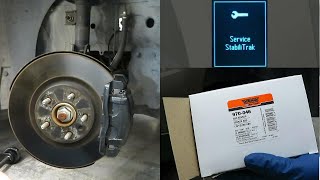
- Replace Left Front Wheel Speed Sensor 🎬 Watch: Step-by-step wheel speed sensor replacement for Equinox and Terrain
— Parts: $40-$100, Labor: $100-$150, ~1.0 hr book time
(Intermediate)
Chevrolet Equinox / GMC Terrain (2018-2023): OEM - Repair Damaged Sensor Wiring — Parts: $10-$30, Labor: $100-$200, ~1.5 hr book time (Intermediate)
- Replace Left Front Wheel Hub Assembly
— Parts: $150-$300, Labor: $200-$350, ~2.0 hr book time
(Professional)
Chevrolet Equinox / GMC Terrain (2018-2023): OEM - Replace Electronic Brake Control Module (EBCM)
— Parts: $400-$1200, Labor: $150-$300, ~2.0 hr book time
(Professional)
Ford Escape (2017-2019): OEM
Used vs. New Parts: Buying Guide

When a used part is worth it: Never buy a used wheel speed sensor or hub assembly. Used parts only make sense when replacing a $1,000+ Electronic Brake Control Module (EBCM).
Donor-vehicle mileage cap: roughly under 60000 miles for the part to have meaningful remaining life.
Donor quality checklist:
- Verify the part number exactly; identical-looking modules often have incompatible internal software.
- Avoid modules pulled from flood-damaged or heavy rust-belt vehicles.
Decision logic:
- If The failed part is a wheel speed sensor or hub assembly → Buy new. The labor cost to install a used bearing that fails quickly outweighs any initial savings.
- If The failed part is the EBCM and a new OEM unit exceeds $1,000 → Use a mail-in module rebuild service or purchase a tested used unit from a reputable recycler.
Warranty tradeoff: Used modules carry 30-90 day warranties. Mail-in rebuild services often provide lifetime warranties on their repairs.
Worst-case if a used part fails: $300 for repeat labor and programming if a used EBCM is defective.
Cost of Not Fixing It
- Immediate: ABS and Traction Control are disabled. Stopping distances increase during panic braking or on wet surfaces. (Added cost: $0)
- 0-6 months: The vehicle fails state safety inspections in jurisdictions that mandate functional ABS systems. (Added cost: $100)
- 6+ months: The lack of ABS contributes to an avoidable collision, resulting in insurance deductibles and premium increases. (Added cost: $500+)
Diagnosis Steps
- Scan for Codes and Symptom Bytes
Connect an ABS-capable OBD-II scanner. If you drive a GM vehicle and see 'C0010 5A' as the only code, you have the driver-induced false code. Do not replace parts.
Tools: ABS-Capable OBD-II Scanner (Beginner) - Clear the Code and Test Drive
Erase the code. Drive the vehicle for 10 minutes, ensuring you come to a complete, dead stop before shifting between Drive and Reverse. If the light stays off, the issue is resolved.
Tools: ABS-Capable OBD-II Scanner (Beginner) - Visually Inspect the Left Front Sensor and Wiring
Raise the left front wheel. Inspect the wiring harness from the wheel hub to the inner fender. Look for chafed insulation, pinched wires, or green corrosion inside the electrical connector.
Tools: Jack, Jack Stands, Flashlight (Beginner) - Monitor Live Wheel Speed Data
Use a scan tool with live data capabilities. Drive straight at 15 mph. The left front wheel speed should exactly match the other three wheels. If it reads 0 mph or fluctuates wildly, the sensor or wiring is faulty.
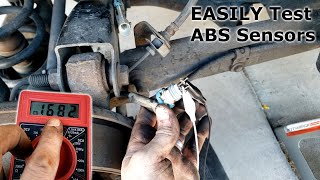
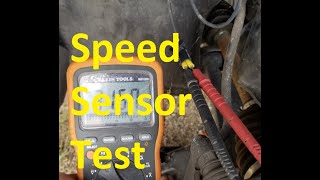
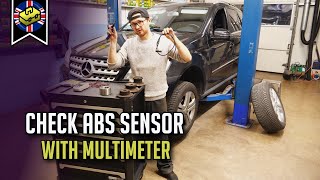
Tools: Advanced OBD-II Scanner (Intermediate) - Test Sensor Resistance and Voltage 🎬 Watch: How to test sensor resistance and AC voltage with a multimeter
Disconnect the sensor. Set a multimeter to Ohms; a healthy passive sensor reads 800-2,500 Ohms. Switch to AC Volts, reconnect the sensor, and spin the wheel by hand. It must generate a steadily increasing voltage (starting around 100mV).
Tools: Digital Multimeter, Jack, Jack Stands (Advanced) - Inspect the EBCM Ground
Locate the main ground bolt for the ABS module on the vehicle's frame rail. Remove the bolt, wire-brush the terminal and frame to bare metal, and reinstall tightly to eliminate voltage drops.
Tools: Socket Set, Wire Brush (Intermediate)
When This Code Triggers (Freeze-Frame Conditions)
- Vehicle Speed: 1-3 mph (GM) or 15-45 mph (For the GM false code, the fault logs at parking lot speeds during a shift. For hardware faults, it logs when one sensor's reading deviates from the others during normal driving.)
- Gear Position: Transitioning D to R (The exact moment the transmission shifts while the wheels are rotating triggers the C0010 5A logic error.)
- System Voltage: 12.5-14.5V (A freeze frame showing voltage below 11.5V indicates a charging system issue is causing module malfunction, not a bad sensor.)
Related Codes
- C0010 5A — A GM-specific symptom byte meaning 'Incorrect Data'. It confirms the driver-induced false code. Clear it and stop completely before shifting.
- C0035 — Specifically means 'Left Front Wheel Speed Sensor Circuit'. If present alongside C0010, it confirms a physical hardware fault in the sensor or wiring.
- C0010:01 — A Ford-specific variant indicating a 'General Electrical Failure' in the inlet control circuit, pointing to a dead ABS module rather than a wheel sensor.
- P0010 — A Powertrain code for engine camshaft timing. It is completely unrelated to the C0010 Chassis code. Do not confuse the two.
Climate & Environmental Factors
- Snow and Ice Buildup: Packed snow physically blocks the wheel speed sensor from reading the tone ring. Thawing the vehicle in a warm garage often resolves the code.
- Road Salt (Rust Belt): Salt accelerates corrosion on the sensor wiring harness, connector pins, and the EBCM's main frame ground bolt, causing high-resistance electrical faults.
- Freeze/Thaw Cycles: Moisture seeps into aging connectors, freezes overnight, and expands to create a temporary open circuit, triggering the code on cold mornings.
How to Clear the Code After You Fix It
- Repair the physical fault or confirm the false code scenario.
- Use an ABS-capable OBD-II scanner to clear codes in the Chassis/ABS menu.
- Cycle the ignition off, then start the engine to confirm the ABS light remains off.
Drive cycle (~10 minutes): Drive the vehicle for 10 minutes, reaching speeds above 25 mph and executing several turns. This forces the EBCM to verify valid signals from all four wheel speed sensors.
Readiness monitors affected: Chassis codes do not affect engine emissions readiness monitors.
Watch out for:
- Using a basic $20 code reader only clears Powertrain (P) codes; it cannot communicate with the ABS module to clear a C0010.
- Disconnecting the battery does not clear hard-stored ABS codes on modern vehicles.
- The code returns instantly if a wiring break or sensor failure was not properly repaired.
Will This Fail Emissions / State Inspection?
No — by itself this code doesn't fail OBD inspection (but it can keep readiness monitors from setting, which causes a separate fail).
- California: An ABS light passes the standard smog check but fails the Brake and Lamp Inspection required for salvage-titled vehicles.
- New York: An illuminated ABS warning light is an automatic failure during the annual safety inspection.
- Texas: An illuminated ABS light passes the safety inspection, but a red 'Brake' warning light fails it.
Most Commonly Affected Vehicles
- Chevrolet Equinox (2015-2024) — Extremely prone to the false C0010 5A code caused by shifting while moving. Covered under GM TSB 20-NA-118.
- GMC Terrain (2015-2024) — Shares the Equinox platform and identical EBCM software sensitivity, making the false code the most common cause.
- Chevrolet / GMC Colorado / Canyon (2018-2022) — Frequently triggers the false code after a 3-point turn. Addressed in GM TSB PIT5696F.
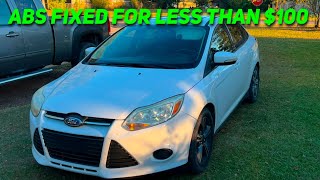
- Ford Escape, Focus, Fusion (2013-2019) 🎬 See how to diagnose and fix ABS problems on Ford Focus — Code C0010:01 indicates a general electrical failure within the ABS module's inlet solenoid circuit, requiring module repair or replacement.
- Mazda 3, 5 (2004-2014) — C0010 points directly to a failed 'Left Front Inlet Control' solenoid inside the ABS hydraulic control unit, requiring pump replacement.
Manufacturer-Specific Notes
- General Motors: GM issued multiple TSBs instructing technicians NOT to replace parts for C0010 5A if it appears alone, as it is a software sensitivity to rolling shifts.
- Ford: C0010 usually points to an internal ABS module failure rather than a wheel speed sensor. Third-party mail-in repair services are the most cost-effective fix.
- Mazda: A C0010 code is a severe indicator of a failed ABS hydraulic unit, often requiring the expensive replacement of the entire ABS pump assembly.
Frequently Asked Questions
I replaced the left front wheel speed sensor, but the C0010 code came back. What now?
You likely misdiagnosed the issue. First, confirm it wasn't the GM false code (C0010 5A). If not, meticulously inspect the wiring harness for hidden breaks, check the wheel bearing for play, and clean the EBCM ground bolt.
Can a weak battery cause a C0010 code?
Yes. The Electronic Brake Control Module (EBCM) is highly sensitive to voltage drops. A failing battery or alternator causes erratic module behavior, triggering false chassis codes.
What is the difference between C0010 and P0010?
C0010 is a Chassis code indicating a brake system or wheel speed sensor fault. P0010 is a Powertrain code indicating an engine camshaft timing issue. They require completely different diagnostic paths.
Will my brakes still work with a C0010 code?
Your standard hydraulic brakes function normally. However, your Anti-lock Braking System (ABS) is disabled, meaning your wheels will lock up and skid during emergency braking.
Why did the C0010 code appear after a 3-point turn?
Shifting from Drive to Reverse while the vehicle is still rolling forward confuses the brake computer. It detects wheel speed when it expects none, logging a false 'Incorrect Data' error.
How much does it cost to fix code C0010?
Clearing a false code costs $0 to $150. Replacing a wheel speed sensor costs $140 to $250. Replacing a failed ABS module on a Ford or Mazda exceeds $1,000 at a dealership.
Key Takeaways
- On GM vehicles from 2015-2024, code C0010 5A is a false alarm triggered by shifting between Drive and Reverse while rolling at 1-3 mph.
- Clear the C0010 code with an ABS-capable scanner and test drive the vehicle before spending $150+ on replacement parts.
- If the code returns, the most common hardware failure is a faulty left front wheel speed sensor, which costs between $140 and $250 to replace.
- Do not confuse the C0010 chassis code with the P0010 engine timing code, as diagnosing the wrong system wastes hours of labor.
Helpful Videos

The information in this article is provided for general reference and educational purposes only. Vehicle specifications, procedures, and part compatibility can vary by production date, trim level, and region. Always consult your vehicle's factory service manual and verify part numbers before purchasing or performing repairs. Safety-critical components such as airbags, seat belts, and braking systems should be installed by a qualified professional.
- 🎬 Helpful Videos
- What Does C0010 Mean?
- Can I Drive With C0010?
- Common Causes
- Symptoms
- Common Fixes & Costs
- Used vs. New Parts: Buying Guide
- Cost of Not Fixing It
- Diagnosis Steps
- When This Code Triggers (Freeze-Frame Conditions)
- Related Codes
- Climate & Environmental Factors
- How to Clear the Code After You Fix It
- Will This Fail Emissions / State Inspection?
- Most Commonly Affected Vehicles
- Manufacturer-Specific Notes
- Frequently Asked Questions
- I replaced the left front wheel speed sensor, but the C0010 code came back. What now?
- Can a weak battery cause a C0010 code?
- What is the difference between C0010 and P0010?
- Will my brakes still work with a C0010 code?
- Why did the C0010 code appear after a 3-point turn?
- How much does it cost to fix code C0010?
- Key Takeaways
- 🎟️ Get 5% Off