

OBD-II Code C0004: Traction Control System Valve Problem
What C0004 means, why it triggers, and how to fix it
- Code C0004 disables your ABS and traction control, increasing your risk of skidding during hard stops or on wet roads.
- The most frequent cause is an internal failure of the ABS control module, which costs between $800 and $1,500 to replace at a shop.
- Before buying expensive parts, inspect the main ABS ground wire on the frame rail and test the 30A/40A ABS fuses, as corrosion or a blown fuse perfectly mimics a dead module.
- Sending your original ABS module to a remanufacturing service costs $200 to $600 and avoids the $150+ dealership reprogramming fee required for new modules.
- A basic $20 engine code reader cannot diagnose this issue; you need an advanced scanner capable of reading Chassis (C-codes) and performing bi-directional ABS tests.
What Does C0004 Mean?

Code C0004 means your ABS Module detected an electrical fault with a specific traction control system valve. This system helps tires maintain grip during acceleration. The fault lies with a small, electronically controlled solenoid valve that modulates brake pressure to prevent wheel spin.
Technical definition: The SAE/OBD-II definition is "Traction Control System (TCS) Control Channel 'B' Valve 2 (Subfault)". This points to an electrical or mechanical fault within a single solenoid valve circuit inside the ABS/TCS hydraulic control unit (HCU). The 'subfault' indicates a self-diagnosed issue, typically an open circuit, short circuit, or internal module driver failure.
Can I Drive With C0004?
Yes, But With Caution. Yes, but your traction control (TCS) and anti-lock brake (ABS) systems are disabled. Drive with extreme caution on wet, icy, or gravel roads, and get the vehicle inspected promptly. Your vehicle retains standard hydraulic braking, but without the anti-lock function, wheels lock up during hard stops, significantly increasing the risk of skidding and losing steering control. Continued driving does not damage other components, but the safety risk is immediate.
Common Causes

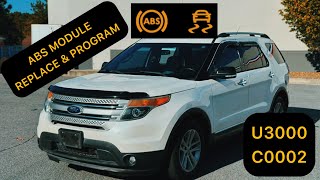
- Faulty ABS/TCS Control Module (Very Common) — The control module fails internally, causing it to incorrectly report a valve issue or fail to operate the valve. On many Ford vehicles, this is a known defect confirmed by secondary codes like U3000. 🎬 Watch: Step-by-step Ford ABS module replacement and programming guide.
- Damaged, Corroded, or Chewed Wiring/Connectors (Common) — Wires leading to the ABS module are exposed to heat, moisture, vibration, and rodents. Cracked insulation, broken wires, or corroded connector pins create poor connections that trigger the code.
- Blown Fuse or Poor Ground Connection (Common) — The ABS/TCS module relies on a robust power and ground supply. A blown fuse or a loose, corroded ground wire starves the module of power, setting fault codes. 🎬 See how to properly test ABS module power and ground. This is a heavily documented issue on GM trucks. 🎬 Watch: How to find and fix common GM ground wire issues.
- Faulty Valve Actuator (Solenoid) or Stuck Valve (Common) — The solenoid valve fails electrically (short/open circuit) or mechanically sticks due to debris from contaminated brake fluid, preventing it from moving when commanded by the control module.
- Low or Unstable Battery Voltage (Less Common) — A failing battery, bad alternator, or poor battery cable connections cause voltage fluctuations. Sensitive electronics interpret this as a fault and set spurious codes, especially during engine cranking or after a jump-start.
- Corrupted Software or Communication Failure (Less Common) — A software glitch within the control module or a loss of communication with other vehicle computers over the CAN bus network leads to a fault code.
Symptoms

- Traction Control (TCS) or Electronic Stability Control (ESC) Light On — A warning light shaped like a car with squiggly lines behind it stays lit on your dashboard.
- ABS Light On — Because traction control is an integral part of the Anti-lock Brake System (ABS), the ABS warning light turns on simultaneously.
- Service StabiliTrak / Service AdvanceTrac Warning — On many GM and Ford vehicles, a text message appears on the driver information center indicating the stability control system needs service.
- Loss of Traction Control — The system no longer prevents wheel spin when you accelerate quickly, especially on slippery surfaces like wet or icy roads.
- Intermittent Warning Light — Warning lights turn on and off sporadically, often triggered by bumps or wet driving conditions, indicating a loose connection or intermittent circuit fault.
Diagnostic Flowchart

Tap your situation to follow the diagnostic path that matches what you're seeing on this code.
Common Fixes & Costs
- Replace ABS Control Module
— Parts: $800-$1300, Labor: $150-$300 (includes programming), ~1.5 hr book time
(Professional)
: OEM
: OEM
: OEM - Have ABS Module Repaired/Remanufactured — Parts: $200-$400, Labor: $110-$250 (for removal and reinstallation), ~1.2 hr book time (Professional)
- Repair Damaged Wiring or Connectors — Parts: $20-$100, Labor: $150-$500, ~2.5 hr book time (Intermediate)
- Clean or Replace Ground Connection / Blown Fuse — Parts: $5-$30, Labor: $50-$150, ~0.5 hr book time (Beginner)
- Reprogram or Re-flash ABS Control Module — Parts: $0, Labor: $150-$250, ~1.0 hr book time (Professional)
DIY vs Professional
- Replace ABS Control Module — Beginner:
- Have ABS Module Repaired/Remanufactured — Beginner:
- Repair Damaged Wiring or Connectors — Beginner:
- Clean or Replace Ground Connection / Blown Fuse — Beginner:
- Reprogram or Re-flash ABS Control Module — Beginner:
Used vs. New Parts: Buying Guide
When a used part is worth it: A used OEM module from a low-mileage donor vehicle is a cost-effective option for older vehicles where new parts are discontinued or prohibitively expensive. It requires a mechanic experienced in programming used modules.
Donor-vehicle mileage cap: roughly under 100000 miles for the part to have meaningful remaining life.
Donor quality checklist:
- Verify the part number matches your original module exactly.
- Purchase from a reputable seller providing the donor vehicle's VIN and mileage.
- Avoid parts from flood-damaged vehicles or regions with heavy road salt use.
Decision logic:
- If The original module can be repaired/remanufactured → Choose remanufacturing. It is cost-effective and avoids the need for VIN programming.
- If Vehicle is older (>10 years) and budget is the main concern → A used module is a viable option, but factor in the cost and hassle of programming.
- If The vehicle is newer and you want maximum reliability and warranty → Buy a new OEM part from a dealer. It is the most expensive but most straightforward option.
Warranty tradeoff: Used parts typically have a 30-90 day warranty. Remanufactured modules often come with a 1-year or lifetime warranty. New OEM parts carry the manufacturer's standard parts warranty (typically 1-2 years).
Worst-case if a used part fails: $300-$600 if a used or improperly repaired module fails. This includes repeat labor for removal/reinstallation and programming attempts.
Cost of Not Fixing It
- Immediate: Loss of ABS and Traction/Stability Control. This significantly increases the risk of skidding and losing steering control during emergency braking or on slippery surfaces. (Added cost: N/A (Safety Risk))
- 0-6 months: No direct damage to other components occurs. The primary cost is the continued safety risk and the eventual, unavoidable cost of repair. Driving with the fault does not cause cascading mechanical failures. (Added cost: $0 (beyond eventual repair))
- 6+ months: An internal electronic short within a failing module potentially leads to further damage within the module itself or causes the ABS pump to run continuously. The main consequence remains the prolonged safety hazard. (Added cost: $0 - $200 (potential for more complex module failure))
Diagnosis Steps
- Scan for All Trouble Codes
Use an OBD-II scanner capable of reading Chassis (C-codes) and Network (U-codes) to confirm C0004 is present. Note any communication codes (U-codes) or codes for other ABS valves (like C0003), as they provide critical clues.
Tools: Advanced OBD-II Scanner (Beginner) - Inspect Fuses and Grounds
Locate all fuses related to the ABS/TCS control module and check for blown fuses. Find the main ground wires for the ABS module (often bolted to the frame rail) and ensure they are clean, tight, and free of corrosion.
Tools: Owner's Manual, Basic Hand Tools (Beginner) - Visually Inspect the Wiring Harness
Trace the wiring to the ABS control module. Look for chafed insulation, melted plastic, rodent chew marks, or green/white corrosion on the connector pins. Gently wiggle the harness with the key on to check for intermittent faults.
Tools: Flashlight (Intermediate) - Check for Power and Ground at the Module
With the key on, use a multimeter to verify the ABS module receives 12.0 to 14.5 volts at the correct pins. Check for ground continuity to the chassis (less than 1.0 ohm required). A lack of voltage or high ground resistance points to a supply circuit problem.
Tools: Multimeter, Vehicle-Specific Wiring Diagram (Advanced) - Test Valve Solenoid Resistance
Disconnect the ABS module connector and measure the resistance of the specified valve coil. An open circuit ('OL') or a short (near-zero resistance) indicates a failed solenoid. Typical values range from 4 to 21 ohms.
Tools: Multimeter, Vehicle-Specific Wiring Diagram (Advanced) - Check CAN Bus Communication
Using a high-end scan tool, monitor the CAN bus network to see if the ABS module communicates with other modules. A lack of communication (often code U0121) points to a failed module or a network wiring problem.
Tools: Advanced Scan Tool with Network Diagnostics (Advanced) - Pro Tip: Active Valve Test & Data Stream Analysis
Perform a bi-directional test, commanding the C0004 valve to cycle on and off. Watch the live data stream for a change in the valve's status PID or current draw. If the module sends the command but the data doesn't change, it confirms a failure in the circuit or valve.
Tools: Bi-Directional Scan Tool (Professional) - Pro Tip: Scope Test the Valve Driver Circuit
Connect a lab scope to the control wire for Valve 2. When activated, you should see a Pulse-Width Modulated (PWM) square wave signal. A clear signal proves the ABS module's internal driver works, pointing the fault to the wiring or solenoid. A flat line indicates a failed module.
Tools: Automotive Oscilloscope, Wiring Diagram (Professional)
When This Code Triggers (Freeze-Frame Conditions)
- System State: Key-On or Driving (The fault is detected during the initial key-on self-test or during normal driving when the module is active.)
- Vehicle Speed: 0 mph or >10 mph (ABS modules perform a self-test at startup (0 mph) and another functional check the first time the vehicle exceeds 10-14 mph.)
- Battery Voltage: 11-15V (The code sets when the system has stable battery voltage. Low voltage during cranking sets spurious codes.)
- TCS/ESC Status: Active or Inactive (An electrical fault like C0004 is a continuous fault, present whether the traction control system is actively intervening or not.)
Related Codes
- C0003 — This code is for 'TCS Control Channel B Valve 1'. It often appears with C0004 because they are part of the same control channel. Seeing both points strongly to a common cause like a faulty control module or a power/ground issue.
- U3000 — This code means 'Control Module Internal Electronic Failure'. It is very common alongside C0004 on Ford vehicles. U3000 confirms the module has an internal error, making a failed ABS module diagnosis almost certain.
- U0121 — This code means 'Lost Communication With ABS Control Module'. Diagnose U0121 first. If the rest of the car cannot communicate with the ABS module, C0004 is simply a symptom of that communication loss.
- C0035 / C0040 — These codes indicate wheel speed sensor circuit faults. They point to a specific wheel speed sensor or its wiring, not the ABS module's internal valves. C0004 is specific to the hydraulic control unit.
Climate & Environmental Factors
- Humidity and Road Salt: In regions with high humidity or where road salt is used, corrosion is a primary driver of C0004 faults. Moisture and salt accelerate the degradation of wiring insulation and cause severe corrosion on the ABS module's electrical connector pins and ground points.
- Extreme Heat: Sustained high ambient temperatures accelerate the aging and failure of electronic components soldered to the ABS module's internal circuit board, leading to cracked solder joints or failure of internal valve driver transistors.
- Extreme Cold: Extreme cold causes wiring to become brittle and crack. It also causes intermittent connection issues as metal contracts, potentially triggering the code until the engine bay warms up.
How to Talk to a Mechanic About This Code
Say this: "I have an ABS and traction control light on, and my scanner shows code C0004. I'd like to schedule a diagnostic. Please check the ABS fuses and the main ground connection for the module before quoting a new ABS module."
This language directs the technician toward a logical, cost-effective diagnostic sequence instead of immediately jumping to the most expensive conclusion (replacing the ABS module). It establishes you as an informed consumer.
Avoid saying:
- 'My ABS light is on, can you fix it?' (Too vague, invites a high quote for the worst-case scenario.)
- 'Just replace whatever is broken.'
- 'I think I need a new ABS module.' (Diagnosing yourself invites an expensive, potentially unnecessary repair.)
Questions to ask before authorizing the repair:
- Did you test for power and ground at the ABS module connector? What were the readings?
- Did you inspect the main ground wire on the frame for corrosion or tightness?
- If you recommend an ABS module, have you confirmed it is an internal failure versus a wiring problem?
- What is the warranty on the recommended repair and the part itself?
Where to Take It: Dealer vs Independent vs Chain
- Dealer:
A necessary option if a new module and proprietary programming are required, but avoid for out-of-warranty diagnosis due to high costs.
Best for: Vehicles under warranty., Complex software-related issues or recalls., When a new module requires online programming only the dealer can perform.
Downsides: Highest labor rates and parts markup, often 50-65% more than independent shops., Refuses to install used or remanufactured parts., Defaults to replacing an entire assembly rather than performing a targeted wiring repair. (Typical cost: +50% vs. baseline) - Independent Shop:
Best fit for most C0004 scenarios. A good independent shop provides the best balance of expertise and value. Ask upfront if they have the tools to diagnose, program, and bleed ABS systems for your specific vehicle.
Best for: Out-of-warranty vehicles where cost is a major factor., Diagnosing common pattern failures like bad grounds or wiring., Installing customer-supplied remanufactured or used parts.
Downsides: Diagnostic tool capability varies; ensure they have a pro-level scanner that reads ABS codes and performs programming., Quality is shop-dependent; look for ASE certifications. (Typical cost: +0% vs. baseline) - Chain Shop:
AVOID for this repair. They are ill-equipped for the module-level diagnostics and programming that C0004 requires.
Best for: Reading the initial code for free.
Downsides: Technicians lack advanced training for complex electrical diagnostics., Not equipped with high-end, bi-directional scan tools needed for ABS module testing., High pressure to upsell and misdiagnose the issue. (Typical cost: -10% vs. baseline)
When to Walk Away From the Repair
If the estimated repair cost for the C0004 code exceeds 40-50% of your vehicle's current private-party market value, pause and consider your options.
- Car worth $5000, fix is $2200: Walk away. The repair cost is nearly half the car's value. Sell it as-is (with full disclosure) to a DIY-er or trade it in.
- Car worth $15000, fix is $1800: Fix it. The repair cost is 12% of the vehicle's value and restores a critical safety system.
- Car worth $8000, fix is $450: Fix it immediately. If the diagnosis is a simple wiring or ground issue, the cost is low compared to the car's value and the safety benefit is high.
What Scan Tool You Need for This Code

Minimum: A scanner that reads and clears Chassis (C-codes) for ABS systems. A basic engine-only (P-code) reader is useless for this code.
A $20 code reader from a parts store will not see Chassis codes. It will display 'No Codes Found' even with the ABS light on. You need a tool specifically advertised to read ABS/SRS codes.
Budget: BlueDriver Pro (~$100) — Reads and clears ABS codes like C0004 on most major brands. Provides live data for wheel speed sensors to rule out related issues. It is not bi-directional, so it cannot command the valve to activate.
Mid-range: Foxwell NT510 Elite / NT630 Plus (~$150) — Provides full system diagnostics, including reading/clearing C0004. Offers bi-directional control (Active Test) to command the ABS solenoids and pump motor to cycle, a critical diagnostic step. Performs the ABS bleed function after a repair.
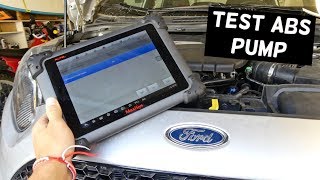
Professional: Autel MaxiCOM MK808S / MK808BT (~$450-550) — Offers full bi-directional control of the ABS module to activate specific valves and watch live data. Performs advanced functions like ABS bleeding and module programming/coding required after replacing the module.
Rent vs buy: Auto parts stores like AutoZone loan scanners that read ABS codes, but they often cannot clear them. Buying a tool like the BlueDriver is a worthwhile investment for ongoing maintenance.
How to Clear the Code After You Fix It
- Reconnect the battery if it was disconnected for the repair.
- Use an OBD-II scan tool to clear the C-codes from the ABS module.
- Perform the ABS self-test drive cycle.
Drive cycle (~10 minutes): After clearing the code, start the vehicle. The ABS light should perform its bulb check and turn off. Drive the vehicle straight ahead and exceed 15 mph. This allows the module to perform its dynamic self-test and verify the solenoids and pump motor are functional. If the light stays off, the repair is successful.
Readiness monitors affected: Not applicable for emissions readiness.
Watch out for:
- Using a basic code reader that only clears Powertrain (P-codes) will not clear a Chassis (C-code) like C0004.
- If the underlying electrical fault is not fixed, the code returns immediately upon the next self-test.
Will This Fail Emissions / State Inspection?
No — by itself this code doesn't fail OBD inspection (but it can keep readiness monitors from setting, which causes a separate fail).
- California: An illuminated ABS light will NOT cause a failure of the emissions (smog) test. The smog check is only concerned with the Check Engine Light and emissions-related systems.
- New York: An illuminated ABS warning light IS grounds for failure of the annual safety inspection. Recent legislation explicitly includes it as a failure item.
- Texas: An illuminated ABS light will NOT cause a failure of the safety inspection. The inspection checks the service brakes for performance, but a non-functional ABS system is not a rejection criterion.
Most Commonly Affected Vehicles
- Ford Explorer (2011-2015) — Extremely prone to internal ABS module failure, often presenting codes C0004:49 and U3000 simultaneously. The ':49' suffix denotes an internal electronic failure, making module replacement or repair the most likely fix.
- Ford F-150 (2007-2014) — Often experiences ABS module communication failures and internal faults. Remanufacturing the original Bosch module is a common and cost-effective repair strategy.
- Chevrolet Silverado (2014-2019) — Wiring issues and internal EBCM (Electronic Brake Control Module) faults are common. A poor ground connection on the frame rail under the driver's door is a frequent root cause.
- GMC Sierra (2014-2019) — Shares the same platform and EBCM as the Chevy Silverado, making it susceptible to the same wiring and module failures, especially poor grounds on the frame.
- Dodge / Ram 1500 / 2500 (2013-2018) — These trucks have known issues with the TRW-brand ABS module (EBC-440), leading to codes C0004 and C2200 (ABS Module Internal). Recent recalls focus on software issues in newer models.
- Hyundai Santa Fe (2013-2020) — Subject to ABS module failures. Predecessor models were involved in major recalls for fire risk related to the ABS module.
- Kia Optima / Sorento (2015-2020) — While module failures occur, ABS/TCS lights on these models are frequently triggered by a faulty wheel speed sensor, which sets a different code (e.g., C0040).
- Subaru Outback / Forester (2010-2017) — ABS/TCS lights are often a symptom of a failing brake light switch, a very common and inexpensive part to fail. Check this before investigating complex ABS faults.
Manufacturer-Specific Notes
- Ford: On models like the Explorer and Edge, C0004 is often accompanied by a two-digit suffix, like C0004:49. This specific combination almost always indicates an internal electronic failure of the ABS module, requiring replacement or repair.
- General Motors (Chevy/GMC): On GM trucks, this code is frequently caused by a poor ground connection for the Electronic Brake Control Module (EBCM). Cleaning and tightening the main ground bolt on the frame rail directly below the driver-side door is the primary diagnostic step.
- Dodge / Ram: On 2013-2018 trucks, this code points to a failure of the TRW EBC-440 ABS module. Before condemning the module, always check fuses F06 and F26 in the underhood Power Distribution Center (PDC), as a blown fuse mimics module failure.
- Subaru: A faulty brake light switch is a common failure item that disables the Vehicle Dynamics Control (VDC) and Traction Control systems, illuminating the warning lights. Check this inexpensive part before performing complex diagnostics.
Frequently Asked Questions
Can I fix code C0004 myself?
Diagnosing the exact cause requires advanced tools. Beginners can check fuses and visually inspect wiring, but replacing or reprogramming the ABS module requires professional equipment. Stop DIY and go to a shop if basic fuse and ground checks do not resolve the issue.
Will clearing the code make it go away?
You can clear the code with a scanner, but a hard fault returns immediately upon the next self-test. It will not stay off until the underlying electrical or mechanical problem is fixed.
My mechanic quoted thousands to replace the whole wiring harness. Is this necessary?
Not always. Dealerships default to replacing the entire harness because they cannot warranty a splice repair. A skilled independent technician can locate the specific broken wire and perform a targeted, permanent repair for $300-$800 instead of $4000+.
Is it better to repair or replace the ABS module?
Repairing (remanufacturing) your original module costs $200-$600, significantly less than buying a new one. A key advantage is that a repaired module retains your vehicle's VIN, avoiding expensive dealership reprogramming fees.
Why did the light come on after I changed my battery?
Sudden voltage drops from disconnecting a battery cause sensitive electronic modules to set spurious fault codes. Clear the code first; if it returns, perform a battery system reset by disconnecting the negative terminal for 30 minutes.
What does the 'subfault' in the C0004 definition mean?
The term 'subfault' means the control module ran an internal self-diagnostic test and pinpointed a specific problem. In this case, it isolated the fault to 'Channel B Valve 2' within the Traction Control System, adding diagnostic precision.
Can a bad wheel speed sensor cause code C0004?
No. A bad wheel speed sensor triggers specific codes (like C0035-C0050), while C0004 isolates a valve control circuit within the ABS hydraulic unit itself. Both turn on the same warning lights, but point to entirely different components.
Key Takeaways
- Code C0004 disables your ABS and traction control, increasing your risk of skidding during hard stops or on wet roads.
- The most frequent cause is an internal failure of the ABS control module, which costs between $800 and $1,500 to replace at a shop.
- Before buying expensive parts, inspect the main ABS ground wire on the frame rail and test the 30A/40A ABS fuses, as corrosion or a blown fuse perfectly mimics a dead module.
- Sending your original ABS module to a remanufacturing service costs $200 to $600 and avoids the $150+ dealership reprogramming fee required for new modules.
- A basic $20 engine code reader cannot diagnose this issue; you need an advanced scanner capable of reading Chassis (C-codes) and performing bi-directional ABS tests.
Helpful Videos

The information in this article is provided for general reference and educational purposes only. Vehicle specifications, procedures, and part compatibility can vary by production date, trim level, and region. Always consult your vehicle's factory service manual and verify part numbers before purchasing or performing repairs. Safety-critical components such as airbags, seat belts, and braking systems should be installed by a qualified professional.
- 🎬 Helpful Videos
- What Does C0004 Mean?
- Can I Drive With C0004?
- Common Causes
- Symptoms
- Diagnostic Flowchart
- Common Fixes & Costs
- DIY vs Professional
- Used vs. New Parts: Buying Guide
- Cost of Not Fixing It
- Diagnosis Steps
- When This Code Triggers (Freeze-Frame Conditions)
- Related Codes
- Climate & Environmental Factors
- How to Talk to a Mechanic About This Code
- Where to Take It: Dealer vs Independent vs Chain
- When to Walk Away From the Repair
- What Scan Tool You Need for This Code
- How to Clear the Code After You Fix It
- Will This Fail Emissions / State Inspection?
- Most Commonly Affected Vehicles
- Manufacturer-Specific Notes
- Frequently Asked Questions
- Can I fix code C0004 myself?
- Will clearing the code make it go away?
- My mechanic quoted thousands to replace the whole wiring harness. Is this necessary?
- Is it better to repair or replace the ABS module?
- Why did the light come on after I changed my battery?
- What does the 'subfault' in the C0004 definition mean?
- Can a bad wheel speed sensor cause code C0004?
- Key Takeaways
- 🎟️ Get 5% Off