

B3935 on 2012-2016 GMC Yukon Denali XL: Security Fault, No-Start Causes and Fixes
On a 2012-2016 Yukon Denali XL, code B3935 almost always indicates a no-start condition caused by radio frequency interference (RFI) with the key's security chip. The most common fix is free: remove all other keys, fobs, and aftermarket chargers from near the ignition. Do not replace parts until RFI is ruled out. For 2014-2015 models, a BCM software update may be the required fix if code B2955 is also present.
- B3935 means your Yukon's security system has failed to authenticate your key, preventing the engine from starting.
- The most common cause is Radio Frequency Interference (RFI). Before paying for any diagnosis or parts, unplug all phone chargers/USB devices and remove all other fobs/cards from your keychain.
- Do NOT let a mechanic replace the BCM or ignition switch without first ruling out RFI, a bad key, and (on 2014-15 models) a software update.
- If RFI is not the cause, your next step is to try a spare key to determine if your primary key has failed.
- This is a well-documented issue by GM, and the fix is often free or involves a software update rather than expensive parts.
What's Unique About the 2012-2016 Gmc YUKON DENALI XL
The GMT900 (2012-2014) and K2XX (2015-2016) platforms used for the Yukon Denali XL are known to have immobilizer systems that are particularly sensitive to radio frequency interference operating at 125 kHz. GM has issued multiple Technical Service Bulletins (TSBs), such as the PIC5650 series, acknowledging that intermittent no-start conditions with code B3935 are frequently caused by RFI from devices like phone chargers, other key fobs, or toll passes. The TSBs specifically advise technicians *not* to replace parts until these external factors have been completely ruled out. [9, Bulletin #PIC5650J] Furthermore, a specific software glitch affects 2014-2015 models, addressed by TSB PI1180A, which requires a BCM reprogram instead of a parts replacement.
Diagnostic Flowchart
Tap your situation to follow the diagnostic path that matches what you're seeing on this vehicle.
Generation note: This range covers two generations: the GMT900 (2012-2014) and the K2XX (2015-2016). The security system issue and the primary cause—Radio Frequency Interference—are common to both generations, as confirmed by TSBs that cover the entire year span. [9, Bulletin #PIC5650M, Bulletin #PIC5650J] However, the 2014-2015 K2XX models are uniquely affected by a BCM software glitch (TSB PI1180A) that is not applicable to the earlier GMT900 platform.
Symptoms You May Notice
- No crank, no start condition.
- Engine starts and immediately stalls.
- Security light is illuminated or flashing on the dashboard. [1, Bulletin #PIC5650M]
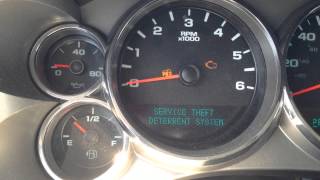
- "Service Theft Deterrent System" message on the Driver Information Center (DIC).
- "No Fob Detected" message may appear on the DIC for vehicles with keyless start.
- Replacing the starter
- Replacing the battery
- Replacing the Body Control Module (BCM) without first checking for RFI or software updates.
Most Likely Causes
- Radio Frequency Interference (RFI) 🔴 High Probability The vehicle's immobilizer system operates at 125 kHz and is highly sensitive to external signals from other devices. TSBs PIC5650J and PIC5650M directly cite this as a primary cause for B3935. Common culprits include other vehicle keys, building access cards, gas station speed passes, and aftermarket electronics like phone chargers or LED lights plugged into the vehicle.
How to confirm: Remove the ignition key from your keychain. Isolate it from all other keys, fobs, and RFID cards. Unplug any aftermarket phone chargers, dash cams, or other devices from the 12V power outlets. If the vehicle starts, RFI was the cause.
Typical fix: Keep the ignition key isolated from other electronic devices. Avoid using low-quality aftermarket chargers in the power outlets near the ignition. This is a no-cost fix.
Est. part cost: $0 - Defective or Damaged Ignition Key 🟡 Medium Probability The transponder chip embedded in the key head is passive but can be damaged from being dropped, water exposure, or simple wear and tear, preventing it from completing the security handshake.
How to confirm: After ruling out RFI, try starting the vehicle with a spare key. If the spare key works reliably and the primary key does not, the transponder chip in the primary key has failed.
Typical fix: The faulty key must be replaced. A new key will need to be cut and electronically programmed to the vehicle by a dealer or an automotive locksmith. In some cases, an owner can perform a 30-minute security relearn procedure. 🎬 Watch: How to perform the 30-minute key relearn procedure
Est. part cost: $75-$250 - Body Control Module (BCM) Software Glitch ⚪ Low Probability Specifically for 2014-2015 models, GM issued TSB PI1180A to address a software issue that could cause a "No Click, No Crank, No Start" condition with codes B3935 and B2955. This is caused by the BCM failing to correctly read the immobilizer information.
How to confirm: This must be confirmed by a GM dealer or a qualified shop. If the vehicle is a 2014 or 2015 model and both B3935 and B2955 are present, this is the likely cause. The technician will check the BCM's current software calibration against the latest version on GM's TIS2WEB portal.
Typical fix: The BCM needs to be reprogrammed with the latest software calibration by a GM dealership using the Service Programming System (SPS). This is a labor-only fix, typically taking 0.5 hours under warranty labor operation 2880218.
Est. part cost: $0 (labor only)
Rare But Worth Checking
- Faulty Immobilizer Antenna (Exciter Ring): The antenna ring around the ignition cylinder energizes the key's transponder. While uncommon, damage to this ring or its wiring can prevent the key from being read, causing B3935. This part is also referred to as the immobilizer transceiver.
- Faulty Body Control Module (BCM): A hardware failure within the BCM itself is rare but possible. This should only be considered after all other possibilities, including RFI, key issues, and software updates, have been exhausted. Water intrusion is a possible cause of BCM failure.
- Poor Ground Connection: These vehicle platforms are known for having ground connection issues. 🎬 See how to diagnose no-start and communication issues A poor ground for the BCM or related instrument panel components can cause a wide range of electrical problems, including theft deterrent system faults.
Diagnosis Steps
- Verify the 'Security' light is on or a 'Service Theft Deterrent System' message is displayed.
- Unplug ALL aftermarket devices from 12V power outlets (phone chargers, dash cams, LED lights, etc.).
- Remove the ignition key from the keychain, isolating it from all other keys, fobs, and RFID cards (e.g., building access cards, gas station passes).
- Attempt to start the vehicle with the isolated key. If it starts, the issue is RFI. Re-introduce items one by one to identify the culprit. 🎬 Watch: Understanding how radio frequency interference affects electronics
- If the vehicle still does not start, try the spare key. If the spare key works, the primary key is faulty.
- If neither key works and RFI has been ruled out, scan for other codes like B3055, B3060, or B2955.
- For 2014-2015 models with both B3935 and B2955 present, consult a dealer about TSB PI1180A for a BCM software update. This is the most likely cause.
- If the key is suspected, attempt the 30-minute manual relearn procedure (3 cycles of turning the key to 'ON' for 10 minutes until the security light goes out). This may work with a new, unprogrammed key.
- If all else fails, have a professional inspect the immobilizer antenna wiring and consider the possibility of a failed BCM or a poor ground connection.
Parts You'll Likely Need
- Ignition Key
(OEM #ACDelco 22936098 (Example for 2012-2014 4-Button w/ Remote Start))— If a spare key works and the primary does not (after ruling out RFI), the transponder chip in the primary key has failed.
Trusted brands: ACDelco, Strattec
OEM price range: $100-$200
Aftermarket price range: $50-$120 - Immobilizer Antenna (Exciter Ring)
(OEM #22738087 (For GMT900 models))— In rare cases where RFI and the key are ruled out, the antenna that powers and reads the key transponder can fail. This part is located around the ignition lock cylinder.
Trusted brands: ACDelco, GM Genuine Parts
OEM price range: $25-$50
Aftermarket price range: $20-$40
Related Codes That Often Appear With This One
- B3055 — This code means 'No Transponder Modulation,' indicating the system received no signal from the key at all. It often appears with B3935 when RFI is severe or the key has completely failed. [10, Bulletin #PIC5650M]
- B3060 — This code means 'Unprogrammed Transponder,' indicating the system read a key that isn't learned. All three codes (B3055, B3060, B3935) are listed together in GM service bulletins for the same no-start security concern. [7, Bulletin #PIC5650M]
- B2955 — On 2014-2015 models, this code for the 'Security Sensor Data Circuit' is a critical indicator. When B2955 appears alongside B3935, it strongly points to the BCM software glitch addressed by TSB PI1180A.
Technical Service Bulletins (TSBs) & Recalls
- PIC5650M: Mentions B3935 with B3055 and B3060 for an intermittent no crank/no start/stall with security light on, and lists numerous potential RFI sources.
- PIC5650J: Advises against replacing parts for B3935 and to instead investigate Radio Frequency Identification devices.
- PI1180A: Addresses a BCM software issue on 2014-2015 models causing B3935 and B2955, fixed by reprogramming.
Platform-Specific Known Issues
- GM Technical Service Bulletin PIC5650J explicitly warns technicians *not* to replace any parts for this concern until investigating Radio Frequency Identification devices as the cause. [9, Bulletin #PIC5650J]
- GM Technical Service Bulletin PI1180A identifies a BCM software glitch on 2014-2015 models that causes B3935, which is fixed by a dealer-installed software update, not parts replacement. This applies when code B2955 is also present.
Mechanic-Grade Diagnostic Values
- Immobilizer Exciter Coil Resistance — expected: While a specific value for this vehicle is not published in common service data, a typical GM exciter coil should measure between 5 and 20 Ohms.. Failure: A reading of 0 Ohms indicates a short circuit, while an infinite (OL) reading indicates an open circuit in the coil windings.
- GDS2 Live Data Parameter: 'Immobilizer Identifier' Status — expected: Should display 'Learned' or 'Valid' when a programmed key is in the ignition.. Failure: A status of 'Unknown' or 'Invalid' points to a failure in the authentication process, confirming the BCM/TDM is not accepting the key's challenge response.
Hidden / Shadow Codes Worth Checking
- B3935 57: This is a GM-specific symptom byte meaning 'Transponder Authentication Error'. It confirms that the BCM/TDM successfully read the key's value but the subsequent cryptographic challenge-response calculation failed. This helps a technician differentiate between a key that isn't being read at all (like B3055) and one that is failing the security check. (see via GM GDS2, Tech2, or a high-end professional scan tool capable of reading manufacturer-specific symptom bytes.)
- B3935 5A: This symptom byte indicates 'Incorrect Immobilizer Key'. It means the transponder value read by the BCM/TDM is valid in its format but does not match any of the keys learned by the vehicle. This would typically occur if trying to start the vehicle with a key from another, similar GM vehicle. (see via GM GDS2 or other professional-grade scan tool.)
Scan Tool Commands That Help
- GDS2 (Global Diagnostic System 2): Module Diagnostics > TDM/BCM > Data Display — Use this to monitor live data from the theft deterrent system. A technician can view parameters like 'Number of Programmed Keys' or 'Key In Ignition Status' to see if the module is correctly identifying the key's presence before the authentication fails.
- GDS2 with SPS (Service Programming System): Body Control Module Reprogramming — This is the specific function required to perform the fix for TSB PI1180A on 2014-2015 models that have both B3935 and B2955. It flashes the BCM with updated software to correct the no-start glitch.
- GDS2: Immobilizer Learn — This function is required after replacing the BCM, ECM, or adding new keys. It guides the technician through the process of programming keys and synchronizing the security components of the vehicle.
Wiring & Ground Locations
- G218 — On K2XX models (2015-2016), this ground stud is located behind the driver's side dashboard, near the A-pillar and speaker.. This is a primary instrument panel ground. GM TSB 18-NA-161 identifies that insulation can get trapped under the ground nut from the factory, causing a poor connection. This can lead to a host of intermittent electrical issues, including no-start conditions and communication DTCs that can mimic a security failure.
- G303 / G304 — These are common ground points located on the instrument panel support structure, near the BCM under the driver's side dash.. A poor or corroded ground connection at these points can cause intermittent voltage drops and communication faults within the BCM, directly leading to security system faults like B3935.
- Engine Wire Harness (K2XX) — The main engine harness that routes over the driver's side of the engine bay, near the ECM/TCM bracket, upper control arm, and shock tower.. A known issue on this platform is harness chafing against metal brackets due to a clip being omitted during assembly. Damage to CAN bus wires within this harness can interrupt communication between the BCM and ECM, preventing the 'fuel enable' signal and causing a no-start that can be misdiagnosed as a primary security failure.
Real Owner Repair Stories
- YouTube channel 'Tio's Auto Diagnostics' (2015 Chevrolet Silverado 1500 (Similar K2XX platform with related architecture)) — No crank, no start. No communication with ECM, TCM, and BCM on scan tool.
❌ Tried (didn't work) Initial scan showed no communication with key modules., Unplugging the ABS module restored some communication, suggesting a CAN bus issue., Checking the terminating resistor at the rear of the vehicle, which was found to be good.
✅ What actually fixed it A corroded wire in the high-speed CAN bus harness was found and repaired. The corrosion interrupted communication between the essential modules, preventing the immobilizer handshake and causing the no-start. Soldering the broken wire restored full communication and fixed the starting issue.
OEM Part Supersession History
15806498, 15845229, 25841840, 25861815, 25992280→22738087— Part number consolidation and revision over time for the Theft Deterrent Module / Immobilizer Antenna.
Heads up: Part number 22738087 is primarily listed for 2008-2009 models but is shown to be compatible with a wider range of GM vehicles from 2007-2015. It is crucial to verify the correct part for the specific VIN, as this component is sometimes included with the entire steering column assembly.
Model Year Variations Within This Range
- 2012-2014 (GMT900): These models use a separate Theft Deterrent Module (TDM) for the Passkey III+ system. The immobilizer antenna (exciter ring) is part number 22738087.
- 2015-2016 (K2XX): On the K2XX platform, the Theft Deterrent Module functions are integrated into the Body Control Module (BCM). There is no separate TDM. This is why the BCM software update (TSB PI1180A) is the fix for 2015 models, as the BCM itself is responsible for the entire security handshake.
- 2013: GM issued a specific Preliminary Information bulletin (PIE0232) for 2013 models with low mileage setting B3935, B3055, or B3060. This bulletin requested technicians to gather data for engineering, highlighting a known sensitivity and a specific focus on RFI for this model year.
Helpful Videos
Used OEM Parts in Stock



New Aftermarket Parts Available



The information in this article is provided for general reference and educational purposes only. Vehicle specifications, procedures, and part compatibility can vary by production date, trim level, and region. Always consult your vehicle's factory service manual and verify part numbers before purchasing or performing repairs. Safety-critical components such as airbags, seat belts, and braking systems should be installed by a qualified professional.
- Gmc YUKON DENALI XL:
- 🎬 Helpful Videos
- 🛍️ Shop This Part
- What's Unique About the 2012-2016 Gmc YUKON DENALI XL
- Diagnostic Flowchart
- Symptoms You May Notice
- Most Likely Causes
- Rare But Worth Checking
- Diagnosis Steps
- Parts You'll Likely Need
- Related Codes That Often Appear With This One
- Technical Service Bulletins (TSBs) & Recalls
- Platform-Specific Known Issues
- Mechanic-Grade Diagnostic Values
- Hidden / Shadow Codes Worth Checking
- Scan Tool Commands That Help
- Wiring & Ground Locations
- Real Owner Repair Stories
- OEM Part Supersession History
- Model Year Variations Within This Range
- 🎟️ Get 5% Off