

B3935 on 2015-2022 Cadillac Escalade: No Start, Security Light Causes and Fixes
Code B3935 on a Cadillac Escalade almost always means there's radio frequency interference preventing the key fob from being read. Before replacing any parts, remove all other RFID devices (like other car keys or access cards) from your keychain and remove any aftermarket electronics like phone chargers from the vehicle. If that fails, try replacing the key fob battery or placing the fob in the dedicated transmitter pocket.
- B3935 is a security code indicating a key authentication failure.
- The most common cause is NOT a broken part, but radio interference from other items on your keychain. Isolate the key fob first.
- If interference isn't the issue, try replacing the key fob battery or using the spare key.
- For a persistent issue on a 2015 model, a BCM software update may be required.
- Do not replace expensive components like the BCM or starter without ruling out these simple, common causes.
What's Unique About the 2015-2022 Cadillac ESCALADE
The 2015-2022 Escalade, along with its platform mates (Chevy Tahoe/Suburban, GMC Yukon), uses a sensitive Pass-Key III+ or PEPS (Passive Entry Passive Start) system. The primary issue, as highlighted in multiple GM Technical Service Bulletins, is the system's susceptibility to Radio Frequency Interference (RFI). Unlike older cars where a bad key was the most common cause, on these SUVs, external signals from other fobs, security cards, gas station payment devices, and even aftermarket LED lights or USB chargers are a very frequent trigger for this code.
Diagnostic Flowchart
Tap your situation to follow the diagnostic path that matches what you're seeing on this vehicle.
Generation note: This range covers the fourth generation (2015-2020, K2XX platform) and the early fifth generation (2021-2022, T1XX platform). While the core issue of RFI is common to both, the location of modules and the specific key fob transmitter pocket may differ. The 2015-2020 models have a dedicated pocket in the center console designed to start the vehicle even with a weak or interfered signal. The K2XX platform vehicles are also specifically mentioned in TSBs related to this code.
Symptoms You May Notice
- Intermittent no-crank, no-start condition.
- Engine starts and immediately stalls.
- Security indicator light is on or flashing on the dashboard.
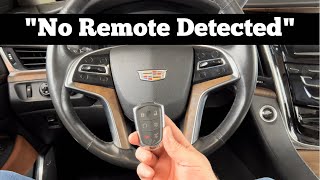
- "No Remote Detected" or "Service Theft Deterrent System" message on the Driver Information Center (DIC).
- Poor or no keyless entry (RKE) range.
- Replacing the vehicle's main battery without testing
- Replacing the starter without proper diagnosis
- Replacing the Body Control Module (BCM) without checking for software updates or RFI first
Most Likely Causes
- Radio Frequency Interference (RFI) 🔴 High Probability The vehicle's immobilizer system operates at 125 kHz, and many other RFID devices (office key cards, other vehicle fobs, toll passes) and aftermarket electronics (USB chargers, LED lights) can operate in a similar range, causing signal jamming. This is explicitly mentioned in GM TSBs PIC5650M, PIC5650L, and PIC5650C.
How to confirm: Remove all other keys, fobs, and cards from the keychain with the Escalade key. Unplug all aftermarket chargers and accessories. Try to start the vehicle with the isolated key. If it starts, RFI was the cause.
Typical fix: Keep the Escalade key fob isolated from other RFID-emitting devices. Remove low-quality aftermarket electronics. No parts replacement is necessary.
Est. part cost: $0 - Weak or Dead Key Fob Battery 🟡 Medium Probability A low battery can produce a weak or inconsistent signal that fails the security authentication, even if it can still lock/unlock the doors.
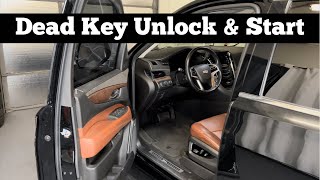
How to confirm: Try the spare key fob. If it works consistently, the battery in the primary fob is the likely culprit. Alternatively, place the problematic fob in the designated transmitter pocket in the center console; this allows the car to start even with a dead battery.
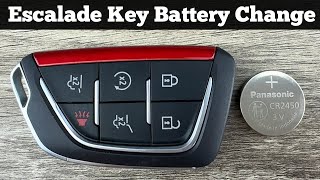
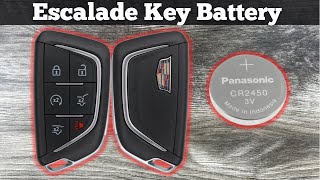
Typical fix: Replace the CR2032 battery in the key fob.
Est. part cost: $2-$10 - Body Control Module (BCM) Software Glitch ⚪ Low Probability For some 2014-2015 models, including the Escalade's platform mates, GM issued a bulletin (PI1180A) for an intermittent no-start with B3935 and B2955 caused by a software issue in the BCM.
How to confirm: A dealer or qualified shop must check the current BCM software calibration against the latest version available on GM's TIS2WEB. This requires a professional scan tool. The condition is a "No Click, No Crank, No Start" with both B3935 and B2955 present.
Typical fix: Reprogram the BCM with the updated software calibration using the Service Programming System (SPS). This is noted as a 0.5-hour labor operation under warranty.
Est. part cost: $0 (if done under warranty or as part of other service)
Rare But Worth Checking
- Faulty Key Fob: If the battery is good and RFI is ruled out, the transponder chip inside the key fob itself may have failed, especially if it has been dropped or exposed to moisture. The entire key fob must then be replaced and programmed.
- Faulty Theft Deterrent Module (TDM) or Antenna: In rare cases, the module that reads the key or the antenna ring can fail, preventing it from authenticating a known-good key. Diagnosis may involve replacing the key first, and if the DTC returns, replacing the TDM is the next step.
- Poor BCM or Battery Cable Grounds: A technical service bulletin (18-NA-161) for these platforms notes that a poor BCM ground (G218) or loose/corroded battery cables can cause a variety of electrical issues, including no-start conditions. Some owners have resolved intermittent starting issues by upgrading the main ground wires (the "Big 3 Upgrade").
Diagnosis Steps
- Check for Technical Service Bulletins (TSBs). TSBs PIC5650M, PIC5650L, and PI1180A are highly relevant.
- Isolate the key fob. Remove ALL other keys, cards, and electronic devices from the keychain and re-test.
- Remove all aftermarket accessories from the vehicle, especially USB chargers and LED lighting, and re-test.
- Test the spare key fob. If the spare key works reliably, the issue is with the primary key fob (likely the battery).
- Replace the key fob battery (CR2032) as a low-cost diagnostic step.
- If the vehicle still won't start, place the key fob in the transmitter pocket located inside the center console and attempt to start the engine. This bypasses the need for a strong wireless signal and is a key diagnostic step for RFI.
- If the issue persists, use a professional scan tool to read codes from the BCM and TDM.
- If codes B3935 and B2955 are present on a 2015 model, investigate a BCM software update per TSB PI1180A.
- If all else fails, professional diagnosis of the Theft Deterrent Module, its antenna, and associated wiring and grounds is required.
Parts You'll Likely Need
- Key Fob Battery
(OEM #CR2032)— A weak battery is a common cause for an inconsistent signal that fails the security handshake.
Trusted brands: Energizer, Duracell
OEM price range: $5-$10
Aftermarket price range: $2-$5 - Keyless Entry Remote Fob
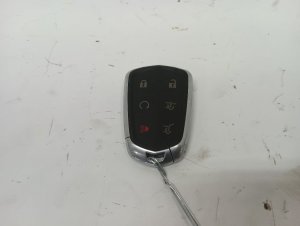
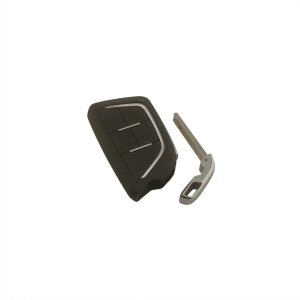
(OEM #13580812, 13594028, 13598511, 13510242 (for 2015-2020 models, FCC ID: HYQ2AB))— If the internal transponder fails, the entire key fob must be replaced and programmed to the vehicle.
Trusted brands: ACDelco (OEM)
OEM price range: $150-$300
Aftermarket price range: $70-$150
Related Codes That Often Appear With This One
- B3055 — Relates to a problem with the key transponder. Often set alongside B3935 due to RFI or a faulty key, as noted in TSB PIC5650M.
- B3060 — Indicates an issue with the transponder antenna circuit. It can be triggered by the same RFI that causes B3935.
- B2955 — Related to the security sensor data circuit. A specific GM bulletin (PI1180A) notes that B2955 and B3935 can appear together on 2015 models due to a BCM software issue requiring an update.
- C0750, C0755, C0760, C0765, C0775 — These are all Tire Pressure Monitor (TPMS) codes. Since the TPMS also uses RF signals, severe RFI can disrupt both the theft deterrent and TPMS systems simultaneously, as mentioned in TSB PIC5650M.
Technical Service Bulletins (TSBs) & Recalls
- PIC5650M / PIC5650L / PIC5650C: Mentions B3935 in relation to intermittent no-start/stall from RFI and advises against replacing parts. It lists numerous sources of RFI including aftermarket LED lights and USB chargers.
- PIC5650B: An earlier version of the above TSB, explicitly calling out RFID devices on the key ring as a cause for B3935.
- PI1180A: Addresses an intermittent no-start with codes B3935 and B2955 on 2015 models (and platform mates), recommending a BCM software update.
- 18-NA-161: While not specific to B3935, it addresses potential no-start conditions on this platform due to poor BCM grounds (G218) or battery cable issues.
Platform-Specific Known Issues
- The vehicle's theft deterrent system is highly sensitive to radio frequency interference from devices like other key fobs, building access cards, and even some phone cases, as documented in TSB PIC5650L.
- A known BCM software issue on 2015 models can cause an intermittent no-start with codes B3935 and B2955, which is fixable with a software update (TSB PI1180A).
- A Reddit user with a 2021 GMC AT4 (T1XX platform mate) reported constant "No remote detected" messages even after changing fob batteries, pointing to a potential receiver issue in the truck itself.
Mechanic-Grade Diagnostic Values
- Negative Battery Cable Voltage Drop — expected: Below 200 mV. Failure: A reading above 200 mV while cranking indicates a bad cable requiring replacement.
- Keyless Entry System Frequencies — expected: 315 MHz, 433 MHz, and 125 kHz. Failure: Using an RFI meter to detect strong interfering signals on these frequencies can pinpoint the source of the problem.
Scan Tool Commands That Help
- GDS2 (GM Global Diagnostic System 2): Vehicle Theft Deterrent Learn — This function is used after replacing a key or the Theft Deterrent Module (TDM). It initiates a 10-13 minute security procedure to program the new component to the vehicle.
- GDS2 (GM Global Diagnostic System 2): Add/Replace Key Fobs — Found under 'Remote Control Door Lock Receiver' > 'Configure/Reset Functions', this is used to program additional key fobs to the vehicle without erasing existing ones.
Wiring & Ground Locations
- Body Control Module (BCM) — On K2XX platform vehicles (2015-2019), the BCM is integrated with the junction block (interior fuse panel) located on the driver's side, above the pedals and to the left, behind the lower dash panel.. The BCM is the central computer for body electronics, including the theft deterrent system. A software glitch, internal failure, or poor connection at the BCM can cause B3935.
- G218 Ground — Located on the driver's side A-pillar, behind the trim and insulation foam.. TSB 18-NA-161 identifies a poor connection at G218 as a potential cause for a wide range of electrical issues, including no-start conditions and BCM-related faults. Ensuring this ground is clean and tight is a critical diagnostic step.
- Theft Deterrent Module (TDM) / Remote Control Door Lock Receiver (RCDLR) — On many GM SUVs of this era, the module responsible for receiving the key fob signal is located high in the dash, often behind the instrument cluster or radio.. This module, also called the RCDLR, is what receives the signal from the key fob. If it fails, it cannot authenticate the key, leading to a B3935 code even with a good key and no RFI.
Real Owner Repair Stories
- Reddit user 'bryberg', technician (2016 Chevrolet Silverado 1500 (platform mate)) — Dash goes black randomly, steering locks up, Stabilitrak message appears momentarily.
❌ Tried (didn't work) The owner initially suspected a recent brake system recall software update was the cause.
✅ What actually fixed it The technician identified the cause as a bad negative battery cable, a known issue covered by TSB 18-NA-161. The fix is to perform a voltage drop test on the cable and replace it if the drop exceeds 200mV while cranking.
Model Year Variations Within This Range
- 2015-2020 (K2XX Platform): On these models, the BCM is tightly integrated with the interior junction block (fuse box). On some, the BCM can be serviced separately, while on others the entire BCM/junction block assembly must be replaced as a unit.
- 2015-2020: These models feature a dedicated transmitter pocket in the center console to start the vehicle if the key fob battery is dead or experiencing interference. This is a key diagnostic feature for ruling out a bad fob vs. RFI.
Helpful Videos

We Have This Part in Stock

The information in this article is provided for general reference and educational purposes only. Vehicle specifications, procedures, and part compatibility can vary by production date, trim level, and region. Always consult your vehicle's factory service manual and verify part numbers before purchasing or performing repairs. Safety-critical components such as airbags, seat belts, and braking systems should be installed by a qualified professional.
- Cadillac ESCALADE:
- 🎬 Helpful Videos
- 🛍️ Shop This Part
- What's Unique About the 2015-2022 Cadillac ESCALADE
- Diagnostic Flowchart
- Symptoms You May Notice
- Most Likely Causes
- Rare But Worth Checking
- Diagnosis Steps
- Parts You'll Likely Need
- Related Codes That Often Appear With This One
- Technical Service Bulletins (TSBs) & Recalls
- Platform-Specific Known Issues
- Mechanic-Grade Diagnostic Values
- Scan Tool Commands That Help
- Wiring & Ground Locations
- Real Owner Repair Stories
- Model Year Variations Within This Range
- 🎟️ Get 5% Off