

B3894 on 2007-2013 Chevrolet Suburban: Cruise Control Inoperative & Trailer Brake Fault Guide
On a 2007-2013 Suburban, code B3894 almost always means the cruise control is disabled because of a fault in the trailer brake system. The most common cause is a poor connection at the brake light switch above the brake pedal, which can often be fixed for free by cleaning the connector and applying dielectric grease as per a GM service bulletin.
- Code B3894 means your cruise control is disabled due to a fault detected by the Trailer Brake Control Module.
- Before buying any parts, inspect and clean the brake light switch connector above the brake pedal. Applying dielectric grease is a common, low-cost fix recommended by GM.
- If cleaning the connector doesn't work, the next most likely cause is a faulty brake light switch itself, which is an inexpensive and DIY-friendly repair.
- Do not immediately suspect the cruise control switch on the steering wheel or the TBCM module itself, as these are less common failure points for this specific code.
What's Unique About the 2007-2013 Chevrolet SUBURBAN
On this generation of Suburban (GMT900 platform), the cruise control system is tightly integrated with the Trailer Brake Control Module (TBCM). A fault that seems related only to trailer braking, like B3894, will directly disable the cruise control function. 🎬 Watch: How to fix cruise control on 07-14 GM trucks. This can be confusing for owners who experience a cruise control failure while the root cause lies within the trailer brake monitoring system. GM issued specific technical service bulletins (PIT4508C and PIT5144) to address this exact scenario, highlighting the interconnected nature of these systems and often pointing to simple connection issues rather than failed parts.
Diagnostic Flowchart
Tap your situation to follow the diagnostic path that matches what you're seeing on this vehicle.
Symptoms You May Notice
- Cruise control is inoperative (will not set or engage).
- "Service Trailer Brake System" message appears on the Driver Information Center (DIC).
- The cruise control light on the steering wheel button may turn on, but the green cruise icon on the instrument cluster will not illuminate when trying to set a speed.
- The warning message may appear intermittently, sometimes triggered by high temperatures or humidity.
- Replacing the cruise control switch on the steering wheel. This switch typically does not cause a B3894 code.
- Replacing the brake light switch without first cleaning and applying dielectric grease to the connector, which is the most common fix recommended by GM.
Most Likely Causes
- Fretting Corrosion at Brake Light Switch Connector 🔴 High Probability GM Technical Service Bulletin PIT5144 explicitly identifies fretting corrosion as the primary cause for B3894 with symptom code 5A. This is a buildup of insulating oxidized debris from micro-vibrations common in vehicles. The bulletin notes that many switches are replaced unnecessarily when the real issue is just a poor connection.
How to confirm: Visually inspect the electrical terminals on both the brake light switch and its harness connector under the dashboard. Look for small, dark smudges or discoloration on the pins. TSB PIT5144 notes that this may require a magnifying glass to see clearly.
Typical fix: Disconnect the battery. Clean the terminals on the switch and in the connector using a dedicated nylon brush and electrical contact cleaner. Apply a small amount of dielectric lubricant (like GM P/N 12345579) to both sides of the connector before reconnecting, as detailed in TSB PIT5144.
Est. part cost: $5-$15 for dielectric grease. - Faulty Brake Light Switch (Brake Pedal Position Sensor) 🟡 Medium Probability The brake light switch is a high-use component that can wear out over time. It contains multiple internal contacts for different systems, and a failure in one can trigger this code, though GM service data suggests this is less common than connector corrosion.
How to confirm: Use a scan tool that can read live data to monitor the brake switch inputs in the BCM or ECM data list. If one of the switch signals shows 'Applied' when the pedal is released, or doesn't change state when the pedal is pressed, the switch is likely faulty.
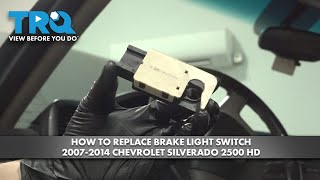
Typical fix: Replace the brake light switch located on the brake pedal support bracket. 🎬 See this walkthrough on how to replace the brake switch.
Est. part cost: $20-$75 - Wiring or Terminal Issues at the Trailer Brake Control Module (TBCM) ⚪ Low Probability The TBCM is located on the frame rail, often above the spare tire, 🎬 Watch: Troubleshooting the Service Trailer Brake System message. making it highly susceptible to corrosion from road spray, salt, and debris. Wires can break at the connector due to moisture intrusion.
How to confirm: Lower the spare tire and visually inspect the TBCM and its electrical connectors for green or white corrosion, broken wires, or loose pins. In one documented case, a power wire was visibly broken right at the connector.
Typical fix: Clean the connectors with electrical contact cleaner and a brush. Repair any broken wires and secure the harness. In severe cases, the connector pigtail may need to be replaced.
Est. part cost: $10-$60 for cleaning supplies or a new pigtail.
Rare But Worth Checking
- Failed Trailer Brake Control Module (TBCM): While not common, if all wiring, connectors, and the brake light switch have been verified as good, the TBCM itself may have an internal fault. Some owners on forums have reported that replacing the module was the ultimate fix. A replacement module must be programmed to the vehicle's VIN.
- Failed Electronic Brake Control Module (EBCM): TSB PIT4508C notes that if a scan tool shows brake pressure with no pedal input, the issue could be with the Master Cylinder Pressure Sensor, which is internal to the EBCM on vehicles with StabiliTrak (RPO JL4). This is an expensive, last-resort diagnosis.
- Faulty Trailer Brake Control Gain/Manual Lever Switch: Though often cited as a misdiagnosis, at least one owner has documented fixing the 'Service Trailer Brake System' message by replacing the gain/manual lever switch assembly on the dashboard. This could be a potential fix if the switch itself has failed internally.
Diagnosis Steps
- Check for the "Service Trailer Brake System" message on the DIC and confirm that the cruise control is inoperative.
- Use a scan tool to confirm the presence of DTC B3894. Note if it has the symptom byte '5A' for 'Stop Lamp Switch Circuit Plausibility Failure', which points directly to TSB PIT5144.
- Begin with the most likely and cheapest fix: Inspect the brake light switch connector above the brake pedal for signs of fretting corrosion (dark smudges).
- If corrosion is found or suspected, disconnect the battery, clean the terminals on both the switch and the connector with a nylon brush, apply dielectric grease to both sides, and reconnect securely. Retest the system.
- If no corrosion is visible, use a scan tool to monitor the brake switch input signals in the BCM or ECM data list. Verify that the signals change from 'Inactive' to 'Active' or 'Released' to 'Applied' when the brake pedal is pressed and released.
- If a signal is stuck or does not change, replace the brake light switch.
- As per TSB PIT4508C, use the scan tool to view live data in the TBCM and check the 'Master Cylinder Pressure' parameter. If it shows any pressure when the brake pedal is not being touched, investigate the master cylinder pressure sensor circuit or the EBCM.
- If the brake switch and its connector are good, lower the spare tire and inspect the wiring and connectors at the Trailer Brake Control Module (TBCM) on the frame rail. Look carefully for corrosion or broken wires right at the connector.
- If all wiring and components check out, the issue may be an internal failure of the TBCM or, more rarely, the EBCM.
Parts You'll Likely Need
- Brake Light Switch / Brake Pedal Position Sensor
(OEM #25981009 (also cited: 22741943, 25912943 - verify by VIN))— This is the most commonly replaced component after accounting for simple connector corrosion. Multiple part numbers may apply depending on specific year and options.
Trusted brands: ACDelco (GM Genuine), Dorman, Standard Motor Products
OEM price range: $25-$75
Aftermarket price range: $15-$40 - Dielectric Grease
(OEM #12345579)— Specifically recommended by GM in TSB PIT5144 to prevent fretting corrosion at the brake light switch connector, which is the most common cause of the code.
Trusted brands: Permatex, ACDelco
OEM price range: $10-$20
Aftermarket price range: $5-$10 - Brake Light Switch Connector Pigtail
(OEM #Varies - verify with dealer)— If the connector for the brake light switch is heavily corroded or damaged, a new pigtail will be needed to splice into the harness.
Trusted brands: ACDelco, Dorman, Carquest
OEM price range: $40-$70
Aftermarket price range: $20-$50
Related Codes That Often Appear With This One
- C0561: This code often relates to the StabiliTrak system being disabled. Since the brake system data is shared between the TBCM and the EBCM (which controls StabiliTrak), a fault in one can trigger codes in the other.
Technical Service Bulletins (TSBs) & Recalls
- PIT4508C: Cruise Control Inoperative with DTC B3894 set in the Trailer Brake Control Module.
Platform-Specific Known Issues
- A GM Technical Service Bulletin (TSB), #PIT5144, directly addresses DTC B3894 with symptom 5A. It states the cause is likely fretting corrosion at the brake switch connector and that the switch itself is often not faulty. The fix is to apply dielectric lubricant.
- Another TSB, #PIT4508C, addresses inoperative cruise control with DTC B3894. It advises checking the 'Master Cylinder Pressure' sensor parameter in the TBCM. If it shows pressure when the brake is not applied, it points towards a sensor, wiring, or EBCM issue.
- Owner forums and videos show that the TBCM, located above the spare tire, is a common point for corrosion, leading to broken wires at the harness connector which can also trigger this fault.
Mechanic-Grade Diagnostic Values
- TBCM Ignition 1 Voltage at Pin 15 of the TBCM connector — expected: 11 volts or greater with ignition ON. Failure: Less than 11 volts indicates a short to ground or an open/high resistance in the IGN 1 voltage circuit.
- TBCM System Voltage (Live Data) — expected: 9-17 volts. Failure: A reading outside this range points to a charging system problem or a fault in the TBCM's power or ground circuits.
- Master Cylinder Pressure (Live Data in TBCM) — expected: 0 psi (or equivalent value) with brake pedal not applied. Failure: Any pressure reading with no pedal input suggests a fault with the Master Cylinder Pressure Sensor, its wiring, or the EBCM.
Scan Tool Commands That Help
- Tech2 / GDS2 or equivalent professional scan tool: Brake Pedal Position Sensor Learn — This procedure must be performed after replacing the Brake Pedal Position Sensor (brake light switch) or the Body Control Module (BCM). It calibrates the new sensor's home value. Failure to perform this learn procedure can cause the code to persist or other system malfunctions. The function is typically found under BCM > Special Functions or Configuration/Reset Functions.
- Tech2 / GDS2 or equivalent professional scan tool: TBCM Data List > Manual Apply Switch — To test the functionality of the manual trailer brake lever on the dashboard. A user on a forum was able to watch the value go from 0% to 100% while moving the slider, confirming the switch was sending a signal, which helps isolate the problem to wiring or the module itself.
Wiring & Ground Locations
- TBCM Power Wire (Red/Black) — Under the hood, coiled and taped to a harness, located between the under-hood fuse box and the driver's side fender. It has an eyelet that must be connected to a specific threaded stud on the fuse box.. On many GMT900 trucks, this wire is left disconnected from the factory. If there is no power to the TBCM, it cannot function and may set various codes. This wire provides the main power for the brake controller functions.
- Trailer Battery Charge Wire (Red/Black) — Under the hood, coiled and taped to a harness, typically found under the master cylinder/brake booster assembly. It has an eyelet that connects to a second threaded stud on the under-hood fuse box.. While not the direct cause of B3894, ensuring this is connected is part of a complete trailer wiring system check. An incomplete circuit can sometimes cause unpredictable electrical issues.
- TBCM (Trailer Brake Control Module) — Mounted to the driver's side frame rail, often above or near the spare tire.. This location makes the module and its connector highly vulnerable to corrosion from road salt and moisture, which can lead to broken wires or poor pin connections, directly causing B3894 and other trailer brake system faults.
- Trailer Wiring Ground — A ring terminal with two wires, often found near the rear of the truck bed support on the driver's side frame rail.. A poor or broken ground connection for the trailer wiring system can cause intermittent faults and trigger the 'Service Trailer Brake System' message. One owner found these ground wires attached to a broken piece of the bed support, causing an unreliable connection.
Real Owner Repair Stories
- YouTube user 'George' (2011-2013 Chevrolet Silverado (same platform)) — "Service Trailer Brake" message on the dash.
❌ Tried (didn't work) Replacing the trailer brake control relay/module on the frame rail did not fix the issue on one of his trucks.
✅ What actually fixed it On one truck, the fix was cleaning a bad ground connection on the frame rail near the rear of the truck. On a second truck, the fix was finding and repairing broken wires for the front ABS wheel speed sensor, which was causing the trailer brake light to come on as well. - YouTube user 'Chevy-Man' (2007-2014 Chevrolet Truck) — Blowing the fuse for the trailer brake system instantly when the key was turned on.
❌ Tried (didn't work) Replacing the fuse repeatedly.
✅ What actually fixed it The Trailer Brake Control Module (also called a relay in the video) located on the frame rail was internally shorted. The plastic housing was cracked, allowing moisture to enter and destroy the internal circuit board. Unplugging the module stopped the fuse from blowing. Replacing the module with a new one resolved the problem.
OEM Part Supersession History
15861245, 22741943→25981009 (ACDelco D1539J)— Standard part evolution and consolidation.
Heads up: Part 25981009 is specified for vehicles *without* power-adjustable pedals. Vehicles with adjustable pedals may use a different part number. Always verify by VIN.
Model Year Variations Within This Range
- 2007-2013: General Motors did not include plug-and-play connectors for aftermarket brake controllers in this generation as they had in the past. Instead, they provided four or five blunt-cut wires under the dash for splicing. Additionally, the critical power wires under the hood were often left disconnected from the fuse block from the factory.
Helpful Videos
We Have This Part in Stock


The information in this article is provided for general reference and educational purposes only. Vehicle specifications, procedures, and part compatibility can vary by production date, trim level, and region. Always consult your vehicle's factory service manual and verify part numbers before purchasing or performing repairs. Safety-critical components such as airbags, seat belts, and braking systems should be installed by a qualified professional.
- Chevrolet SUBURBAN:
- 🎬 Helpful Videos
- 🛍️ Shop This Part
- What's Unique About the 2007-2013 Chevrolet SUBURBAN
- Diagnostic Flowchart
- Symptoms You May Notice
- Most Likely Causes
- Rare But Worth Checking
- Diagnosis Steps
- Parts You'll Likely Need
- Related Codes That Often Appear With This One
- Technical Service Bulletins (TSBs) & Recalls
- Platform-Specific Known Issues
- Mechanic-Grade Diagnostic Values
- Scan Tool Commands That Help
- Wiring & Ground Locations
- Real Owner Repair Stories
- OEM Part Supersession History
- Model Year Variations Within This Range
- 🎟️ Get 5% Off