

OBD-II Code B3500: Express Window Circuit Malfunction
What B3500 means, why it triggers, and how to fix it
- Code B3500 is a General Motors-specific fault indicating the rear right window's 'express-up' circuit has failed.
- Replacing the driver's door master power window switch resolves this code in over 60% of cases.
- Diagnose this issue promptly to rule out a short circuit in the master switch, which has triggered multiple GM fire-risk recalls.
- Perform a free window re-initialization (roll fully down, then fully up and hold for 5 seconds) before buying any replacement parts.
- Ignore search results mentioning the Dodge B3500 van, as generic search engines frequently confuse this GM trouble code with the discontinued Dodge vehicle.
What Does B3500 Mean?
Code B3500 indicates the Body Control Module (BCM) detects a fault in the 'express-up' (one-touch-up) circuit for the rear right passenger window. The window still operates manually by holding the switch, but the automatic function fails. This is a General Motors-specific OBD-II code.
Technical definition: General Motors defines B3500 as 'RR window express up circuit (main cntl) malfunction'. The Body Control Module (BCM) monitors voltage on the express-up signal circuit. It expects a specific voltage when the switch activates. If the signal is missing, incorrect, or shows high resistance, the BCM sets this code.
Can I Drive With B3500?
Yes. This code disables the automatic 'express-up' window feature but does not impact vehicle safety or drivability. However, diagnose the issue promptly, as related failures like a shorted master switch have prompted GM recalls due to fire risk.
Common Causes
- Faulty Master Power Window Switch (Very Common) — The driver's side master switch is the central hub for the window system and the most frequent failure point. 🎬 See this walkthrough for replacing the master power window switch. Internal contacts for the rear right window's 'express-up' function wear out, accumulate dust, or corrode from moisture, causing an open or high-resistance circuit.
- Broken or Damaged Door Wiring (Common) — The wiring harness passing through the flexible rubber boot between the driver's door and the main body constantly flexes. Over time, these wires fatigue and break, creating an open circuit. A similar failure occurs in the harness leading to the rear door.
- Blown Fuse or Tripped Circuit Breaker (Common) — Fuses or a circuit breaker (often under the driver's seat on GM vans) protect the power window system. A blown fuse cuts power entirely, while a weak circuit breaker trips unnecessarily during the motor's initial power surge.
- Failed Rear Right Window Motor (Common) — The electric motor moving the window glass burns out from age, overheats from excessive use, or suffers internal gear damage. An internal short or open circuit in the motor's electronics triggers a BCM circuit malfunction.
- Binding Window Regulator (Common) — The mechanical window regulator assembly bends, wears out, or its tracks become obstructed by debris. This physical resistance forces the motor to draw excessive current, which the BCM interprets as an electrical fault.
- Corroded Switch Connector (Less Common) — The electrical connector plugging into the master switch is highly susceptible to moisture intrusion. Spilled drinks or rain cause corrosion on the pins, leading to a poor connection and intermittent operation.
- Faulty Rear Window Switch (Less Common) — The individual switch on the rear right door malfunctions less frequently than the master switch. While it lacks an 'express-up' button, its internal circuitry routes the overall window control system, and a fault here triggers a BCM code.
- Faulty Body Control Module (BCM) (Rare) — The BCM controls the power windows and other body functions. The BCM itself rarely fails, but when it does, it sends incorrect or zero signals to the window motor circuit. Suspect this only after verifying all other components.
Symptoms
- Rear Right 'Express-Up' Feature Inoperative — The one-touch automatic closing feature for the rear right window fails. You must hold the switch in the 'up' position to close the window completely.
- Rear Right Window Won't Go Up or Down — The window is completely unresponsive when using either the master switch on the driver's door or the switch on the rear door.
- Window Operates From One Switch But Not The Other — The rear window works from its own switch but not from the master switch, or vice-versa. This isolates the failure to the non-working switch or its direct wiring.
- Clicking or Grinding Noise From Rear Door — Pressing the switch produces noises from inside the door panel, but the window struggles or fails to move. This indicates a failed motor or a broken regulator assembly.
- Window Moves Slowly, Intermittently, or Auto-Reverses — The window struggles to move, stops and starts, or goes up a few inches and reverses direction. This signals a failing motor, binding regulator, or lost window initialization programming.
- BCM Does Not Register Switch Input (scan-tool only — no driver-felt sign) — On a scan tool, the live data parameter for the 'RR Window Express Up Switch' remains 'Inactive' when the button is pressed, confirming the BCM receives no signal.
Diagnostic Flowchart
Tap your situation to follow the diagnostic path that matches what you're seeing on this code.
Common Fixes & Costs
- Replace Master Power Window Switch
— Parts: $40-$200, Labor: $75-$150, ~0.8 hr book time
(DIY)
Chevrolet Silverado / GMC Sierra (2007-2013): OEM 25783950 (Alt: Dorman 901-339, Standard Motor Products DWS1383)
Chevrolet Silverado / GMC Sierra (2014-2019, Crew Cab): OEM 23427098, 23129539 (Alt: Dorman 901-473, ACDelco 23427094)
Chevrolet Tahoe / GMC Yukon (2015-2020): OEM 23427094, 84672417 (Alt: ACDelco 22818011, Dorman 920-047) - Repair Broken Wire in Door Harness — Parts: $5-$20, Labor: $100-$250, ~2.0 hr book time (Professional)
- Replace Blown Fuse / Circuit Breaker — Parts: $1-$25, Labor: $0, ~0.1 hr book time (DIY)
- Replace Rear Right Window Motor & Regulator Assembly
— Parts: $70-$350, Labor: $130-$250, ~1.5 hr book time
(Intermediate)
Chevrolet Silverado / GMC Sierra (2007-2013): OEM 25885885 (Alt: Dorman 741-891, TYC 660287)
Chevrolet Silverado / GMC Sierra (2014-2018): OEM 84043807 (Alt: Dorman 751-063, Aisin RPAGM-194)
Chevrolet Tahoe / GMC Yukon (2015-2020): OEM 23220138 (Alt: Dorman 751-413, ACDelco 84621037) - Replace Rear Right Window Switch — Parts: $25-$80, Labor: $40-$80, ~0.6 hr book time (DIY)
DIY vs Professional
- Replace Blown Fuse / Circuit Breaker — Beginner:
Tools: ['Fuse puller', 'Pliers'] - Replace Master Power Window Switch — Beginner:
Tools: ['Trim removal tool set', '7mm socket or screwdriver', 'Pick tool'] - Replace Rear Right Window Switch — Beginner:
Tools: ['Trim removal tool set', 'Screwdriver set'] - Replace Rear Right Window Motor & Regulator Assembly — Beginner:
Tools: ['Trim removal tool set', 'Socket set (7mm, 10mm)', 'Ratchet and extensions', 'Pliers', 'Tape (to hold window glass)'] - Repair Broken Wire in Door Harness — Beginner:
Tools: ['Multimeter', 'Wire cutters/strippers', 'Butt connectors', 'Heat shrink tubing', 'Heat gun']
Used vs. New Parts: Buying Guide
When a used part is worth it: A used OEM master power window switch from a low-mileage vehicle is often more reliable than a cheap aftermarket part. This is ideal for older vehicles where new OEM parts are cost-prohibitive.
Donor-vehicle mileage cap: roughly under 80000 miles for the part to have meaningful remaining life.
Donor quality checklist:
- Verify the donor vehicle's mileage and ensure it's from a reliable model year.
- Inspect the switch for signs of water damage, such as corrosion on the pins or discoloration.
- Match the part number exactly. Switches look identical but have different internal logic for different trim levels.
Decision logic:
- If Vehicle is newer and under warranty, or part cost is low → Buy new OEM for guaranteed compatibility and longevity.
- If Budget is the primary concern and you are performing the labor yourself → A new aftermarket switch offers a low initial cost, but be prepared for potential premature failure.
- If Vehicle is older and you value reliability over warranty → A used OEM part from a reputable salvage yard balances cost and quality.
Warranty tradeoff: Used parts typically have a 30-90 day warranty. New aftermarket parts offer a one-year or 'limited lifetime' warranty (excluding labor). New OEM parts carry a 1-2 year warranty and provide the highest quality.
Worst-case if a used part fails: $100-$200 if a used or cheap aftermarket part fails after the warranty period, requiring a new part and repeat labor.
What Happens If You Wait — Timeline
- 0-1 month: Code B3500 is set. The 'express-up' feature for the rear right window stops working. The window still operates manually. No other symptoms are present. (MPG impact: 0%% · Added cost: $0)
- 1-6 months: The underlying fault worsens. The window becomes intermittent. If the fault is in the switch, a minor parasitic draw begins, often too small to notice. (MPG impact: 0%% · Added cost: $0)
- 6-12 months: A hard failure occurs. A broken wire severs completely, or a corroded switch develops a significant short, leading to a parasitic drain that kills the battery. (MPG impact: 0%% · Added cost: $150-$300 (for a new battery and potential roadside assistance))
- 12+ months: Worst-case scenario from an ignored short circuit. Severe water intrusion causes the master switch to overheat, melt its connector, and produce smoke, creating a fire risk. (MPG impact: 0%% · Added cost: $500-$2000+ (for replacing a melted wiring harness, BCM, or repairing fire damage))
Cost of Not Fixing It
- Immediate: Loss of convenience. The 'express-up' feature for the rear right window fails, requiring manual operation. (Added cost: $0)
- 1-6 months: Potential for parasitic battery drain. A failing master switch creates a continuous electrical draw, leading to a dead battery if parked for several days. (Added cost: $150-$300 (for a new battery and/or roadside assistance))
- 6+ months: Increased risk of cascading failures or safety hazards. Prolonged moisture intrusion into a faulty switch causes short circuits, overheating, and a risk of fire. (Added cost: $500 - $5000+ (potential for damage to BCM, wiring harness, or fire-related damage))
Diagnosis Steps
- Perform Window Re-Initialization
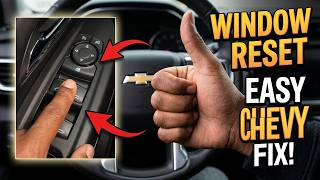
Ensure the child lock is off. Roll the window all the way down while holding the switch, then roll it all the way up and continue holding the switch for 5-10 seconds after it closes. This restores express functionality after a battery disconnect or power loss. 🎬 Watch: How to reset and re-initialize your Chevrolet power windows.
Tools: ['None'] - Inspect the Fuse / Circuit Breaker
Locate the fuse box and find the fuse or circuit breaker labeled for power windows (e.g., 'PWR WDO'). Pull the fuse and visually inspect for a broken filament. For a circuit breaker, test for continuity with a multimeter.
Tools: ['Fuse Puller', 'Multimeter'] - Listen to the Motor
Have a helper stand next to the rear right door while you operate the master switch. A distinct clicking or whirring sound from inside the door means power reaches the motor, pointing to a faulty motor or regulator. No sound means the problem is upstream in the switch or wiring.
Tools: ['Helper (Optional)'] - Inspect the Door Wiring Harness
Pull back the rubber boot protecting the wires between the driver's door and the car's body. Visually inspect the thicker gauge power and ground wires for breaks, chafing, or corrosion. A broken wire in this flexible jamb is a highly common failure.
Tools: ['Flashlight'] - [PRO TIP] Test the Master Switch
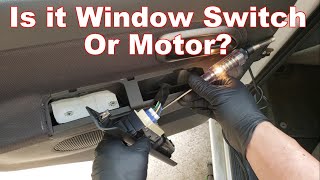
Remove the master window switch. Using a multimeter set to continuity, probe the two output wires for the RR window. Pressing 'up' creates continuity between power and one output; pressing 'down' creates continuity with the other. No continuity confirms a bad switch.
Tools: ['Multimeter', 'Trim Removal Tool', 'Wiring Diagram'] - Test Power at Motor Connector
Remove the rear door panel to access the window motor connector. While pressing the switch, use a multimeter to check for +12V across the pins in one direction ('up') and -12V in the other ('down'). Correct voltage with no motor movement confirms a dead motor.
Tools: ['Multimeter', 'Trim Removal Tool', 'Screwdriver Set'] - [PRO TIP] Check Scan Tool Data
Connect a professional scan tool and view BCM live data. The 'RR Window Up Switch' status must change from 'Inactive' to 'Active' when pressing the button. If the status doesn't change despite a verified good switch, the wiring between the switch and BCM is faulty.
Tools: ['OBD-II Scan Tool with BCM Access'] - Check the RAP Relay
GM windows operate via the Retained Accessory Power (RAP) relay. If no windows work, locate the RAP relay in the fuse box and swap it with an identical relay from a non-critical system (like the horn). Restored function confirms a bad relay.
Tools: ['None'] - [ADVANCED] Measure Motor Current Draw
Clamp an inductive amp meter around the motor's positive wire. A healthy motor draws 2-5 amps. A reading significantly higher than 5 amps during travel, or a continuous high draw, indicates a worn motor or a binding regulator triggering the BCM fault.
Tools: ['Inductive Amp (Clamp) Meter'] (Advanced) - [ADVANCED] Test BCM Signal Circuit
Identify the 'RR Window Express Up' signal wire at the BCM connector. Back-probe this wire with a multimeter set to DC Volts. It reads 0V at rest and jumps to a specific voltage (typically 5V or 12V) when the button is pressed. Missing voltage confirms a wiring break.
Tools: ['Multimeter', 'Vehicle-Specific Wiring Diagram', 'Back-probe Pins'] (Advanced)
When This Code Triggers (Freeze-Frame Conditions)
- System Voltage: 11.5-14.8V (BCM is powered and active.)
- Ignition Status: Run or Accessory (Code is typically set when the vehicle's electrical systems are active.)
- Retained Accessory Power (RAP) Status: Active (Fault can be detected shortly after turning the vehicle off, if the RAP system is active.)
- RR Window Express-Up Command: Active/Requested (The code is set at the moment the BCM fails to see the correct voltage signal when the express-up function is commanded by the switch.)
Related Codes
- B3495 — Indicates the same 'express' circuit malfunction for the Left Rear window. If B3500 and B3495 appear together, the fault is in a shared component like the master power window switch or its power source, not the individual motors.
- B3501, B3502, B3503, B3504 — Provide a more specific electrical diagnosis for the Rear Right window circuit (e.g., 'Circuit Low Voltage' or 'Open Circuit'). Technicians use these to pinpoint the exact electrical fault.
- U0140 — Means 'Lost Communication with Body Control Module (BCM)'. If U0140 appears alongside B3500, the B3500 code is a symptom. Fixing the network communication issue resolves the window code automatically.
- U0155 — Means 'Lost Communication With Instrument Panel Cluster (IPC) Control Module'. On some GM platforms, master window switch signals route through the instrument panel. A communication failure here interrupts the signal to the BCM.
Climate & Environmental Factors
- High Humidity: Moisture penetrates switch housings and electrical connectors, corroding contacts. This increases electrical resistance, disrupting the sensitive voltage signals the BCM requires and triggering a circuit malfunction code.
- Cold Weather / Ice: Freezing temperatures cause window glass to freeze to rubber seals. Operating a frozen window puts extreme strain on the motor, drawing excessive current that blows fuses or damages internal components.
- Water Intrusion: Rain from an open window or spilled drinks introduces liquid directly into the master power window switch. This well-documented issue causes short circuits and is the subject of several GM fire-risk recalls.
How to Talk to a Mechanic About This Code
Say this: "I have a GM-specific code, B3500, for the rear right express window function. The window works manually from the rear switch, but not from the master switch. I've already checked the fuse and tried the re-initialization procedure. I'd like a diagnostic focused on the master switch and the driver's door jamb wiring."
This signals you've done basic homework, points the mechanic directly to the most likely causes, and helps avoid wasting time on less likely issues like the motor, saving diagnostic labor costs.
Avoid saying:
- 'My back window is broken.' (too vague)
- 'Just fix the window.' (invites replacement of the most expensive part first)
- 'I think it's the motor.' (leads to confirmation bias and unnecessary parts replacement)
Questions to ask before authorizing the repair:
- Did you test the master switch for continuity on the rear right window circuit?
- Did you inspect the wiring inside the driver's door-to-body boot for breaks?
- If the motor/regulator needs replacement, what specific symptoms led to that conclusion?
- What is the warranty on the recommended parts and labor?
Where to Take It: Dealer vs Independent vs Chain
- Dealer:
Recommended only if the vehicle is under warranty or if initial diagnosis points to a BCM failure requiring GM-specific software.
Best for: Vehicles still under warranty, Complex BCM (Body Control Module) programming issues, When a specific recall or Technical Service Bulletin (TSB) applies
Downsides: Highest labor rates (1.5-2x independent shops), May replace a whole assembly when a smaller component is the cause (Typical cost: +50% vs. baseline) - Independent Shop:
Best fit. Most competent independent shops have extensive experience diagnosing and repairing bad master switches, broken door harness wires, and faulty window regulators.
Best for: Out-of-warranty vehicles where cost is a factor, Common electrical issues like switch replacement or wire repair, General diagnosis and repair of mechanical parts like motors and regulators
Downsides: Shop quality and diagnostic skill vary; look for ASE certifications., May lack expensive, dealer-level programming tools for complex module failures. (Typical cost: +0% vs. baseline) - Chain Shop:
Use with caution. Acceptable for a simple, pre-diagnosed master switch replacement. AVOID for initial diagnosis, intermittent electrical problems, or suspected wiring issues.
Best for: Simple, straightforward parts replacement like a window switch if you have already diagnosed the problem yourself.
Downsides: Technician skill varies dramatically., Often lack the in-depth electrical diagnostic experience needed to trace wiring faults., May default to replacing the most expensive part without proper diagnosis. (Typical cost: -10% vs. baseline)
When to Walk Away From the Repair
If the estimated repair cost for the window exceeds 25% of the car's private-party value, and the car is over 10 years old, it may not be worth fixing. For a non-safety item, the threshold is lower than the typical 50% rule.
- Car worth $4000, fix is $450: Fix it. The cost is a small fraction of the car's value.
- Car worth $12000, fix is $500: Fix it. This is a routine repair cost for a vehicle of this value.
- Car worth $2500, fix is $600: Borderline. Consider selling 'as-is' with disclosure. The repair is nearly 25% of the car's value.
What Scan Tool You Need for This Code
Minimum: A scanner that reads manufacturer-specific Body Control Module (BCM) codes for GM vehicles.
A basic $20 engine code reader only scans the Powertrain Control Module (PCM) and will NOT see B-series codes like B3500. You will see 'No Codes Found' and be misled.
Budget: BlueDriver Pro (~$100) — Reads and clears BCM codes on GM vehicles, provides freeze-frame data, and allows you to view live data from the window switch.
Mid-range: Foxwell NT510 Elite for GM (~$180) — Offers full GM-specific system access and provides bidirectional control to command the window motor up or down directly from the scanner.
Professional: Autel MaxiCOM MK808S / MK906BT (~$400-1200) — Provides full, OE-level bidirectional control and diagnostics for all modules. Ideal for serious DIYers performing advanced functions like BCM programming.
Rent vs buy: Most auto parts stores offer free in-store scanning, but their loaner tools rarely read BCM codes. Buying a capable scanner like the BlueDriver is a wise investment for modern GM vehicles.
How to Clear the Code After You Fix It
- Fix the underlying electrical or mechanical fault.
- Use an OBD-II scan tool capable of reading BCM codes to clear the fault.
- Alternatively, disconnect the negative battery terminal for 15-30 minutes to reset the BCM.
- Perform the window re-initialization procedure: roll the window fully down, then fully up, holding the switch for 5-10 seconds in the full up position.
- Test the express-up and express-down functions multiple times to verify the repair.
Drive cycle (~5 minutes): A traditional 'drive cycle' is not required for this body code. After clearing the code and performing the re-initialization, operate the switch for the affected window through its full range of motion at least 5 times to confirm the fix.
Readiness monitors affected: None
Watch out for:
- Using a basic code reader that only communicates with the Powertrain Control Module (PCM) fails to see or clear BCM codes.
- Forgetting to perform the window re-initialization procedure leaves the express functions inoperative, even if the repair was successful.
- Clearing the code without fixing the root cause results in the code returning immediately.
Will This Fail Emissions / State Inspection?
No — by itself this code doesn't fail OBD inspection (but it can keep readiness monitors from setting, which causes a separate fail).
- California: This code does NOT cause a failure in a California Smog Check. The test focuses on powertrain (P-series) codes; B-series codes are ignored.
- New York: A B3500 code does NOT cause a failure of the NYS OBD-II emissions inspection. However, the separate safety inspection requires functional components, and an inspector could flag a window that cannot be secured.
- Texas: This code does not cause a failure of the OBD-II emissions test portion of the Texas state inspection, which checks for emissions-related DTCs only.
Most Commonly Affected Vehicles
- Chevrolet Silverado (2007-2022) — Extremely common on GMT900 and later trucks, especially higher trims (LTZ, High Country). The 2007-2013 models are notorious for master switch failures and broken wires in the driver's door jamb.
- GMC Sierra (2007-2022) — Identical to the Silverado, this is a frequent issue on SLT, AT4, and Denali trims. The complex master switch and door wiring are the primary failure points.
- Chevrolet Tahoe (2007-2020) — The express-up feature fails due to a bad master switch or a broken wire in the flexible boot between the door and the body. The failure pattern mirrors the Silverado/Sierra.
- GMC Yukon / Yukon XL (2007-2020) — Especially on Denali models, the master switch controlling all windows sees heavy use and is a primary cause for this code. Wiring in the driver's door boot is the second most likely cause.
- Cadillac Escalade (2007-2020) — As a luxury model with express features on all windows, the likelihood of a circuit fault increases. Repair costs are higher due to brand-name parts.
- Chevrolet Avalanche (2007-2013) — Owners report frequent issues with intermittent window operation, traced back to the master switch or wiring in the door jamb.
- Chevrolet Express / GMC Savana (2008-2022) — Prone to electrical issues related to power windows, often stemming from a faulty RAP relay or circuit breaker. GM recall #18155 addresses liquid intrusion into the master switch causing fire risks.
- Cadillac CTS (2003-2014) — Prone to power window issues, including express-up/down failures. On 2003-2007 models, rear window regulator failure is very common and accompanied by grinding noises.
Manufacturer-Specific Notes
- General Motors: The 'express-up/down' feature loses its programming after a battery disconnect. Always re-initialize the window before replacing parts: roll fully down, then fully up, and hold the switch 'up' for 5-10 seconds.
- General Motors: On base and mid-level trims, 'express-down' is present on the driver's window, but 'express-up' is reserved for higher trims (LTZ, Denali). The physical switch looks identical across trims, leading to diagnostic confusion.
- General Motors: GM has issued numerous recalls (e.g., #18155) for inoperative power windows due to water intrusion into the driver's master switch, causing corrosion, short circuits, and fire risks.
- General Motors: The Retained Accessory Power (RAP) system controls the power windows, allowing operation for 10 minutes after the key turns off. If windows fail entirely but other accessories work, suspect the RAP relay.
Real Owner Stories
2011 GMC Yukon Denali at 125K miles
Rear passenger (RR) window only went down, not up, from the master switch. It worked fine from its own door switch. Express-up failed and code B3500 was present.
What they tried:
- Checked the power window fuse (was OK).
- Performed the window re-initialization procedure multiple times with no change.
Outcome: Replaced the driver's side master power window switch with an OEM part. The new switch fixed the problem immediately. The old switch showed internal contact wear.
Lesson: If a window works from its own switch but not the master switch, the master switch itself is the most probable cause.
2008 Chevrolet Silverado 1500 LTZ at 160K miles
Intermittent failure of the rear right window. Eventually, it stopped working completely from any switch. Code B3500 was stored in the BCM.
What they tried:
- Replaced the master window switch with an aftermarket part - no change.
- Listened for motor clicks; there was no sound at all in the rear door.
Outcome: Inspected the wiring harness in the rubber boot between the driver's door and the A-pillar. Found two wires broken completely in half. Repaired the wires using butt connectors and heat shrink tubing, restoring full function.
Lesson: For intermittent issues that become a hard failure, always inspect the door jamb wiring before replacing expensive parts.
2015 Chevrolet Tahoe at 95K miles
Rear right window was slow to go up and would sometimes stop. Eventually, it only made a grinding/clicking noise from inside the door panel. Code B3500 was present.
What they tried:
- Verified the switch was sending power by listening for the 'click' noise.
- Removed the door panel to inspect the window motor and regulator assembly.
Outcome: The cable on the window regulator had frayed and jumped off a pulley, causing it to bind. Replaced the entire window motor and regulator assembly with an aftermarket unit, solving the problem.
Lesson: Audible grinding or clicking noises from inside the door strongly point to a mechanical failure of the regulator or motor, not an electrical switch issue.
How to Prevent This Code From Triggering
- Clean and lubricate window tracks and seals annually (Once per year) — Dirt and debris increase friction, forcing the motor to work harder. Cleaning tracks and applying silicone spray reduces strain on the motor and regulator.
- Exercise all power windows regularly (Once per week) — Operating the windows fully down and up keeps internal cable mechanisms lubricated and prevents seals from sticking.
- Avoid leaving windows open in the rain (Daily habit) — Direct water exposure is the primary cause of master window switch failure, causing corrosion and short circuits that lead to fire risks.
- Inspect the driver's door jamb boot (Every 2-3 years or 50K miles) — The wiring harness in the flexible door boot fails from metal fatigue. Checking for cracks or wire chafing catches problems before wires break completely.
- Don't force a frozen window (During cold weather) — Attempting to lower a frozen window puts immense stress on the motor and plastic gears, causing burnouts, blown fuses, or stripped gears.
Frequently Asked Questions
Can I fix a B3500 code myself?
Yes, many common fixes are DIY-friendly. Replacing a fuse, circuit breaker, or the master power window switch takes under an hour with basic tools. Replacing a window motor/regulator is more involved but achievable for an experienced DIYer.
What is the most common misdiagnosis for B3500?
The most common mistake is immediately replacing the window motor without proper diagnosis. The master power window switch fails much more frequently. Listen for a click from the door when pressing the switch; no sound points to the switch or wiring, not the motor.
Why did my window stop working after it got cold or wet?
Moisture is a primary enemy of power window systems, causing corrosion and short circuits inside the master switch. In cold weather, ice freezes the window in its tracks. Forcing a frozen window blows fuses, damages the motor, or strips regulator gears.
My scan tool shows B3500 on my Ford/Toyota/Honda. What does that mean?
Code B3500 is strictly a General Motors trouble code. However, Dodge manufactured a popular full-size van named the 'B3500'. Generic scan tools and search engines frequently confuse the GM trouble code with this Dodge vehicle model.
Will clearing the code fix the problem?
No. Clearing the code only erases the stored fault temporarily. The Body Control Module (BCM) re-runs its diagnostic tests and triggers the code again the moment you attempt to use the express-up function.
Does the B3500 code turn on the Check Engine Light?
Typically, no. As a Body (B-series) code, it does not illuminate the main Check Engine Light (CEL). You only find this code by scanning the vehicle with an OBD-II scanner capable of reading BCM modules.
What's the difference between a window motor and a window regulator?
The window motor is the small electric motor providing power to move the glass. The window regulator is the mechanical assembly of arms, gears, and cables that physically lifts it. Modern vehicles combine these into a single 'window regulator and motor assembly'.
Key Takeaways
- Code B3500 is a General Motors-specific fault indicating the rear right window's 'express-up' circuit has failed.
- Replacing the driver's door master power window switch resolves this code in over 60% of cases.
- Diagnose this issue promptly to rule out a short circuit in the master switch, which has triggered multiple GM fire-risk recalls.
- Perform a free window re-initialization (roll fully down, then fully up and hold for 5 seconds) before buying any replacement parts.
- Ignore search results mentioning the Dodge B3500 van, as generic search engines frequently confuse this GM trouble code with the discontinued Dodge vehicle.
Helpful Videos

The information in this article is provided for general reference and educational purposes only. Vehicle specifications, procedures, and part compatibility can vary by production date, trim level, and region. Always consult your vehicle's factory service manual and verify part numbers before purchasing or performing repairs. Safety-critical components such as airbags, seat belts, and braking systems should be installed by a qualified professional.
- 🎬 Helpful Videos
- What Does B3500 Mean?
- Can I Drive With B3500?
- Common Causes
- Symptoms
- Diagnostic Flowchart
- Common Fixes & Costs
- DIY vs Professional
- Used vs. New Parts: Buying Guide
- What Happens If You Wait — Timeline
- Cost of Not Fixing It
- Diagnosis Steps
- When This Code Triggers (Freeze-Frame Conditions)
- Related Codes
- Climate & Environmental Factors
- How to Talk to a Mechanic About This Code
- Where to Take It: Dealer vs Independent vs Chain
- When to Walk Away From the Repair
- What Scan Tool You Need for This Code
- How to Clear the Code After You Fix It
- Will This Fail Emissions / State Inspection?
- Most Commonly Affected Vehicles
- Manufacturer-Specific Notes
- Real Owner Stories
- 2011 GMC Yukon Denali at 125K miles
- 2008 Chevrolet Silverado 1500 LTZ at 160K miles
- 2015 Chevrolet Tahoe at 95K miles
- How to Prevent This Code From Triggering
- Frequently Asked Questions
- Can I fix a B3500 code myself?
- What is the most common misdiagnosis for B3500?
- Why did my window stop working after it got cold or wet?
- My scan tool shows B3500 on my Ford/Toyota/Honda. What does that mean?
- Will clearing the code fix the problem?
- Does the B3500 code turn on the Check Engine Light?
- What's the difference between a window motor and a window regulator?
- Key Takeaways
- 🎟️ Get 5% Off