

B3060 on 2015-2022 Chevrolet Suburban: Uncoded Key & No-Start Fixes
Code B3060 on a 2015-2022 Suburban means the anti-theft system doesn't recognize the key, causing a no-start or start-and-stall condition. The most common fix is to try a spare key. If that fails, the key may need reprogramming or replacement, which often requires a professional locksmith or dealer. RF interference and faulty immobilizer components are also common culprits.
- B3060 means your Suburban's anti-theft system doesn't recognize your key, and it will not let the engine run.
- Before calling a mechanic, try your spare key and remove all other fobs or RFID cards from your keychain.
- This is not a DIY-friendly fix if a simple key swap doesn't work, as programming new keys or modules requires special equipment.
- Do not immediately assume the starter or battery is bad; the flashing security light is the key indicator of an immobilizer problem.
What's Unique About the 2015-2022 Chevrolet SUBURBAN
The 2015-2022 Suburban uses GM's Pass-Key III+ or a similar immobilizer system. This system requires a constant, clear line of communication between the transponder chip in the key, an exciter ring (antenna) around the ignition cylinder, and the vehicle's control module. This generation is particularly sensitive to radio frequency (RF) interference, as noted in GM Technical Service Bulletins. Everyday items like RFID-blocking wallets, other key fobs, or even some office access cards on the same keychain can interrupt the signal and trigger a B3060 code. TSB PIC5650M also warns that aftermarket devices plugged into the OBD-II port or accessory power outlets can be a source of RF interference, leading to an intermittent no-start condition that can be difficult to diagnose. [⭐ MANUFACTURER TSB — highest authority]
Diagnostic Flowchart
Tap your situation to follow the diagnostic path that matches what you're seeing on this vehicle.
Generation note: This range covers two Suburban generations: the 11th (K2XX platform, 2015-2020) and the 12th (T1XX platform, 2021-2022). While both use a transponder-based anti-theft system, the specific modules and key designs differ. The K2XX models use a traditional key blade with a chip, while higher trims and the T1XX generation move towards keyless start systems. The core issue of an unrecognized transponder remains the same, but diagnostic steps for keyless systems may vary.
Symptoms You May Notice
- Engine does not crank when the key is turned or the start button is pressed.
- Engine starts and immediately stalls (typically within 2 seconds).
- Flashing "Security" light on the instrument cluster.
- "No Fob Detected" message on the driver information center (for keyless start models).
- A single click from the starter relay with no crank. 🎬 See this walkthrough for diagnosing Suburban no-start issues.
- Instrument cluster may go blank or gauges may cycle erratically during a failed start attempt.
- Replacing the starter motor when the engine doesn't crank. The security system actively prevents the starter from engaging.
- Replacing the battery without first testing it. While a low battery can be a cause, people often replace a good battery when the real issue is the key, RF interference, or a bad ground connection.
Most Likely Causes
- Unprogrammed or Faulty Key 🔴 High Probability Using a new, unprogrammed key, a cheap copy without a proper transponder, or a key with a damaged internal chip is the most frequent trigger. The chip can be damaged from being dropped or getting wet.
How to confirm: Try starting the vehicle with a known-good spare key. If the spare key works, the original key is the problem. A locksmith can also use a tool to test if the key is emitting a signal.
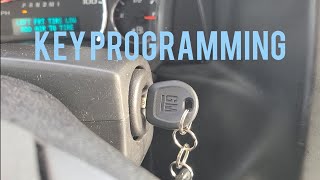
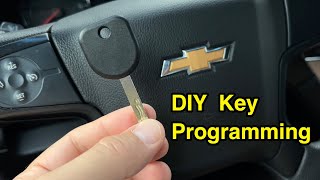
Typical fix: The faulty key must be replaced and the new key programmed to the vehicle. This can be done with a scan tool or by following the 30-minute key relearn procedure. 🎬 Watch: How to perform the 30-minute key relearn process.
Est. part cost: $75-$250 - Radio Frequency (RF) Interference 🟡 Medium Probability As documented in TSB PIC5650M, devices like other key fobs, security badges, aftermarket OBD-II scanners, or even certain phone chargers can block the signal between the key and the vehicle's immobilizer antenna.
How to confirm: Remove all other keys, fobs, and cards from the keychain. Unplug any aftermarket devices from the OBD-II port or power outlets. Try starting the vehicle with the bare Chevrolet key. If it starts consistently, interference was the cause.
Typical fix: Keep other RFID-emitting devices separate from the vehicle key when starting the engine. Remove any low-quality aftermarket electronic devices.
Est. part cost: $0 - Faulty Immobilizer Antenna/Exciter Ring ⚪ Low Probability The antenna is a coil around the ignition lock cylinder that energizes the key's transponder. A break in its wiring or internal failure can prevent it from reading the key. It is often part of the ignition lock housing assembly.
How to confirm: A technician can use a scan tool to monitor the key-read status while checking the wiring and connections to the antenna. The antenna's resistance can also be checked with a multimeter.
Typical fix: Replacement of the immobilizer antenna ring. For K2XX models, this is often sold as part of the ignition lock housing, such as ACDelco P/N 23377962.
Est. part cost: $50-$150 - Failing Body Control Module (BCM) ⚪ Low Probability The BCM is the central computer for this system. While robust, it can fail internally due to voltage spikes, water intrusion, or internal component failure, losing its ability to recognize learned keys.
How to confirm: This is a diagnosis of exclusion. If the keys, antenna, and all related wiring (including grounds) are confirmed to be good, the BCM is the likely culprit. A high-end scan tool is needed to check for communication errors with the BCM.
Typical fix: The BCM must be replaced and programmed by a dealer or qualified shop with access to GM's service programming system. Checking BCM ground connections for corrosion is a critical first step before replacement.
Est. part cost: $400-$800
Rare But Worth Checking
- Low Battery Voltage: Weak or failing battery can cause communication errors between various modules, including the BCM and TDM, sometimes incorrectly triggering a security code. A user on a Tahoe forum noted that a host of communication codes, including B3060, were triggered by a failing battery.
- Poor BCM or Engine Ground Connection: Corroded or loose ground wires for the BCM or engine block can cause intermittent and difficult-to-diagnose electrical problems, including no-start conditions that mimic an immobilizer fault. Forum users on TahoeYukonForum.com have resolved intermittent no-start issues by cleaning and tightening main ground connections.
Diagnosis Steps
- Verify the battery is fully charged (above 12.4V) and the terminals are clean and tight.
- Remove all other fobs, keys, and RFID cards from the keychain. Unplug any aftermarket devices from power outlets or the OBD-II port. Attempt to start the vehicle with the bare key.
- Attempt to start the vehicle with a known-good spare key. If it starts, the primary key is faulty.
- If no keys work and you have a new, cut key, attempt the '30-Minute Key Relearn Procedure': Insert the new key and turn to the 'ON' position. The security light will illuminate. Wait approximately 10 minutes until the light turns off. Turn the key 'OFF' for 5 seconds. Repeat this cycle two more times for a total of 3 cycles / 30 minutes. After the third cycle, turn the key off and then try to start the engine.
- Inspect the wiring around the steering column for the immobilizer antenna (exciter ring). Check for any visible damage or loose connectors.
- Inspect major ground connections, particularly the main battery-to-chassis ground and any grounds connected to the BCM or firewall, for corrosion or looseness.
- Use a professional scan tool to read the status of the Theft Deterrent Module (TDM) or Body Control Module (BCM). Check if it recognizes a key being inserted and what fault it is reporting.
- If the key is not being recognized, test the immobilizer antenna for correct resistance and continuity using a multimeter.
- If the antenna and keys are confirmed good, further diagnostics on the Body Control Module (BCM) are required, which is best left to a professional.
Parts You'll Likely Need
- Transponder Ignition Key / Key Fob
(OEM #13541565 (Example for 2021+ T1XX models))— This is the most common failure point. The internal transponder chip can be damaged or the key can lose its programming.
Trusted brands: ACDelco
OEM price range: $100-$200
Aftermarket price range: $50-$120 - Immobilizer Antenna Ring / Ignition Lock Housing
(OEM #23377962 (For K2XX models, often sold as ignition lock housing assembly))— This part reads the chip in the key. If it fails, no signal is sent to the BCM, causing a no-start condition.
Trusted brands: ACDelco
OEM price range: $70-$130
Aftermarket price range: $40-$90
Related Codes That Often Appear With This One
- B3055 — This code means 'No Transponder Modulation or No Transponder,' indicating the system received no signal from the key at all. It often appears with B3060 when the key is damaged, there's heavy RF interference, or the antenna is faulty.
- B3935 — Transponder Authentication Failed. This code can also be set alongside B3060 during a failed key-read attempt, as noted in GM service bulletins.
Technical Service Bulletins (TSBs) & Recalls
- PIC5650M: Addresses an intermittent no crank, no start, or start stall concern with the security light on, potentially caused by RF interference from aftermarket devices or other items on the key ring. It lists B3060 as a primary diagnostic code for this issue. [⭐ MANUFACTURER TSB — highest authority]
Platform-Specific Known Issues
- An intermittent no-crank or start-and-stall condition, often accompanied by the security light and DTCs B3055 or B3060, is a known issue across many GM vehicles of this era, as documented in Technical Service Bulletin #PIC5650M. [⭐ MANUFACTURER TSB — highest authority]
Mechanic-Grade Diagnostic Values
- Immobilizer Exciter Coil Resistance — expected: A few tens of Ohms. While exact GM specs are not published, a typical reading for this type of coil is between 10 and 30 Ohms.. Failure: An open circuit (infinite resistance) or a dead short (0 Ohms) indicates a failed coil.
Hidden / Shadow Codes Worth Checking
- B3060 00: The '00' is a symptom byte that means 'No Sub Type Information'. This indicates the base DTC provides the full description, which is 'Unprogrammed Transponder Identification Code Received'. It's the most common variant of this code. (see via A professional scan tool like GM's GDS2 will display the code with its symptom byte.)
Scan Tool Commands That Help
- GDS2 (GM Global Diagnostic System 2): Immobilizer Learn / Add or Replace Key Fobs — This function is required after replacing a key, the BCM, or the Theft Deterrent Module (TDM). It guides the technician through the process of programming new keys/fobs to the vehicle's immobilizer memory.
- GDS2 (GM Global Diagnostic System 2): Module Diagnostics > Remote Control Door Lock Receiver > Configure/Reset Functions — This specific path is used to program the remote (RKE) portion of the key fob after the transponder chip has been learned to the immobilizer system.
- Immobilizer Coil Tester: Inductive Signal Test — This is a simple, non-invasive go/no-go test. Holding this inexpensive tool near the ignition switch while turning the key should cause an LED on the tool to light up. If it lights, it confirms the BCM is sending power to the exciter coil and the coil is creating an RF field. This quickly rules out a faulty coil. If it does not light up, the coil or its circuit is likely faulty.
Wiring & Ground Locations
- G218 — Located on the driver's side, behind the lower dash trim panel, near the A-pillar. It is a stud on the body where multiple ground eyelets are secured by a nut.. This is the primary ground for the Body Control Module (BCM). A poor connection here, often caused by the dash insulation mat getting trapped under the ground nut, can cause a multitude of intermittent electrical issues, including no-start conditions and communication DTCs like B3060. GM issued TSB PIT5405C regarding issues stemming from this ground.
- Theft Deterrent Module (TDM) / Exciter Coil — The exciter coil is a ring that is part of the ignition lock cylinder housing assembly on the steering column. The TDM logic is integrated into this assembly or the BCM itself on these models.. This is the antenna that reads the key's transponder chip. Any damage to the wiring in the steering column leading to this component will prevent the key from being read, directly causing a B3060 code.
- Fuse F29 (Driver Instrument Panel Fuse Block) — In the fuse block on the driver's side of the dashboard, accessible when the driver's door is open.. Fuse F29 is a 10A fuse often designated for the Theft Deterrent System. While a blown fuse is uncommon, it's a critical and easy check that can prevent power from reaching the immobilizer module.
Real Owner Repair Stories
- Forum user experience (paraphrased from multiple similar reports) (2015-2018 Chevrolet Suburban/Tahoe) — Intermittent no-crank, no-start. Security light flashes. Sometimes works fine for weeks, then fails unexpectedly. B3060 and B3055 stored.
❌ Tried (didn't work) Replacing the battery, Trying the spare key, Performing the 30-minute key relearn procedure
✅ What actually fixed it An aftermarket remote start system was improperly wired or had a failing module that was interfering with the factory Pass-Key III+ system. Disconnecting the aftermarket remote start system completely resolved the intermittent no-start and the B3060 code. - GM TSB PIT5405C (2015-2017 Chevrolet Suburban/Tahoe/Silverado) — Engine stall, no-start, service stabilitrak message, IPC/Radio going blank, various communication DTCs including P0513 (related to invalid key).
❌ Tried (didn't work) Replacing modules, Replacing battery
✅ What actually fixed it The issue was a poor BCM ground at G218. The factory dash insulation mat was often trapped between the ground eyelet and the body stud, causing a poor connection. The fix was to cut away the interfering insulation, clean the contact surfaces, and properly tighten the ground nut.
OEM Part Supersession History
Multiple, e.g., 22982328, 23103652, 23203935→23377962— Component revisions and consolidation for the Ignition Lock Housing / Immobilizer Module for K2XX platform.
Heads up: Part 23377962 is listed for many GM vehicles but requires programming via SPS (Service Programming System) with a tool like GDS2 to function in the specific vehicle. It is not a plug-and-play part.13536380, 13541808→13548775— Updated Body Control Module (BCM) for 2021+ T1XX models.
Heads up: BCMs are platform-specific. A K2XX (2015-2020) BCM is not compatible with a T1XX (2021+) vehicle, and vice-versa. Replacement always requires online programming via GM's SPS.
Model Year Variations Within This Range
- 2015-2020 (K2XX Platform): These models typically use a bladed key with an integrated transponder chip, even on push-to-start models. The immobilizer antenna/reader is part of the ignition lock housing (P/N 23377962 is common). The BCM is located inside the cabin, and ground G218 is a well-documented issue.
- 2021-2022 (T1XX Platform): These models moved to GM's new Global B electrical architecture. They predominantly use keyless start systems. The BCM (e.g., P/N 13548775) and other modules are different and require the latest version of GDS2 and SPS2 for programming. While the principle of an unrecognized key is the same, the diagnostic and programming procedures are specific to the new architecture.
Helpful Videos
We Have This Part in Stock



The information in this article is provided for general reference and educational purposes only. Vehicle specifications, procedures, and part compatibility can vary by production date, trim level, and region. Always consult your vehicle's factory service manual and verify part numbers before purchasing or performing repairs. Safety-critical components such as airbags, seat belts, and braking systems should be installed by a qualified professional.
- Chevrolet SUBURBAN:
- 🎬 Helpful Videos
- 🛍️ Shop This Part
- What's Unique About the 2015-2022 Chevrolet SUBURBAN
- Diagnostic Flowchart
- Symptoms You May Notice
- Most Likely Causes
- Rare But Worth Checking
- Diagnosis Steps
- Parts You'll Likely Need
- Related Codes That Often Appear With This One
- Technical Service Bulletins (TSBs) & Recalls
- Platform-Specific Known Issues
- Mechanic-Grade Diagnostic Values
- Hidden / Shadow Codes Worth Checking
- Scan Tool Commands That Help
- Wiring & Ground Locations
- Real Owner Repair Stories
- OEM Part Supersession History
- Model Year Variations Within This Range
- 🎟️ Get 5% Off