

B3060 on 2015-2020 Chevrolet Impala: Immobilizer Fault, No-Start Causes & Fixes
Code B3060 on a 2015-2020 Impala means the car's security system doesn't recognize the key, causing a no-start. The most common causes are a faulty key, a bad immobilizer antenna around the ignition, or radio frequency interference from other devices on your keychain.
- B3060 means your Impala's security system has locked you out, usually causing a no-start and a security light.
- Before spending any money, try the simplest fixes: use your spare key and remove all other electronic fobs and cards from your keychain to eliminate interference.
- The 10-minute key relearn procedure is a valid DIY step that can often resolve temporary glitches without a trip to the shop.
- If a new key is needed, it must be professionally programmed to the car; a simple hardware store copy will not work.
- This issue is officially recognized by GM, and the cause is frequently external interference, not a broken part on the car.
What's Unique About the 2015-2020 Chevrolet IMPALA
The 2015-2020 Impala (10th generation) uses a common GM Pass-Key III+ or a similar transponder-based immobilizer system that is highly sensitive. A series of GM Technical Service Bulletins (PIC5650) acknowledges that intermittent no-start conditions with code B3060 are a known issue across dozens of GM models from this era, including the Impala. The primary cause highlighted by GM is not a failed part, but rather radio frequency interference (RFI) from other electronic devices on the owner's keychain, which can disrupt the key's 125 kHz signal.
Diagnostic Flowchart
Tap your situation to follow the diagnostic path that matches what you're seeing on this vehicle.
Symptoms You May Notice
- Engine will not crank or turn over
- Engine starts and immediately stalls (typically within 1-2 seconds)
- Security indicator light is on or flashing on the dashboard
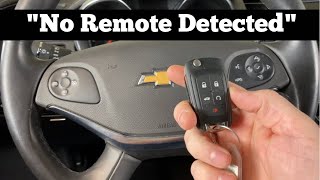
- "No Fob Detected" message on vehicles with keyless start
- "Service Theft Deterrent System" message on the Driver Information Center (DIC)
- Doors will not unlock remotely with the key fob
- Replacing the starter motor when the no-crank is caused by the security system disabling the starter relay.
- Replacing the battery when the no-start is not due to a lack of power, but a security lockout.
Most Likely Causes
- Radio Frequency Interference (RFI) 🔴 High Probability The immobilizer system operates at 125 kHz, a frequency easily disrupted by other electronic devices, a fact repeatedly noted in GM TSBs PIC5650B, C, K, and M. Common sources include other vehicle keys, building access cards, gas station speed passes, and even some aftermarket phone chargers or LED lights.
How to confirm: Remove all other keys, fobs, access cards, and electronic devices from the keychain with the Impala key. Try to start the vehicle with the key completely isolated. If it starts, RFI was the cause.
Typical fix: Keep other RFID-emitting devices on a separate keychain from the vehicle's ignition key. Advise the customer to check their owner's manual under "Immobilizer Operation" or "Radio Frequency Statement" for more details.
Est. part cost: $0 - Defective or Unprogrammed Ignition Key 🟡 Medium Probability The transponder chip embedded in the key can be damaged from being dropped, exposed to water, or can lose its programming, preventing the car from recognizing it. A dead battery in the key fob can also cause this issue.
How to confirm: Try starting the vehicle with a known-good spare key. If the spare key works consistently, the original key is faulty. For push-to-start models with a dead fob battery, placing the fob in the designated pocket in the center console may allow the car to start. A locksmith or dealer can also test the transponder signal.
Typical fix: The faulty key must be replaced and the new key programmed to the vehicle using a specialized scan tool. In some cases, only the fob battery needs replacement.
Est. part cost: $5-$250 - Faulty Immobilizer Antenna (Exciter Ring) ⚪ Low Probability The antenna is a coil of wire around the ignition lock cylinder that energizes and reads the key's transponder. It can fail due to an internal break in the coil winding, though it's less common than key or interference issues.
How to confirm: This requires testing the circuit with a multimeter or observing live data with an advanced scan tool to see if the Theft Deterrent Module is receiving a signal from the antenna. A professional diagnosis is usually needed.
Typical fix: Replace the immobilizer antenna/exciter ring. This part is often referred to as an "Ignition Lock Key Transmitter Antenna." A key relearn procedure may be required after replacement.
Est. part cost: $25-$150 - Failing Body Control Module (BCM) ⚪ Low Probability The BCM is the central computer for the security system in many GM vehicles. While robust, an internal failure can prevent it from correctly validating the key signal. A Reddit user with a 2014 Impala reported that after extensive troubleshooting, the dealer suspected a faulty BCM as the root cause of an intermittent theft mode issue.
How to confirm: This is typically a diagnosis of exclusion. If the key, antenna, and wiring are all confirmed to be good, the BCM is the likely culprit. A technician may find other BCM-related codes or communication errors.
Typical fix: Replace the Body Control Module and program it to the vehicle, which requires dealer-level tools and software.
Est. part cost: $300-$600
Rare But Worth Checking
- Worn Ignition Lock Cylinder: A very worn or damaged ignition cylinder can prevent the key from sitting in the correct position, affecting the antenna's ability to read the transponder chip. In some cases, the entire ignition switch assembly may be at fault.
- Poor Ground Connection or Wiring Issue: A loose or corroded ground strap for the BCM or related components can cause a wide range of intermittent electrical issues, including security system faults. Damaged wiring between the antenna and the TDM/BCM can also prevent the signal from being received. A corroded positive battery cable at the main fuse block has also been reported 🎬 Watch: How to clean corroded battery terminals to restore power. to cause these symptoms.
Diagnosis Steps
- Check the dashboard for an illuminated security light. This is the first sign of an immobilizer issue.
- Isolate the key. Remove all other keys, fobs, and electronic cards from the keychain. Attempt to start the car with only the single Impala key present to rule out RFI.
- Try starting the vehicle with a known-good spare key. If it starts, the primary key is the problem.
- For push-to-start models, if the fob battery is suspected to be dead, place the fob in the transmitter pocket located inside the center console storage compartment 🎬 Watch: How to start your Impala with a dead key fob. and try to start the vehicle.
- If the car still won't start, try the 10-minute key relearn procedure: Turn the key to the 'ON' position (do not start), and wait 10-12 minutes until the security light turns off or stops flashing. Turn the key off for 5 seconds, then try to start the engine. This may need to be repeated up to three times for a total of ~30 minutes. 🎬 See this walkthrough of the GM security relearn procedure.
- Scan the Body Control Module (BCM) and Engine Control Module (ECM) for all stored trouble codes with an OBD-II scanner capable of reading body codes.
- Inspect the wiring and connector at the immobilizer antenna (around the ignition lock cylinder) for any damage or looseness.
- If all else fails, have a professional technician test the outputs from the immobilizer antenna and the BCM using an oscilloscope or advanced scan tool.
Parts You'll Likely Need
- Transponder Ignition Key / Key Fob
(OEM #13584831 (Example 5-Button Fob))— The chip inside the key is the most common hardware failure point for this code, or the battery may be dead.
Trusted brands: ACDelco, GM Genuine Parts
OEM price range: $100-$200
Aftermarket price range: $50-$120 - Immobilizer Control Module Antenna
(OEM #13502549)— Also known as the exciter ring or Ignition Lock Key Transmitter Antenna, this part reads the key. It can fail, preventing the key's code from being read.
Trusted brands: ACDelco, GM Genuine Parts
OEM price range: $40-$70
Aftermarket price range: $25-$50
Related Codes That Often Appear With This One
- B3055 — This code means "No Transponder Modulation or No Transponder," indicating the system received no signal at all, often appearing with B3060 when the key is faulty or interference is strong.
- B3935 — This code, "Transponder Authentication Failed," is also part of the immobilizer logic and can be set alongside B3060 during a security event.
- C0750, C0755, C0760, C0765, C0775 — These are tire pressure monitor sensor codes. They can appear with B3060 because the RFI that disrupts the 125 kHz immobilizer system can also interfere with the TPMS receivers, as noted in TSB PIC5650M.
Technical Service Bulletins (TSBs) & Recalls
- PIC5650M: Notes an intermittent no crank, no start, or start stall concern with the security light on, potentially caused by RFI. Lists B3060 as a primary related DTC.
- PIC5650B/C/K: Earlier versions and updates of the same TSB, which list dozens of affected GM vehicles and provide an extensive list of potential RFI sources.
Platform-Specific Known Issues
- GM Technical Service Bulletin PIC5650M directly addresses intermittent no-crank/no-start conditions with code B3060, pointing to Radio Frequency Interference (RFI) as a primary cause that technicians should investigate before replacing parts.
- For push-to-start models, there is a specific pocket inside the center console designed to read the key fob even if its battery is dead. Many owners are unaware of this feature, which can be a simple fix for a "No Fob Detected" message.
Mechanic-Grade Diagnostic Values
- Starter Relay Control Wire Voltage — expected: 12V during crank signal. Failure: A lower voltage, such as 6V, is insufficient to activate the relay and may indicate a failing Engine Control Module (ECM).
- Immobilizer Antenna Coil Resistance — expected: A specific Ohm value is not available in public documentation, but the coil should show continuity (not an open circuit) when tested with a multimeter.. Failure: An open-loop (infinite resistance) reading indicates a broken coil winding, requiring replacement of the antenna.
Hidden / Shadow Codes Worth Checking
- B3060 00: The '00' is a standard GM symptom byte meaning 'No Sub Type Information'. It indicates that the base DTC text string provides the complete description of the failure and no further specific failure type information is available from the code itself. (see via A professional scan tool capable of reading GM-specific body codes, such as a Tech2 or GDS2.)
Scan Tool Commands That Help
- GDS2 (GM Global Diagnostic System 2): Module Diagnostics -> Remote Control Door Lock Receiver -> Configure/Reset Functions -> Add or Replace Key Fobs — This function is used to program an additional key when at least one working key is already available.
- GDS2 with SPS (Service Programming System): Immobilizer Learn / All Keys Lost Programming — This function is required when no recognized keys are available. It involves a more complex procedure that requires an online connection to GM's servers to program the first key, which then erases all previously stored keys.
Wiring & Ground Locations
- Body Control Module (BCM) — Located under the driver's side of the dash, to the left of the steering column and typically just above the OBD-II diagnostic port.. The BCM is the control center for the Passkey III+ immobilizer system. All related wiring for the key and antenna terminates here, making it a central point for electrical testing.
- BCM Connector X2 (Blue, 27-pin) — One of the main connectors plugging into the BCM.. Contains CAN bus communication wires (Pins 23 and 24) that are essential for the BCM to communicate with other modules like the ECM.
- BCM Green 25-pin Connector, Pin 2 — A specific pin on one of the BCM's main connectors.. This pin carries the signal from the immobilizer LIN bus (Light Blue wire). A fault on this specific circuit can directly cause code B3060.
Real Owner Repair Stories
- YouTube channel 'Auto Repair Tips' (Chevrolet Impala (generation similar to 2015-2020)) — No crank, no start condition.
❌ Tried (didn't work) Jumping the starter directly confirmed the starter motor was good., Testing the starter relay showed it was not receiving a proper 12V signal.
✅ What actually fixed it The Engine Control Module (ECM) was found to be faulty, only sending 6V to the starter relay's control pin instead of 12V. Replacing and reprogramming the ECM resolved the no-start condition. - Reddit user bireland203 in r/Impala (2014 Impala LT) — Intermittent no-crank with cabin lights/dashboard turning on, random anti-theft system activation.
❌ Tried (didn't work) Assuming it was a starter or battery issue.
✅ What actually fixed it The positive battery cable connecting to the fuse block that sits on top of the battery was found to have significant corrosion. Replacing the corroded cable end with a new terminal fixed the intermittent no-start and security issues. - YouTube channel 'Repairs and Rides' (2016 Chevrolet Impala) — No crank, no start, just a single click. All electronics had power.
❌ Tried (didn't work) Cleaning the battery terminals., Checking fuses.
✅ What actually fixed it The starter relay in the underhood fuse box was malfunctioning. The owner swapped it with an identical relay from another circuit in the same fuse box, and the car started immediately. A new relay was purchased and installed, permanently fixing the issue.
"I Checked Everything" — The Actual Cause
- In the context of electrical diagnosis, a common pattern is for all components (key, antenna, BCM) to test good, yet the problem persists. In one documented case for a 2014 Impala, the root cause was high resistance from a corroded positive battery cable where it connects to the main fuse panel on top of the battery, causing intermittent security system activation and no-start symptoms.
- Another case involved a no-crank condition where the starter and relay tested good, but the Engine Control Module (ECM) was only outputting 6V to the starter relay control circuit instead of the necessary 12V, preventing the relay from activating. The actual fault was a bad ECM, not the immobilizer system itself.
When the Usual Fixes Don't Work
- While B3060 points directly to a key recognition failure, the symptoms (especially intermittent no-crank) are not always caused by the core immobilizer components. Real-world repairs show that technicians should not overlook simpler electrical faults. A faulty starter relay in the underhood fuse box can perfectly mimic a security lockout and can be diagnosed in minutes by swapping it with a known-good relay. Furthermore, high-resistance connections, particularly at the main battery-to-fuse-block junction, can cause voltage drops that trigger random, intermittent security faults that are difficult to trace. In rare cases, the fault can even be upstream in the ECM, which may fail to provide the correct voltage to the starter relay control circuit, preventing a start even if the BCM has approved it.
OEM Part Supersession History
13502549→N/A— No supersession information found. This part number appears to be consistent for the immobilizer antenna across many GM models of the era.
Heads up: An alternate part, 13523300, is listed for 2014-2017 Impala models, suggesting a possible variation, but it is not a direct replacement for 13502549.
Model Year Variations Within This Range
- 2014-2017 vs 2018-2020: There is a potential part number difference for the immobilizer transceiver/antenna. Part number 13523300 is listed specifically for 2014-2017 models, which may indicate a different part was used in later years, though this is not definitively confirmed.
Helpful Videos

Used OEM Parts in Stock


New Aftermarket Parts Available


The information in this article is provided for general reference and educational purposes only. Vehicle specifications, procedures, and part compatibility can vary by production date, trim level, and region. Always consult your vehicle's factory service manual and verify part numbers before purchasing or performing repairs. Safety-critical components such as airbags, seat belts, and braking systems should be installed by a qualified professional.
- Chevrolet IMPALA:
- 🎬 Helpful Videos
- 🛍️ Shop This Part
- What's Unique About the 2015-2020 Chevrolet IMPALA
- Diagnostic Flowchart
- Symptoms You May Notice
- Most Likely Causes
- Rare But Worth Checking
- Diagnosis Steps
- Parts You'll Likely Need
- Related Codes That Often Appear With This One
- Technical Service Bulletins (TSBs) & Recalls
- Platform-Specific Known Issues
- Mechanic-Grade Diagnostic Values
- Hidden / Shadow Codes Worth Checking
- Scan Tool Commands That Help
- Wiring & Ground Locations
- Real Owner Repair Stories
- "I Checked Everything" — The Actual Cause
- When the Usual Fixes Don't Work
- OEM Part Supersession History
- Model Year Variations Within This Range
- 🎟️ Get 5% Off