

B3055 on 2011-2018 Buick Regal: No-Start Causes and Fixes
This code means your Regal's anti-theft system can't read the transponder chip in your key. This results in a no-start or start-and-stall condition. The most common causes are a faulty key, a weak key fob battery, or radio frequency interference from other devices on your keychain.
- Before panicking, try the simple fixes: use your spare key, remove all other items from your keychain, and make sure your flip-key is fully extended.
- Code B3055 means your car's anti-theft system is working as designed but cannot verify your key, so it's preventing the car from starting.
- This is an electrical issue, not a mechanical one. Do not replace the starter or battery without first properly diagnosing the immobilizer system.
- If a new key is needed, it MUST be professionally programmed to your vehicle; you cannot simply get a new key cut.
What's Unique About the 2011-2018 Buick REGAL
For this generation of Buick Regal and other GM vehicles on the Epsilon II platform, the immobilizer system is sensitive to both the key's physical position and radio frequency interference. A specific GM Technical Service Bulletin (PIT5030E) notes that if the flip-out key is not fully extended and locked, it can fail to communicate with the car and set a B3055 code. Additionally, another TSB (PIC5650 series) highlights that intermittent no-start issues with this code are often caused by aftermarket devices like phone chargers, toll passes, or even other car keys on the same keyring interfering with the key's signal. The TSB notes this RFI can be so significant it also interferes with other systems, like the Tire Pressure Monitoring System (TPMS), setting codes C0750-C0775 concurrently.
Diagnostic Flowchart
Tap your situation to follow the diagnostic path that matches what you're seeing on this vehicle.
Generation note: This issue affects both the fifth generation (2011-2017) and the sixth generation (2018) of the Buick Regal, as both are covered under related Technical Service Bulletins. The underlying immobilizer technology and its potential issues are similar across these years. The fifth generation Regal is based on the Opel Insignia and the GM Epsilon II platform, which is shared with other vehicles that experience the same B3055 fault.
Symptoms You May Notice
- Engine will not crank or start.
- Engine starts and then immediately stalls.
- Security light is illuminated or flashing on the dashboard.
- A 'Service Theft Deterrent System' message appears on the Driver Information Center (DIC).
- Replacing the starter motor. A no-crank condition might lead someone to suspect the starter, but the presence of B3055 and a security light points directly to the anti-theft system.
- Replacing the car's main battery. While a low battery can cause many electrical issues, it's not the direct cause of a B3055 code, though it's always good to ensure the battery is healthy before proceeding with more expensive repairs.
Most Likely Causes
- Radio Frequency Interference (RFI) 🔴 High Probability As documented in TSB PIC5650, the immobilizer system is sensitive to external radio signals from devices plugged into the accessory power outlet or even other RFID-enabled cards on the keychain.
How to confirm: Remove all other keys, fobs, access cards, and aftermarket electronic devices (like phone chargers) from the key ring and from inside the car. Try starting the vehicle again.
Typical fix: Keep the Buick key on its own ring or separate from other electronic devices that could cause interference. Avoid using cheap, unshielded phone chargers.
Est. part cost: $0 - Incorrect Key Usage (Flip Key Not Extended) 🔴 High Probability TSB PIT5030E specifically calls out this issue on 2010-2014 Regals. The design of the flip key can cause a poor signal if it's not fully locked in the open position when inserted into the ignition.
How to confirm: Remove the key, ensure it is fully extended and locked straight, then re-insert it and try to start the engine.
Typical fix: Ensure the key is fully extended before use. This is a user-training issue.
Est. part cost: $0 - Damaged or Faulty Ignition Key 🟡 Medium Probability The transponder chip inside the key head can be damaged from being dropped or getting wet. The flip mechanism can also wear out, causing the key to be loose. Technicians report seeing these transponders fail even without physical damage.
How to confirm: Try starting the vehicle with a spare key. If the spare key works reliably, the original key is the problem. A locksmith can also test the transponder chip directly.
Typical fix: The faulty key needs to be replaced and the new key must be programmed to the vehicle by a dealer or locksmith with the proper tools. The metal key blade will also need to be cut.
Est. part cost: $75-$250 - Weak or Dead Key Fob Battery ⚪ Low Probability While the transponder chip is typically passive (powered by the car's antenna), a very weak fob battery can sometimes contribute to communication issues, especially on push-to-start models.
How to confirm: Replace the battery in the key fob. On push-to-start models, try placing the fob in the designated transmitter pocket/slot (often in the center console or glove box), which allows the car to read it even with a dead battery.
Typical fix: Replace the CR2032 battery inside the key fob.
Est. part cost: $5-$10 - Faulty Immobilizer Exciter Ring/Antenna ⚪ Low Probability This component, which surrounds the ignition lock cylinder, energizes and reads the key's transponder. It can fail electrically over time, preventing communication.
How to confirm: This requires testing the wiring and resistance of the exciter module, usually done by a professional technician with a multimeter and service information.
Typical fix: Replacement of the exciter ring/theft deterrent module and reprogramming the system. The steering column shrouds must be removed for access.
Est. part cost: $50-$150
Rare But Worth Checking
- Faulty Body Control Module (BCM): The BCM is the brain of the immobilizer system. While not a common failure point for this specific code, it is the last step in the diagnostic chain if all other components (key, antenna, wiring) check out.
- Wiring Harness Damage: Damage to the wires between the immobilizer antenna and the BCM can cause a loss of communication. This is rare but can happen due to previous repairs or rodent damage.
- Low Vehicle Battery Voltage: A weak or failing main vehicle battery can cause various electronic modules to malfunction during cranking, potentially setting communication codes like B3055. It's a good practice to ensure the main battery is healthy before diving into complex diagnostics.
Diagnosis Steps
- Check for a security light on the dashboard. This confirms an anti-theft issue.
- Remove all other keys, fobs, and electronic devices from your keychain and from inside the vehicle to eliminate Radio Frequency Interference (RFI).
- If you have a flip-key, ensure it is fully extended and locked straight before inserting it into the ignition.
- Try starting the car with your spare key. If it starts, the primary key is faulty.
- Replace the battery in the key fob as a low-cost preliminary step.
- If the car has a push-button start, place the fob in the designated transmitter pocket (check owner's manual for location) and try to start it. This bypasses issues with a weak fob battery.
- Check the vehicle's main 12V battery voltage. A reading below 12.4 volts at rest may indicate a weak battery that could be causing electronic issues.
- Inspect the wiring around the ignition lock cylinder and steering column for any visible damage.
- If the problem persists, have a professional technician use a scan tool to check for communication between the key, the immobilizer module, and the Body Control Module (BCM). Live data should be checked for 'Key Detected' status.
Parts You'll Likely Need
- Ignition Key / Key Fob
(OEM #13504202, 13504203)— The transponder chip in the original key may have failed or been damaged. This is a common failure point. Part number varies by specific options (e.g., remote start).
Trusted brands: ACDelco, Strattec
OEM price range: $100-$200
Aftermarket price range: $50-$120 - Theft Deterrent Exciter Module (Antenna Ring)
(OEM #13504233)— This part reads the key chip. If it fails, it cannot send the key's signal to the BCM. It is located around the ignition lock cylinder.
Trusted brands: ACDelco
OEM price range: $70-$150
Aftermarket price range: $40-$90
Related Codes That Often Appear With This One
- B3060 — This code often relates to an unprogrammed transponder, which can be set along with B3055 when there's a key communication failure.
- B3935 — This is another transponder-related code that can appear with B3055 during an intermittent security system fault, often related to RFI.
- B2955 — This code for 'Security Sensor Data Circuit' can be logged along with B3055, indicating a broader issue within the theft deterrent system communication pathway that the BCM is detecting.
Technical Service Bulletins (TSBs) & Recalls
- PIC5650M: Addresses intermittent no-crank, no-start, or start-stall with security light on, citing B3055 and pointing to Radio Frequency Interference (RFI) as a likely cause.
- PIT5030E: Notes that an intermittent no-crank can be caused by the flip-key not being fully extended on 2010-2014 models.
Platform-Specific Known Issues
- TSB PIC5650M (and earlier versions) documents an intermittent no-crank or start-stall condition with code B3055, often caused by radio frequency interference from aftermarket devices like phone chargers, toll passes, or even other keys on the same keyring.
- TSB PIT5030E points out that on models with a flip-style key, not having the key fully extended can cause an intermittent no-crank and may set code B3055.
- Owner Experience: On buickforums.com, a user with a 2011 Regal experienced a no-start and B3055. After trying the spare key, which also failed, the dealer diagnosed and replaced the 'exciter ring' (Theft Deterrent Exciter Module) around the ignition, which resolved the problem.
Mechanic-Grade Diagnostic Values
- Immobilizer Signal Circuit Voltage to Ground — expected: Less than 1.0 V. Failure: A reading of 1.0 V or greater indicates a short to voltage in the signal circuit between the exciter coil and the BCM.
- Immobilizer Exciter Coil Resistance — expected: Greater than 2 ohms. Failure: A resistance of less than 2 ohms may indicate a faulty Body Control Module (BCM), designated as K9 in service literature.
Hidden / Shadow Codes Worth Checking
- B3055 00: The '00' is a symptom byte indicating 'No Sub Type Information'. This means the base DTC description ('No Transponder Modulation') is the complete fault information available from the module, as seen on a GDS2 or similar advanced scan tool. (see via GM GDS2, Topdon, advanced Autel scanners)
Scan Tool Commands That Help
- GM GDS2 / Techline Connect: Immobilizer Learn / Add or Replace Key Fobs — This function is required after replacing a key, the BCM, or the immobilizer module. It guides the technician through the 10-minute security relearn procedure to program new key transponders to the vehicle. The path is often under 'Body Control Module' or 'Remote Control Door Lock Receiver' -> 'Configuration/Reset Functions'.
- Manual Procedure (No Scan Tool): 10-Minute or 30-Minute Key Relearn — Used when adding a new key when all keys are lost. The procedure typically involves turning the new key to the 'ON' position and waiting 10 minutes for the security light to turn off, repeating this cycle three times for a total of 30 minutes. This erases all old keys and learns the new key.
- Key Cloning Tool (e.g., VVDI Key Tool): Transponder Cloning — This is an advanced locksmith technique used when a key's transponder is failing intermittently. The tool reads the data from the faulty original key and writes it to a new blank chip, creating a clone. This avoids the need for a full vehicle relearn procedure.
Wiring & Ground Locations
- K9 Body Control Module (BCM) — For 2014-2017 models, the BCM is located on the passenger side, behind/underneath the glove box. For earlier 2011-2012 models, some wiring diagrams suggest a location under the driver's side of the dash.. The BCM is the control center for the immobilizer system. All signals from the key and exciter ring are processed here. Checking its connectors for corrosion or looseness is a critical diagnostic step.
- K89 Immobilizer Control Module (Exciter Ring/Antenna) — This is the antenna ring located around the ignition lock cylinder, under the steering column shrouds.. This module energizes and reads the transponder chip in the key. Its wiring connects directly to the BCM, and damage to this short harness can cause code B3055.
Real Owner Repair Stories
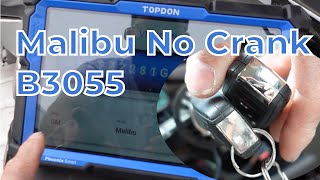
- Hands On Auto Training (YouTube) (2015 Chevrolet Malibu (shared Epsilon II platform)) — No crank, no start, security light on. Codes B3055 (No Transponder Modulation) and B2955 (Security Sensor Data Circuit) were present.
❌ Tried (didn't work) Clearing codes (they returned instantly).
✅ What actually fixed it The transponder chip inside the original key had failed. A key tool confirmed the exciter coil was producing a signal, but the scan tool live data showed 'no key detected'. Programming a brand new key to the vehicle using an Auto Pro Pad (10-minute security learn) resolved the problem completely. - ADD AUTOMOBILE SERVICES (YouTube) (2013 Chevrolet Equinox (related GM platform)) — Intermittent no-start with security light on and code B3055.
❌ Tried (didn't work) Cycling the key would sometimes work and sometimes not.
✅ What actually fixed it The original key's transponder was failing intermittently. A locksmith used a VVDI Key Tool to read the data from the faulty key and clone it onto a new 'super chip'. This new chip was then placed inside the original key fob, providing a reliable signal and fixing the intermittent start issue without needing to perform a full vehicle relearn procedure.
Model Year Variations Within This Range
- 2011-2013 vs 2014-2017: The physical location of the Body Control Module (BCM) appears to have changed. On 2014-2017 facelift models, it is confirmed to be behind the passenger-side glove box. Some data for earlier 2011-2012 models points to a driver-side location. Technicians should verify the location based on the specific model year before beginning diagnosis.
- 2011-2014: TSB PIT5030E, which addresses a no-start if the flip-key is not fully extended, specifically covers up to the 2014 model year. This may indicate a change in the key or immobilizer antenna design for 2015+ models that made this issue less common.
Helpful Videos


We Have This Part in Stock




The information in this article is provided for general reference and educational purposes only. Vehicle specifications, procedures, and part compatibility can vary by production date, trim level, and region. Always consult your vehicle's factory service manual and verify part numbers before purchasing or performing repairs. Safety-critical components such as airbags, seat belts, and braking systems should be installed by a qualified professional.
- Buick REGAL:
- 🎬 Helpful Videos
- 🛍️ Shop This Part
- What's Unique About the 2011-2018 Buick REGAL
- Diagnostic Flowchart
- Symptoms You May Notice
- Most Likely Causes
- Rare But Worth Checking
- Diagnosis Steps
- Parts You'll Likely Need
- Related Codes That Often Appear With This One
- Technical Service Bulletins (TSBs) & Recalls
- Platform-Specific Known Issues
- Mechanic-Grade Diagnostic Values
- Hidden / Shadow Codes Worth Checking
- Scan Tool Commands That Help
- Wiring & Ground Locations
- Real Owner Repair Stories
- Model Year Variations Within This Range
- 🎟️ Get 5% Off