

B3055 on 2016-2023 Buick Enclave: Causes for No Start & Security Light
Code B3055 on a Buick Enclave means the vehicle's security system cannot detect the key, causing a no-start or stall. The most common causes are a faulty key, radio frequency interference, or a bad ignition lock cylinder. Always try your spare key first, and remove other electronic fobs from your keychain before seeking service.
- B3055 is a security code, not an engine or starter problem. It means your car doesn't recognize your key.
- The first and easiest diagnostic step is to try your spare key.
- Before paying for repairs, remove all other RFID cards and fobs from your keychain and try again.
- If you have a flip-style key, make sure it's fully locked in the straight position before inserting it.
- Most fixes for this code, including replacing a key, require professional programming tools.
What's Unique About the 2016-2023 Buick ENCLAVE
On these Enclave models and their platform mates like the Traverse and Acadia, the B3055 code is frequently linked to intermittent no-start or start-and-stall conditions, often accompanied by the security light. GM has issued several Technical Service Bulletins (TSBs) acknowledging this sensitivity. The issue can be caused by something as simple as how a flip key is positioned when inserted into the ignition, or interference from other RFID devices on the same keychain, making it a common but sometimes tricky issue to diagnose. Aftermarket devices like cell phone chargers and even LED interior lights have been identified as sources of Radio Frequency Interference (RFI) that can trigger this code.
Diagnostic Flowchart
Tap your situation to follow the diagnostic path that matches what you're seeing on this vehicle.
Generation note: The 2016-2023 year range covers two generations of the Enclave: the first generation (2016-2017) and the second generation (2018-2023). While the underlying security system is similar, first-gen models typically use a traditional flip key (FCC ID: OUC60270), whereas second-gen models are more likely to have push-button start with a smart key (FCC ID: HYQ4EA). The causes are similar, but the physical components (ignition lock cylinder vs. start button and various antenna placements) differ.
Symptoms You May Notice
- Engine will not crank or turn over
- Engine starts and immediately stalls
- Security light is illuminated or flashing on the dashboard
- "No Remote/Fob Detected" message on the driver information center (DIC)
- "Theft Attempted" message on the DIC
- "Service Theft Deterrent System" message on the DIC
- Replacing the starter motor. A no-crank condition caused by the security system is often mistaken for a bad starter. A Reddit post detailed a case where a customer was certain the starter failed, but the issue was a B3055 code from a destroyed key.
- Replacing the battery. While a low battery can cause various electrical issues and prevent key programming, it's not the root cause of a B3055 code, though a stable voltage is needed for diagnosis.
Most Likely Causes
- Faulty or Damaged Ignition Key 🔴 High Probability The transponder chip inside the key fob can fail, become dislodged, or the key's circuit board can be damaged from drops or wear. A low fob battery can also sometimes cause this issue.
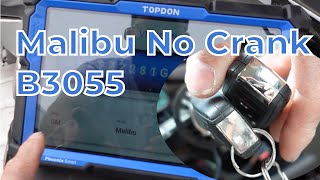
How to confirm: Try starting the vehicle with a spare key. If the spare key works without issue, the original key is the problem. A technician can also see a "No key detected" status in the BCM data stream with a scan tool. 🎬 Watch: Using a scan tool to diagnose the B3055 code.
Typical fix: Replace and program the faulty key fob. This requires a specialized tool for programming.
Est. part cost: $150-$400 - Radio Frequency (RF) Interference 🟡 Medium Probability GM TSB PIC5650M and its successors specifically mention that other RFID devices (office key cards, gas station fobs, other car keys) or even aftermarket electronics like phone chargers and LED lights can interfere with the 125 kHz signal from the car key.
How to confirm: Remove all other keys and electronic devices from the keychain and from inside the vehicle. Try to start the vehicle again. If the problem disappears, RFI is the cause.
Typical fix: Keep other RFID-emitting devices separate from the vehicle key. Advise the customer per GM bulletins.
Est. part cost: $0 - Incorrect Key Usage (Flip Keys) 🟡 Medium Probability For models with a flip key (primarily 2016-2017), if the key is not fully extended and locked straight, it can be misaligned in the ignition cylinder, preventing a proper read. This is noted in GM TSB PIT5030E.
How to confirm: Remove the key, ensure it is fully extended and locked, and re-insert it straight into the ignition before turning.
Typical fix: User education on proper key insertion.
Est. part cost: $0 - Faulty Ignition Lock Cylinder / Transponder Antenna ⚪ Low Probability
How to confirm: If multiple known-good keys fail to start the vehicle and RFI has been ruled out, the problem is likely with the reader. A technician can use a scan tool to check if the theft deterrent module is receiving any signal from the key and test the antenna circuit for proper resistance.
Typical fix: Replace the ignition lock cylinder (which contains the antenna) or the standalone antenna module in push-to-start models. The part may be called an 'exciter module'.
Est. part cost: $200-$500
Rare But Worth Checking
- Failing Body Control Module (BCM): This is an unlikely cause, but possible if all other components (keys, antenna, wiring) check out. A BCM failure will typically be accompanied by other strange electrical issues like erratic lights, door lock malfunctions, or random warning lights for unrelated systems.
- Wiring Harness Damage: A break or short in the wiring between the ignition cylinder antenna (exciter module) and the BCM can prevent the signal from being received. This requires a detailed inspection of the wiring harness, checking for continuity and shorts to ground or voltage.
Diagnosis Steps
- Check the security light on the dashboard. A solid or flashing light confirms a theft deterrent issue.
- Try starting the vehicle with a known-good spare key. This is the most important step to isolate the problem to a specific key.
- Remove all other keys, fobs, and RFID cards from the keychain to eliminate radio frequency interference. Also unplug any aftermarket chargers or devices.
- For flip keys (2016-2017), ensure the key is fully extended and locked before inserting it into the ignition.
- Inspect the key for any visible damage. A severely damaged key can cause this code. Replace the battery in the key fob as a low-cost measure.
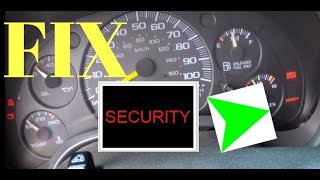
- If a new key or ignition component was installed, attempt the GM 10-minute relearn procedure: Turn the key to 'ON' (not start) for 10 minutes until the security light goes out. Turn key 'OFF' for 5 seconds. Repeat two more times for a total of 3 cycles. 🎬 See a walkthrough of this GM security reset procedure.
- Use a professional scan tool to read codes from the Body Control Module (BCM), not just the engine computer. Check the BCM data for key status.
- If all keys fail and there is no interference, have a technician inspect the wiring and test the transponder antenna circuit for opens, shorts, or incorrect resistance per the service manual.
- If all other components are confirmed to be working, the Body Control Module (BCM) may need to be diagnosed and possibly replaced/reprogrammed.
Parts You'll Likely Need
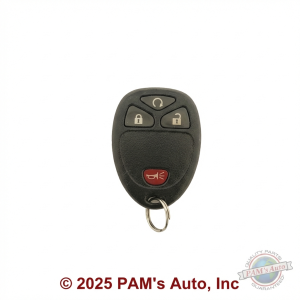
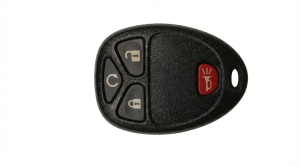
- Ignition Key with Transponder (Gen 1 Flip Key)
(OEM #15913420, 20868852, 22936098, 22936099)— This is the most common failure point for 2016-2017 models. The internal chip fails or the key becomes damaged.
Trusted brands: ACDelco, Strattec
OEM price range: $100-$200
Aftermarket price range: $20-$70 - Smart Key Fob (Gen 2 Push-Button Start)
(OEM #13521090, 13532751)— The most common failure for 2018-2023 models. The internal transponder or circuitry fails.
Trusted brands: ACDelco, GM Genuine Parts
OEM price range: $150-$250
Aftermarket price range: $50-$120 - Ignition Lock Cylinder
(OEM #D1464G (ACDelco))— Contains the antenna that reads the key on non-push-button-start models. If the antenna fails, no key will be detected.
Trusted brands: ACDelco, Standard Motor Products (Locksmart), Dorman
OEM price range: $35-$70
Aftermarket price range: $20-$50
Related Codes That Often Appear With This One
- B3060 — Also related to the transponder key circuit, indicating a different aspect of the same security system failure. Often cited together with B3055 in TSBs.
- B3935 — Another code related to the transponder key system, often set alongside B3055 and B3060 per TSBs.
Technical Service Bulletins (TSBs) & Recalls
- PIC5650M: Addresses intermittent no crank/no start/stall with security light on, potentially setting B3055, B3060, and B3935. Advises checking for RFID interference from a long list of aftermarket devices.
- PIT5030E: Notes that an intermittent no-crank with code B3055 can be caused by not having the flip key fully extended and locked straight when inserting it into the ignition.
Platform-Specific Known Issues
- GM Technical Service Bulletin PIC5650M (and its many predecessors like PIC5650B/C/K) directly addresses intermittent no-crank, no-start, or start/stall conditions with the security light on, where code B3055 may be set. It highlights radio frequency interference from aftermarket devices (phone chargers, LED lights) and other RFID cards as a key diagnostic path to check before replacing parts.
Hidden / Shadow Codes Worth Checking
- B3055 with symptom byte 00: Indicates 'No Transponder Modulation or No Transponder'. This is the standard fault when the BCM receives no signal from the key's transponder chip. (see via A GM-specific scan tool like GDS2 or a high-end professional scanner (Topdon, Auto Propad) will display the symptom byte along with the main DTC.)
Scan Tool Commands That Help
- GDS2 / Tech2 / Professional Scan Tool: Immobilizer/Theft Deterrent Data Display — Use this to view the 'Transponder Key' status parameter. It should read 'Present' when a known-good key is in the ignition. If it reads 'Not Present' for all keys, it points towards the antenna (exciter) or BCM, rather than the key itself.
- GDS2 / Professional Scan Tool: BCM RPO Programming — This function is required after replacing the Body Control Module (BCM) to program the vehicle's specific options and security information into the new module.
- GDS2 / Professional Scan Tool: Add/Replace Keys — This is the professional procedure for programming new keys to the vehicle's immobilizer system. It is required when a key is replaced or when all keys are lost. This is often a more reliable method than the 30-minute manual relearn.
Wiring & Ground Locations
- Body Control Module (BCM) — For the 2018-2023 generation, the BCM is located in the center console area, accessible after removing the passenger side lower trim panel. For the 2016-2017 generation, it is typically under the driver's side of the dash, near the steering column.. The BCM is the central module for the Pass-Key III anti-theft system. It receives the signal from the key via the antenna and makes the decision to enable or disable the engine start.
- G103 — Located at the left rear of the engine compartment on the cowl, often above the brake booster.. This is a major ground point that provides the ground for the Body Control Module (BCM), Instrument Panel Cluster (IPC), and Data Link Connector (DLC). A poor connection at G103 can cause intermittent BCM communication issues, potentially leading to a B3055 code.
- BCM Connector X1, Pin 4 (Ignition Voltage) — This is on the BCM itself. The specific connector and pin number can vary, but it's a key input for the theft deterrent system.. The BCM needs to see a valid ignition voltage signal to initiate the key-reading sequence. A fault on this circuit could prevent the system from ever attempting to read the key.
- BCM Green 25-Pin Plug, Pin 6 (Ignition 1) — On some models like the related Encore, the main ignition signal is on the green connector at the BCM.. This is the primary 'key-on' signal wire. A fault here means the BCM may not know the ignition has been turned on, preventing it from energizing the transponder exciter coil.
Real Owner Repair Stories
- YouTube video from a technician (2013 Chevrolet Equinox (similar GM platform)) — Intermittent no-start. Security light would sometimes stay on, sometimes go off. Cranking would fail. Code B3055 was present.
❌ Tried (didn't work) Cycling the key multiple times.
✅ What actually fixed it The original key's internal transponder chip was failing intermittently. The technician used a VVDI key tool to clone the data from the failing chip onto a new 'super chip', then placed the new chip inside the original key fob. This solved the intermittent starting problem because the BCM would now always see a valid transponder signal. - YouTube video from Project Sullivan Auto (2013 Chevrolet Malibu (similar GM platform)) — Intermittent no-crank, no-start, and stalling. Code B3055-00 (No Transponder Modulation) was found.
❌ Tried (didn't work) Checking the starter motor., Checking battery voltage., Using a spare key (which also eventually failed).
✅ What actually fixed it The ultimate cause was determined to be RF interference from other devices near the ignition key and a potentially faulty key. The immediate fix shown was clearing codes and removing other fobs from the keychain. The long-term solution involved replacing and reprogramming the key.
OEM Part Supersession History
N/A→13521090— This is a common current part number for the Gen 2 (2018-2023) smart key.
Heads up: This part requires programming by a dealer or a locksmith with appropriate tools. It is not compatible with the first-generation (2016-2017) models that use a flip key.20766607→D1464G (ACDelco Kit)— D1464G is the service kit for replacing the ignition lock cylinder on Gen 1 (2016-2017) models. The original part number may have been 20766607.
Heads up: This part is only for vehicles with a physical ignition key and does not apply to push-button start models. It contains the tumblers but not the electronic transponder antenna itself, which is part of the surrounding housing.
Model Year Variations Within This Range
- 2016-2017: These first-generation models use a traditional flip-style key and an ignition lock cylinder with a surrounding transponder exciter coil. They are susceptible to issues from the key not being fully extended.
- 2018-2023: These second-generation models primarily use a push-button start with a smart key. The system uses multiple antennas inside the cabin to detect the key's presence, and the BCM location is moved to the center console area.
Helpful Videos
We Have This Part in Stock



The information in this article is provided for general reference and educational purposes only. Vehicle specifications, procedures, and part compatibility can vary by production date, trim level, and region. Always consult your vehicle's factory service manual and verify part numbers before purchasing or performing repairs. Safety-critical components such as airbags, seat belts, and braking systems should be installed by a qualified professional.
- Buick ENCLAVE:
- 🎬 Helpful Videos
- 🛍️ Shop This Part
- What's Unique About the 2016-2023 Buick ENCLAVE
- Diagnostic Flowchart
- Symptoms You May Notice
- Most Likely Causes
- Rare But Worth Checking
- Diagnosis Steps
- Parts You'll Likely Need
- Related Codes That Often Appear With This One
- Technical Service Bulletins (TSBs) & Recalls
- Platform-Specific Known Issues
- Hidden / Shadow Codes Worth Checking
- Scan Tool Commands That Help
- Wiring & Ground Locations
- Real Owner Repair Stories
- OEM Part Supersession History
- Model Year Variations Within This Range
- 🎟️ Get 5% Off