

B3000 on 2016-2020 Mazda MX-5: Understanding This Undocumented Code
The code B3000 is not a valid or recognized trouble code for a 2016-2020 Mazda MX-5. If you see this code, it is almost certainly a scan tool error or a generic flag for a failing electronic module. The first step is to re-scan the vehicle with a professional-grade, Mazda-compatible diagnostic tool like FORScan or the dealer's IDS.
- B3000 is not a defined trouble code for the 2016-2020 Mazda MX-5.
- Do not use information intended for the 'Mazda B3000' pickup truck; it is irrelevant and will lead to misdiagnosis.
- The most likely cause of seeing this code is an error from a basic OBD-II scanner.
- Your first step should always be to have the vehicle re-scanned with a professional, Mazda-compatible tool (like FORScan) to find the true fault code.
- If electrical problems are present, diagnose the symptoms directly (e.g., parasitic draw, erratic lights) and investigate the Body Control Module (BCM) as a potential cause, rather than the non-existent B3000 code.
What's Unique About the 2016-2020 Mazda MX-5
The primary issue with code B3000 is the widespread confusion with the old Mazda B3000 pickup truck, a rebadged Ford Ranger produced until 2009. Nearly all online search results and even some unrelated Technical Service Bulletins (TSBs) refer to this truck model, not a diagnostic code for a modern MX-5 sports car. It is critical for owners of the 2016-2020 MX-5 (ND generation) to understand that information related to the B3000 truck is completely irrelevant to diagnosing their vehicle. Additionally, the ND MX-5 shares its chassis and many electronics with the Fiat 124 Spider; however, searches for a B3000 code on that platform are also fruitless, reinforcing that this is not a valid code for this vehicle architecture.
Diagnostic Flowchart
Tap your situation to follow the diagnostic path that matches what you're seeing on this vehicle.
Symptoms You May Notice
- No specific symptoms are directly linked to code B3000, as it is not a valid code for this car.
- If the code is a misinterpretation of a real fault, you may see symptoms of a failing Body Control Module (BCM), such as erratic lights, wipers, or power lock issues.
- Parasitic battery drain leading to a dead battery is a very common symptom of a failing BCM that might be misreported as B3000.
- Other warning lights on the dashboard (e.g., Airbag, ABS, Check Engine, or a general 'In-Vehicle Network Malfunction' message) may be present, which indicate the true source of the problem.
- Keyless entry or ignition system problems, where the key fob is not recognized.
- Replacing parts based on information for the Mazda B3000 pickup truck.
- Attempting to diagnose a fuel system issue based on irrelevant TSBs for the B3000 truck.
- Replacing fuses or relays without diagnosing the underlying module fault that may be causing electrical issues.
Most Likely Causes
- Scan Tool Error or Incompatibility 🔴 High Probability Generic or consumer-grade OBD-II scanners may not be fully compatible with Mazda's specific protocols, leading them to display 'ghost' or misinterpreted codes. This is the most common reason for seeing a B3000 code.
How to confirm: Re-scan the vehicle's computers using a different, professional-grade scan tool or a Mazda-specific diagnostic system like FORScan or the dealer's IDS. If the code disappears, the original tool was at fault.
Typical fix: No repair is needed if a re-scan shows no codes. The issue is with the original scan tool.
Est. part cost: $0 - Internal Control Module Failure ⚪ Low Probability While not a common issue, any modern vehicle can suffer from a control module failure due to electrical issues or internal component degradation. The BCM is a central hub for many electronic functions and its failure can cause widespread, seemingly unrelated issues.
How to confirm: A professional scan tool can attempt to communicate with all modules on the vehicle's network (CAN bus). The module that fails to respond, reports internal errors, or is accompanied by multiple 'U' (communication) codes is the likely culprit.
Typical fix: Replace the faulty control module (e.g., Body Control Module, SRS Module). This requires programming the new module to the vehicle with specialized tools.
Est. part cost: $400-$1200
Diagnosis Steps
- Confirm the code. Re-scan the vehicle with a high-quality, professional scan tool (like Autel) or Mazda-specific software (like FORScan) to see if the B3000 code reappears. If it does not, the issue was with the initial tool.
- Check for other codes. Pay close attention to any other DTCs stored in any module. These are the real codes that should be diagnosed. A complex electrical issue was traced back to a single melted O2 sensor wire in one documented ND Miata case.
- Perform a full network scan. Use an advanced tool to check for communication with all modules (BCM, PCM, SRS, ABS, etc.). A module that is offline is a strong indicator of the problem's location.
- Address Symptoms, Not the Code. If symptoms like erratic lights or battery drain are present, diagnose them directly. For example, perform a parasitic draw test on the battery to confirm if a module is failing to go to sleep.
- Inspect for physical damage. If symptoms point to a specific system (e.g., interior electronics), inspect the related module (often the BCM located in the cabin) and its wiring for any signs of water intrusion, corrosion, or physical damage.
- Test power and ground. If a module is suspect, a technician will use a multimeter and wiring diagrams to verify it has proper power and ground connections before condemning the module itself.
Parts You'll Likely Need
- Body Control Module (BCM)
(OEM #DB4G-67-560B, D23N-67-560 (Note: Part numbers are year/trim specific. Always verify with VIN))— If the B3000 code is accompanied by widespread electrical issues, a faulty BCM is a possible underlying cause. This is not a direct fix for B3000, but a potential outcome of proper diagnosis. A replacement BCM must be programmed by a dealer or specialist.
Trusted brands: Mazda (OEM)
OEM price range: $500-$900
Aftermarket price range: Not typically available, though used/rebuilt units can be found for $75-$200.
Related Codes That Often Appear With This One
- U-series codes (e.g., U0140, U0151) — If B3000 is triggered by a module failure, it's often accompanied by U-series communication codes, indicating that the module is not communicating with other modules on the network. A generic scanner might misinterpret a U-code as B3000.
Technical Service Bulletins (TSBs) & Recalls
- MT-002-21a & MT-002-21: These TSBs mention 'B3000' but refer to the 1999-2001 Mazda B3000 truck and its E85 fuel compatibility. They are NOT relevant to a diagnostic trouble code on a 2016-2020 Mazda MX-5.
Platform-Specific Known Issues
- There are no documented, widespread issues on the 2016-2020 Mazda MX-5 that are known to cause a B3000 trouble code.
- No owner experiences with a legitimate B3000 code on an ND MX-5 could be found on major forums like Miata.net or Reddit. This strongly supports the conclusion that any appearance of this code is a scanner anomaly.
Mechanic-Grade Diagnostic Values
- Parasitic Draw (Current) — expected: Under 50 milliamps (0.050 A) after all modules have entered sleep mode (wait 30-60 minutes).. Failure: A sustained reading above 50 milliamps indicates a component or module is not shutting down correctly, causing battery drain.
- Voltage Drop Across Fuses (for Parasitic Draw) — expected: 0 mV on most fuses after the vehicle is in sleep mode.. Failure: Any stable millivolt reading indicates current is flowing through that fuse's circuit. The amperage can be calculated from the mV reading and fuse resistance, but any non-zero reading on a non-essential circuit points to the source of a draw.
Scan Tool Commands That Help
- Mazda IDS (Integrated Diagnostic Software): Module Programming / BCM Configuration — Required when replacing the BCM. The new module must be programmed to the vehicle's VIN and configuration. IDS can also be used to read/write the configuration from an old BCM to a new one.
- FORScan: BCM Reset / Load Factory AB (As-Built) — If BCM settings have been corrupted or incorrectly modified, FORScan can be used to clear DTCs which resets internal module FETs (Field Effect Transistors). For more severe issues, it can download and write the original factory 'As-Built' data for the BCM, restoring it to its original state (requires an internet connection).
- FORScan: PMI (Programmable Module Installation) — When replacing a BCM, the PMI function can be used to copy the configuration from the old module and write it to the new one. This is followed by a parameter reset and PATS (Passive Anti-Theft System) key programming.
Wiring & Ground Locations
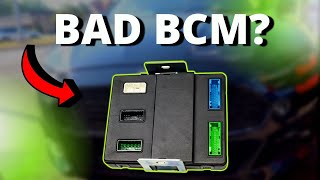
- Body Control Module (BCM) — Located high up inside the dashboard, to the left of the heater blower unit, typically on the passenger side for LHD vehicles. Access is difficult and may require removing the lower dash panel and/or glove box.. If a B3000 code is a misinterpretation of a BCM fault, knowing the module's location is critical for physical inspection (for water damage, corrosion) and for testing its power/ground connections.
- Main Interior Ground Points — A service update for the Global MX-5 Cup car identifies seven critical ground locations to check for corrosion or looseness: Left Rear Strut Tower, Right Rear Strut Tower, and five other points on the factory harness inside the car.. Poor grounding can cause erratic electronic behavior, mimicking a module failure. Cleaning and securing these grounds is a key diagnostic step for any widespread electrical issue.
- GND14 / GND15 — These are specific ground point designators shown in the ND MX-5 wiring diagrams, located in the instrument panel and rear harness areas.. A technician would use a wiring diagram to locate these specific points to perform voltage drop tests to confirm a solid ground for the BCM and related circuits.
OEM Part Supersession History
DB4G-67-560B→DB4G-67-560F— Internal revision or update by the manufacturer.
Heads up: While these parts supersede, any replacement BCM (new, used, or superseded) is NOT plug-and-play. It requires programming to the vehicle's VIN and security system to function and allow the car to start.
Model Year Variations Within This Range
- 2016-2018 (ND1): These early models used an ABS-based indirect tire pressure monitoring system. The suspension tuning and steering rack calibration were also updated in 2017/2018.
- 2019-2020 (ND2): The ND2 refresh brought significant changes. The engine received internal upgrades for more power (181 hp vs 155 hp). The instrument cluster display was updated, and the vehicle switched to a direct TPMS system with sensors in the wheels. These electronic changes could affect diagnostics, though the BCM's core function remains similar.
Helpful Videos


We Have This Part in Stock



The information in this article is provided for general reference and educational purposes only. Vehicle specifications, procedures, and part compatibility can vary by production date, trim level, and region. Always consult your vehicle's factory service manual and verify part numbers before purchasing or performing repairs. Safety-critical components such as airbags, seat belts, and braking systems should be installed by a qualified professional.
- Mazda MX-5:
- 🎬 Helpful Videos
- 🛍️ Shop This Part
- What's Unique About the 2016-2020 Mazda MX-5
- Diagnostic Flowchart
- Symptoms You May Notice
- Most Likely Causes
- Diagnosis Steps
- Parts You'll Likely Need
- Related Codes That Often Appear With This One
- Technical Service Bulletins (TSBs) & Recalls
- Platform-Specific Known Issues
- Mechanic-Grade Diagnostic Values
- Scan Tool Commands That Help
- Wiring & Ground Locations
- OEM Part Supersession History
- Model Year Variations Within This Range
- 🎟️ Get 5% Off