

B2955 on 2015 Chevrolet Colorado: 'Service Theft System' Causes and Fixes
This code indicates a fault in the vehicle's anti-theft immobilizer system. The most common cause is a wiring issue near the ignition's immobilizer module, as noted in a GM Technical Service Bulletin. The fix is often inspecting and securing the harness, but can sometimes require a BCM software update.
- Code B2955 on a 2015 Colorado points to a problem with the anti-theft system's ability to read your key.
- Before replacing any parts, physically inspect the immobilizer wiring harness near the ignition for tension, as this is a very common, well-documented issue with a free fix.
- If the wiring is secure, the next step is to have a dealer check for and apply any available BCM software updates, which is another common, parts-free solution.
- The issue is shared with the 2015 GMC Canyon, so solutions for one apply to the other.
What's Unique About the 2015-2015 Chevrolet COLORADO
For the 2015 Colorado and its twin, the GMC Canyon, this code is specifically addressed by a manufacturer's Technical Service Bulletin (TSB PIT5382D). The TSB points directly to a physical wiring problem where the harness connecting to the immobilizer module (exciter coil) around the ignition lock cylinder may not have enough slack. This tension, often from the factory routing, can cause an intermittent connection, leading to the 'Service Theft System' message and a no-start condition. This is a well-documented issue for this platform, making a physical inspection of this specific harness 🎬 Watch: See how to fix the Service Anti Theft System fault. the primary diagnostic step.
Diagnostic Flowchart
Tap your situation to follow the diagnostic path that matches what you're seeing on this vehicle.
Symptoms You May Notice
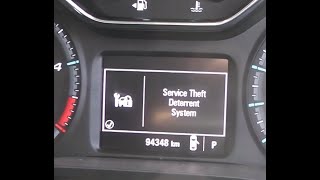
- "Service Theft System" message on the Driver Information Center
- Security indicator light is illuminated or flashing
- Engine does not crank or start (no-click, no-crank)
- Engine starts and immediately stalls
- Intermittent no-start condition, which may seem random or be affected by temperature changes.
- Replacing the Body Control Module (BCM) without first checking for software updates or inspecting the immobilizer harness.
- Replacing the ignition switch when the issue is with the separate immobilizer module or its wiring.
- Replacing the vehicle's main battery, unless it is failing and causing multiple, unrelated electrical problems.
Most Likely Causes
- Immobilizer Harness Connection or Lack of Slack 🔴 High Probability A specific GM Technical Service Bulletin (#PIT5382D) was issued for this exact problem on the 2015 Colorado and GMC Canyon, indicating it's a known manufacturing or design issue where the harness is routed too tightly.
How to confirm: Remove the lower steering column cover (typically held by a few screws). Visually inspect the wiring and connector at the immobilizer module, which is a ring on the ignition lock cylinder housing. Check if the harness is taut, stretched, or kinked.
Typical fix: Disconnect the connector, reposition the harness to create more slack, and securely reconnect it. Some owners add a zip tie to hold the harness in a position with less tension. Repair any wires or terminals if they are visibly damaged.
Est. part cost: $0-$25 - Outdated Body Control Module (BCM) Software 🟡 Medium Probability GM has released software updates to address false circuit faults detected by the BCM on the immobilizer antenna circuits for some 2015 models. TSBs like 16-NA-128 and PI1180A address this for various GM vehicles of the same era, explicitly stating not to replace parts for this condition.
How to confirm: A GM dealer or a shop with access to GM's Service Programming System (SPS) must check the current BCM calibration against the latest available version on TIS2WEB.
Typical fix: Reprogram the Body Control Module (BCM) with the latest software calibration. The TSBs explicitly state not to replace any parts for this condition.
Est. part cost: $0 - Faulty Immobilizer Module (Antenna) ⚪ Low Probability While less common than wiring or software issues, the electronic module itself can fail over time. It is a simple coil and is generally reliable.
How to confirm: After confirming the wiring and software are correct, test the module's circuits according to the service manual. This typically involves checking resistance and voltage at the connector.
Typical fix: Replace the immobilizer module/antenna ring and perform the key relearn procedure.
Est. part cost: $40-$100
Rare But Worth Checking
- Faulty Ignition Key Transponder: The chip inside the key can be damaged or lose its programming. Trying a spare key is a quick and easy way to check for this possibility.
- Faulty Body Control Module (BCM): This is rare and should only be considered after all other possibilities, including wiring and software, have been thoroughly ruled out. Misdiagnosing a BCM is a costly mistake.
- Aftermarket Accessories Causing Interference: A metallic trim ring around the ignition, a large number of other keys, or even a cell phone placed too close to the ignition can sometimes interfere with the RFID signal between the key and the immobilizer antenna. TSB PIT5382D advises verifying no proximity passes or non-GM fobs are on the keyring.
Diagnosis Steps
- Scan the Body Control Module (BCM) for stored trouble codes. Confirm if B2955 is present, and check for B3935 as well.
- Crucial First Step: Inspect the wiring harness and connector at the immobilizer module on the ignition cylinder, as per TSB #PIT5382D. Remove the lower steering column shroud for a clear view. Check for a taut harness, pull on it gently to see if it has any slack, and ensure the connector is fully seated.
- If a spare key is available, try starting the vehicle with it to rule out a faulty key transponder.
- Remove any aftermarket metallic trim or accessories near the ignition. Also, remove all other keys, fobs, or proximity cards from the keyring and try starting with the single ignition key.
- Verify with a dealer or qualified shop if the BCM has the latest software calibration. If not, have the BCM reprogrammed as per TSBs 16-NA-128 or PI1180A.
- If wiring and software are confirmed to be good, perform electrical tests on the immobilizer antenna circuit for proper voltage and resistance according to the factory service manual.
- If all circuit tests are normal, the immobilizer antenna is the likely faulty part and should be replaced.
Parts You'll Likely Need
- Immobilizer Control Module / Antenna
(OEM #23232310)— If wiring and software are ruled out, the antenna that reads the key transponder is the next most likely component to have failed. Note: Some parts databases may incorrectly label this as a 'Steering Column Tilt / Telescope Sensor' or 'Steering Wheel Position Sensor', but it is the correct part for the immobilizer function on this vehicle.
Trusted brands: ACDelco
OEM price range: $60-$110
Aftermarket price range: $40-$80
Related Codes That Often Appear With This One
- B3935 — This code for 'Transponder Authentication Failed' often appears with B2955. TSB PI1180A specifically mentions that when both codes are present on certain GM models, a BCM software update is the required fix for a no-crank, no-start condition.
Technical Service Bulletins (TSBs) & Recalls
- PIT5382D: Addresses a 'Service Theft System' message and DTC B2955 caused by a lack of slack in the immobilizer harness on 2015 Colorado and Canyon models.
- 16-NA-128: Notes that B2955 can be set by a false circuit fault and requires a BCM software update, not parts replacement.
- PI1180A: Pertains to a no-start condition with both B2955 and B3935 set, which is resolved by reprogramming the BCM on various 2014-2015 GM trucks and SUVs.
Platform-Specific Known Issues
- Insufficient Harness Slack (TSB PIT5382D): A known issue documented in TSB #PIT5382D involves insufficient slack in the immobilizer module wiring harness, causing poor connections and intermittent 'Service Theft System' messages. An owner on ColoradoFans.com described their fix: 'I took the bottom cover off the steering column... Sure enough, the wire going to the key cylinder was tight. I unplugged it, pulled some slack through, plugged it back in and zip-tied it. Hasn't happened since.'
- BCM Software Glitch (TSB 16-NA-128): Several TSBs (like 16-NA-128 and PI1180A) indicate that a BCM software glitch can cause this code, sometimes along with B3935. The only fix is a software update, not part replacement. A 2015 GMC Canyon owner on Reddit reported this exact scenario: the dealer found B2955, applied a BCM software update as per the service manual, which resolved the issue temporarily, suggesting a complex interplay between software and potential physical triggers like heat.
Mechanic-Grade Diagnostic Values
- Immobilizer Antenna Low Reference Circuit Resistance — expected: Less than 30 ohms. Failure: A reading greater than 30 ohms indicates an open or high resistance in the ground circuit for the immobilizer antenna.
- Immobilizer Antenna Serial Data Circuit Voltage — expected: 12-13 Volts. Failure: A voltage reading less than 12V suggests a short to ground or an open/high resistance in the data circuit. A reading greater than 13V suggests a short to voltage.
- Immobilizer Antenna B+ Circuit Power — expected: Test lamp illuminates for three seconds. Failure: If the test lamp does not illuminate when connected between terminal 3 (B+) and ground when the ignition is turned ON, it indicates a fault in the power supply circuit to the antenna.
Hidden / Shadow Codes Worth Checking
- B2955 00: This code with a '00' symptom byte (No Additional Information) is commonly associated with a direct failure of the immobilizer antenna itself. (see via A professional scan tool like the GM GDS2/Tech2 is required to view symptom bytes.)
Scan Tool Commands That Help
- GDS2 / SPS: Body Control Module Programming and Setup — This function is required to apply software updates to the BCM. TSBs 16-NA-128 and PI1180A explicitly call for this to fix false circuit faults or no-start conditions where B2955 is set, often with B3935.
- Scan Tool (e.g., GDS2) or Manual Procedure: 30-Minute Key Relearn Procedure — Used to program new keys or reprogram existing keys after replacing the BCM or immobilizer module without access to GM's online Service Programming System (SPS). It involves cycling the ignition on for 10 minutes, three consecutive times.
- GDS2 / SPS: 10-Minute Key Relearn Procedure — A faster method for programming keys when a scan tool with access to GM's Service Programming System (SPS) is available. The scan tool initiates the security programming, which completes in approximately 10 minutes.
Wiring & Ground Locations
- G218 — Driver's side of the instrument panel, behind the dash end cap trim, near the A-pillar.. This is a primary ground for the Body Control Module (BCM) on many GM trucks of this era. A poor connection here, often caused by an insulation mat getting trapped under the ground terminal, can cause numerous electrical faults, including intermittent BCM communication issues that could potentially trigger a B2955 code.
- Immobilizer Antenna Connector — A 3-pin or 6-pin connector plugged into the immobilizer antenna ring around the ignition lock cylinder housing, under the steering column shrouds.. This is the direct connection point for the component that reads the key. TSB PIT5382D identifies a lack of slack in this harness as the primary cause of B2955. Pin 1 is Low Reference (Ground), Pin 2 is Serial Data, and Pin 3 is B+ (Power).
- X51A — The main fuse block for the instrument panel.. This fuse block supplies power to the BCM and related circuits. While not a direct cause, checking relevant fuses here (such as for the BCM) is a basic but essential diagnostic step.
"I Checked Everything" — The Actual Cause
- In cases related to TSB 16-NA-128, a technician can perform full circuit integrity tests on the immobilizer antenna wiring (checking for opens, shorts to ground, and shorts to power) and find no issues. The wiring will test perfectly fine, but the code will persist. The actual cause is a software glitch within the Body Control Module (BCM) that causes it to incorrectly interpret normal circuit values as a fault. The only fix is to reprogram the BCM with updated software, not to replace any physical parts.
OEM Part Supersession History
23232310→No supersession found.
Heads up: This part number for the immobilizer antenna/module is frequently mislabeled in aftermarket and even some OEM parts catalogs as a 'Steering Shaft Torque Sensor' or 'Steering Column Tilt / Telescope Sensor'. This can cause significant confusion when ordering. A technician must verify by application, not just by name, that they are ordering the correct part for the immobilizer system.
Helpful Videos
Used OEM Parts in Stock

New Aftermarket Parts Available



The information in this article is provided for general reference and educational purposes only. Vehicle specifications, procedures, and part compatibility can vary by production date, trim level, and region. Always consult your vehicle's factory service manual and verify part numbers before purchasing or performing repairs. Safety-critical components such as airbags, seat belts, and braking systems should be installed by a qualified professional.
- Chevrolet COLORADO:
- 🎬 Helpful Videos
- 🛍️ Shop This Part
- What's Unique About the 2015-2015 Chevrolet COLORADO
- Diagnostic Flowchart
- Symptoms You May Notice
- Most Likely Causes
- Rare But Worth Checking
- Diagnosis Steps
- Parts You'll Likely Need
- Related Codes That Often Appear With This One
- Technical Service Bulletins (TSBs) & Recalls
- Platform-Specific Known Issues
- Mechanic-Grade Diagnostic Values
- Hidden / Shadow Codes Worth Checking
- Scan Tool Commands That Help
- Wiring & Ground Locations
- "I Checked Everything" — The Actual Cause
- OEM Part Supersession History
- 🎟️ Get 5% Off