

OBD-II Code B2910: Steering Column Lock Fault
What B2910 means, why it triggers, and how to fix it
- Test the 12-volt battery first; a voltage drop below 11.8V during engine crank is the number one cause of B2910 on GM vehicles.
- For 2007-2013 Nissan and Infiniti models, permanently prevent ESCL failure by pulling the 10A 'STEER LOCK' fuse while the engine is running.
- Install a $50-$200 aftermarket steering lock emulator on Mercedes-Benz and Corvette models to bypass the failure-prone mechanical lock entirely.
- Never buy a used steering column lock module for GM or Mercedes vehicles, as they are permanently VIN-locked and cannot be reprogrammed.
- On 2017-2019 Subaru models, B2910 indicates a right-side adaptive headlight communication failure, completely unrelated to the steering lock.
What Does B2910 Mean?

B2910 is a body diagnostic trouble code (DTC) pointing to a vehicle security system failure. On General Motors vehicles, the Steering Column Lock Control Module (SCLCM) detects a password mismatch with the Body Control Module (BCM), preventing the engine from starting. On Nissan and Infiniti vehicles, it indicates a failure of the Electronic Steering Column Lock (ESCL) unit. For Mercedes-Benz, while different codes are used (e.g., A25464), the symptoms of a failed Electronic Steering Lock (ESL) are identical. On Subaru vehicles, this code means something completely different: a communication problem with the right-side Steering Responsive Headlight.
Technical definition: For General Motors, B2910 is 'Steering Column Lock Password Incorrect,' set when the SCLCM password does not match the Instrument Panel Module (IPM) or Remote Control Door Lock Receiver (RCDLR). For Nissan/Infiniti, it points to a malfunction within the ESCL module. For Subaru, it is 'Steering Responsive Headlight Communication RH.'
Can I Drive With B2910?
No — Do Not Drive. This code indicates a critical anti-theft system fault that prevents the engine from starting. If the car does start intermittently, driving risks the lock failing to disengage on your next trip, leaving you stranded without warning. Do not rely on the vehicle until the root cause is resolved.
Common Causes

- Weak or Failing 12-Volt Battery (Very Common) — Low system voltage is the primary cause of this fault on GM vehicles. Control modules are highly sensitive to voltage drops during engine crank. A drop below 11.8 volts corrupts the security handshake process, triggering a password mismatch even if the lock module is perfectly fine.
- Faulty Steering Column Lock Module (SCLCM/ESCL/ESL) (Very Common) — The lock module frequently fails due to internal mechanical wear. The small electric motor burns out, or the internal plastic gears bind and break, preventing the locking pin from retracting. This is the definitive cause for most Nissan, Infiniti, and Mercedes-Benz failures.
- Improperly Programmed Replacement Module (Common) — Security modules are permanently 'married' to the vehicle's VIN. Installing a used module from a salvage yard, or a new module without performing the mandatory dealer-level VIN setup procedure, causes an immediate password mismatch.
- Wiring Harness or Connector Issues (Less Common) — Corrosion or loose pins in the wiring between the SCLCM and the Body Control Module (BCM) interrupt the data network. This prevents the modules from successfully exchanging the security password.
- Aftermarket Remote Starter Interference (Less Common) — Improperly installed aftermarket remote start or alarm systems introduce electrical noise or data conflicts on the CAN bus, blocking the factory anti-theft system's communication pathways.
- Faulty Body Control Module (BCM) (Rare) — The fault occasionally originates in the master module (BCM or IPM) responsible for sending the correct security password to the steering column lock.
Symptoms
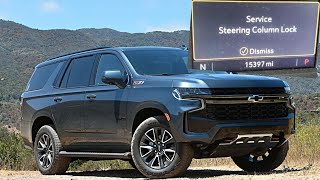
 🎬 Watch: See this warning message on a Chevy Tahoe dashboard." loading="lazy" style="max-width:100%;height:auto;border-radius:6px;display:block;box-shadow:0 2px 8px rgba(0,0,0,0.1);" />
- Engine will not crank or start — The dashboard lights turn on, but the engine does not crank because the anti-theft system disables the starter relay.
- 'Service Steering Column Lock' Message — A direct warning message appears on the driver information center (DIC) or instrument cluster.
- Steering wheel remains locked — The physical lock on the steering column fails to disengage, preventing the steering wheel from turning even with the correct key present.
- Intermittent No-Start Condition — The vehicle fails to start, but works normally after a few attempts or waiting 10 minutes. This always precedes a permanent module failure.
- Solid or Flashing Yellow 'KEY' Light — On Nissan and Infiniti vehicles, a yellow key icon illuminates on the dashboard, signaling an intelligent key system failure tied to the steering lock.
- Adaptive Headlight Malfunction (Subaru only) — On Subaru models, the right-side steering-responsive headlight stops turning with the wheel, and a dash warning light illuminates.
Diagnostic Flowchart
Tap your situation to follow the diagnostic path that matches what you're seeing on this code.
Common Fixes & Costs
- Replace 12-Volt Battery — Parts: $150-$350, Labor: $50-$100, ~0.5 hr book time (DIY)
- Pull 'STEER LOCK' Fuse (Nissan/Infiniti) — Parts: $0, Labor: $0, ~0.1 hr book time (DIY)
- Install Steering Lock Emulator/Bypass Module — Parts: $50-$200, Labor: $100-$200, ~1.0 hr book time (Intermediate)
- Replace Steering Column Lock Module (SCLCM/ESCL)
— Parts: $60-$550, Labor: $250-$600, ~2.5 hr book time
(Professional)
Nissan/Infiniti (Altima, G37, 370Z): OEM 48700-JF00D (Alt: Dorman 601-037)
GM Trucks (2021+ Silverado/Sierra): OEM 13543768 (Alt: ACDelco 13534627) - Reprogram BCM per TSB (2005 Corvette)
— Parts: $20, Labor: $200-$300, ~1.5 hr book time
(Professional)
2005 Chevrolet Corvette: OEM 26046984 (Lock Plate to be removed) (Alt: N/A)
DIY vs Professional
- Replace 12-Volt Battery — Beginner:
Tools: Wrench set, terminal cleaner - Pull 'STEER LOCK' Fuse (Nissan/Infiniti) — Beginner:
Tools: Fuse puller, owner's manual - Install Steering Lock Emulator/Bypass Module — Beginner:
Tools: Trim removal tools, socket set, screwdrivers, flashlight - Replace Steering Column Lock Module (SCLCM/ESCL) — Beginner:
Tools: Extensive tool set, trim tools, J2534 pass-thru programmer.
Used vs. New Parts: Buying Guide
When a used part is worth it: Never. Used steering column lock modules are permanently VIN-locked to the donor vehicle and cannot be reprogrammed for GM or Mercedes-Benz vehicles.
Donor quality checklist:
- Do not buy used modules. Purchase a new OEM module or a high-quality aftermarket emulator.
Decision logic:
- If Vehicle is GM, Cadillac, or Mercedes-Benz → Buy a NEW OEM module and have it professionally programmed, OR install an aftermarket emulator.
- If Vehicle is Nissan/Infiniti and you are stranded → Tap the module to get it unstuck, start the car, and immediately pull the 'STEER LOCK' fuse to permanently disable it.
- If You want a permanent, reliable fix for any affected model → Install a high-quality aftermarket steering lock emulator to bypass the mechanical parts entirely.
Warranty tradeoff: New OEM parts installed by a dealer carry a 12-month/12,000-mile warranty. Aftermarket emulators often include a lifetime warranty.
Worst-case if a used part fails: $600. Installing a used part guarantees failure, forcing you to pay labor twice and buy the correct new part.
What Happens If You Wait — Timeline
- 0-4 weeks: The 'Service Steering Column Lock' message appears once, or the car fails to start on the first try but works normally afterward. (Added cost: $0)
- 1-3 months: The no-start condition becomes intermittent, requiring several key cycles or waiting a few minutes to start. (Added cost: $150 (Cost of a single tow).)
- 3-6 months: Failure happens multiple times a week. Temporary fixes like tapping the steering column become less effective. (Added cost: $300+ (Accumulated costs of multiple tows and lost time).)
- 6+ months: The lock module fails permanently. The vehicle will not start, and the steering wheel is stuck in the locked position. (Added cost: $500-$1200+ (Full cost of repair, plus extra labor to forcibly remove the jammed lock).)
Cost of Not Fixing It
- Immediate: Intermittent no-start conditions leave you stranded without warning. (Added cost: $100-$200 for an emergency tow.)
- 1-3 months: The intermittent failure becomes a permanent no-start condition. The steering wheel locks permanently. (Added cost: Repeated towing costs and lost wages from missed appointments.)
- 6+ months: The vehicle is completely inoperable. If the lock fails in the engaged position, mechanics must cut the steering column to remove it. (Added cost: $300+ in extra labor to extract a permanently jammed lock module.)
Diagnosis Steps
- Load Test the 12-Volt Battery
A weak battery is the number one cause on GM vehicles. Use a battery load tester to confirm its health. A multimeter showing 12.4V resting is not enough; if voltage drops below 11.5V during a crank attempt, replace the battery before diagnosing modules.
Tools: Battery Load Tester, Multimeter (Beginner) - Perform a Hard System Reset
Disconnect the negative battery terminal for 30 minutes to drain residual power from all modules. Reconnect it and attempt to start the vehicle. This frequently clears temporary voltage-induced glitches on newer GM trucks.
Tools: Wrench set (Beginner) - Perform the Physical Actuator 'Tap Test'
If the steering wheel is locked on a Nissan, Infiniti, or Mercedes, locate the black lock module under the steering column. Tap it firmly with a screwdriver handle while attempting to start the car. The vibration often frees a jammed internal motor for one final start.
Tools: Screwdriver or small hammer, Flashlight (Intermediate) - Check Dedicated Steering Lock Fuses
Inspect the fuses powering the anti-theft system. On Nissan/Infiniti models, locate the 10A fuse labeled 'STEER LOCK' in the IPDM (Intelligent Power Distribution Module) near the battery. Replace if blown.
Tools: Fuse puller, Owner's manual (Beginner) - Scan for Accompanying Trouble Codes
Use an advanced OBD-II scanner to read all Body (B) and Network (U) codes. If GM code B1327 (Device Voltage Low) is present, you must fix the power supply issue first. U-codes indicate a broken communication wire.
Tools: Advanced OBD-II Scanner (Intermediate) - Check for Technical Service Bulletins (TSBs)
Search NHTSA or manufacturer databases for TSBs. For the 2005 Corvette, TSB #18-NA-346 dictates a permanent fix by disabling the lock system and reprogramming the BCM, saving you from buying unnecessary parts.
Tools: Online TSB Database (Intermediate) - Analyze Scan Tool Live Data
Navigate to the BCM or SCLCM data stream. Check the 'SCLCM Password Match Status' PID. If it reads 'Mismatch' or 'No', the security handshake is failing. Check the 'Steering Column Lock Status' to see if the computer thinks it is locked or unlocked.
Tools: Advanced OBD-II Scanner with Live Data (Advanced) - Perform Voltage Drop Test at SCLCM Connector
On GM vehicles, test the positive and negative battery cables under load. Voltage drop must not exceed 100 mV on the positive side or 200 mV on the negative side during a crank. High resistance in the cables causes the B2910 module dropout.
Tools: Digital Multimeter (DMM) (Advanced) - Inspect the SCLCM Wiring Harness
Remove the plastic shrouds around the steering column. Visually inspect the wiring harness and connector at the lock module for chafed wires, loose pins, or green corrosion.
Tools: Trim removal tools, Screwdriver set, Flashlight (Intermediate) - Perform Module Setup and VIN Programming
If replacing the SCLCM, you must program the new module. Connect a J2534 pass-thru device, log into the manufacturer's programming software (e.g., GM SPS2), and execute the VIN security link procedure. The vehicle will not start without this step.
Tools: J2534 Pass-Thru Device, OEM Programming Subscription, Battery Maintainer (Advanced)
When This Code Triggers (Freeze-Frame Conditions)
- Ignition Status: On/Crank Request (The fault sets during the startup sequence when the driver presses the start button.)
- Module Voltage: < 11.5V (Triggers when SCLCM voltage drops during engine crank, corrupting the data transfer.)
- Vehicle Speed: 0 mph (This is strictly a startup fault; it does not occur when the vehicle is in motion.)
- Security Handshake: Failed/Password Mismatch (The SCLCM fails to validate the security password from the BCM.)
Related Codes
- B1327 / B1328 — GM codes for 'Device Voltage Low/High'. Service manuals mandate fixing B1327 before addressing B2910. A voltage drop below 9.5 volts triggers the B2910 password mismatch.
- U0100, U0140, U1000 — U-codes indicate a communication loss on the CAN bus network. If present alongside B2910, diagnose the U-code first, as the lock module cannot receive its password if the network is down.
- B2911 — On Subaru vehicles, B2911 indicates a communication fault with the LEFT-side Steering Responsive Headlight, acting as the companion code to B2910.
- A25464, 9003, 9005 — Mercedes-specific codes indicating a fault within the Electronic Steering Lock (ESL). They produce the exact same no-start symptoms as B2910.
Climate & Environmental Factors
- Low Temperatures: Cold weather significantly reduces battery cranking amperage. This makes the voltage-sensitive GM B2910 fault highly prevalent in winter, as borderline batteries drop below the 11.8V threshold during cold starts.
- High Humidity: Sustained high humidity promotes moisture intrusion and green corrosion on the electrical connectors for the SCLCM, leading to high resistance and communication dropouts.
How to Talk to a Mechanic About This Code
Say this: "I have a [Vehicle Make/Model] with a no-start condition and a 'Service Steering Column Lock' message, indicating code B2910. Before assuming it's the lock module, I authorize one hour of diagnostic time to load test the battery and check for manufacturer TSBs related to the steering column lock for my VIN."
This proves you understand the cheapest causes (battery, software updates) and directs the shop to perform high-value diagnostic steps first, preventing them from immediately quoting an expensive module replacement.
Avoid saying:
- 'My car won't start, can you fix it?'
- 'The steering wheel is locked, I think something is broken.'
- 'Just do whatever it takes to get it running again.'
Questions to ask before authorizing the repair:
- Did the battery pass a loaded test, and what was its voltage during a crank?
- Is there a TSB for this issue recommending a software update instead of a full module replacement?
- Does the quoted price for the new module include the mandatory VIN programming and setup procedure?
- Are you proposing a new OEM part or an aftermarket emulator? What is the warranty on both?
- For a Nissan/Infiniti, will you perform the option of pulling the steering lock fuse as a permanent fix?
Where to Take It: Dealer vs Independent vs Chain
- Dealer:
Safest and most reliable option. Essential for TSB-related software flashes and guaranteed VIN programming.
Best for: Vehicles under warranty, Executing manufacturer-specific TSBs (like the 2005 Corvette fix), Owners who prioritize a guaranteed fix with OEM parts
Downsides: Highest labor rates, Unwilling to install aftermarket emulators or perform non-standard fixes like pulling a fuse (Typical cost: +50% vs. baseline) - Independent Shop:
Best choice for value. Ask directly: 'Can you program a new steering column lock module for a [Your Make]?' If they hesitate, go to the dealer.
Best for: Out-of-warranty vehicles where cost is a major factor, Installing aftermarket emulators or performing well-documented fixes (like the Nissan fuse pull)
Downsides: MUST verify the shop has a J2534 pass-thru device capable of security module programming. (Typical cost: +0% vs. baseline) - Chain Shop:
AVOID for diagnosis. Only use if you have already confirmed the battery is the sole problem.
Best for: Simple battery replacement if you are certain that is the cause.
Downsides: Lack the required tools to diagnose body codes or program security modules., High risk of misdiagnosis. (Typical cost: -10% vs. baseline)
When to Walk Away From the Repair
If the estimated repair cost exceeds 50% of the car's private-party value, consider not fixing it. For older (10+ years) or high-mileage (150k+) cars, a lower threshold of 30-40% is appropriate.
- Car worth $3500, fix is $1500: Walk away. The repair cost is 43% of the car's value. It is not financially sound to invest this much into an older vehicle.
- Car worth $35000, fix is $1200: Fix it. The repair cost is less than 4% of the vehicle's value.
- Car worth $6000, fix is $750: Fix it, especially if using an emulator or a lower-cost independent shop fix. The cost is only 12.5% of the car's value.
What Scan Tool You Need for This Code
Minimum: A scanner that reads and clears codes from the Body Control Module (BCM) and views live data. Basic $20 readers that only handle engine codes (P-codes) are useless for B2910.
B2910 is a Body (B) code, invisible to basic engine code readers. Repairing this code requires a tool with programming or special 'relearn' functions.
Budget: THINKCAR ThinkDiag2 (~$99) — Connects to a smartphone app to read B-codes and view live data from the BCM. Sufficient for initial diagnosis but cannot program a new module.
Mid-range: Foxwell NT510 Elite (~$150) — Provides full system diagnostics to read/clear B-codes. Crucially, it performs special functions like the 'Security Relearn' procedure required after a new module is installed on many vehicles.
Professional: Autel MaxiSys MS906Pro (~$1200) — Offers full bidirectional control and J2534 pass-thru capabilities. Allows the tool, with a manufacturer subscription, to perform OEM-level module programming required for GM and Mercedes vehicles.
Rent vs buy: Buy. Free loaner tools at auto parts stores are basic engine code readers that cannot diagnose a B2910 code. To program a module, you must buy a professional-level tool or pay a shop.
How to Clear the Code After You Fix It
- Use a J2534 pass-thru device to perform the 'Module Setup' or 'VIN Relearn' procedure if a new module was installed.
- Use an advanced scan tool to clear the B2910 code from the Body Control Module.
- Cycle the ignition off, wait 1 minute, then start the vehicle to verify the 'Service Steering Column Lock' message is gone.
Drive cycle (~5 minutes): A drive cycle is not required. The B2910 code status is evaluated immediately at every startup attempt.
Readiness monitors affected: None. B2910 is a Body (B) code and does not affect emissions readiness monitors.
Watch out for:
- Clearing the code with a basic scanner fails instantly; the code returns on the next start attempt if the hardware or programming fault remains.
- Skipping the mandatory 'Module Setup' procedure after replacing the SCLCM guarantees a permanent no-start condition.
Will This Fail Emissions / State Inspection?
No — by itself this code doesn't fail OBD inspection (but it can keep readiness monitors from setting, which causes a separate fail).
- All States: While B2910 does not affect emissions monitors, it causes a practical inspection failure. If the vehicle will not start, the inspection cannot be performed.
- New York: The NYS safety inspection requires proper operation of the starting system. A no-crank condition or an illuminated security warning light results in an automatic failure.
Most Commonly Affected Vehicles
- Chevrolet Silverado, Tahoe, Suburban (2021-2024) — Extremely common on newer GM trucks. Triggered almost exclusively by a weak 12V battery dropping voltage during crank. A battery reset provides a temporary fix.
- Nissan / Infiniti Altima, Maxima, G35, G37, 370Z (2007-2013) — Suffer from a near 100% failure rate of the mechanical ESCL module. Pulling the steering lock fuse while the car is running is the standard permanent fix.
- Mercedes-Benz C-Class (W204), E-Class (W212), GLK (X204) (2008-2015) — Notorious for Electronic Steering Lock (ESL) failure, presenting identical no-crank symptoms. Installing an aftermarket emulator is the most cost-effective repair.
- Chevrolet Corvette (C6) (2005-2005) — Exclusive to the 2005 manual transmission model. The permanent fix is TSB #18-NA-346, which removes the lock plate and reprograms the BCM.
- Subaru Forester, Outback, Crosstrek (2017-2019) — B2910 indicates a communication fault with the right-side Steering Responsive Headlight, completely unrelated to the steering lock. See TSB 07-137-18.
Manufacturer-Specific Notes

- General Motors: The root cause is rarely a failed module on modern trucks; it is almost always a weak 12-volt battery. Replacement SCLCMs must be brand new; used modules cannot be reprogrammed to a new VIN.
- Nissan / Infiniti: The ESCL module failure is so prevalent that Nissan issued a warranty extension (now expired). The accepted enthusiast fix is to start the car and pull the 10A 'STEER LOCK' fuse, disabling the system permanently.
- Mercedes-Benz: ESL failure is considered a 'when, not if' problem. A tell-tale sign of impending failure is the absence of the distinct 'buzz-click' sound when inserting the key. Emulators are the standard repair.
- Subaru: Code B2910 has zero connection to the steering column. It exclusively flags a communication error with the passenger-side adaptive headlight per TSB 07-137-18.
Real Owner Stories
2022 Chevy Silverado owner resolves intermittent no-start with a new battery.
A 2022 Silverado with 30,000 miles exhibited intermittent no-start conditions. The dash illuminated, the 'Service Steering Column Lock' message appeared, but the engine wouldn't crank.
What they tried:
- The owner performed a hard reset by disconnecting the negative battery terminal for 30 minutes, temporarily resolving the issue.
- When the problem returned, the dealer diagnosed a faulty lock module but also noted the battery failed a load test.
Outcome: The dealer replaced the 12-volt battery under warranty. The B2910 code never returned, proving the lock module was perfectly fine.
Lesson: On modern GM trucks, always load-test the battery first. A system reset gets you to a shop, but a weak battery is the true root cause.
2009 Nissan Altima owner permanently fixes ESCL failure for $0.
A 2009 Altima failed to start in a parking lot. The yellow 'KEY' light illuminated, the brake pedal was hard, and the car refused to crank.
What they tried:
- The owner tapped the black ESCL box on the steering column with a hammer, vibrating the jammed motor free and allowing one final start.
- With the engine running and the steering unlocked, they removed the 10A 'STEER LOCK' fuse from the IPDM fuse box.
Outcome: Pulling the fuse permanently disabled the electronic steering lock. The car has started reliably for over a year with zero parts cost.
Lesson: For Nissan/Infiniti models, the 'fuse pull' is the ultimate free fix. You must get the car started one last time to unlock the wheel before pulling the fuse.
2005 Corvette owner utilizes official GM TSB to disable the lock.
A 2005 manual Corvette owner experienced a no-start condition after an aftermarket column lock eliminator failed.
What they tried:
- The owner discovered GM's permanent fix via Technical Service Bulletin #18-NA-346.
- They took the car to a Chevrolet dealer to execute the TSB.
Outcome: The dealer removed the physical lock plate and reprogrammed the Body Control Module (BCM) to disable the function entirely. The dealer charged $150 for labor and programming.
Lesson: The official TSB is the most reliable solution for the 2005 C6 Corvette. It is cheaper than replacing the lock assembly and more robust than third-party eliminators.
2010 Mercedes C300 owner bypasses failed ESL with an emulator.
A C300 owner noticed the car occasionally failed to start, and the distinct 'buzz-click' of the steering lock disengaging was missing. The car eventually died completely in their garage.
What they tried:
- They confirmed the Electronic Steering Lock (ESL) failed in the unlocked position, avoiding the need to cut the steering column.
- They ordered a $150 ESL emulator online and mailed their Electronic Ignition Switch (EIS) and key to the vendor for programming.
Outcome: The owner plugged in the programmed emulator, and the car started immediately. Total cost was under $200, avoiding a $1,200 dealer repair.
Lesson: For Mercedes, an emulator is the most cost-effective permanent fix. Replace the ESL with an emulator at the first sign of intermittent failure to avoid getting stranded.
How to Prevent This Code From Triggering
- Maintain 12-Volt Battery Health (Ongoing) — On GM vehicles, low system voltage during engine crank is the primary cause of the B2910 security handshake failure. A healthy battery prevents this voltage drop.
- Proactively Pull the Fuse (Nissan/Infiniti) (Once, preventatively) — The ESCL module on 2007-2013 Nissan/Infiniti models has an extremely high failure rate. Pulling the 10A 'STEER LOCK' fuse while the car is running permanently disables the lock, preventing future failure.
- Install an Emulator (Mercedes-Benz) (Once, preventatively) — The motor in the Mercedes ESL is a wear-and-tear item. Replacing the mechanical lock with an electronic emulator before it fails saves you from being stranded.
- Avoid Forcing the Steering Wheel When Parked (Daily habit) — Applying pressure to the steering wheel after the car is off forces the lock pin against the column, accelerating mechanical wear on the internal motor.
Frequently Asked Questions
What is the most common misdiagnosis for B2910?
The most expensive mistake is replacing the Steering Column Lock Module without load-testing the 12-volt battery first. A weak battery is the leading cause of this code on GM vehicles. Always verify system voltage during engine crank before buying parts.
Can I install a steering column lock bypass module?
Yes. Aftermarket 'emulators' are widely available for Corvettes, Nissan/Infiniti, and Mercedes-Benz models. They plug into the factory wiring and mimic a functioning lock, providing a permanent fix that bypasses the failure-prone mechanical gears.
Can hitting the steering column fix the problem?
Yes, as a temporary emergency measure. If the internal motor is jammed, firmly tapping the lock module under the steering column while turning the key vibrates the motor free, allowing one final start.
Is there a recall for the B2910 steering column lock issue?
Generally, no. Manufacturers address this with Technical Service Bulletins (TSBs) or limited-time warranties, like the expired Nissan ESCL extension. The 2005 Corvette TSB (#18-NA-346) is a notable example where dealers reprogram the BCM to disable the lock.
Can the steering lock engage while I'm driving?
It is extremely rare for the lock to engage while in motion. The B2910 fault specifically triggers when the lock fails to disengage during the startup sequence.
Why did my car show this message after a jump-start?
Jump-starts introduce severe voltage fluctuations. Sensitive security modules interpret this as a fault, corrupting the security handshake and triggering the B2910 code.
Can I replace the Steering Column Lock Module myself?
Physical installation is possible, but the vehicle will not start until the new module is programmed to the VIN. This requires a J2534 pass-thru device and an OEM software subscription.
My Subaru has code B2910. Is my steering going to lock up?
No. On Subarus, B2910 indicates a problem with your right-side adaptive headlight. Your car will start and drive normally, but the headlight will not turn with the steering wheel.
Key Takeaways
- Test the 12-volt battery first; a voltage drop below 11.8V during engine crank is the number one cause of B2910 on GM vehicles.
- For 2007-2013 Nissan and Infiniti models, permanently prevent ESCL failure by pulling the 10A 'STEER LOCK' fuse while the engine is running.
- Install a $50-$200 aftermarket steering lock emulator on Mercedes-Benz and Corvette models to bypass the failure-prone mechanical lock entirely.
- Never buy a used steering column lock module for GM or Mercedes vehicles, as they are permanently VIN-locked and cannot be reprogrammed.
- On 2017-2019 Subaru models, B2910 indicates a right-side adaptive headlight communication failure, completely unrelated to the steering lock.
Helpful Videos

The information in this article is provided for general reference and educational purposes only. Vehicle specifications, procedures, and part compatibility can vary by production date, trim level, and region. Always consult your vehicle's factory service manual and verify part numbers before purchasing or performing repairs. Safety-critical components such as airbags, seat belts, and braking systems should be installed by a qualified professional.
- 🎬 Helpful Videos
- What Does B2910 Mean?
- Can I Drive With B2910?
- Common Causes
- Symptoms
- Diagnostic Flowchart
- Common Fixes & Costs
- DIY vs Professional
- Used vs. New Parts: Buying Guide
- What Happens If You Wait — Timeline
- Cost of Not Fixing It
- Diagnosis Steps
- When This Code Triggers (Freeze-Frame Conditions)
- Related Codes
- Climate & Environmental Factors
- How to Talk to a Mechanic About This Code
- Where to Take It: Dealer vs Independent vs Chain
- When to Walk Away From the Repair
- What Scan Tool You Need for This Code
- How to Clear the Code After You Fix It
- Will This Fail Emissions / State Inspection?
- Most Commonly Affected Vehicles
- Manufacturer-Specific Notes
- Real Owner Stories
- 2022 Chevy Silverado owner resolves intermittent no-start with a new battery.
- 2009 Nissan Altima owner permanently fixes ESCL failure for $0.
- 2005 Corvette owner utilizes official GM TSB to disable the lock.
- 2010 Mercedes C300 owner bypasses failed ESL with an emulator.
- How to Prevent This Code From Triggering
- Frequently Asked Questions
- What is the most common misdiagnosis for B2910?
- Can I install a steering column lock bypass module?
- Can hitting the steering column fix the problem?
- Is there a recall for the B2910 steering column lock issue?
- Can the steering lock engage while I'm driving?
- Why did my car show this message after a jump-start?
- Can I replace the Steering Column Lock Module myself?
- My Subaru has code B2910. Is my steering going to lock up?
- Key Takeaways
- 🎟️ Get 5% Off