

OBD-II Code B2699: Right Headlamp Control Circuit Fault
The Ultimate Guide to What B2699 Means, Why It Triggers, and How to Fix It
- On 2014-2019 GM trucks, B2699 is almost always caused by an incompatible aftermarket snowplow module, requiring a $150-$350 updated isolation harness to fix.
- Swap the right and left low-beam bulbs as your first diagnostic step; if the problem moves to the left side, you simply need a $20-$60 replacement bulb.
- For 2015-2020 Cadillac Escalades, moisture inside the lens guarantees internal circuit failure, requiring a complete $1,000+ headlight assembly replacement.
- Never authorize a $500-$1,200 Body Control Module (BCM) replacement until a shop definitively rules out the bulb, wiring grounds, and HID ballasts using a bi-directional scan tool.
What Does B2699 Mean?

Code B2699 signifies the Body Control Module (BCM) detected a critical electrical fault in the right-side (passenger-side) low-beam headlight circuit. This fault is an open circuit (broken wire or burnt bulb), a short to ground (power wire touching the frame), or a short to power (circuit receiving unintended voltage). Upon detection, the BCM instantly disables power to that circuit to protect its internal drivers.
Technical definition: The SAE/ISO definition for B2699 is "Right Headlamp Control Circuit Open/Short." The BCM continuously monitors voltage and resistance on the right headlamp control circuit. When values fall outside the predetermined range—such as near-zero resistance (short to ground) or infinite resistance (open circuit)—the BCM sets DTC B2699 and deactivates the circuit.
Can I Drive With B2699?
Yes, But With Caution. You can drive during daylight hours, but it is unsafe and illegal to operate a vehicle at night or in poor visibility with a non-functioning headlight. This poses a significant safety risk and results in a traffic citation. Continuing to operate the vehicle with an intermittent electrical fault also stresses the Body Control Module (BCM).
Common Causes

- Faulty or Incompatible Aftermarket Snowplow Wiring (Very Common) — On 2014-2019 GM trucks, this is the primary cause. The BCM's diagnostic check is extremely fast; if the snowplow's headlight module responds too slowly, the BCM misinterprets the delay as a short circuit. GM TSBs confirm this is an aftermarket equipment issue, not a truck defect.
- Burnt-Out Headlight Bulb (Common) — A broken halogen or HID bulb filament creates a perfect open circuit. The BCM detects zero current flow despite commanding the light on and flags a fault.
- Damaged Wiring or Poor Connection (Common) — The headlight wiring harness is exposed to heat, moisture, and vibration. This leads to melted connectors, corroded pins (green/white powder), or chafed wires shorting to the chassis.
- Faulty HID Headlight Ballast or Igniter (Common) — The HID ballast is a high-voltage power supply that ignites the bulb. Ballasts fail intermittently, often becoming temperature-sensitive and causing the headlight to flicker or fail when cold.
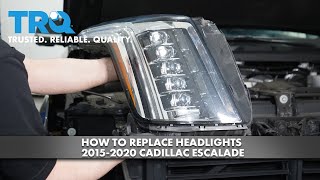
- Internal Headlight Assembly Failure (Moisture Intrusion) (Common) — On modern vehicles with sealed LED/HID units (e.g., Cadillac Escalade), failed seals allow moisture inside. Water corrodes internal circuit boards and shorts LED drivers, requiring complete assembly replacement. 🎬 Watch: How to replace the full headlight assembly on an Escalade.
- Blown Fuse (Less Common) — A blown fuse in the under-hood or interior panel severs power to the BCM's monitoring circuit, triggering the code.
- Incorrect Bulb Type Installed (Less Common) — Installing a standard halogen in an HID system, or an aftermarket LED without proper resistance, confuses the BCM. The module expects a specific current draw and interprets the variance as a fault.
- Faulty Body Control Module (BCM) (Rare) — The BCM sets the code but rarely causes the failure. Only consider replacing the BCM after exhaustively testing the bulb, ballast, wiring, and aftermarket accessories.
Symptoms

- Right low-beam headlight does not work — The right-side (passenger) low-beam headlight fails to illuminate when commanded on.
- Right headlight flickers or fails in cold weather — A loose connection or failing HID ballast causes the headlight to work sporadically, often failing only when temperatures drop.
- Warning message on the dashboard — The driver information center displays "Service Headlamp System" or a general service vehicle icon.
- Right headlight stays on constantly — In a 'Short to Power' scenario, the control circuit receives constant voltage, causing the headlight to remain illuminated even when the switch is off.
- High-beam works but low-beam does not — Because high and low beams utilize separate circuits, the B2699 code frequently appears for a failed low-beam while the high-beam functions perfectly.
Diagnostic Flowchart
Tap your situation to follow the diagnostic path that matches what you're seeing on this code.
Common Fixes & Costs
- Repair or Replace Snowplow Headlight Module
— Parts: $150-$350, Labor: $150-$400, ~1.5 hr book time
(Professional)
2014-2019 GM Trucks: OEM - Replace Headlight Bulb
— Parts: $20-$120, Labor: $25-$150, ~0.8 hr book time
(DIY)
2014-2019 Chevrolet Silverado: OEM - Repair Damaged Wiring or Replace Connector
— Parts: $10-$60, Labor: $150-$600, ~2.5 hr book time
(Intermediate)
General Purpose: OEM - Replace HID Ballast/Igniter
— Parts: $100-$300, Labor: $150-$450, ~2 hr book time
(Intermediate)
GM Vehicles (Equinox, SRX): OEM - Replace Complete Headlight Assembly
— Parts: $400-$1600, Labor: $250-$500, ~2.5 hr book time
(Professional)
2015-2020 Cadillac Escalade: OEM - Replace Body Control Module (BCM)
— Parts: $300-$800, Labor: $150-$350, ~1.5 hr book time
(Professional)
2016 Chevrolet Silverado: OEM
Used vs. New Parts: Buying Guide
When a used part is worth it: For $1,000+ sealed assemblies (e.g., Escalade), a used OEM unit saves money and fits better than cheap aftermarket options.
Donor-vehicle mileage cap: roughly under 60000 miles for the part to have meaningful remaining life.
Donor quality checklist:
- Verify exact part numbers.
- Inspect for clear lenses and intact tabs.
- Never buy used HID ballasts.
Decision logic:
- If The failed part is a halogen bulb or a wiring pigtail → Always buy new.
- If The failed part is a complete OEM LED/HID assembly costing over $800 → A used OEM part from a reputable salvage yard is a good option.
- If The failed part is an HID ballast → Favor a new OEM or high-quality aftermarket part.
Warranty tradeoff: Salvage yards offer 30-90 days. New aftermarket offers 1-year to lifetime. New OEM carries a 1-2 year warranty.
Worst-case if a used part fails: $300-$600 if a used assembly fails prematurely, requiring repeat labor.
What Happens If You Wait — Timeline
- Immediate: BCM detects fault, sets B2699, and disables the right low-beam. (MPG impact: 0%% · Added cost: $25-$240)
- 1-3 Months: Repeatedly triggering the protective circuit stresses the BCM's Field Effect Transistor (FET). (MPG impact: 0%% · Added cost: $0)
- 3-6 Months: Moisture inside the assembly corrodes circuit boards, guaranteeing complete unit failure. (MPG impact: 0%% · Added cost: $800-$1800)
- 6+ Months (Worst Case): A persistent high-current short overheats the FET, permanently destroying the BCM's headlight driver. (MPG impact: 0%% · Added cost: $500-$1200)
Cost of Not Fixing It
- Immediate: Traffic citation for inoperative headlight. (Added cost: $25-$240)
- 0-3 Months: Reduced visibility at night. Constant cycling of a shorted circuit stresses the BCM's internal driver. (Added cost: 0)
- 3+ Months: A persistent short to ground overheats the BCM's output driver, destroying the module. (Added cost: $500-$1200)
Diagnosis Steps

- Check for Aftermarket Equipment (Snowplows)
If your GM truck has a snowplow, disconnect the main electrical harness for the snowplow completely. Clear the B2699 code and cycle the headlights. If the code does not return, the fault is entirely within the snowplow's wiring module.
Tools: OBD-II Scan Tool (Beginner) - Swap the Headlight Bulbs
Swap the right (non-working) low-beam bulb with the known-good left bulb. If the problem moves to the left side, the bulb is burnt out. Wear gloves to avoid touching the glass of halogen or HID bulbs.
Tools: Gloves, basic hand tools (Beginner) - Inspect the Wiring Connector and Ground Point
Unplug the main connector from the headlight assembly. Look for melted plastic, green/white corrosion on the pins, or loose wires. Locate the chassis ground wire (usually bolted to the frame near the headlight) and ensure it is clean and tight.
Tools: Flashlight, basic hand tools (Intermediate) - Inspect Fuses for the Right Headlight
Locate the specific fuses for the 'Right Low-Beam Headlamp' in the under-hood or in-cabin fuse boxes. Pull each fuse and visually inspect for a broken filament.
Tools: Fuse puller or needle-nose pliers (Beginner) - [PRO TIP] Use a Test Light for a Quick Circuit Check
With the headlight unplugged and ignition on, connect a 12V test light to a known good ground. Probe the power pin in the connector while a helper toggles the headlight switch. If the light toggles, the BCM power supply is good. If it stays off, there is an open circuit. If it stays on constantly, there is a short to power.
Tools: 12V Test Light (Intermediate) - [ADVANCED] Perform Multimeter Tests Based on Suffix Code
For '04 Open Circuit': Check ground wire resistance to chassis (must be < 5 ohms). For '02 Short to Ground': With key off, check continuity between the control wire and ground (must read 'OL' infinite resistance). For '01 Short to Power': With key on/lights off, check voltage on the control wire (must be < 1 volt).
Tools: Digital Multimeter (Advanced) - [ADVANCED] Scan Tool Bi-Directional Control
Use a professional scan tool to manually command the 'Right Low Beam Headlamp' ON. If the headlight works via the scanner, the BCM driver, wiring, and bulb are functional, pointing to a faulty headlight switch. If it fails, the fault is in the output circuit or BCM.
Tools: Bi-directional Scan Tool (Advanced) - Perform a Parasitic Draw Test
If a short is draining the battery, disconnect the negative terminal and connect a multimeter in series (Amps). Wait 30 minutes for modules to sleep. If draw exceeds 50mA, pull headlight fuses one by one until the amperage drops to identify the shorted circuit.
Tools: Digital Multimeter with Amp setting (Advanced)
When This Code Triggers (Freeze-Frame Conditions)
- Ignition Status: ON (The BCM performs circuit checks when the ignition turns on.)
- Headlight Switch Command: ON (The fault is detected the exact millisecond the BCM sends power to the circuit.)
- System Voltage: 9-16 Volts (The BCM requires normal voltage to run diagnostics.)
- Fault Time: < 1 second (Circuit protection is instantaneous; the BCM disables the output immediately upon detecting a short.)
Related Codes
- B2575 — Identical fault for the left headlamp. Seeing both simultaneously strongly suggests an incompatible aftermarket snowplow module.
- B2699 01 / 02 / 04 — Critical symptom bytes: 01 is Short to Battery, 02 is Short to Ground, 04 is Open Circuit. These dictate the exact electrical test required.
- U0140 — Loss of Communication With BCM. A severe headlight circuit short disrupts the entire CAN bus network.
- B3445 — Right High Beam Circuit Fault. Appearing with B2699 points to a shared ground or total assembly failure.
Climate & Environmental Factors
- Cold Weather: Cold temperatures cause aging HID ballasts to fail. The ballast struggles to generate the 23,000V ignition voltage, resulting in flickering or complete failure.
- High Humidity / Rain: Rain leads to moisture intrusion in sealed assemblies (e.g., Escalade). Water pools inside, shorting internal LED drivers and triggering B2699.
- Heat Cycling: Thermal cycling makes plastic connectors brittle and causes wires to expand and contract. This creates loose pin connections and intermittent open circuits.
How to Talk to a Mechanic About This Code
Say this: "I have a B2699 code on my [Vehicle Year, Make, Model] and the right headlight is out. Based on my research, the most common causes are the bulb, wiring, ballast, or aftermarket accessories, not the BCM. Can you start by testing those things first?"
This signals you are an informed customer. It directs the technician to follow a logical diagnostic path and prevents them from immediately quoting an expensive Body Control Module (BCM) replacement.
Avoid saying:
- 'My headlight's out, can you fix it?'
- 'My truck is telling me code B2699.'
- 'A guy online said it's probably the BCM.'
Questions to ask before authorizing the repair:
- If my truck has a snowplow, did you disconnect its harness completely to see if the fault cleared?
- Did you swap the bulbs side-to-side to rule out a simple bulb failure?
- If you are recommending a new headlight assembly, can you show me the evidence of moisture intrusion?
- Before replacing the BCM, can you show me the test results proving the wiring and HID ballast are good?
- Will you provide me with the old parts you are replacing?
Where to Take It: Dealer vs Independent vs Chain
- Dealer:
Recommended for high-tech, under-warranty, or confirmed BCM failures.
Best for: Vehicles under warranty, Complex repairs on newer models with sealed headlight assemblies, When a BCM replacement and programming is confirmed
Downsides: Highest labor rates and OEM part costs., May misdiagnose issues caused by aftermarket snowplows., Defaults to replacing entire assemblies rather than wiring repairs. (Typical cost: +50% vs. baseline) - Independent Shop:
Best fit for most B2699 scenarios. Find a shop specializing in electrical issues.
Best for: Out-of-warranty vehicles., Diagnosing common failures like bad bulbs, wiring, or HID ballasts., Shops with good reviews for electrical diagnostics.
Downsides: Quality varies greatly., May lack tools to program a new BCM. (Typical cost: +0% vs. baseline) - Chain Shop:
AVOID. This code requires specific diagnostic expertise beyond the scope of a typical chain shop.
Best for: Selling you a new headlight bulb.
Downsides: Technicians lack the advanced electrical diagnostic skills needed for BCM codes., High pressure to upsell unnecessary services., Very likely to misdiagnose the issue. (Typical cost: -10% vs. baseline)
When to Walk Away From the Repair
If the estimated repair cost exceeds 50% of your vehicle's current private-party value, consider selling or trading it in instead of repairing it.
- Car worth $21000, fix is $2200: Fix it. A $2,200 repair for a failed headlight assembly on a 2017 GMC Sierra is high, but well below the walk-away threshold.
- Car worth $4000, fix is $2200: Walk away. The repair cost is over 50% of the vehicle's value.
- Car worth $8000, fix is $400: Fix it. A $400 repair for a wiring issue or HID ballast makes complete sense.
What Scan Tool You Need for This Code
Minimum: A scanner that reads Body Control Module (BCM) codes. Basic engine-only readers will NOT see B-codes.
A $20 scanner only checks the Engine Control Module (ECM). This code lives in the BCM, requiring a tool that communicates with it.
Budget: BlueDriver Pro (~$100) — Reads and clears BCM codes via smartphone.
Mid-range: FOXWELL NT510 Elite / XTOOL InPlus IP508 (~$150) — Offers bi-directional control to manually command the headlight ON, verifying the BCM driver.
Professional: Autel MaxiCOM MK808S (~$450-900) — Displays 2-digit symptom bytes (e.g., '02' for short to ground) and programs new BCMs.
Rent vs buy: Parts stores loan basic scanners that CANNOT read BCM codes. You must buy a capable scanner or pay for professional diagnosis.
How to Clear the Code After You Fix It
- Fix the underlying electrical fault (e.g., replace bulb, repair wiring).
- Reconnect any disconnected components, including the battery.
- Use a compatible OBD-II scan tool to connect to the BCM and select 'Clear DTCs'.
- Cycle the ignition off, then on, and activate the headlights to confirm the repair.
Drive cycle (~10 minutes): A complex drive cycle is unnecessary. The BCM re-runs its check upon the next headlight activation.
Readiness monitors affected: Not applicable
Watch out for:
- Disconnecting the battery rarely clears BCM memory.
- If the root cause is not repaired, the code returns immediately upon headlight activation.
- Basic code readers cannot access or clear B-codes stored in the BCM.
Will This Fail Emissions / State Inspection?
No — by itself this code doesn't fail OBD inspection (but it can keep readiness monitors from setting, which causes a separate fail).
- California: Fails the Vehicle Safety Systems Inspection required for revived salvage vehicles. Results in a fix-it ticket.
- New York: Automatic failure of the annual safety inspection. All exterior lamps must function.
- Texas: Fails commercial vehicle inspections and violates the Texas Transportation Code, resulting in citations.
Most Commonly Affected Vehicles
- Chevrolet Silverado 1500/2500/3500 (2014-2019) — Extremely common due to aftermarket snowplow wiring. Documented in GM TSB PIT5412D.
- GMC Sierra 1500/2500/3500 (2014-2019) — Identical to Silverado; shares the ultra-sensitive BCM noted in GM Upfitter Bulletin #116.
- Cadillac Escalade (2015-2020) — Code points to sealed LED headlight failure from moisture intrusion (TSB #PIT5487F). Requires expensive bumper-off replacement.
- Chevrolet Equinox (2018-2022) — Common on HID models. Faulty ballasts become temperature-sensitive, failing in cold weather.
- Cadillac SRX (2010-2016) — Prone to HID ballast failures and connector corrosion. Covered under special GM moisture reimbursement programs.
- Chevrolet Tahoe (2015-2020) — Shares K2XX electrical architecture with Silverado; suffers similar BCM lighting faults.
- GMC Yukon (2015-2020) — GMC counterpart to Tahoe. Sealed assemblies fail, requiring bumper removal for service.
- Buick LaCrosse (2011-2016) — Service manuals specifically define B2699 as a right headlamp circuit fault requiring wiring or BCM diagnostics.
Manufacturer-Specific Notes
- General Motors (Chevrolet/GMC): The 2014+ K2XX BCM features an ultra-fast diagnostic check. Snowplow modules switch too slowly, causing the BCM to defensively shut down the circuit.
- Cadillac: GM issued special coverage (e.g., N182192960) for moisture intrusion. Water is the primary B2699 trigger on Escalade and SRX models.
- SAAB: Models like the 9-4X share GM's electrical architecture and define B2699 identically, requiring the same diagnostic approach.
- Ford / Chrysler (Stellantis): Use similar control logic (TIPM) but assign different code numbers (e.g., B16B4) for headlight circuit faults.
Real Owner Stories
2017 GMC Sierra 2500 with Western Snowplow
After installing a new Western snowplow, the right headlight stopped working and code B2699 appeared.
Outcome: The owner disconnected the plow's main wiring harness. The B2699 code disappeared and the factory headlight worked perfectly. Installing the updated isolation module from Western permanently resolved the issue.
Lesson: On a GM truck with a snowplow, B2699 is almost never a truck fault. Disconnect the plow harness before replacing any factory parts.
2016 Cadillac Escalade at 75,000 miles
The right low-beam headlight failed after a rainstorm. Condensation was visible inside the lens. Code B2699 was present.
Outcome: The owner purchased a used OEM headlight assembly for $700 and paid an independent shop $400 for installation. The code cleared and did not return.
Lesson: Condensation destroys sealed headlight assemblies. If you see moisture, the unit has failed. A used OEM part provides significant savings.
2018 Chevy Equinox in winter
The right headlight flickered and failed on cold mornings, returning when the car warmed up.
Outcome: The owner diagnosed a temperature-sensitive HID ballast. Replacing the right-side ballast under the headlight assembly fixed the cold-start failure.
Lesson: Intermittent headlight failure dependent on cold temperatures is a classic symptom of a failing HID ballast.
2012 Ford Focus after DIY LED install
An attempt to install aftermarket LED bulbs caused the headlights to fail completely. A mechanic found the BCM was shorted.
Outcome: Incompatible LEDs and improper wiring caused a short that destroyed the BCM's output driver, requiring a costly module replacement and programming.
Lesson: Using incompatible parts creates shorts that damage the BCM, turning a simple issue into a very expensive repair.
How to Prevent This Code From Triggering
- Apply Dielectric Grease to Connector Seals (Whenever a bulb is replaced or connector is unplugged) — Apply to rubber seals, not metal pins, to block moisture and prevent corrosion.
- Inspect Headlight Assembly Seals and Vents (Annually or after a car wash) — Clear clogged vents. Apply clear silicone to cracking lens seals to prevent catastrophic water leaks.
- Ensure Proper Installation of Aftermarket Accessories (During installation) — Use manufacturer-specified isolation modules for snowplows. Never splice directly into factory wiring.
- Avoid Touching Halogen/HID Bulb Glass (During bulb replacement) — Oils from skin create hot spots, weakening quartz glass and causing premature open circuits. Wear gloves.
- Secure Wiring Harnesses Away From Heat (During any under-hood service) — Secure harnesses away from exhaust manifolds and sharp edges to prevent chafing and shorts to ground.
Frequently Asked Questions
Can I just replace the headlight bulb to fix code B2699?
Sometimes. If a burnt-out bulb is the cause (an open circuit), a new bulb fixes it. If the code returns, the fault lies deeper in the wiring, ballast, or headlight assembly.
I have a snowplow on my GM truck. Is that really the problem?
Yes, it is overwhelmingly the most likely cause for 2014-2019 GM trucks. The plow's electronics interfere with the truck's BCM. The permanent fix is installing an updated, GM-compliant isolation module from the snowplow manufacturer.
Why does my headlight only stop working when it's cold?
This points to a component failing due to thermal contraction. An aging HID ballast, a cracked solder joint, or a corroded connector are common culprits. As the component cools and shrinks, it creates a poor electrical connection.
The repair shop wants to replace my BCM. Is this necessary?
This is the absolute last resort. A faulty BCM is a rare cause for B2699. Ensure the shop definitively rules out the bulb, wiring, aftermarket accessories, and HID ballast before authorizing an expensive BCM replacement.
What does the '01', '02', or '04' after B2699 mean?
These are symptom bytes specifying the exact fault type. 01 means Short to Battery, 02 means Short to Ground, and 04 means Open Circuit. Knowing this suffix requires an advanced scan tool and makes diagnosis much faster.
Why did my headlight fail after it rained?
This strongly suggests water intrusion. On vehicles like the Cadillac Escalade, a failed main seal allows water to enter and short out internal electronics. This directly triggers the B2699 code.
Can a bad battery cause code B2699?
While low voltage (below 9V) causes numerous electrical issues, it is not a direct cause of B2699. This code points to a specific open or short in one circuit, not a general power supply problem. However, a fully charged battery is essential for accurate diagnosis.
Key Takeaways
- On 2014-2019 GM trucks, B2699 is almost always caused by an incompatible aftermarket snowplow module, requiring a $150-$350 updated isolation harness to fix.
- Swap the right and left low-beam bulbs as your first diagnostic step; if the problem moves to the left side, you simply need a $20-$60 replacement bulb.
- For 2015-2020 Cadillac Escalades, moisture inside the lens guarantees internal circuit failure, requiring a complete $1,000+ headlight assembly replacement.
- Never authorize a $500-$1,200 Body Control Module (BCM) replacement until a shop definitively rules out the bulb, wiring grounds, and HID ballasts using a bi-directional scan tool.
Helpful Videos


The information in this article is provided for general reference and educational purposes only. Vehicle specifications, procedures, and part compatibility can vary by production date, trim level, and region. Always consult your vehicle's factory service manual and verify part numbers before purchasing or performing repairs. Safety-critical components such as airbags, seat belts, and braking systems should be installed by a qualified professional.
- 🎬 Helpful Videos
- What Does B2699 Mean?
- Can I Drive With B2699?
- Common Causes
- Symptoms
- Diagnostic Flowchart
- Common Fixes & Costs
- Used vs. New Parts: Buying Guide
- What Happens If You Wait — Timeline
- Cost of Not Fixing It
- Diagnosis Steps
- When This Code Triggers (Freeze-Frame Conditions)
- Related Codes
- Climate & Environmental Factors
- How to Talk to a Mechanic About This Code
- Where to Take It: Dealer vs Independent vs Chain
- When to Walk Away From the Repair
- What Scan Tool You Need for This Code
- How to Clear the Code After You Fix It
- Will This Fail Emissions / State Inspection?
- Most Commonly Affected Vehicles
- Manufacturer-Specific Notes
- Real Owner Stories
- 2017 GMC Sierra 2500 with Western Snowplow
- 2016 Cadillac Escalade at 75,000 miles
- 2018 Chevy Equinox in winter
- 2012 Ford Focus after DIY LED install
- How to Prevent This Code From Triggering
- Frequently Asked Questions
- Can I just replace the headlight bulb to fix code B2699?
- I have a snowplow on my GM truck. Is that really the problem?
- Why does my headlight only stop working when it's cold?
- The repair shop wants to replace my BCM. Is this necessary?
- What does the '01', '02', or '04' after B2699 mean?
- Why did my headlight fail after it rained?
- Can a bad battery cause code B2699?
- Key Takeaways
- 🎟️ Get 5% Off