

B2430 on 2007-2014 GMC Yukon XL: Heated Seat Failure Causes and Fixes
Code B2430 on a 2007-2014 GMC Yukon XL means there's a fault in the right (passenger) side seat heater circuit. The most common cause is a broken heating element inside the seat cushion, followed by a burnt electrical connector under the seat. Replacing the seat heater pad is the typical fix.
- B2430 specifically points to a problem with the passenger side heated seat.
- The most likely fix is replacing the heating element pad inside the seat bottom cushion.
- Before ordering parts, visually inspect the large connector under the passenger seat for signs of melting or burning, as this is a very common secondary failure point.
What's Unique About the 2007-2014 Gmc YUKON XL
The GMT900 platform, which includes the Yukon XL, Tahoe, Suburban, and Escalade, is well-known for heated seat failures. The primary issue is the design and placement of the thin heating element wires within the seat cushion, which can break from the stress of passengers getting in and out. A secondary, but also very common, issue is the main electrical connector for the seat module overheating and melting due to high current draw. GM used a single pin for power and a single pin for ground on a module designed with provisions for two of each, leading to the pins overheating and burning.
Diagnostic Flowchart
Tap your situation to follow the diagnostic path that matches what you're seeing on this vehicle.
Symptoms You May Notice
- Passenger side heated seat does not get warm.
- The heated seat indicator light turns on but the seat remains cold.
- The heated seat indicator light turns on for a few seconds, then shuts off automatically.
- A burning plastic smell may be noticed from under the passenger seat if the connector is melting.
- Replacing the heated seat switch on the door. The switch is rarely the cause of a single seat failure; a switch problem usually affects both seats or would not cause a specific circuit fault code like B2430.
- Replacing the main fuse. A blown fuse would typically disable more than just one seat heater and would not usually set a circuit-specific code.
Most Likely Causes
- Broken Seat Heater Element 🔴 High Probability The thin wires in the heater element grid are prone to fracturing from repeated flexing and passenger weight over time. This creates an open circuit.
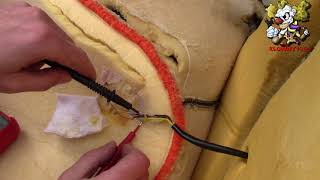
How to confirm: Disconnect the heater element connector under the seat and measure the resistance across its two pins with a multimeter. A reading of 'OL' (Open Loop) or infinite resistance confirms the element is broken. A good element should have a resistance of approximately 5 - 7.5 ohms. Some owners report that you may need to have someone sit in the seat and move around while you test, as a broken wire may only show as an open circuit when flexed.
Typical fix: Replace the seat heater element pad. This requires removing the seat from the vehicle and taking off the leather or cloth upholstery to access the pad, which is often glued to the foam cushion. 🎬 See this walkthrough on how to replace the heater element pad.
Est. part cost: $50-$150 - Burnt or Melted Module Connector 🟡 Medium Probability The main connector for the heated/cooled seat module (located under the passenger seat) can't handle the high electrical current because GM only utilized a single power and ground pin. This causes the pins to overheat, melt the plastic connector housing, and lose connection, as noted in TSB #10-08-50-008B.
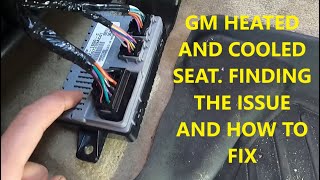
How to confirm: Visually inspect the largest electrical connector (a 12-pin connector) going into the silver module under the passenger seat. Look for discoloration, charring, or melted plastic around the pins, particularly the corner pins for power and ground.
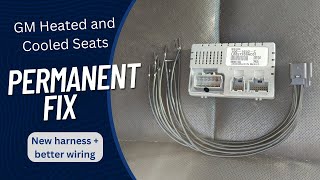
Typical fix: The damaged connector and corresponding pins on the module must be replaced. This involves cutting off the old connector and splicing in a new pigtail harness. A common permanent repair, documented by owners, is to use a new pigtail and jump the single power and ground wires to the two empty adjacent pins on the connector, effectively distributing the load across two pins 🎬 Watch this video to see the connector repair and pin jump. as the module was designed to handle.
Est. part cost: $25-$75 - Incorrect Accessory Harness Installation ⚪ Low Probability This applies if a GM accessory heated seat kit was installed. The harness has two identical connectors for the seat bottom and seat back elements. If they are reversed, the system will detect a fault and set this code.
How to confirm: As per TSB #PIT5215A, inspect the two heater element connectors. The longer lead (in convoluted tubing) should go to the seat back, and the shorter lead (taped) goes to the seat bottom.
Typical fix: Swap the connectors to their correct positions.
Est. part cost: $0
Rare But Worth Checking
- Failed Rear Heated Seat Module (RHSM): If the heater elements and all wiring/connectors test good, the control module itself may have failed internally. This is less common than element or connector failure.
Diagnosis Steps
- Scan the Rear Heated Seat Module (RHSM) for codes. Confirm B2430 is present and note any symptom bytes (e.g., 0D for high resistance).
- Move the passenger seat to its highest and most forward position for access.
- Visually inspect the large 12-pin electrical connector plugged into the seat control module under the passenger seat. Look for any signs of melting, charring, or corrosion, especially on the corner pins.
- If the vehicle has an accessory heated seat kit, verify the seat back and bottom heater connectors are installed correctly per TSB #PIT5215A.
- Locate the connector for the passenger seat bottom heater element. Disconnect it.
- Using a multimeter set to Ohms (Ω), measure the resistance of the heater element itself. A good element should have low resistance, specifically between 5-7.5 ohms. A reading of infinite resistance (OL) indicates a broken element that needs replacement.
- One owner on a forum noted a helpful diagnostic clue: a shop found a large discrepancy in resistance between the seat back (13.1 ohms) and seat bottom (2.6 ohms), indicating a fault in one of the elements even though neither was a complete open circuit.
- If the element's resistance is good, check for power at the harness side of the connector. With the key on and heated seat activated, you should see a pulsing voltage, as the module uses Pulse Width Modulation (PWM) to control temperature.
- If all wiring and the element are confirmed to be good, the Rear Heated Seat Module (RHSM) is the likely point of failure.
Parts You'll Likely Need
- Seat Heater Element Pad (Bottom)
(OEM #23168136)— This is the most common failure point. The wires inside the pad break, creating an open circuit and triggering code B2430.
Trusted brands: ACDelco, Dorman (641-105)
OEM price range: $100-$180
Aftermarket price range: $50-$90 - Heated Seat Module Connector Pigtail
(OEM #WPT-928 (Ford part number, widely cited as compatible))— Used to repair the common issue of the main module connector melting from high electrical current.
Trusted brands: Dorman, ACDelco (e.g., PT2887, PT2712 - verify pin count)
OEM price range: $40-$75
Aftermarket price range: $25-$50
Related Codes That Often Appear With This One
- B2425 — B2425 is the equivalent code for the Left (Driver) Seat Heater Cushion Circuit. It's common for both heating elements to fail around the same time due to similar age and wear.
Technical Service Bulletins (TSBs) & Recalls
- PIT5215A: Addresses inoperative GM Accessory Heated Seats and DTC B2430 due to reversed heater element connectors.
- 10-08-50-008B: Addresses driver or passenger heated seat being inoperative, potentially setting B2430 0D, due to loose terminal tension in the harness connector to the memory seat module.
Platform-Specific Known Issues
- A known issue on this platform is the main electrical connector for the seat module under the passenger seat burning out, requiring replacement of the pigtail.
- TSB #PIT5215A was issued for accessory heated seat kits being installed with the seat back and seat bottom heater element connectors reversed, causing this code.
- TSB #10-08-50-008B directly addresses inoperative heated seats with code B2430 0D, pointing to loose terminal tension in the main module connector 🎬 Watch a detailed guide on permanently fixing the module connector. as the cause.
Mechanic-Grade Diagnostic Values
- Seat Cushion Heater Element Resistance — expected: 2.5 - 8.5 ohms (at room temperature). Failure: A reading of 'OL' (infinite resistance) indicates a broken element. A reading significantly outside the expected range also indicates a fault.
- Seat Back Heater Element Resistance — expected: 3.5 - 11.5 ohms (at room temperature). Failure: A reading of 'OL' (infinite resistance) indicates a broken element. A reading significantly outside the expected range also indicates a fault.
- Seat Temperature Sensor Resistance — expected: 850 - 300k ohms. Failure: A reading outside this very wide range suggests a faulty sensor, which is integrated into the heater element pad.
- Seat Temperature Sensor Signal Voltage — expected: 4.8 - 5.2 volts. Failure: Voltage significantly higher or lower than this range points to a short or open in the signal circuit or a failed Rear Heated Seat Module (RHSM).
Hidden / Shadow Codes Worth Checking
- B2430 0D: Right Seat Heater Cushion Circuit Resistance Above Threshold. This is the most common symptom byte, indicating an open circuit, usually from a broken wire in the element. (see via Professional scan tool (like a Tech 2 or high-end Snap-on/Autel) that can read GM-specific body codes and symptom bytes.)
- B2430 0E: Right Seat Heater Cushion Circuit Resistance Below Threshold. This indicates a short circuit in the heating element. (see via Professional scan tool.)
- B2430 04: Right Seat Heater Cushion Circuit Open. The module does not detect a temperature change within 210 seconds of activation. (see via Professional scan tool.)
- B2430 0A: Right Seat Heater Cushion Circuit Rate of Change Below Threshold. The module detects that the target temperature has not been reached within 8.5 minutes. (see via Professional scan tool.)
Scan Tool Commands That Help
- Tech 2 / GDS2 / Professional Scan Tool: Heated Seat Functional Test / Output Control — Use this command to directly activate the heated seat elements, bypassing the door switch and some logic. If the seat heats up using this command but not with the door switch, it helps isolate the problem to the control side (switch, module logic) rather than the element or wiring itself.
Wiring & Ground Locations
- G303 / G304 — Under the front seats, bolted to the floor pan near the transmission tunnel.. These are the primary ground points for the seat modules and accessories. A loose or corroded ground here can cause intermittent or failed operation of the heated seats and other seat functions.
- RHSM Connector (12-pin) — Plugged into the silver Rear Heated Seat Module under the front passenger seat.. This is the connector that is prone to melting. The power (thick Red/White wire) and ground (thick Black wire) pins are in the corners and are the most common points of failure due to high current draw.
Real Owner Repair Stories
- YouTube video by 'Nick's Garage' (2010 Cadillac Escalade (same GMT900 platform and components)) — Heated and cooled seats were inoperative due to a melted main connector on the seat module.
❌ Tried (didn't work) A temporary fix of cleaning the contacts failed after some time.
✅ What actually fixed it The permanent fix was to cut off the melted factory connector and splice in a new pigtail (Ford part WPT-928). Crucially, the single power wire was spliced to feed TWO pins on the new connector, and the single ground wire was spliced to feed TWO ground pins, distributing the electrical load across the four corner pins as the module was designed to handle. - PerformanceTrucks.net forum user 'SS Dave' (2004 Silverado SS (earlier platform but identical DTCs and diagnostic principles)) — Heated seats would turn on then shut off after a few seconds or minutes, setting B2425 and B2430.
❌ Tried (didn't work) Replacing the heater elements, as the new parts had similar out-of-spec resistance readings as the old ones.
✅ What actually fixed it The user discovered a GM Technical Information System (TIS) note about a software update for the Driver Seat Module (DSM) that specifically addressed 'the false setting of heated seat DTC's and open/short circuit detection.' The final diagnosis was that the module's software was too sensitive and needed to be updated by a dealer before condemning any more parts.
OEM Part Supersession History
Various older numbers→23168136— Consolidation and potential design updates.
Heads up: Part number 23168136 is listed for 2014-2018 models but is the correct service replacement for the 2007-2014 generation as well. It fits seats without the ventilated/cooled option.
Helpful Videos
We Have This Part in Stock



The information in this article is provided for general reference and educational purposes only. Vehicle specifications, procedures, and part compatibility can vary by production date, trim level, and region. Always consult your vehicle's factory service manual and verify part numbers before purchasing or performing repairs. Safety-critical components such as airbags, seat belts, and braking systems should be installed by a qualified professional.
- Gmc YUKON XL:
- 🎬 Helpful Videos
- 🛍️ Shop This Part
- What's Unique About the 2007-2014 Gmc YUKON XL
- Diagnostic Flowchart
- Symptoms You May Notice
- Most Likely Causes
- Rare But Worth Checking
- Diagnosis Steps
- Parts You'll Likely Need
- Related Codes That Often Appear With This One
- Technical Service Bulletins (TSBs) & Recalls
- Platform-Specific Known Issues
- Mechanic-Grade Diagnostic Values
- Hidden / Shadow Codes Worth Checking
- Scan Tool Commands That Help
- Wiring & Ground Locations
- Real Owner Repair Stories
- OEM Part Supersession History
- 🎟️ Get 5% Off