

B2430 on 2007-2014 Chevrolet Suburban: Heated Seat Problems and Fixes
On a 2007-2014 Suburban, code B2430 almost always points to an issue with the heated seats. The most common causes are reversed heater element connectors after an installation or a burnt power connector at the control module under the passenger seat. Inspecting these two items will solve the majority of cases.
- B2430 on a 2007-2014 Suburban is a heated seat code, not a headlight or sensor code.
- Before buying any parts, inspect the large power connector on the heated seat module under the passenger seat for melting or burn marks.
- If accessory heated seats were ever installed, confirm the seat cushion and backrest heater connectors are not swapped.
- Repairing the power connector with a new pigtail is the most common fix and is an inexpensive, DIY-friendly job.
What's Unique About the 2007-2014 Chevrolet SUBURBAN
The GMT900 platform, which includes the 2007-2014 Suburban, has two very common and well-documented issues related to this code. First, a GM Technical Service Bulletin (TSB) points to a simple but common installation error where the connectors for the seat cushion and seat back heater elements are reversed. Second, the main power connector for the heated seat control module under the passenger seat is known to be under-engineered; it frequently overheats and melts, causing a loss of power and setting faults. This happens because the high current draw for both seat heaters is routed through a single power pin and a single ground pin in the connector, causing them to overheat and fail. These two issues account for a vast majority of B2430 complaints on these trucks.
Diagnostic Flowchart
Tap your situation to follow the diagnostic path that matches what you're seeing on this vehicle.
Symptoms You May Notice
- Heated seat indicator lights turn on briefly, then shut off.
- Heated seat indicator lights stay on, but the seat does not produce heat.
- One or both of the passenger heated seat functions (cushion and/or back) are inoperative
- A burning plastic smell may be noticed from under the passenger seat in cases of a melted connector.
- Both driver and passenger heated/cooled seats are inoperative (as the single module under the passenger seat controls both).
- Replacing the entire seat
- Replacing the Heated Seat Module when only its power connector is burnt
Most Likely Causes
- Burnt Power Connector at Heated Seat Module Very high Probability The module uses single pins for power and ground, which are overloaded by the current draw of the heating elements, causing the connector and module pins to overheat and melt. This is a well-documented design flaw.
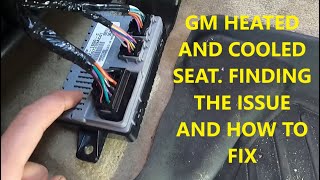
How to confirm: Visually inspect the largest connector (a 12-pin connector) on the heated seat module, located under the front passenger seat. Look for discoloration, melting, or burnt plastic on the connector and the module itself, specifically at the heavy-gauge power (red/white) and ground (black) wire locations.
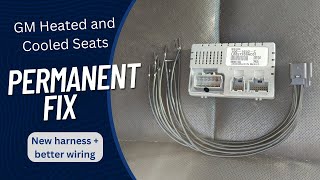
Typical fix: Replace the connector with a new pigtail (e.g., ACDelco PT2388 or Dorman 926-007), which must be spliced into the factory harness. A popular and more robust repair involves modifying the new pigtail to use both available power and ground terminals on the module to better distribute the electrical load and prevent a repeat failure. 🎬 Watch this video to see the permanent wiring modification fix.
Est. part cost: $20-$50 - Reversed Seat Heater Element Connectors 🔴 High Probability This is most common after the installation of a GM Accessory Heated Seat Kit, as documented in a TSB. The harness has two identical connectors that are easily swapped.
How to confirm: Inspect the two heater element connectors under the passenger seat. Per TSB #PIT5215A, the longer wire lead (with convoluted tubing) should go to the seat BACK element, and the shorter lead (taped only) goes to the seat BOTTOM element.
Typical fix: Correctly plug in the connectors. No parts are required.
Est. part cost: $0 - Failed Seat Heating Element 🟡 Medium Probability The thin wires in the heating element grid inside the seat cushion or back can break over time from the stress of someone sitting in the seat. The driver's side cushion element is particularly prone to failure from wear and tear of getting in and out.
How to confirm: Unplug the heating element and test its resistance with a multimeter. An open circuit (infinite resistance) indicates a broken element. A healthy element should have a low resistance value, typically between 3.5 and 11.5 ohms at room temperature.
Typical fix: The seat upholstery must be removed to replace the faulty heating element pad. This is labor-intensive but can be done DIY. 🎬 See this walkthrough on how to replace the seat heater element.
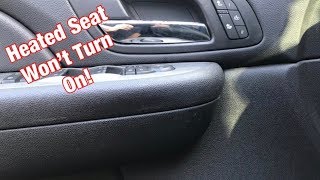
Est. part cost: $70-$150 - Failed Heated Seat Switch ⚪ Low Probability The switch is located in the door panel and can fail electronically from repeated use. Often, the failure is due to cracked solder joints on the switch's circuit board.
How to confirm: Test for power at the switch connector. If power is present but the switch doesn't activate the system, the switch is likely faulty. A common DIY fix is to disassemble the switch and re-solder the joints on the circuit board.
Typical fix: Replace the heated seat switch assembly in the driver's or passenger's door panel. A common part number is 22845195. 🎬 Watch: How to replace the heated seat switch in the door.
Est. part cost: $40-$75
Rare But Worth Checking
- Faulty Heated Seat Module: While the connector is the common failure point, the module itself can fail internally. This should only be suspected after all wiring, connectors, and heating elements have been confirmed to be good. If the connector pins on the module are severely burnt or corroded, the module may need replacement along with the connector pigtail.
- Blown Fuse: A blown fuse can result from the high resistance of a melting connector. Check the fuse labeled 'HTD SEAT' or similar in the underhood fuse block. For this generation, it's often a 30A fuse in the underhood fuse block labeled 'SEAT'.
Diagnosis Steps
- Check the heated seat fuse. On GMT900 trucks, this is often a 30-amp fuse labeled 'SEAT' or 'HTD SEAT' in the underhood fuse block.
- Tilt the front passenger seat all the way back and up to gain maximum access underneath.
- Locate the Heated Seat Control Module (DCSM). It is a black plastic box bolted to the seat frame, often with two connectors.
- Carefully unplug and inspect the main 12-pin power connector for any signs of melting, charring, or discoloration. Pay close attention to the large gauge red/white (power) and black (ground) wires.
- If the connector is melted, it must be replaced. Also, inspect the corresponding pins on the module itself for damage or corrosion. Clean the pins carefully if they are salvageable.
- If accessory heated seats were ever installed or serviced, verify the two smaller, identical connectors for the heating elements are plugged in correctly per TSB PIT5215A: the longer wire goes to the seat back, the shorter wire to the seat bottom.
- If no visible wiring issues are found, use a multimeter set to Ohms to test the resistance of the passenger seat heating elements. Disconnect the element and probe its two wires. A reading between 3.5-11.5 Ohms is good; infinite resistance (OL) means the element is bad.
- If elements and wiring are good, the next step is to test the door switch for proper operation. This may require removing the door panel.
- If all other components test good, the Heated Seat Module itself may be faulty.
Parts You'll Likely Need
- Heated Seat Module Power Connector Pigtail
(OEM #ACDelco PT2388 (GM 19167755))— This is the most common failure point, where the original connector melts due to being overloaded.
Trusted brands: ACDelco, Dorman (926-007), Motorcraft (WPT-928)
OEM price range: $30-$50
Aftermarket price range: $20-$40 - Seat Heater Element Pad
(OEM #20792748 (replaces 15232559))— The element grid inside the seat cushion can break over time, creating an open circuit.
Trusted brands: GM Genuine, ACDelco, Dorman
OEM price range: $100-$150
Aftermarket price range: $70-$120 - Front Seat Heater Switch
(OEM #22845195)— The switch in the door panel can fail, preventing the system from turning on. Often repairable by re-soldering cracked joints.
Trusted brands: GM Genuine, ACDelco
OEM price range: $50-$75
Aftermarket price range: $40-$60
Related Codes That Often Appear With This One
- B2425 — This code also relates to the heated seat system (specifically the driver's side) and is mentioned in the same TSB as B2430.
- B1935 — Another heated seat system code mentioned in TSB PIT5215A, indicating a related fault.
- B2180 — Also listed in TSB PIT5215A as a potential companion code for heated seat issues.
Technical Service Bulletins (TSBs) & Recalls
- PIT5215A: Addresses inoperative GM Accessory Heated Seats, noting that DTC B2430 can be set if the seat back and bottom heater element connectors are reversed during installation.
Platform-Specific Known Issues
- The 'Double Pin' Repair for Melted Connectors: A widely discussed permanent fix in owner forums involves modifying the replacement pigtail. The factory connector only uses one power and one ground pin, even though the module has two of each available. When splicing in the new pigtail, owners will split the main power wire to feed both power pins and split the main ground wire to feed both ground pins on the new connector. This distributes the electrical load across two circuits, drastically reducing the heat buildup that caused the original failure.
- The power connector for the heated seat module under the passenger seat is a known weak point that frequently melts and causes an open circuit.
Mechanic-Grade Diagnostic Values
- Seat Heater Element Resistance — expected: 3.5 - 11.5 Ohms (at 20°C / 68°F). Failure: A reading of infinite resistance (Open Loop) or a value outside the specified range.
Hidden / Shadow Codes Worth Checking
- B2430 04: Right Seat Heater Cushion Circuit Open (see via Requires a dealer-level scan tool like a GM Tech2 or GDS2.)
- B2430 0D: Right Seat Heater Cushion Circuit Resistance Above Threshold (see via Requires a dealer-level scan tool. This is the specific symptom code mentioned in TSB PIT5215A.)
- B2430 0E: Right Seat Heater Cushion Circuit Resistance Below Threshold (see via Requires a dealer-level scan tool.)
Wiring & Ground Locations
- G303 — Near the base of the left 'B' pillar.. This is a ground point for the front heated seats circuit. A poor connection here could cause various electrical issues with the system.
- X305 — Main driver seat connector under the driver seat.. This is the main interface between the body harness and the driver's seat, which contains the memory module controlling both heated seats on some trims. Pin A (Red/White) is main power and Pin F is a common ground location.
- Heated Seat Module Connector (under passenger seat) — Under the front passenger seat, connected to the control module.. This 12-pin connector is the most common failure point. The Red/White wire is the power supply and the Black wire is the ground; these are the pins that typically overheat and melt.
Real Owner Repair Stories
- Chevrolet Forum user 'Rbahri5206' (2007 Suburban) — Passenger front heated seat not working. The switch would not light up at all, day or night. Driver side worked fine.
❌ Tried (didn't work) Checked underhood fuses., Checked under-dash fuses.
✅ What actually fixed it While replacing a peeling door handle, the owner had the passenger door panel off and discovered the heated seat switch wiring harness was simply unplugged. Plugging it back in resolved the issue completely. - YouTube channel 'FTP Speed Shop' (2011 Suburban) — Heated and cooled seats had not worked for a couple of years. Indicator lights on the door panel would turn on, but the seats would not heat or cool.
❌ Tried (didn't work) Initially had no power at the module, which was traced to a blown fuse, likely caused by high resistance from the failing connector.
✅ What actually fixed it The main power connector on the control module under the passenger seat was burnt and melted. The owner replaced the connector with a new pigtail and performed the 'double pin' modification, splitting the main power and ground wires to feed both available power and ground pins on the new connector to prevent future failure.
OEM Part Supersession History
13506705, 13509388→13510339— Standard part revision and consolidation by the manufacturer.
Heads up: These part numbers are for the heated/ventilated seat control module. While they may be physically similar, always verify the correct part number for the vehicle's specific trim and options (e.g., heated only vs. heated/ventilated).
Model Year Variations Within This Range
- 2007-2014: While the core issue is consistent, higher trims like LTZ and Denali feature both heated and cooled seats, which use the same problematic control module and connector. Lower trims (LS, LT) may only have heated seats. The diagnostic process for the B2430 code remains the same regardless of the trim level.
Helpful Videos
Used OEM Parts in Stock




New Aftermarket Parts Available



The information in this article is provided for general reference and educational purposes only. Vehicle specifications, procedures, and part compatibility can vary by production date, trim level, and region. Always consult your vehicle's factory service manual and verify part numbers before purchasing or performing repairs. Safety-critical components such as airbags, seat belts, and braking systems should be installed by a qualified professional.
- Chevrolet SUBURBAN:
- 🎬 Helpful Videos
- 🛍️ Shop This Part
- What's Unique About the 2007-2014 Chevrolet SUBURBAN
- Diagnostic Flowchart
- Symptoms You May Notice
- Most Likely Causes
- Rare But Worth Checking
- Diagnosis Steps
- Parts You'll Likely Need
- Related Codes That Often Appear With This One
- Technical Service Bulletins (TSBs) & Recalls
- Platform-Specific Known Issues
- Mechanic-Grade Diagnostic Values
- Hidden / Shadow Codes Worth Checking
- Wiring & Ground Locations
- Real Owner Repair Stories
- OEM Part Supersession History
- Model Year Variations Within This Range
- 🎟️ Get 5% Off