

OBD-II Code B2283: Vehicle Speed Sensor Malfunction
What B2283 means, why it triggers, and how to fix it
- Always use a manufacturer-specific scanner to read B2283, as its definition ranges from a Toyota Smart Key fault to a Corvette battery circuit error.
- On Toyota and Lexus models, B2283 triggers the Certification ECU to disable the engine, causing an immediate no-start condition or stalling.
- Check live data first; if one wheel speed sensor reads 0 MPH, replace that sensor or repair its wiring to fix the code.
- Expect a 5-10% drop in fuel economy and erratic transmission shifting if you drive with an active B2283 code for more than a few days.
- Look for companion code B2282; its presence guarantees the fault lies in the instrument cluster or CAN bus network, not the wheel sensors.
What Does B2283 Mean?

B2283 indicates the vehicle's body control module (BCM) or Certification ECU detects an irrational vehicle speed signal. The computer sees impossible data, such as the car decelerating instantly or the speed signal contradicting engine RPM.
Technical definition: SAE/ISO defines B2283 as a 'Vehicle Speed Sensor Malfunction'. On Toyota and Lexus vehicles, the Certification ECU triggers this logic when it detects excessive deceleration or a speed signal that fails to correlate with engine speed, using this data as a safety check to prevent the engine from shutting off while in motion.
Can I Drive With B2283?
Yes, But With Caution. Yes, but drive cautiously to a repair shop. Driving with B2283 disables ABS and traction control, significantly increasing braking distances in emergencies. On many vehicles, it causes erratic transmission shifting, engine stalling, or an immediate no-start condition.
Common Causes

- Damaged, corroded, or loose wiring to a speed sensor. (Very Common) — Speed sensor wiring is exposed to road debris, vibration, and moisture. A visual inspection often reveals a chafed wire, a broken harness, or a connector packed with green corrosion.
- Faulty wheel speed sensor (ABS sensor). (Common) — Located at each wheel hub, these sensors fail internally from heat, age, and metal particle contamination. Because the primary speed reading averages these sensors, a single dead sensor triggers the code. 🎬 See this guide on diagnosing and fitting new wheel speed sensors.
- Faulty Vehicle Speed Sensor (VSS) on the transmission. (Common) — On vehicles utilizing a transmission-mounted VSS, this sensor serves as the primary speed input for the speedometer and transmission control module. Internal electrical failure stops the signal entirely.
- Malfunctioning instrument cluster. (Less Common) — The instrument cluster processes raw speed signals from the sensors and relays a refined signal to the BCM. An internal circuit board failure corrupts this signal, triggering B2283 even if the wheel sensors work perfectly.
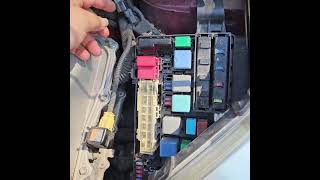
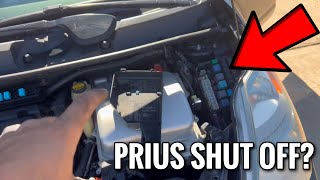
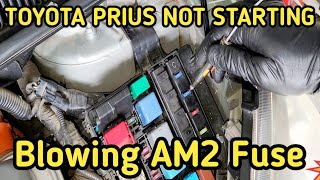
- Short in the AM2 fuse circuit (often a failed inverter water pump on Toyota hybrids). (Uncommon) — The AM2 fuse powers the instrument cluster and ignition system. A short to ground—frequently caused by an internally shorted inverter water pump on older Prius models—blows this fuse, causing a B2283 code and a dead vehicle.
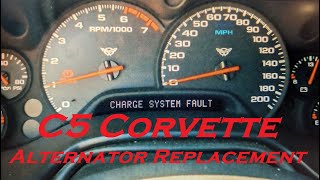
- Low battery voltage (Specific to C5 Corvette). (Uncommon) — On the 1997-2004 Chevrolet Corvette, B2283 specifically means 'Battery #1 Circuit Fault'. 🎬 Watch: Troubleshooting charging system and battery faults on a C5 Corvette. It triggers when system voltage drops below 8.5V or spikes above 16.3V for more than 2 seconds.
- Faulty Body Control Module (BCM) or Certification ECU. (Rare) — The module logging the code has failed internally. Replace this only after verifying all wiring, sensors, and the instrument cluster are fully functional.
Symptoms
- Inaccurate or dead speedometer — The speedometer stays at 0 MPH, jumps erratically, or displays a speed completely disconnected from reality.
- ABS and Traction Control warning lights illuminate — The system disables ABS and traction control due to unreliable wheel speed data, turning on the dashboard warning lights.
- Engine won't start or stalls — On push-button start vehicles, the computer disables the ignition if it cannot confirm the vehicle is stationary (0 MPH).
- Erratic automatic transmission shifting — The transmission shifts harshly, delays gear changes, or fails to lock the torque converter because it lacks accurate speed data.
- Cruise control disabled — The vehicle disables cruise control as a mandatory safety precaution when the speed signal fails.
Diagnostic Flowchart

Tap your situation to follow the diagnostic path that matches what you're seeing on this code.
Common Fixes & Costs
- Repair damaged wiring or clean connectors. — Parts: $5-$20, Labor: $100-$200, ~1.5 hr book time (Intermediate)
- Replace faulty wheel speed sensor (ABS sensor).
— Parts: $50-$210, Labor: $111-$200, ~1 hr book time
(DIY)
: OEM - Replace faulty vehicle speed sensor (on transmission).
— Parts: $25-$228, Labor: $120-$275, ~1.5 hr book time
(Intermediate)
: OEM - Repair or replace the instrument cluster. — Parts: $125-$600, Labor: $80-$200, ~1.5 hr book time (Professional)
- Replace the Body Control Module (BCM) or Certification ECU. — Parts: $300-$700, Labor: $125-$400, ~2 hr book time (Professional)
Used vs. New Parts: Buying Guide
When a used part is worth it: Buying a used wheel speed sensor is never recommended due to the high failure rate of aged electronics. Only buy a used instrument cluster or BCM if a new OEM unit is discontinued or prohibitively expensive.
Donor-vehicle mileage cap: roughly under 50000 miles for the part to have meaningful remaining life.
Donor quality checklist:
- Match the module part number exactly; slight variations cause immobilizer lockouts.
- Avoid sensors or wiring harnesses from vehicles in rust-belt regions.
- Verify the donor instrument cluster has a lower mileage than your vehicle, as some cannot be programmed upward.
Decision logic:
- If The failed part is a wheel speed sensor or transmission VSS → Buy a new OEM or premium aftermarket part. The labor to replace it twice outweighs any savings.
- If The failed part is an instrument cluster → Send your original cluster to a specialized repair service to fix the circuit board. This avoids VIN programming issues entirely.
Warranty tradeoff: Used modules offer 30-day warranties. Premium aftermarket sensors offer limited lifetime warranties. OEM parts carry 12-month warranties.
Worst-case if a used part fails: $300-$500 if a used instrument cluster fails and locks out the immobilizer system.
What Happens If You Wait — Timeline
- 0-1 month: ABS and Traction Control disable. Speedometer dies. Cruise control locks out. (MPG impact: 0-5%% · Added cost: $0-$50 in wasted fuel)
- 1-4 months: Transmission shifts harshly or late. Torque converter fails to lock up at highway speeds, accelerating fluid breakdown. (MPG impact: 5-15%% · Added cost: $100-$400 in wasted fuel and fluid degradation.)
- 4-8 months: Sustained hydraulic shock from hard shifting damages clutch packs and valve body solenoids. (MPG impact: 10-20%% · Added cost: $500-$1500 for solenoid or valve body replacement.)
- 8+ months: Catastrophic transmission failure. Hard parts shatter under the stress of unmodulated shifting. (MPG impact: 15-25%% · Added cost: $2,500-$5,000+ for a complete transmission rebuild.)
Cost of Not Fixing It
- Immediate: Critical safety systems like ABS and Traction Control are disabled, increasing the risk of an accident in emergency braking. (Added cost: N/A)
- 0-3 months: Erratic shifting causes premature wear on transmission clutches. Fuel economy decreases by 5-10% due to torque converter lockup failure. (Added cost: $200-$500 in wasted fuel and fluid degradation.)
- 6+ months: Severe, long-term hydraulic shock from hard shifting destroys internal transmission hard parts, requiring a complete rebuild. (Added cost: $2,500-$5,000+)
Diagnosis Steps
- Read Codes and Check Live Data
Use an advanced OBD-II scanner to read all Body (B), Chassis (C), and Communication (U) codes. Next, view live data for all four wheel speed sensors while driving at 10 MPH. If one sensor reads 0 MPH while the others show 10 MPH, you have isolated the faulty circuit.
Tools: Advanced OBD-II Scanner with Live Data (Beginner) - Visually Inspect Wiring and Fuses
Inspect the wiring harness for the suspect sensor. Look for chafed insulation, broken wires, or corroded pins inside the connector. Check the 'Meter/Gauge', 'ECU-IG', and 'AM2' fuses; a blown fuse immediately points to a short circuit.
Tools: Flashlight, Mirror (Beginner) - Test Sensor Circuit Voltage and Resistance
Disconnect the sensor. Turn the ignition on and use a multimeter to verify the harness provides reference voltage (typically 5V-12V for active sensors). For passive sensors, measure resistance across the sensor pins (usually 800-2,400 ohms). An 'OL' reading means the sensor is dead.
Tools: Multimeter, Vehicle-specific repair manual (Intermediate) - Test Sensor Signal Output
Back-probe the connected sensor's signal wire. Spin the wheel by hand. Passive sensors should generate 100-700mV AC. Active sensors should toggle DC voltage (e.g., 0.7V to 1.4V). For definitive proof, use an oscilloscope to verify a clean, repeating square or sine wave without dropouts.
Tools: Multimeter, Oscilloscope, Back-probe pins (Advanced) - Inspect Instrument Cluster Connections
If all sensors and wiring test perfectly, remove the dashboard trim to access the instrument cluster. Check the rear electrical connectors for loose seating or corrosion. Test for continuity between the cluster output pin and the BCM/Certification ECU.
Tools: Trim removal tools, Multimeter (Advanced) - Perform Zero Point Calibration
On Toyota/Lexus vehicles, replacing a speed sensor or ABS component requires a 'Zero Point Calibration' for the yaw rate and deceleration sensors. Park on a level surface and initiate the calibration via a high-level scan tool.
Tools: Advanced diagnostic scan tool (Professional)
When This Code Triggers (Freeze-Frame Conditions)
- Vehicle Speed: 25-55 MPH (The fault is almost always detected when the vehicle is in motion, not at idle.)
- Engine RPM: 1500-2500 RPM (Occurs during steady cruise or light acceleration, where the speed signal is expected to be perfectly stable.)
- System Voltage: < 8.5V or > 16.3V (Specific to GM/Corvette models triggering the battery circuit fault definition.)
Related Codes
- B2282 — Sets when the ECU detects a mismatch between the hardwired speed signal and the CAN bus speed signal. Seeing B2282 alongside B2283 guarantees the fault is in the instrument cluster or network, not the wheel sensors.
- P0500 — The generic powertrain code for 'Vehicle Speed Sensor A Malfunction'. Its presence confirms the primary transmission speed sensor circuit has failed.
- C0035 to C0050 — ABS codes for specific wheel speed sensor circuits (e.g., C0035 for Left Front). These pinpoint exactly which wheel sensor is dead, making diagnosis trivial.
- U0129 / U0155 — Communication codes indicating lost contact with the Brake System or Instrument Cluster. B2283 is merely a symptom of this total network failure.
Climate & Environmental Factors
- Road Salt and High Humidity: Saltwater acts as a highly corrosive electrolyte. It seeps into micro-cracks in wire insulation, corroding the copper from the inside out and destroying sensor connectors.
- Extreme Cold: Sub-zero temperatures make wire insulation brittle and prone to cracking from suspension vibration. Materials contract in the cold, causing marginal electrical connections to fail intermittently.
- Rust Buildup: Corrosion builds up on the hub assembly underneath the wheel speed sensor, physically pushing the sensor away from the tone ring. This increased air gap weakens the magnetic signal.
How to Talk to a Mechanic About This Code
Say this: "I have a B2283 code on my [Year/Make/Model]. I know this is a body code with manufacturer-specific meanings, not just a generic speed sensor fault. I need a diagnostic to check live sensor data and verify the instrument cluster communication."
This proves you understand B2283 requires advanced diagnostics. It prevents the shop from blindly throwing a $200 wheel speed sensor at a problem caused by a failing instrument cluster.
Avoid saying:
- 'My car says B2283, just replace the speed sensor.'
- 'The internet said it's the ABS module, swap it out.'
Questions to ask before authorizing the repair:
- Did you check for companion codes like B2282 or ABS C-codes?
- If you're recommending a sensor replacement, did you verify the other three sensors read correctly in live data?
- If you're recommending an instrument cluster replacement, what specific electrical test failed?
Where to Take It: Dealer vs Independent vs Chain
- Dealer:
Recommended. Given the manufacturer-specific nature of B2283 and the high likelihood of module programming, the dealer has the exact tools required.
Best for: Vehicles under warranty., Repairs requiring module programming (new instrument cluster or BCM).
Downsides: Highest labor rates., Often default to replacing entire $800 modules instead of repairing a $10 wire. (Typical cost: +50% vs. baseline) - Independent Shop:
Good Fit. Verify they have the equipment to read manufacturer-specific body codes before dropping off the car.
Best for: Out-of-warranty vehicles requiring sensor or wiring repairs.
Downsides: Must possess an advanced scan tool capable of reading B-codes and programming modules. (Typical cost: +0% vs. baseline) - Chain Shop:
AVOID. The risk of misdiagnosis and unnecessary parts replacement is extremely high.
Best for: Tires and oil changes.
Downsides: Technicians lack the training and scan tools required for complex body code diagnostics. (Typical cost: -10% vs. baseline)
When to Walk Away From the Repair
If the estimated repair cost exceeds 50% of your car's private-party value, sell the vehicle.
- Car worth $4000, fix is $350: Fix it. A wheel sensor or wiring repair is a minor expense.
- Car worth $6000, fix is $1100: Borderline. This cost indicates a module replacement. Get a second opinion to confirm the module is actually dead.
- Car worth $3000, fix is $1800: Walk away. The repair cost exceeds 50% of the vehicle's value.
What Scan Tool You Need for This Code
Minimum: A scanner that reads manufacturer-specific Body (B) codes and displays live data for all four wheel speed sensors.
A basic $20 code reader cannot read B-codes. It will either show 'No Codes Found' or provide a generic, misleading definition that causes you to replace the wrong parts.
Budget: BlueDriver Pro (~$99) — Reads enhanced BCM codes and graphs live data from all four wheel speed sensors to instantly identify a dead circuit.
Mid-range: Foxwell NT510 Elite (~$150) — Offers full-system diagnostics and bidirectional controls to perform special functions like Zero Point Calibration.
Professional: Autel MaxiSys MS906BT (~$1200) — Provides dealer-level diagnostics, ECU coding, and module programming required if the instrument cluster must be replaced.
Rent vs buy: Buy. AutoZone loaner tools rarely read manufacturer-specific B-codes accurately. The BlueDriver pays for itself by preventing one misdiagnosis.
How to Clear the Code After You Fix It
- Use an OBD-II scan tool to erase B2283 and any related C-codes or U-codes.
- Perform a complete drive cycle to allow the vehicle's readiness monitors to run.
- Rescan the vehicle to confirm the code remains clear.
Drive cycle (~20 minutes): Start the engine cold, idle for 3 minutes, drive in stop-and-go city traffic for 10 minutes, and finish with 5-10 minutes of steady highway driving at 55-60 MPH.
Readiness monitors affected: Comprehensive Component Monitor
Before emissions retest: drive at least 50 miles to fully set monitors.
Watch out for:
- Disconnecting the battery clears the light but resets all readiness monitors to 'Not Ready', guaranteeing an emissions test failure.
- Failing to perform a Zero Point Calibration on Toyota models will cause ABS lights to return immediately.
Will This Fail Emissions / State Inspection?
Yes — this code typically fails an OBD-II emissions inspection.
- California: An illuminated Check Engine Light from B2283 causes an automatic Smog Check failure. All monitors must be 'Ready'.
- New York: An active B2283 code fails the OBD-II inspection. You must complete a full drive cycle after repairs before re-inspection.
- Texas: Vehicles in emissions-testing counties fail instantly with an active B2283 code or incomplete readiness monitors.
Most Commonly Affected Vehicles
- Toyota RAV4 (2019-2025) — Frequently accompanied by B2282. The issue almost always traces to the Certification ECU or a loose instrument cluster communication line.
- Toyota Camry (2009-2018) — Often related to a fault within the instrument cluster. Testing a good ABS sensor on the 2009 model should show very low resistance (around 0.1 ohms).
- Toyota Prius (2004-2009) — A failed inverter water pump shorts out and blows the AM2 fuse, which powers the gauge cluster. This results in a dead dashboard, a no-start condition, and the B2283 code.
- Lexus ES 350 (2007-2012) — The signal path routes from the Skid Control ECU to the combination meter, then to the Main Body ECU. A failure at any point triggers the code.
- Chevrolet Corvette (C5) (1997-2004) — B2283 specifically indicates a 'Battery #1 Circuit Fault', not a speed sensor issue. It triggers when voltage drops below 8.5V or exceeds 16.3V for 2 seconds.
- Ford Various (2000-2015) — Ford uses B2283 to indicate 'Turn indicator chime circuit short to battery', completely unrelated to vehicle speed.
- Mazda Various (2006-2016) — Mazda defines B2283 as 'Steering Lock Unit Communication Error', requiring diagnosis of the steering column lock module.
Manufacturer-Specific Notes

- Toyota/Lexus: B2283 is tied to the Smart Key System. The Certification ECU sets the code when it sees 'excessive deceleration' to prevent the engine from being turned off while driving, often resulting in a no-start condition.
- Chevrolet/GM: On the C5 Corvette, B2283 means 'Battery #1 Circuit Fault'. Diagnosing this as a speed sensor issue guarantees wasted money. Test the battery and alternator instead.
- Ford: Ford uses B2283 for 'Turn indicator chime circuit short to battery'. Never rely on generic code definitions for B-series codes.
Real Owner Stories
2008 Toyota Prius - The Blown AM2 Fuse
Car died suddenly while driving. No dash lights, no power, would not start. The 15A AM2 fuse kept blowing instantly.
What they tried:
- Replaced the inverter coolant pump, a known cause for blown AM2 fuses.
- The new fuse blew immediately.
- Unplugged the inverter pump entirely, but the fuse still blew, proving the short was elsewhere.
Outcome: The owner traced the AM2 circuit and found a shorted wire behind the instrument cluster. Repairing the wire stopped the fuse from blowing and cleared the B2283 code.
Lesson: Never blindly replace parts when a fuse blows. Unplug components on the circuit one by one until the short disappears to isolate the true culprit.
2019 Toyota RAV4 - The $1,200 Misdiagnosis
ABS and Brake lights illuminated. Codes B2283 and B2282 were active, but the speedometer worked perfectly.
What they tried:
- The dealership diagnosed a faulty ABS module and quoted $1,200 for replacement.
- The owner sought a second opinion. The independent mechanic noted that B2282 and B2283 together indicate a communication mismatch at the instrument cluster.
- The mechanic pulled the cluster and found a loose connector.
Outcome: Reseating the instrument cluster connector fixed the issue permanently. Total cost was one hour of diagnostic labor.
Lesson: Companion code B2282 is the smoking gun for an instrument cluster or wiring fault. Do not let a shop replace wheel sensors or ABS modules if B2282 is present.
2002 C5 Corvette - The Battery Trap
Passenger window and door locks stopped working. Scanned for codes and found B2283.
What they tried:
- Searched online and found the generic 'Vehicle Speed Sensor' definition.
- Checked Corvette forums and learned B2283 means 'Battery #1 Circuit Fault' on this specific chassis.
- Tested the main 12V battery and found it resting at 10.5 volts.
Outcome: Replacing the weak 12V battery restored full voltage to the Door Control Module, clearing the code and fixing the windows.
Lesson: Generic code definitions for B-series codes are dangerous. Always verify the manufacturer-specific definition before touching a wrench.
How to Prevent This Code From Triggering
- Apply Dielectric Grease to Connectors (During any brake job or tire rotation) — Dielectric grease seals out moisture and road salt, preventing the green corrosion that destroys sensor wiring.
- Clean Sensor Mounting Surfaces (When replacing wheel bearings or rotors) — Removing rust from the hub ensures the sensor sits flush, maintaining the precise air gap required to read the magnetic tone ring.
- Secure Wiring Harnesses (During any under-car service) — Clipping wires into their factory retainers prevents them from rubbing against suspension components and shorting out.
Frequently Asked Questions
What is the most common misdiagnosis for a B2283 code?
Mechanics frequently replace wheel speed sensors when the actual fault lies within the instrument cluster. On Toyota and Lexus models, the cluster processes all speed signals; if its internal circuit board fails, it triggers B2283 even if the sensors are perfect.
Why doesn't my generic code reader show the right definition for B2283?
B2283 is a body code with manufacturer-specific meanings. A generic scanner defaults to 'Vehicle Speed Sensor Malfunction', which is completely wrong for cars like the C5 Corvette (Battery Circuit Fault) or Ford (Chime Circuit). Use a professional-level scan tool to avoid replacing the wrong parts.
Can a bad battery cause a B2283 code?
Yes. On the C5 Corvette, B2283 specifically flags a battery circuit fault. On any modern vehicle, a weak battery causes voltage drops that trigger spurious communication errors, including B2283.
Will clearing the code fix the problem?
No. Clearing the code temporarily turns off the warning light, but the computer will detect the hardware fault and trigger the code again on your next drive cycle.
What is the 'AM2 fuse' mentioned in Toyota repair guides?
The AM2 fuse powers the ignition system and instrument cluster. If a component like the inverter water pump shorts out, it blows the AM2 fuse, killing the instrument cluster and triggering B2283 alongside a no-start condition.
Is it safe to drive with the ABS and Traction Control lights on?
Your standard hydraulic brakes will work, but you lose anti-lock braking and traction control. Drive cautiously, double your following distance, and avoid slippery roads until the system is repaired.
Why would a speed sensor problem make my car not start?
Push-button start systems require confirmation that the vehicle is stationary (0 MPH) before engaging the starter. An erratic speed signal makes the computer think the car is moving, disabling the ignition as a safety precaution.
Key Takeaways
- Always use a manufacturer-specific scanner to read B2283, as its definition ranges from a Toyota Smart Key fault to a Corvette battery circuit error.
- On Toyota and Lexus models, B2283 triggers the Certification ECU to disable the engine, causing an immediate no-start condition or stalling.
- Check live data first; if one wheel speed sensor reads 0 MPH, replace that sensor or repair its wiring to fix the code.
- Expect a 5-10% drop in fuel economy and erratic transmission shifting if you drive with an active B2283 code for more than a few days.
- Look for companion code B2282; its presence guarantees the fault lies in the instrument cluster or CAN bus network, not the wheel sensors.
Helpful Videos


The information in this article is provided for general reference and educational purposes only. Vehicle specifications, procedures, and part compatibility can vary by production date, trim level, and region. Always consult your vehicle's factory service manual and verify part numbers before purchasing or performing repairs. Safety-critical components such as airbags, seat belts, and braking systems should be installed by a qualified professional.
- 🎬 Helpful Videos
- What Does B2283 Mean?
- Can I Drive With B2283?
- Common Causes
- Symptoms
- Diagnostic Flowchart
- Common Fixes & Costs
- Used vs. New Parts: Buying Guide
- What Happens If You Wait — Timeline
- Cost of Not Fixing It
- Diagnosis Steps
- When This Code Triggers (Freeze-Frame Conditions)
- Related Codes
- Climate & Environmental Factors
- How to Talk to a Mechanic About This Code
- Where to Take It: Dealer vs Independent vs Chain
- When to Walk Away From the Repair
- What Scan Tool You Need for This Code
- How to Clear the Code After You Fix It
- Will This Fail Emissions / State Inspection?
- Most Commonly Affected Vehicles
- Manufacturer-Specific Notes
- Real Owner Stories
- 2008 Toyota Prius - The Blown AM2 Fuse
- 2019 Toyota RAV4 - The $1,200 Misdiagnosis
- 2002 C5 Corvette - The Battery Trap
- How to Prevent This Code From Triggering
- Frequently Asked Questions
- What is the most common misdiagnosis for a B2283 code?
- Why doesn't my generic code reader show the right definition for B2283?
- Can a bad battery cause a B2283 code?
- Will clearing the code fix the problem?
- What is the 'AM2 fuse' mentioned in Toyota repair guides?
- Is it safe to drive with the ABS and Traction Control lights on?
- Why would a speed sensor problem make my car not start?
- Key Takeaways
- 🎟️ Get 5% Off