

B2180 on 2007-2011 GMC Yukon Denali: Heated Seat Failure Causes and Fixes
On a 2007-2011 GMC Yukon Denali, code B2180 almost always points to a failed passenger-side heated seat element (pad) or a burnt connector on the heated seat module under the passenger seat. The most common fix is replacing the seat heater pad, which costs about $70-$150 for the part. This is a very common issue on the GMT900 platform, which includes the Tahoe, Suburban, and Escalade.
- B2180 on your Yukon Denali means there is a fault with the passenger-side heated seat, usually the seat back element.
- Before tearing the seat apart, always check the large electrical connector on the silver module under the front passenger seat for signs of melting or burning, as this is a very common and easier fix.
- The most likely repair is replacing a broken heating element pad inside the seat, which requires removing the seat cover.
- You can safely drive the vehicle with this code, as it only affects a comfort feature.
What's Unique About the 2007-2011 Gmc YUKON DENALI
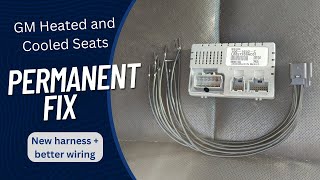
The GMT900 platform, which includes the Yukon, Tahoe, Suburban, and Escalade, is well-known for heated seat issues. The primary culprits are not the control modules, but the physical components that see daily wear. The heating element wires embedded in the seat cushions are prone to breaking from occupant weight and movement over time. Additionally, the main electrical connector for the heated/cooled seat module located under the passenger seat is known to be undersized for the electrical current. GM only utilized single power and ground pins in the connector, leading to high resistance, overheating, and melting of the connector and module pins.
🎬 Watch: How to fix melted connectors and module pins.Diagnostic Flowchart
Tap your situation to follow the diagnostic path that matches what you're seeing on this vehicle.
Symptoms You May Notice
- Heated seat indicator light turns on for a few seconds, then turns off.
- Heated seat indicator light stays on, but the seat produces no heat.
- Passenger heated seat is inoperative.
- In vehicles with cooled seats, that function may also be disabled as it runs through the same module.
- A blown fuse for the heated seats, often labeled "SEAT CB" in the interior fuse panel.
- Replacing the heated seat switch on the dashboard. This switch rarely fails and diagnosis should focus on the components under the seat first. A faulty switch usually won't set a B2180 code.
Most Likely Causes
- Failed Passenger Seat Heating Element (Pad) 🔴 High Probability The thin resistive wires inside the seat cushion and seat back pads become brittle over time and can break from the repeated stress of a person getting in and out of the vehicle. The passenger seat back element is the most common point of failure for code B2180.
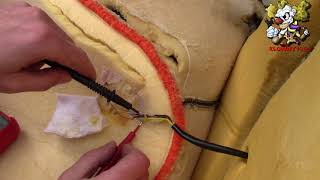
How to confirm: Disconnect the heating element connector under the seat. Use a multimeter to measure the resistance across the element's two wires. A reading of infinite resistance (OL) means the element is broken. A normal reading should be approximately 3.5-11.5 ohms for the back element and 2.5-8.5 ohms for the bottom element.
Typical fix: Replace the faulty heating element pad (either the seat bottom or seat back). This requires removing the seat from the vehicle and taking off the leather upholstery. 🎬 See this walkthrough on replacing the seat heating element. Some owners find a visible burn mark on the element where the break occurred.
Est. part cost: $70-$150 - Burnt Connector on Heated Seat Module 🟡 Medium Probability The main power (often a large red/white wire) and ground terminals on the large connector for the heated/cooled seat module (located under the front passenger seat) can't handle the high current draw. This causes them to overheat, melt the plastic connector housing, and create a poor or open connection, triggering the fault code.
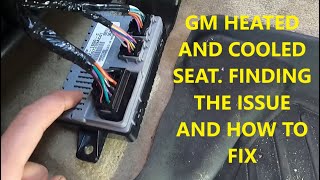
How to confirm: Visually inspect the largest connector plugged into the silver control module under the front passenger seat. Look for signs of melting, charring, or discoloration on the connector body and the module's pins, particularly at the corner pins for the power and ground wires.
Typical fix: Replace the burnt connector with a new pigtail, which involves cutting the old connector off and splicing the new one in wire by wire. The terminals on the module itself should be cleaned of any melted plastic. Many replacement pigtails utilize both available power and ground pins on the module to better distribute the electrical load.
Est. part cost: $25-$50 - Damaged Wiring Under Seat ⚪ Low Probability Wiring under the seat can get pinched or chafed by the seat's movement mechanisms, especially the seat tracks, leading to a short or open circuit.
How to confirm: Perform a thorough visual inspection of all wiring harnesses under the passenger seat. Check for any pinched, stretched, or bare wires shorting against the metal seat frame.
Typical fix: Repair the damaged section of wire using solder and heat shrink tubing or appropriate butt connectors.
Est. part cost: $5-$15
Rare But Worth Checking
- Reversed Heater Element Connectors: This is primarily an issue if the heated seats were installed as a GM accessory after the vehicle was built. TSB PIT5215A notes that the seat back and bottom element connectors are identical and can be accidentally swapped, causing this code. The longer lead goes to the seat back, the shorter lead to the bottom cushion.
- Failed Heated Seat Module: While possible, the control module is far less likely to fail than the heating elements or connectors. This should only be considered after all other components have been tested and confirmed to be good. Some owners have replaced the module only to find the problem persisted.
Diagnosis Steps
- Confirm the symptom: Press the passenger heated seat button and observe the indicator lights. Note if they turn off immediately or stay on without producing heat.
- Scan for codes using an OBD-II scanner capable of reading Body Control Module (BCM) codes to confirm B2180 and check for any other related DTCs. Note any symptom bytes (e.g., 04, 0D, 0E).
- Visually inspect the silver Heated Seat Module and its main electrical connector, located under the front passenger seat. Look carefully for any signs of melting, burning, or corrosion on the connector or module pins, especially the heavy-gauge power and ground wires.
- If the connector looks good, locate the smaller connectors for the seat bottom and seat back heating elements under the passenger seat.
- Disconnect the connector for the seat back element. Set a multimeter to Ohms (Ω) and measure the resistance across the two pins 🎬 Watch: A step-by-step guide to troubleshooting GM seat heaters. on the element side of the connector.
- An 'OL' or infinite reading indicates a broken element that needs replacement. A reading of approximately 3.5-11.5 ohms is normal for the backrest element.
- Repeat the resistance test for the seat bottom heating element. A normal reading is typically lower, around 2.5-8.5 ohms.
- If both elements test within spec and all wiring appears intact, the fault may lie with the Heated Seat Module itself, though this is the least likely cause.
Parts You'll Likely Need
- Seat Heater Element Pad (Back)
(OEM #20792749 (replaces 15232560, 25911156))— This is the most common failure point for code B2180. The internal wires break from normal use, creating an open circuit detected by the control module.
Trusted brands: ACDelco (Genuine GM), Dorman
OEM price range: $100-$180
Aftermarket price range: $70-$150 - Seat Heater Element Pad (Bottom)
(OEM #23168136)— While less common than the backrest for this specific code, the bottom element can also fail and is often replaced at the same time.
Trusted brands: ACDelco (Genuine GM), Dorman
OEM price range: $100-$150
Aftermarket price range: $70-$120 - Heated Seat Module Connector Pigtail
(OEM #ACDelco PT2377 (or similar multi-pin connector))— If the main connector on the module under the passenger seat has melted, this pigtail is needed to replace it. The original Ford part WPT-928 is often cross-referenced, but a GM-specific pigtail is preferred.
Trusted brands: ACDelco, Dorman, Motorcraft
OEM price range: $40-$60
Aftermarket price range: $25-$40
Related Codes That Often Appear With This One
- B2425 — This is a general GM code for 'Seat Heater Element Circuit Malfunction' and is often set with B2180, as noted in TSB PIT5215A.
- B2430 — Another GM heated seat code, also mentioned in TSB 10-08-50-008B, that points to a fault in the seat heating system.
- B1935 — This code is the equivalent of B2180 but for the driver's side ('Left Seat Back Heater Circuit'). It's common to see issues on both seats.
Technical Service Bulletins (TSBs) & Recalls
- PIT5215A: Addresses inoperative accessory heated seats, where indicators may stay on but no heat is produced, and lists DTCs B1935, B2180, B2425, and B2430 as potential codes.
- 10-08-50-008B: Describes symptoms of heated seats turning off intermittently or being inoperative, pointing to loose terminal tension in the Memory Seat Module (MSM) connector as a potential cause for DTC B2180.
Platform-Specific Known Issues
- A known issue documented in TSB 10-08-50-008B involves loose terminal tension in the heated seat module connector causing intermittent operation or failure.
- A separate known issue documented in TSB PIT5215A involves the heated seat being inoperative after the installation of a GM Accessory heated seat kit. The cause is often the seat back and bottom heater element connectors being reversed.
Mechanic-Grade Diagnostic Values
- Passenger (Right) Seat Back Heater Element Resistance — expected: 3.5 - 11.5 Ohms. Failure: A reading of infinite resistance ('OL') indicates an open circuit (broken wire). A reading outside the specified range indicates a failing element.
- Passenger (Right) Seat Cushion Heater Element Resistance — expected: 2.5 - 8.5 Ohms. Failure: A reading of infinite resistance ('OL') indicates an open circuit. A reading outside the specified range suggests a failing element.
- Passenger Seat Back Temperature Sensor Resistance — expected: 850 - 300k Ohms. Failure: A reading outside this very wide range suggests a fault in the temperature sensor or its wiring, which is integrated into the heater element.
Hidden / Shadow Codes Worth Checking
- B2180 04: Right Seat Back Heater Circuit Open. This is the most common sub-code and directly points to a broken wire within the heater element grid. The module sets this if it doesn't detect a temperature change within 210 seconds. (see via GM Tech2, GDS2, or other professional-grade scan tool capable of reading body module fault codes.)
- B2180 0D: Right Seat Back Heater Circuit Resistance Above Threshold. This indicates the module has calculated the resistance to be too high, often due to a corroded connector or a failing element. (see via GM Tech2, GDS2, or other professional-grade scan tool.)
- B2180 0E: Right Seat Back Heater Circuit Resistance Below Threshold. This indicates the module has calculated the resistance to be too low, pointing to a short circuit in the element or wiring. (see via GM Tech2, GDS2, or other professional-grade scan tool.)
Scan Tool Commands That Help
- GM Tech2 / GDS2: Output Control > Heated Seat Command — After checking resistance, a technician can use this bidirectional command to manually activate the heated seat circuit. This helps verify if the control module is capable of sending the command and if the wiring is intact, bypassing the switch on the dash.
- GM Tech2 / GDS2: Data Display > Heated Seat Status — While diagnosing, viewing the live data stream can show the commanded state (On/Off), measured element current, and temperature sensor readings, which can help differentiate between a bad element, a faulty sensor, or a module issue.
Wiring & Ground Locations
- G302 — Under the front passenger's seat, on the floor pan.. This is the primary ground point for the passenger seat module (MSM/HSM). A loose or corroded G302 can cause intermittent operation or a complete failure of the heated seat system, potentially setting various codes including B2180.
- MSM Connector X1, Pin 14 & 1 — On the Memory Seat Module (MSM) under the passenger seat.. For testing the seat *cushion* heater element circuit directly at the module, you test for resistance between terminal 14 (supply voltage) and terminal 1 (control circuit).
- MSM Connector X1, Pin 6 & 4 — On the Memory Seat Module (MSM) under the passenger seat.. For testing the seat *back* heater element circuit (the one specifically for B2180) directly at the module, you test for resistance between terminal 6 (supply voltage) and terminal 4 (control circuit).
Real Owner Repair Stories
- Forum user reports, confirmed by multiple YouTube repair videos (2011 Chevrolet Suburban (GMT900 platform equivalent)) — Heated and cooled seats were inoperative for several years.
❌ Tried (didn't work) The owner lived with the problem, but a common misdiagnosis is replacing the control module itself when the connector is the actual point of failure.
✅ What actually fixed it The owner inspected the main connector on the control module under the passenger seat and found it had melted. The fix was to cut off the old connector and splice in a new pigtail (a commonly referenced part is the Motorcraft WPT-928). Crucially, the repair involved using both available power and ground wires on the new pigtail to connect to the single power and ground from the vehicle harness, distributing the electrical load across more pins to prevent a repeat failure.
OEM Part Supersession History
15232560, 25911156→20792749— Standard part evolution and consolidation by the manufacturer for the seat back heater element.
Heads up: These part numbers are generally interchangeable for the 2007-2014 GMT900 platform. Always verify fitment with VIN, but no major incompatibility issues are noted.
Model Year Variations Within This Range
- 2007-2010 vs 2011-2014: While the B2180 code and its common causes are consistent, the type of heated/cooled seat technology changed. Early models (approx. 2007-2010) often used a Thermo-Electric Device (TED) that blew hot or cold air. Later models (approx. 2011-2014) used traditional resistive wire heating elements combined with a ventilation fan for cooling. This does not change the B2180 diagnosis (which relates to the heating circuit) but is a notable difference in the overall seat system.
- 2007-2013 vs 2014: The primary diagnostic tool used by GM dealers changed. Models from 2007-2013 are typically diagnosed with the Tech2 scan tool, while 2014 models use the newer GDS2 software platform. Both can read and diagnose B2180, but the user interface and specific test paths may differ slightly.
Helpful Videos
We Have This Part in Stock



The information in this article is provided for general reference and educational purposes only. Vehicle specifications, procedures, and part compatibility can vary by production date, trim level, and region. Always consult your vehicle's factory service manual and verify part numbers before purchasing or performing repairs. Safety-critical components such as airbags, seat belts, and braking systems should be installed by a qualified professional.
- Gmc YUKON DENALI:
- 🎬 Helpful Videos
- 🛍️ Shop This Part
- What's Unique About the 2007-2011 Gmc YUKON DENALI
- Diagnostic Flowchart
- Symptoms You May Notice
- Most Likely Causes
- Rare But Worth Checking
- Diagnosis Steps
- Parts You'll Likely Need
- Related Codes That Often Appear With This One
- Technical Service Bulletins (TSBs) & Recalls
- Platform-Specific Known Issues
- Mechanic-Grade Diagnostic Values
- Hidden / Shadow Codes Worth Checking
- Scan Tool Commands That Help
- Wiring & Ground Locations
- Real Owner Repair Stories
- OEM Part Supersession History
- Model Year Variations Within This Range
- 🎟️ Get 5% Off