

B1935 on 2007-2013 Chevrolet Avalanche: Heated Seat Fault Causes and Fixes
On a 2007-2013 Avalanche, code B1935 indicates a fault in the heated seat system, not the airbags. The most common cause is a broken heating element in the driver's seat cushion or backrest, or a burnt wiring connector at the heated seat module under the passenger seat. Expect to pay $100-$250 for a new heating element and 2-3 hours of labor for the repair.
- B1935 on your 2007-2013 Avalanche is a heated seat code, not an airbag code. Do not replace airbag parts.
- The most likely cause is a broken heating element inside the driver's seat, which can be confirmed with a multimeter.
- Before replacing parts, always perform a thorough visual inspection of the wiring under both front seats, especially the large connector at the module under the passenger seat.
- As a simple first step, check all fuses related to seats and other systems mentioned by owners, as it's a quick and free check.
- If the 'Service Airbag' light is on, the problem may be a damaged wiring harness affecting both systems, which warrants a professional inspection.
What's Unique About the 2007-2013 Chevrolet AVALANCHE
The 2007-2013 Avalanche is part of the GMT900 platform, shared with the Silverado, Tahoe, and Suburban. On these trucks, B1935 is a well-documented heated seat code. The confusion arises because generic scan tools often misidentify it. Furthermore, the heated seat control module (HSCM) is located under the *passenger* seat, in close proximity to the airbag's Passenger Presence System (PPS). This means a single issue, like a chafed wiring harness under the passenger seat, could potentially trigger both a heated seat code and a 'Service Airbag' warning, even though B1935 itself is not an airbag code.
Diagnostic Flowchart
Tap your situation to follow the diagnostic path that matches what you're seeing on this vehicle.
Symptoms You May Notice
- Driver's heated seat does not work (either back, bottom, or both).
- Heated seat indicator light turns on for a few seconds (up to 30) and then the system shuts off.
- Heated seat indicator lights stay on, but the seat produces no heat.
- In rare cases, the code may be stored with no noticeable symptoms if the fault is intermittent or marginal.
- Replacing airbag components. Many people are misled by generic scan tools that define B1935 as an airbag code. On this GM platform, it is not related to the airbags, although related wiring damage can trigger airbag codes.
Most Likely Causes
- Broken Heating Element in Seat Cushion or Backrest 🔴 High Probability The fine wires in the heating element grid are subject to stress from the driver getting in and out of the vehicle. Over time, this repeated flexing can cause a wire to break, creating an open circuit. The driver's seat cushion element is the most common point of failure.
How to confirm: Disconnect the heating element connector under the driver's seat and measure its resistance with a multimeter. An open circuit ('OL' or infinite resistance) confirms a broken element. According to technician resources, a good seat cushion element should read approximately 3.5-11.5 ohms, and a good backrest element should be 2.5-8.5 ohms. Some sources suggest a reading of around 3-4 ohms for the bottom element and 5.3-5.5 ohms for the top is normal.
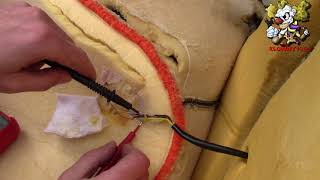
Typical fix: Replace the faulty heating element pad (either seat bottom or back). This requires removing the seat from the truck 🎬 Watch this DIY walkthrough on repairing a broken heating element. and the seat's upholstery (hog rings).
Est. part cost: $80-$250 - Damaged Wiring Harness or Burnt Connector 🟡 Medium Probability The main 12-pin connector at the Heated Seat Control Module (HSCM), located under the front *passenger* seat, is a known weak point. The heavy-gauge power and ground wires can overheat, melting the connector housing and causing a poor connection.
How to confirm: Move the front passenger seat all the way forward and up. Visually inspect the large wiring connector at the silver control module. Look for any signs of melting, charring, or discoloration, especially on the corner pins (heavy gauge wires).
Typical fix: Repair the damaged section of wire using solder and heat shrink. If the module connector is burnt, it must be replaced with a new pigtail connector. Splicing the new connector in wire-by-wire is required.
Est. part cost: $15-$50 - Reversed Element Connectors (Accessory Heaters Only) ⚪ Low Probability This applies specifically to vehicles where a GM *accessory* heated seat kit was installed, not factory heaters. The wiring harness for the kit has two identical connectors for the seat back and bottom elements, which can be easily swapped by mistake during installation.
How to confirm: Per TSB #PIT5215A, inspect the two element connectors under the driver's seat. The lead with convoluted (ribbed plastic) tubing should go to the seat back, and the shorter, taped lead should go to the seat bottom.
Typical fix: Swap the connectors to their correct positions.
Est. part cost: $0 - Blown Fuse ⚪ Low Probability While less common for an isolated B1935 code, a blown fuse can disable the system. This is more likely if both seats are inoperative.
How to confirm: Check the fuse blocks (under the hood and in the cabin) for any blown fuses. Pay special attention to fuses labeled for seats (e.g., 'SEATS', 'MSM', 'HVAC/ECAS').
Typical fix: Replace the blown fuse with a new one of the same amperage.
Est. part cost: $1-$5
Rare But Worth Checking
- Faulty Heated Seat Control Module (HSCM): The module itself, located under the passenger seat, can fail internally. This is usually suspected only after confirming the heating elements and wiring are in good condition. A reset by disconnecting the battery or the relevant fuse for 10-15 minutes can sometimes temporarily resolve the issue, pointing towards a module glitch.
- Faulty Heated Seat Switch: The switch in the door panel can fail, but this is less common than element or wiring failures. If the switch lights behave erratically, don't illuminate at all, or get stuck, it could be the cause.
Diagnosis Steps
- Verify the symptom: Confirm the driver's heated seat is inoperative and note the behavior of the indicator lights on the switch (e.g., turns on then off).
- Scan for codes using a GM-compatible scanner to confirm B1935 and check for any other related body (B) or SRS (B) codes.
- Check Fuses: Check all related fuses in both the under-hood and interior fuse panels, such as 'SEATS' or 'HVAC/ECAS'.
- Inspect Module Connector: Move the passenger seat fully forward and upward. Visually inspect the large connector on the Heated Seat Module for signs of melting or burnt pins, a very common failure.
- Inspect Under-Seat Wiring: Visually inspect all wiring harnesses under the driver's seat for any signs of chafing, cuts, or pinching from the seat tracks.
- Test Heating Elements: Disconnect the driver's seat heating element connectors. Use a multimeter set to Ohms. Test the cushion element (should be ~3.5-11.5 ohms) and the backrest element (~2.5-8.5 ohms). A reading of 'OL' (Open Loop) indicates a broken element that needs replacement.
- Test for Power and Ground: If elements test good, reconnect them. Back-probe the element connector and check for voltage when the switch is activated. The module sends a brief pulse of power; if it detects a fault, it shuts off. Seeing a brief voltage spike then nothing confirms the module is seeing a fault.
- If a GM accessory heater was installed, verify the element connectors are not reversed as described in TSB PIT5215A.
Parts You'll Likely Need
- Driver Seat Cushion Heater Element
(OEM #20792748 (replaces 15232559))— This is the most common failure point. The internal wiring breaks from normal use, creating an open circuit and triggering the code.
Trusted brands: ACDelco / GM Genuine, Dorman
OEM price range: $120-$180
Aftermarket price range: $80-$150 - Driver Seat Back Heater Element
(OEM #20792749 (replaces 15232560, 25911156))— This is the second most common element to fail. It is replaced in the same manner as the seat cushion element.
Trusted brands: ACDelco / GM Genuine, Dorman
OEM price range: $100-$160
Aftermarket price range: $70-$120 - Heated Seat Module Connector Pigtail
(OEM #PT1071 (ACDelco example))— If the main connector to the heated seat module under the passenger seat has melted or corroded pins, this pigtail is needed to repair the harness.
Trusted brands: ACDelco, Dorman
OEM price range: $30-$50
Aftermarket price range: $15-$30
Related Codes That Often Appear With This One
- B2425 — This is another GM-specific code for a 'Driver Seat Heater Circuit' fault. It is often logged alongside B1935 and is mentioned in the same TSB.
- B2430 — This code points to a fault in the Passenger Seat Heater Circuit. If seen with B1935, it could indicate a problem common to both seats, like a power, ground, or the burnt module connector under the passenger seat.
- B0081 — This is a Passenger Presence System (PPS) code. If the under-seat wiring harness is damaged, it can affect both the heated seat circuits and the airbag sensor circuits, causing both codes to appear simultaneously.
Technical Service Bulletins (TSBs) & Recalls
- PIT5215A: Notes that heated seats may be inoperative and set codes B1935, B2180, B2425, or B2430. A primary cause on accessory-equipped vehicles is the seat
Platform-Specific Known Issues
- TSB PIT5215A directly addresses this code, noting that on vehicles with GM accessory heated seats, the issue can be caused by reversed connectors for the seat back and seat bottom heating elements. [Bulletin #PIT5215A, 20]
Mechanic-Grade Diagnostic Values
- Driver Seat Bottom Heating Element Resistance — expected: Approximately 3-4 Ohms. Failure: A reading of 'OL' (Open Loop) or infinite resistance indicates a broken element. A reading over 5 Ohms suggests the element is starting to fail.
- Driver Seat Back Heating Element Resistance — expected: Approximately 5.3-5.5 Ohms. Failure: A reading of 'OL' (Open Loop) indicates a broken element. A reading over 7 or 8 Ohms suggests the element is failing.
Hidden / Shadow Codes Worth Checking
- B1935 Sym 0E: This is a GM-specific symptom byte that accompanies the main DTC. TSB #PIT5215A directly links 'B1935 0E' to a circuit malfunction within the accessory heated seat system, often caused by reversed element connectors or a wiring fault. (see via A professional scan tool capable of reading GM-specific body codes and their symptom bytes, such as a GM Tech2 or GDS2.)
Scan Tool Commands That Help
- GM Tech2 / GDS2: Output Control > Heated Seat Module > Actuator Tests — After verifying the heating elements have correct resistance, this command can be used to bypass the door switch and directly command the Heated Seat Control Module (HSCM) to activate the driver's seat heater. If the seat heats up during this test, the problem lies with the switch or its wiring. If it does not, the issue is likely in the HSCM or the wiring between the module and the element.
Wiring & Ground Locations
- G303 — Near the base of the left (driver's side) 'B' pillar.. Wiring diagrams for the 2008 model year show this as the ground point for the driver's heated seat elements. A corroded or loose connection at G303 could create high resistance or an open in the ground circuit, causing the system to shut down and set a code.
- HSCM Connector (C305 on some diagrams) — Under the front passenger seat, connected to the silver Heated Seat Control Module.. This 12-pin connector is the central hub for power, ground, and control signals for both front heated seats. The power (Pin A, Red/White) and ground (Pin F or B8, Black) wires are known to carry high current, leading to overheating and melting of the connector, which is a primary cause of this code.
Real Owner Repair Stories
- Ford F150 Forum / Lincoln vs Cadillac Forums (describing identical module/connector issue) (Various Ford/Lincoln models using the same HSCM and connector as GM) — Heated/cooled seats stopped working, sometimes accompanied by a burning plastic smell.
❌ Tried (didn't work) Replacing fuses, Resetting the module
✅ What actually fixed it The main connector to the seat control module under the passenger seat was found to have a burnt/melted ground pin. The fix was to replace the connector with a new pigtail (e.g., Motorcraft WPT-928, which also fits GM applications). Some users de-pinned the old connector and replaced only the single burnt wire and terminal to avoid splicing all 12 wires.
OEM Part Supersession History
15232559→20792748— Standard part revision/update for the Driver Seat Cushion Heater Element.15232560, 25911156→20792749— Standard part revision/update for the Driver Seat Back Heater Element.N/A→ACDelco PT2389 (GM #88988313)— This is a common service pigtail for the 12-pin HSCM connector. It is also cross-compatible with Ford's Motorcraft WPT-928, as both manufacturers used the same module.
Helpful Videos
We Have This Part in Stock



The information in this article is provided for general reference and educational purposes only. Vehicle specifications, procedures, and part compatibility can vary by production date, trim level, and region. Always consult your vehicle's factory service manual and verify part numbers before purchasing or performing repairs. Safety-critical components such as airbags, seat belts, and braking systems should be installed by a qualified professional.
- Chevrolet AVALANCHE:
- 🎬 Helpful Videos
- 🛍️ Shop This Part
- What's Unique About the 2007-2013 Chevrolet AVALANCHE
- Diagnostic Flowchart
- Symptoms You May Notice
- Most Likely Causes
- Rare But Worth Checking
- Diagnosis Steps
- Parts You'll Likely Need
- Related Codes That Often Appear With This One
- Technical Service Bulletins (TSBs) & Recalls
- Platform-Specific Known Issues
- Mechanic-Grade Diagnostic Values
- Hidden / Shadow Codes Worth Checking
- Scan Tool Commands That Help
- Wiring & Ground Locations
- Real Owner Repair Stories
- OEM Part Supersession History
- 🎟️ Get 5% Off