

Ultimate B1882 Guide: Seatbelt Pretensioner vs. Power Liftgate Fault
Why B1882 triggers, what it means for your specific car, and how to fix it for good
- Code B1882 indicates a disabled passenger seatbelt pretensioner on Ford and Mazda vehicles, or a disabled power liftgate on 2011-2012 Jeep and Dodge models.
- An active B1882 seatbelt fault completely disables your vehicle's airbag system, making it unsafe to drive until repaired.
- For 2011-2012 Jeep and Dodge owners, do not replace the liftgate motor until a dealer confirms the TSB 08-005-13 software update was performed.
- Diagnosing a seatbelt B1882 requires a multimeter to verify the pretensioner resistance is between 1.5 and 3.3 ohms before replacing parts.
What Does B1882 Mean?
B1882 points to two distinct problems depending on your vehicle. For Ford, Mazda, and Toyota, it signals an electrical short in the passenger seatbelt pretensioner system. For 2011-2012 Jeep/Dodge and some Mercedes-Benz models, it indicates a power liftgate position sensor or wiring failure.
Technical definition: The SAE defines B1882 as 'Seatbelt Passenger Pretensioner Circuit Short to Battery' or 'Short to Voltage', meaning the Restraints Control Module detects abnormally high voltage in the pretensioner circuit. Chrysler and Mercedes define it as 'Power Liftgate Position Sensor 1 Circuit', indicating a sensor or wiring malfunction. Suffixes like B1882-92 denote specific fault types, such as 'Performance or Incorrect Operation'.
Can I Drive With B1882?
No — Do Not Drive. Driving is possible, but unsafe. An active B1882 seatbelt fault completely disables the Supplemental Restraint System (SRS). In a crash, airbags will not deploy and seatbelt pretensioners will not activate. This critical safety failure must be addressed immediately.
Common Causes
- Outdated Power Liftgate Module (PLGM) Software (Jeep/Dodge) (Very Common) — On 2011-2012 Grand Cherokees and Durangos, a software glitch incorrectly flags a sensor fault, disabling the liftgate. TSB 08-005-13 fixes this.
- Damaged Wiring Under Passenger Seat (Very Common) — Moving the seat or storing items underneath stretches and breaks the seatbelt pretensioner wires, causing a short circuit.
- Damaged Wiring in Liftgate Hinge (Common) — Wires passing through the flexible rubber boot fatigue and break after thousands of open/close cycles, losing the position sensor signal.
- Faulty Seatbelt Pretensioner (Common) — The internal wiring of the pyrotechnic 'squib' fails or develops high resistance, creating an electrical fault detected by the Restraints Control Module.
- Weak Liftgate Support Struts (Jeep/Dodge) (Common) — Weak passive gas struts force the motorized strut to work harder. The module misinterprets this excessive current draw as a sensor fault.
- Corroded Electrical Connectors (Less Common) — Moisture or spilled drinks corrode the bright yellow SRS connectors under the seat, interrupting the signal.
Symptoms
- Airbag Warning Light On — The airbag computer illuminates the warning light and disables the entire safety system.
- Power Liftgate Inoperative — The power function is disabled as a safety measure, requiring manual operation.
- Liftgate Stops or Reverses — The liftgate starts to open or close, then suddenly stops or changes direction.
- Liftgate Ajar Warning — The faulty position sensor incorrectly reports the liftgate is open.
Common Fixes & Costs
- Update Power Liftgate Module Software (Jeep/Dodge) — Parts: $0, Labor: $150-$250, ~1.0 hr book time (Professional)
- Repair Damaged Wiring — Parts: $10-$50, Labor: $150-$300, ~1.5 hr book time (Intermediate)
- Replace Seatbelt Pretensioner Assembly — Parts: $150-$350, Labor: $150-$300, ~1.2 hr book time (Professional)
- Replace Weak Liftgate Struts — Parts: $50-$100, Labor: $50-$100, ~0.5 hr book time (DIY)
- Replace Power Liftgate Motor Assembly — Parts: $250-$450, Labor: $150-$250, ~1.5 hr book time (Intermediate)
- Rebuild Seatbelt Pretensioner (Mail-in Service) — Parts: $75-$120, Labor: $100-$150, ~1.0 hr book time (Intermediate)
Used vs. New Parts: Buying Guide
When a used part is worth it: A used OEM Power Liftgate Motor is a good value. Buying used Seatbelt Pretensioners is strictly prohibited due to their single-use pyrotechnic design. Use a reputable rebuild service instead.
Donor-vehicle mileage cap: roughly under 60000 miles for the part to have meaningful remaining life.
Donor quality checklist:
- Verify the donor vehicle was not involved in a collision.
- Match part numbers exactly.
- For mail-in rebuild services, demand a lifetime warranty.
Decision logic:
- If The part is a seatbelt pretensioner or airbag component → Buy new OEM or use a certified rebuild specialist. Never buy from a junkyard.
- If The part is an electronic module or motor → A used part from a reputable recycler with a warranty is cost-effective.
- If The part is a mechanical liftgate strut → Buy new aftermarket parts; used is not worth the minimal savings.
Warranty tradeoff: Used salvage parts carry a 30-90 day warranty. New OEM parts offer 1-year warranties. Reputable seatbelt rebuilders offer lifetime warranties.
Worst-case if a used part fails: $300-$600 if a used electronic module fails, requiring repeat labor and a new part.
What Happens If You Wait — Timeline
- Immediate: Code B1882 sets. For seatbelt faults, the SRS is disabled and the airbag light illuminates. For liftgate faults, the power liftgate is disabled. (MPG impact: 0%% · Added cost: $0)
- 1-6 months: The vehicle automatically fails state safety inspections due to the illuminated airbag light. Liftgate wiring shorts cause adjacent wires to break. (MPG impact: 0%% · Added cost: $50-$200 (Failed inspection fees or complex wiring repairs).)
- 6+ months: Ignoring a liftgate wiring short damages the Power Liftgate Module. Ignoring an SRS light significantly reduces vehicle resale value and creates legal liability. (MPG impact: 0%% · Added cost: $500-$1500 (Module replacement or diminished value).)
Cost of Not Fixing It
- Immediate: The SRS is disabled. Airbags and seatbelt pretensioners will not deploy in a crash, drastically increasing the risk of serious injury. (Added cost: N/A (Safety Risk))
- 0-6 Months: The vehicle automatically fails state safety inspections that check the SRS light. (Added cost: $50-$200 (Failed inspection fees))
- 6+ Months: Ignoring a liftgate wiring issue causes a complete electrical short, damaging the Power Liftgate Control Module. Ignoring an SRS light reduces resale value. (Added cost: $500-$1500 (Module replacement or diminished value))
Diagnosis Steps
- Identify Vehicle Fault Type
Determine if B1882 indicates a seatbelt issue (Ford, Mazda, Toyota) or a liftgate issue (2011-2012 Jeep/Dodge, Mercedes).
Tools: Internet access (Beginner) - Check for TSB 08-005-13 (Jeep/Dodge Liftgate)
Call a dealer with your VIN to verify if the PLGM software update has been performed. This is the mandatory first step for these vehicles.
Tools: Phone, VIN (Beginner) - Inspect Under-Seat Wiring (Seatbelt)
Look under the front passenger seat for the bright yellow wiring harness. Check for pinched or broken wires and ensure connectors are fully seated.
Tools: Flashlight (Beginner) - Inspect Liftgate Hinge Wiring (Liftgate)
Peel back the rubber boot protecting the wires between the vehicle body and the liftgate. Inspect for broken or frayed wires.
Tools: Trim removal tool (Intermediate) - Test Pretensioner Resistance (Seatbelt)
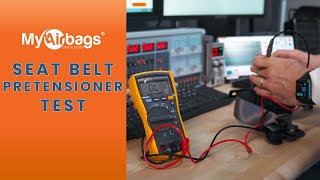
Disconnect the battery for 30 minutes. Unplug the pretensioner connector. Measure resistance across the two pins of the pretensioner unit. Normal is 1.5-3.3 ohms. Anything else requires replacement.
Tools: Multimeter, basic hand tools (Advanced) - Measure Harness Voltage (Seatbelt)
Turn the ignition ON. Measure the voltage between each pin on the vehicle-side harness connector and a chassis ground. Any reading over 0V indicates a short to power.
Tools: Multimeter, probe adapters (Advanced) - Isolate Fault with Test Resistor (Seatbelt)
Plug a 2.0-3.3 ohm SRS test resistor into the vehicle-side harness connector. If the code clears, the vehicle wiring is good and the pretensioner is faulty.
Tools: SRS-safe 2.0-3.3 ohm resistor, scan tool (Professional) - Analyze Live Sensor Data (Liftgate)
Monitor the 'Liftgate Position Sensor 1' PID while manually opening the liftgate. The voltage should change smoothly between 0.5V and 4.5V. Erratic jumps confirm a sensor or wiring fault.
Tools: Professional bidirectional scan tool (Professional) - Scan and Reprogram Module
For a liftgate fault, a dealer must perform the TSB software update. For a seatbelt fault, diagnose the Restraints Control Module if all wiring tests pass.
Tools: OEM-level scan tool (Professional)
When This Code Triggers (Freeze-Frame Conditions)
- System State: Self-Test During Startup (The control module performs a self-check every time the ignition is turned ON, setting the code immediately if a fault is detected.)
- Battery Voltage: 9V - 16V (The code triggers if battery voltage is normal but a specific circuit is shorted to that voltage.)
- Vehicle Speed: 0 mph (Because the fault is detected during the startup self-test, freeze frame data almost always shows 0 mph.)
- Component Status: Fault Present (The code sets the instant the measured voltage or resistance goes outside the manufacturer's specified range.)
Related Codes
- B1883 — Means 'Seatbelt Passenger Pretensioner Circuit Short to Ground'. B1882 indicates high voltage, while B1883 indicates the circuit is touching the vehicle's metal frame.
- B1881 — Indicates an 'Open Circuit' in the passenger pretensioner, meaning a completely broken wire or unplugged connector.
- B1886 — Means 'Seatbelt Passenger Pretensioner Circuit Resistance Low'. Often accompanies a short circuit code that creates a shorter path for electricity.
- B1970 / B1978 — Relates to faults in the power seat adjustment switches. If present with B1882, it confirms a damaged wiring harness under the seat.
Climate & Environmental Factors
- High Humidity / Water Intrusion: Corrodes SRS and liftgate module connector pins, causing high resistance or short circuits.
- Cold Weather: Reduces internal pressure of gas liftgate struts by 10-15%, forcing the motor to overwork and triggering false B1882 codes.
- Vibration and Flexing: Repeated flexing of liftgate hinge wires causes metal fatigue and breakage.
How to Talk to a Mechanic About This Code
Say this: "For a Jeep/Dodge liftgate: 'I have a B1882 code. Before scheduling a diagnostic, can you check my VIN to see if TSB 08-005-13 has been performed?' For an airbag light: 'I have a B1882 code pointing to the passenger pretensioner circuit. Please inspect the wiring under the seat for damage before recommending a new pretensioner.'"
Forces the shop to check the cheapest fixes (software update or wiring repair) before defaulting to expensive part replacements.
Avoid saying:
- 'My airbag light is on, can you just fix it?'
- 'Just do whatever you think is best.'
- 'My liftgate is broken, I think I need a new motor.'
Questions to ask before authorizing the repair:
- Did you test the resistance of the original pretensioner and find it out of spec?
- Did you confirm the TSB software update was performed and the support struts are strong?
- What is the warranty on this specific repair?
Where to Take It: Dealer vs Independent vs Chain
- Dealer:
Required for the Jeep/Dodge software fix. Recommended for SRS repairs if you lack a trusted independent specialist.
Best for: 2011-2012 Jeep/Dodge liftgate faults requiring the TSB software update., Vehicles under warranty., Complex SRS diagnostics.
Downsides: Highest labor rates., Quick to replace entire assemblies rather than repair single wires. (Typical cost: +50% vs. baseline) - Independent Shop:
Best fit for most B1882 repairs, except the Jeep/Dodge software update.
Best for: Diagnosing seatbelt-related B1882 faults., Mercedes liftgate wiring repairs., Out-of-warranty vehicles.
Downsides: Cannot perform the dealer-specific software update for Jeep/Dodge liftgates. (Typical cost: +0% vs. baseline) - Chain Shop:
AVOID. The risk of an incorrect repair on a critical safety system is too high.
Best for: Simple maintenance like oil changes.
Downsides: Lack specialized tools for SRS diagnostics or module programming., High risk of misdiagnosing complex electrical issues. (Typical cost: -10% vs. baseline)
When to Walk Away From the Repair
If the total estimated repair cost exceeds 40-50% of your car's current private-party value, consider selling it.
- Car worth $3500, fix is $1800: Walk away. The repair cost is over 50% of the car's value.
- Car worth $15000, fix is $850: Fix it. The repair is a small fraction of the vehicle's value and critical for safety.
- Car worth $5000, fix is $200: Fix it. This represents a simple fix like a software update or liftgate struts.
What Scan Tool You Need for This Code
Minimum: A scan tool that reads and clears Body (B-prefix) codes for the SRS/Airbag module. Standard engine-only readers will not work.
Basic readers cannot communicate with the SRS or Power Liftgate Module and will report 'No Codes Found' even with the warning light on.
Budget: BlueDriver Pro Scan Tool (~$100) — Reads and clears SRS codes for most major manufacturers, confirming the B1882 code exists and clearing it after a repair.
Mid-range: Foxwell NT510 Elite (~$150) — Provides full-system diagnostics and live data to monitor erratic position sensor signals.
Professional: Autel MaxiCOM MK808 (~$500) — Offers dealer-level diagnostics, live data streams, and PLGM hard resets (cannot perform dealer-only TSB flashes).
Rent vs buy: Auto parts stores do not rent SRS-capable scanners due to liability. Buying a budget or mid-range scanner is required.
How to Clear the Code After You Fix It
- Ensure the underlying fault has been properly repaired.
- Reconnect the vehicle's battery.
- Use a professional-grade OBD-II scan tool capable of accessing the SRS or Body Control Module to clear the fault codes.
- Turn the ignition off, then on again, and verify the warning light turns off after the initial system check.
Drive cycle (~10 minutes): A complex drive cycle is not required. After clearing the code, a 10-minute drive with a few key cycles confirms the fix.
Readiness monitors affected: Not applicable. B1882 is a body code and does not affect emissions readiness monitors.
Watch out for:
- A basic OBD-II engine code reader cannot clear SRS or body control module codes.
- Disconnecting the battery will not clear a hard code like B1882 from the module's memory.
- If the code returns immediately, the underlying electrical fault was not fixed.
Will This Fail Emissions / State Inspection?
No — by itself this code doesn't fail OBD inspection (but it can keep readiness monitors from setting, which causes a separate fail).
- California: An illuminated airbag light does not cause a smog test failure, but technicians note it as a safety issue.
- New York: The airbag warning lamp is checked during safety inspections. If on, it is an advisement but not cause for rejection.
- Texas: An illuminated airbag light is not on the safety inspection checklist and will pass.
- Virginia: An illuminated airbag light causes an automatic failure of the state safety inspection.
Most Commonly Affected Vehicles
- Jeep Grand Cherokee (2011-2012) — B1882 indicates a 'Power Liftgate Position Sensor Circuit' fault due to a software glitch covered by TSB 08-005-13.
- Dodge Durango (2011-2012) — Shares the same platform and faulty Power Liftgate Module software as the Grand Cherokee.
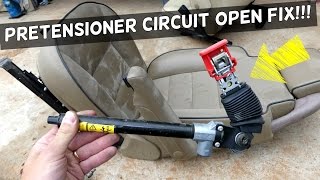
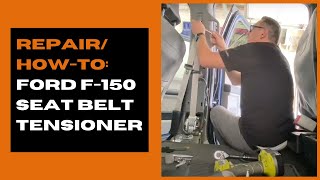
- Ford F-150 (2004-2008) — B1882 reliably points to a 'Passenger Pretensioner Circuit Short to Voltage' fault. Wiring under the passenger seat is the primary suspect. 🎬 Watch: Ford F-150 seatbelt pretensioner assembly replacement walkthrough.
- Ford Expedition (2002-2006) — Prone to B1882 as a seatbelt pretensioner fault. The service manual provides a specific pinpoint test for shorts to battery in circuits 1081 and 1082.
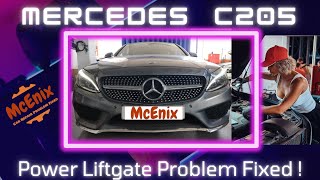
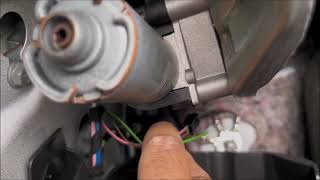
- Mercedes-Benz C-Class (W205) (2015-2021) — B1882-29 indicates a power tailgate position sensor malfunction, frequently caused by broken wires in the hinge harness. 🎬 Watch: Troubleshooting the Mercedes B1882-29 position sensor fault.
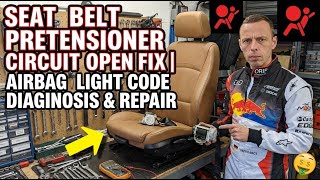
- Mazda 6 (2009-2013) — Indicates an issue with the passenger-side pre-tensioner circuit. Pretensioner resistance must test between 1.5-3.1 ohms. 🎬 See how to perform a pretensioner OHM resistance test.
- Toyota Tacoma / Camry (2004-2015) — B1882 records a fault in a 'squib circuit', referring to the pyrotechnic igniter circuit for seatbelt pretensioners or specific airbags.
- General Motors Silverado / Sierra (2007-2014) — Appears for a passenger pretensioner fault. Diagnosis requires verifying communication with the Sensing and Diagnostic Module (SDM).
Manufacturer-Specific Notes
- Ford / Mazda: B1882 consistently means 'Passenger Pretensioner Circuit Short to Voltage'. Diagnosis focuses entirely on the SRS system and under-seat wiring.
- Chrysler (Jeep / Dodge): On 2011-2012 models, B1882 relates to the power liftgate. Checking for TSB 08-005-13 is the mandatory first diagnostic step.
- Mercedes-Benz: B1882 points to a power liftgate position sensor malfunction, but the root cause is almost always broken wires in the liftgate hinge harness.
- Toyota: Toyota uses 'squib' to describe all SRS igniter circuits. B1882 requires careful diagnosis to pinpoint the exact squib circuit at fault.
Real Owner Stories
2012 Jeep Grand Cherokee with 115K miles
The power liftgate suddenly stopped working and would only operate manually. The owner heard a click but saw no movement.
What they tried:
- Checked fuses.
- Replaced the non-motorized liftgate support struts.
Outcome: The owner called a Jeep dealership with their VIN. The dealer confirmed TSB 08-005-13, a software update for the Power Liftgate Module (PLGM), had never been performed. A one-hour dealer appointment to flash the new software completely fixed the problem for $200.
Lesson: For 2011-2012 Jeep/Dodge owners, always verify TSB 08-005-13 has been performed before replacing hardware. A simple software flash often resolves this code.
2015 Mercedes C-Class (W205) at 70K miles
The power trunk would not open electronically. A scan revealed code B1882-29, indicating an invalid signal from the position sensor.
What they tried:
- Priced out a replacement position sensor and motor assembly.
Outcome: The owner removed the trunk trim to access the wiring harness near the liftgate hinge. They discovered five broken wires within the harness. They repaired the wires using solder and heat shrink tubing, restoring full power liftgate function.
Lesson: On vehicles where the wiring harness flexes with movement, wire fatigue is the primary failure point. Inspect the hinge wiring before replacing the motor or sensor.
2009 Mazda 6 with an intermittent airbag light
The airbag light illuminated intermittently, usually after moving the passenger seat.
What they tried:
- Wiggled the yellow connector under the passenger seat, which temporarily turned the light off.
Outcome: The owner disconnected the battery, unplugged the yellow SRS connector under the seat, cleaned the contacts, and secured it firmly with a zip tie to prevent movement. This permanently resolved the issue.
Lesson: The under-seat connector is the most common culprit for seatbelt-related B1882 codes. Securing a loose connector is a highly effective, zero-cost repair.
How to Prevent This Code From Triggering
- Keep the area under front seats clear of debris. (Daily) — Items sliding under the seat snag and break sensitive SRS wiring harnesses, causing open or short circuits.
- Clean and lubricate power liftgate hinges and tracks. (Every 6 months) — Reduces mechanical friction, preventing the motor from straining and triggering false circuit faults in the control module.
- Address interior water leaks immediately. (As needed) — Water intrusion corrodes SRS and body control module connectors, causing high resistance and electrical shorts.
- Secure loose wiring with split loom tubing. (During any repair) — Prevents chafing and abrasion against the vehicle body in high-movement areas like liftgate hinges or under seats.
Frequently Asked Questions
Can I fix code B1882 myself?
Simple issues like loose connectors or weak liftgate struts are DIY-friendly. However, SRS part replacements or module software updates require professional tools and expertise. A software flash for Jeep/Dodge liftgates is a dealer-only task.
What is the biggest misdiagnosis for B1882?
For Jeep/Dodge, replacing the expensive liftgate motor before confirming the TSB 08-005-13 software update was performed. For seatbelt faults, replacing the pretensioner when the actual fault is damaged under-seat wiring.
Can a weak liftgate strut cause an electrical code?
Yes. If a weak gas strut provides insufficient support, the power liftgate motor works much harder. The control module interprets this irregular current draw as a position sensor circuit fault, setting code B1882.
Why is the airbag connector yellow?
Industry convention uses bright yellow connectors for the Supplemental Restraint System (SRS). This visually warns technicians they are handling a critical safety system containing explosive pyrotechnic devices.
Will clearing the code fix the problem?
No. B1882 is a hard code that triggers a self-test at every startup. If the underlying electrical short or software glitch remains, the code returns immediately.
What is a seatbelt pretensioner?
A pretensioner uses a small pyrotechnic charge to rapidly pull the seatbelt tight during a crash. This removes slack and holds the occupant firmly in their seat, maximizing airbag effectiveness.
Can I use a resistor to turn off the light permanently?
No, using a resistor is strictly a temporary diagnostic tool. Leaving it installed permanently disables that specific safety component. In a crash, the pretensioner will not activate, creating a severe safety hazard.
What does the suffix on my code mean?
A two-digit suffix provides specific fault details. For example, B1882-29 means 'Invalid Signal' on a Mercedes, while B1882-92 means 'Incorrect Operation' on a Jeep. This helps technicians pinpoint the exact failure mode.
Key Takeaways
- Code B1882 indicates a disabled passenger seatbelt pretensioner on Ford and Mazda vehicles, or a disabled power liftgate on 2011-2012 Jeep and Dodge models.
- An active B1882 seatbelt fault completely disables your vehicle's airbag system, making it unsafe to drive until repaired.
- For 2011-2012 Jeep and Dodge owners, do not replace the liftgate motor until a dealer confirms the TSB 08-005-13 software update was performed.
- Diagnosing a seatbelt B1882 requires a multimeter to verify the pretensioner resistance is between 1.5 and 3.3 ohms before replacing parts.
Helpful Videos

The information in this article is provided for general reference and educational purposes only. Vehicle specifications, procedures, and part compatibility can vary by production date, trim level, and region. Always consult your vehicle's factory service manual and verify part numbers before purchasing or performing repairs. Safety-critical components such as airbags, seat belts, and braking systems should be installed by a qualified professional.
- 🎬 Helpful Videos
- What Does B1882 Mean?
- Can I Drive With B1882?
- Common Causes
- Symptoms
- Common Fixes & Costs
- Used vs. New Parts: Buying Guide
- What Happens If You Wait — Timeline
- Cost of Not Fixing It
- Diagnosis Steps
- When This Code Triggers (Freeze-Frame Conditions)
- Related Codes
- Climate & Environmental Factors
- How to Talk to a Mechanic About This Code
- Where to Take It: Dealer vs Independent vs Chain
- When to Walk Away From the Repair
- What Scan Tool You Need for This Code
- How to Clear the Code After You Fix It
- Will This Fail Emissions / State Inspection?
- Most Commonly Affected Vehicles
- Manufacturer-Specific Notes
- Real Owner Stories
- 2012 Jeep Grand Cherokee with 115K miles
- 2015 Mercedes C-Class (W205) at 70K miles
- 2009 Mazda 6 with an intermittent airbag light
- How to Prevent This Code From Triggering
- Frequently Asked Questions
- Can I fix code B1882 myself?
- What is the biggest misdiagnosis for B1882?
- Can a weak liftgate strut cause an electrical code?
- Why is the airbag connector yellow?
- Will clearing the code fix the problem?
- What is a seatbelt pretensioner?
- Can I use a resistor to turn off the light permanently?
- What does the suffix on my code mean?
- Key Takeaways
- 🎟️ Get 5% Off