

B1788 on 2020-2022 Subaru Outback: Occupant Detection System Causes and Fixes
This code indicates a fault in the passenger-side Occupant Detection System (ODS). For many 2020-2022 Outback and Legacy models, this is caused by a manufacturing defect covered under Safety Recall WRA-24 (NHTSA #24V-227), making the repair free. The defect involves a cracked capacitor on the sensor's circuit board. If not covered by the recall, the fix may be a simple recalibration, but often requires replacing the ODS sensors, which are part of the passenger seat cushion assembly, at a signifi
- B1788 is a critical safety code for the passenger airbag system; do not ignore it.
- Check for Safety Recall WRA-24 first; if your VIN is affected, the repair is free at a Subaru dealer.
- The cause is a known manufacturing defect in the ODS sensor's circuit board for many vehicles.
- If not covered by the recall, the first professional step is a system recalibration.
- If recalibration and wiring checks fail, the required repair is replacing the ODS sensors, which is an expensive, non-DIY job.
What's Unique About the 2020-2022 Subaru OUTBACK
For the 2020-2022 Outback, this code is addressed by two key documents. First, Subaru TSB #18-217-22R was issued to correct the original factory service manual's diagnostic procedure. More importantly, Subaru issued Safety Recall WRA-24 (NHTSA #24V-227) for 118,723 Outback and Legacy vehicles due to a high failure rate of the ODS sensors. The recall identifies a specific manufacturing defect in the sensor's circuit board as the root cause. This means for a large number of owners, the diagnosis is confirmed and the repair is performed for free at a dealership, superseding the standard diagnostic path that would lead to a costly replacement of the seat cushion assembly.
Diagnostic Flowchart
Tap your situation to follow the diagnostic path that matches what you're seeing on this vehicle.
Symptoms You May Notice
- Airbag warning light illuminated on the dashboard.
- Passenger airbag 'OFF' indicator is lit even when an adult is seated.
- Passenger airbag 'ON' indicator may be off when an adult is seated
- Replacing the airbag control module without diagnosing the ODS system first.
- Attempting to replace just the sensor mat, which is not typically sold separately from the seat cushion assembly for this model (though the recall procedure replaces the individual sensors).
- Charging a customer for a seat cushion replacement when their vehicle is covered under the WRA-24 safety recall.
Most Likely Causes
- Faulty Occupant Detection Sensor (Manufacturing Defect) 🔴 High Probability A capacitor on the ODS sensor's Printed Circuit Board (PCB) is prone to cracking due to a manufacturing defect. This allows moisture to enter and cause a short circuit. This widespread issue prompted Safety Recall WRA-24 for 118,723 vehicles.
How to confirm: A Subaru dealer confirms the vehicle's VIN is part of recall WRA-24. The presence of DTC B1788 confirms the failure has occurred.
Typical fix: Perform recall service WRA-24, where a dealer replaces all four ODS sensors on the front passenger seat with new parts, free of charge.
Est. part cost: $0 - Temporary Fault from Seat Impact ⚪ Low Probability The sensor system is sensitive and can register a fault if the seat is subjected to a sharp jolt or a heavy object is dropped on it. This is less likely to be the root cause given the known manufacturing defect.
How to confirm: A technician will attempt a 'Zero Point Calibration and Sensitivity Check'. If the procedure completes successfully and the code clears (and the vehicle is not under recall), this was the cause.
Typical fix: Perform Zero Point Calibration and Sensitivity Check with a compatible scan tool. No parts are replaced.
Est. part cost: $0 - Wiring Harness or Connector Issue ⚪ Low Probability Connectors under the seat can be disturbed by items stored there or during vehicle cleaning. However, this is much less common than the sensor failure itself.
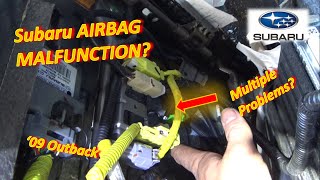
How to confirm: A visual inspection reveals damage, or a technician finds a lack of continuity 🎬 See this DIY troubleshooting guide for seat and harness defects or poor pin tension when testing the harness per the TSB diagnostic steps. This would typically be performed on a vehicle not covered by the recall.
Typical fix: Repair the damaged wiring or clean/secure the connector. In rare cases, a harness pigtail or section may need replacement.
Est. part cost: $0-$150
Rare But Worth Checking
- Occupant Classification ECU Malfunction: This is the control module for the ODS. While listed as a possible cause in service literature, it is much less common than sensor failure. It should only be considered after all other steps in the TSB have been exhausted and the vehicle is confirmed to not be part of the WRA-24 recall.
Diagnosis Steps
- Check if the vehicle's VIN is covered by Subaru Safety Recall WRA-24 using the Vehicle Coverage Inquiry function on subarunet.com or by contacting a dealer. This is the most critical first step.
- If the recall is active, take the vehicle to a Subaru dealer for the free repair. The diagnosis is complete.
- If the recall is not applicable, proceed with the standard diagnosis. Read DTCs with a Subaru-compatible scan tool to confirm B1788 is the active code.
- Perform a thorough visual inspection of the passenger seat area, including under the seat, for any foreign objects, aftermarket seat covers, or damage to the wiring harness.
- Attempt to clear the code and perform the 'Zero Point Calibration and Sensitivity Check' as described in the service manual.
- If the code returns, follow the detailed diagnostic procedure in TSB #18-217-22R. This involves using specific test harnesses to check wiring and connector integrity between the sensor and the ODS ECU.
- If the code is still present after all diagnostic steps in the TSB are completed, the passenger ODS sensors require replacement. This typically involves replacing the seat cushion assembly.
- After replacement, perform the Zero Point Calibration and Sensitivity Check 🎬 Watch: How to perform a passenger detection system calibration again to initialize the new sensor.
Parts You'll Likely Need
- Front Seat Cushion Frame Assembly (Right Hand) / ODS Sensors
(OEM #Varies by trim (cloth/leather, heated/non-heated, etc.))— For vehicles not covered by the recall, TSB #18-217-22R points to replacing the entire assembly. For vehicles covered by recall WRA-24, the dealer replaces the four individual ODS sensors within the assembly. These sensors are the root cause of the failure.
Trusted brands: Subaru (OEM)
OEM price range: $800-$1500
Aftermarket price range: Not Available
Technical Service Bulletins (TSBs) & Recalls
- WRA-24 / NHTSA #24V-227: Safety Recall – ODS Sensor Replacement. This is the most critical document, overriding standard repairs for affected VINs. It details the defect and the free replacement of all four ODS sensors.
- 18-217-22R: Service Manual Correction / DTC B1788 Occupant Detection Sensor Power Supply. This TSB provides the official, updated diagnostic steps for technicians to follow if a vehicle is not covered by the recall.
Platform-Specific Known Issues
- Subaru issued TSB #18-217-22R specifically to correct the diagnostic procedure for this code on 2020-2022 Outback, Legacy, and 2022 BRZ models, indicating it was a point of confusion for technicians.
- A major safety recall, WRA-24 (NHTSA #24V-227), was issued for 118,723 Outback and Legacy models from 2020-2022 because of this specific issue, making the repair free for affected owners.
- The recall was prompted by a manufacturing defect in a capacitor on the sensor's circuit board, which could crack and short circuit, disabling the passenger airbag.
Mechanic-Grade Diagnostic Values
- Voltage between test harness BB (98299FL020) connector terminal 2BB, pin #5, and chassis ground. — expected: Less than 1V. Failure: Voltage of 1V or more indicates a short to power in the harness.
- Torque for battery ground terminal when reconnecting. — expected: 7.5Nm (5.5 ft-lbs). Failure: Improper torque can lead to poor connections.
- Torque for new ODS sensor mounting nuts during recall repair. — expected: 25Nm (18.5 ft-lbs). Failure: N/A - This is an installation specification.
- ODS Control Module Ignition Power Supply Voltage — expected: 9 - 16 V. Failure: Voltage outside this range indicates a power supply issue to the module.
Hidden / Shadow Codes Worth Checking
- B178D, B178E, B178F, B1790, B1791, B1792, B1793, B1794: These are related ODS sensor circuit codes. If any of these are present alongside B1788, the diagnostic procedure in TSB 18-217-22R instructs the technician to diagnose these codes first before proceeding with B1788 diagnostics. (see via Subaru Select Monitor (SSM) or equivalent professional scan tool.)
Scan Tool Commands That Help
- Subaru Select Monitor (SSM): Zero Point Adjustment / System Calibration (Rezeroing) — This function is required after replacing any ODS components, disassembling the passenger seat, or to clear temporary faults. It establishes a baseline for the empty seat. It has strict prerequisites, including the vehicle being on a level surface and the seat temperature being between 32-104°F (0-40°C).
- Subaru Select Monitor (SSM): Read Diagnostic Code(s) Display / Clear Memory — Used to read the specific SRS/ODS trouble codes and to clear them after a repair has been completed.
Wiring & Ground Locations
- AB67, AB68, AB69, AB70 — Under the front passenger seat, connecting directly to the four individual ODS load sensors.. These are the primary sensor connectors. TSB 18-217-22R provides a procedure for testing the harness using these connection points with a special test harness.
- AB7 — Connector for the rear airbag harness, located under the passenger seat.. This is a key connection point for isolating and testing the harness between the main vehicle body and the seat components, as detailed in TSB 18-217-22R.
- OBD-II DLC Connector — Under the driver's side dashboard, above the pedals.. This is the access point for the Subaru Select Monitor. Pins 4 and 5 are grounds, Pin 16 is battery power, and pins 9, 11, 12, and 13 are used for SSM communication.
Real Owner Repair Stories
- Reddit user on r/SubaruForester (2016 Subaru Forester (similar ODS system)) — Recurring passenger airbag OFF light, even after a previous recall repair.
❌ Tried (didn't work) Taking it to the original dealer, who read the code and quoted a full seat replacement without performing detailed diagnostics.
✅ What actually fixed it The issue was not fully resolved in the thread, but the user made progress by contacting Subaru of America, who then sponsored a proper diagnostic (including harness continuity checks) at a different dealership. This highlights that a code read is insufficient and the full TSB diagnostic procedure is necessary. - YouTube user 'Advancing DIY' (2018 Subaru Forester (similar ODS system)) — Airbag warning light on, dealer diagnosed ODS fault and quoted $1468 for seat cushion replacement.
❌ Tried (didn't work) Initial dealer diagnosis.
✅ What actually fixed it The airbag light turned off and stayed off after the owner wiggled the harness connector under the passenger seat while trying to read a part number label. This strongly suggests an intermittent connection in the harness was the root cause, not a failed sensor. The owner was able to pass state inspection and later negotiated with Subaru of America for 'Goodwill' assistance to reduce the cost of a permanent repair.
OEM Part Supersession History
Seat Cushion Assembly (Varies, e.g., 64139AN00A, 64139AN01B)→Individual ODS Sensors (replaced via WRA-24 recall)— Recall WRA-24 created a procedure to replace only the four failed ODS sensors and their mounting nuts (p.n. 64157AN03A) instead of the entire seat cushion assembly.
Heads up: The recall parts are restricted and must be ordered by a dealer through a special Quality Monitoring Report (QMR) process; they are not available for general sale.N/A→99804AN090 (Socket Tool), 99804AN100 (JIG Tool)— These are special service tools created specifically for dealers to perform the WRA-24 recall repair.
Heads up: These are dealer-only tools required for the recall procedure.
Model Year Variations Within This Range
- 2020-2022: There are no known significant variations in the ODS system, its failure mode, or the diagnostic/repair process for this code within the 2020-2022 model year range. The manufacturing defect and subsequent recall (WRA-24) apply consistently across all three years.
Helpful Videos
We Have This Part in Stock

The information in this article is provided for general reference and educational purposes only. Vehicle specifications, procedures, and part compatibility can vary by production date, trim level, and region. Always consult your vehicle's factory service manual and verify part numbers before purchasing or performing repairs. Safety-critical components such as airbags, seat belts, and braking systems should be installed by a qualified professional.
- Subaru OUTBACK:
- 🎬 Helpful Videos
- 🛍️ Shop This Part
- What's Unique About the 2020-2022 Subaru OUTBACK
- Diagnostic Flowchart
- Symptoms You May Notice
- Most Likely Causes
- Rare But Worth Checking
- Diagnosis Steps
- Parts You'll Likely Need
- Technical Service Bulletins (TSBs) & Recalls
- Platform-Specific Known Issues
- Mechanic-Grade Diagnostic Values
- Hidden / Shadow Codes Worth Checking
- Scan Tool Commands That Help
- Wiring & Ground Locations
- Real Owner Repair Stories
- OEM Part Supersession History
- Model Year Variations Within This Range
- 🎟️ Get 5% Off