

OBD-II Code B1784: Ignition Key Antenna Circuit Malfunction
The Ultimate 2026 Guide to Diagnosing and Fixing B1784
- Code B1784 indicates a total communication failure between the ignition key and the Ford PATS anti-theft system, preventing the engine from starting.
- Always test a programmed spare key first; a failed transponder chip inside the primary key causes a significant percentage of these faults.
- The most common hardware fix is replacing the PATS transceiver antenna ring, a $40-$100 plug-and-play part requiring no reprogramming.
- On 2004 and newer Ford trucks, an intermittent B1784 code often points to cracked solder joints in the instrument cluster, requiring a $200-$600 professional repair.
- Remove heavy keychains and other transponder keys from your ring to eliminate radio frequency (RF) interference before replacing any parts.
What Does B1784 Mean?
The B1784 code means the Passive Anti-Theft System (PATS) module is not receiving a signal from the transceiver antenna around the ignition lock cylinder. This antenna energizes and reads the security chip inside your key. Without this signal, the computer assumes a theft attempt is in progress and disables the engine.
Technical definition: PATS Transceiver Module Signal Is Not Received. This diagnostic trouble code (DTC) is logged by the PATS control module when it fails to receive any signal from the ignition key transceiver after the ignition is switched to the ON position. It indicates a complete break in communication between the key reader and the module.
Can I Drive With B1784?
Yes, But With Caution. If the engine starts, the vehicle is mechanically safe to drive. However, the underlying fault creates a significant risk: the anti-theft system can fail at any time, preventing the engine from starting. This leaves you stranded after a routine stop. The risk is not vehicle damage, but complete immobilization.
Common Causes
- Faulty PATS Transceiver (Antenna Ring) (Very Common) — The transceiver is a coil antenna surrounding the ignition cylinder. It is the most common failure point, breaking internally due to age, vibration, or damage to its fine coil windings.
- Faulty Ignition Key (Common) — The transponder chip inside the key head fails, sustains damage from drops, or loses its programming. This renders the key unable to respond to the transceiver's signal.
- Damaged Wiring or Connectors (Common) — The wiring from the transceiver to the control module sustains damage, often where it flexes within the steering column from tilt-wheel use. Connectors also become loose or disconnected from previous dash repairs.
- Radio Frequency (RF) Interference (Less Common) — Strong RF interference disrupts the low-power signal between the key and transceiver. Common sources include having multiple transponder keys on the same keychain, large metal objects, or cheap aftermarket phone chargers.
- Faulty Instrument Cluster (HEC/VIC) (Less Common) — On many Ford models, the instrument cluster is an active part of the PATS security chain. Cracked solder joints on the cluster's circuit board cause intermittent communication failures, leading to a B1784 code.
- Aftermarket Remote Starter Issues (Rare) — Improperly installed remote start systems use a PATS bypass module that tricks the car into thinking a key is present. Failure of this bypass module directly interferes with the PATS transceiver circuit.
- Corrupted Key Data in Module Memory (Rare) — A significant voltage drop or spike, such as during a jump-start, occasionally corrupts the key data stored in the PATS module's memory. The system then fails to recognize valid keys.
- Failed Powertrain Control Module (PCM) or Body Control Module (BCM) (Very Rare) — The control module that manages the PATS system fails internally. This is the least likely cause and should only be considered after exhaustively checking all wiring and grounds.
Symptoms
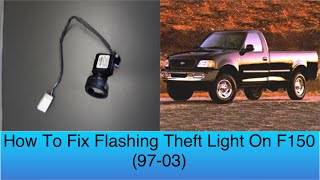
- Engine will not start and theft light flashes rapidly 🎬 Watch: How to fix a flashing theft light on F-150s — The engine fails to start, and the anti-theft light (often a car with a lock symbol) blinks rapidly instead of turning off after a few seconds.
- Engine cranks but will not fire — PATS allows the starter to crank the engine but disables the fuel injectors or ignition system. The engine turns over but never fires.
- Engine will not crank at all — PATS disables the starter relay. Turning the key produces no response, though interior electronics function normally.
- Intermittent no-start condition — The vehicle starts normally for weeks, then fails unpredictably. Temperature or humidity changes often trigger the fault, pointing to a failing solder joint or cracked wire.
- Code B1784 is stored in memory (scan-tool only — no driver-felt sign) — A B1784 trouble code is found in the Body Control Module (BCM) or Instrument Cluster Module (ICM) when scanned with a compatible OBD-II scanner.
Common Fixes & Costs
- Replace PATS Transceiver Antenna Ring
— Parts: $40-$100, Labor: $100-$175, ~1 hr book time
(DIY)
: OEM
: OEM
: OEM - Replace and Program a New Key — Parts: $20-$80, Labor: $100-$250, ~1 hr book time (Professional)
- Repair Wiring Harness — Parts: $10-$30, Labor: $150-$350, ~2.5 hr book time (Intermediate)
- Repair or Replace Instrument Cluster — Parts: $200-$600 (Used/Remanufactured), Labor: $150-$300, ~1.5 hr book time (Professional)
- Replace Powertrain/Body Control Module (PCM/BCM) — Parts: $700-$1200, Labor: $150-$250, ~1.5 hr book time (Professional)
Used vs. New Parts: Buying Guide
When a used part is worth it: A used PATS transceiver ring makes sense if purchased from a reputable seller with a warranty. Because it is a simple antenna coil without complex electronics, a tested used unit performs identically to a new one. This is highly recommended for older vehicles where new OEM parts are discontinued.
Donor-vehicle mileage cap: roughly under 150000 miles for the part to have meaningful remaining life.
Donor quality checklist:
- Match the OEM part number exactly, though the final two letters (suffix) may sometimes differ without affecting compatibility.
- Ensure the seller offers a warranty or return policy.
- Visually inspect the part for any cracks in the plastic housing or damage to the connector and wiring pigtail.
Decision logic:
- If A new aftermarket or OEM part is available for under $100 → Buy new. The small cost saving for a used part is not worth the risk of it failing prematurely.
- If The vehicle is over 15 years old and a new OEM part is discontinued or very expensive → A tested used part from a reputable salvage yard or online seller is a perfectly acceptable and cost-effective option.
- If The only available part is a used one with a questionable history or no return policy → Avoid it. The risk of receiving a non-functional part and repeating the labor is too high.
Warranty tradeoff: Used parts typically offer a 30-90 day warranty. New aftermarket parts usually come with a 1-year to limited lifetime warranty. New OEM parts carry a 1-2 year warranty.
Worst-case if a used part fails: $100-$200 if a used part fails after installation, primarily due to repeated labor costs and diagnostic time.
Cost of Not Fixing It
- Immediate: Intermittent no-start condition creates unpredictable reliability. You risk being stranded without warning. (Added cost: $75-$200 for a potential tow.)
- 1-3 months: The intermittent problem becomes a permanent no-start condition. The vehicle is completely immobilized. (Added cost: $250-$500 for an emergency mobile locksmith visit or a tow plus dealership diagnostic fees.)
- 6+ months: No additional mechanical damage occurs to the vehicle. The primary cost is the complete loss of vehicle use and the eventual cost of repair, which does not increase over time but becomes unavoidable. (Added cost: N/A)
Diagnosis Steps
- Try a Spare Key & Isolate
Remove all other keys and fobs from the keychain. Try to start the car with only the single key. If it fails, try a different, known-good programmed key. If the spare key works, the original key's transponder is faulty.
Tools: Spare programmed key (Beginner) - Observe the Theft Light 🎬 Watch: How to diagnose Ford anti-theft codes without a scanner
Turn the key to the 'ON' position and watch the anti-theft light. A rapid, continuous flash indicates a PATS fault. If it flashes a specific pattern 🎬 See this guide on decoding Ford F-150 theft light patterns (e.g., 1 flash, pause, 6 flashes for Code 16), this points to a different issue than a total communication loss.
Tools: None (Beginner) - Scan for All Related Codes
Use an OBD-II scanner capable of reading Body ('B') and Powertrain ('P') codes. Look for B1681, B1600, B1232, or P1260. The presence of P1260 ('Theft Detected') confirms the no-start is due to PATS. The specific 'B' code narrows the fault.
Tools: OBD-II Scanner (with BCM/PATS capability) (Intermediate) - Inspect Transceiver and Wiring
Remove the steering column shrouds. Visually inspect the transceiver ring around the ignition cylinder and its 4-pin connector. Look for pinched wires, loose connections, or signs of damage. Jiggle the connector and harness while trying to start the car to check for intermittent faults.
Tools: Screwdriver set, trim removal tools (Intermediate) - Pro Tip: Measure Transceiver Coil Resistance
With the transceiver disconnected, use a multimeter to measure the resistance between the TX and RX pins (usually Pins 1 and 2) on the transceiver itself. A good transceiver coil has low resistance, typically between 5 and 15 ohms. A reading of infinity (OL) indicates a broken internal coil, confirming the transceiver is bad.
Tools: Multimeter (Advanced) - Pro Tip: Test the Transceiver Circuit with a Multimeter
Disconnect the transceiver's 4-pin connector. Using a wiring diagram, probe the harness-side connector. You should find: Pin 1 (TX): AC voltage signal when key is turned on. Pin 2 (RX): AC voltage signal when key is turned on. Pin 3 (GND): Continuity to chassis ground (<5 ohms). Pin 4 (B+): Battery voltage (12V+) with key on. A lack of power or ground indicates an upstream wiring issue.
Tools: Multimeter, vehicle-specific wiring diagram (Advanced) - Check Fuses
Consult your owner's manual to locate and check all fuses related to the Instrument Cluster, PCM, and BCM. A single blown fuse disables the entire PATS system.
Tools: Fuse puller or needle-nose pliers (Intermediate) - Pro Tip: Analyze Live Data PIDs
Using a professional scan tool, monitor PATS-related PIDs. Key PIDs include 'PATS_STATUS' (should show 'Active' or 'Enabled'), 'NUM_KEYS' (should show 2 or more), and 'PATS_KEY_VALID' (should read 'Yes' with a programmed key). A 'No' or invalid status on these PIDs while using a known-good key points towards a module or communication issue.
Tools: Professional OBD-II Scan Tool (Advanced) - Pro Tip: Check Fuel System Pressure
When PATS is activated and causing a no-start, it typically disables the fuel pump relay. Connect a fuel pressure gauge to the fuel rail's Schrader valve. Turn the key to the 'ON' position (KOEO). If the gauge reads 0 PSI and code P1260 is present, it confirms PATS has disabled the fuel system.
Tools: Fuel pressure gauge (Advanced) - Pro Tip: Analyze the Transceiver Signal with an Oscilloscope
For definitive diagnosis, connect an oscilloscope to the transceiver's RX wire. When the ignition is turned on, you should see a distinct waveform: an initial unmodulated carrier wave from the transceiver, followed by a modulated signal returned from the key's transponder. A flat line confirms a lack of communication.
Tools: Oscilloscope, wiring diagram (Professional)
When This Code Triggers (Freeze-Frame Conditions)
- Ignition Status: RUN (The fault is logged the moment the key is turned to the 'ON' or 'RUN' position and the PATS module fails to receive a signal from the key.)
- Battery Voltage: 11.5V - 12.5V (Typically occurs at normal battery voltage; however, very low voltage during a crank attempt causes various module errors, though not usually B1784 directly.)
- PATS Status: Error / No Signal (The internal status flag within the PATS control module shows a failure to receive the key's transponder signal.)
- Engine RPM: 0 (Since the code is set at Key-On-Engine-Off (KOEO) and prevents the engine from starting, the RPM remains zero.)
Related Codes
- B1681 — Functionally identical to B1784. Both mean the transceiver signal was not received. Some scanners or vehicle models use one code preferentially over the other for the exact same fault.
- B1600 / B1601 — Indicates an invalid key signal was received. B1784 means NO signal was received at all (points to transceiver/wiring). B1600 means a signal WAS received, but the key's code was unreadable or not programmed to the car (points to the key itself or interference).
- B1232 / B2103 — These codes specifically diagnose an electrical open/short in the transceiver's antenna coil. They are a definitive confirmation that the transceiver ring itself has failed internally.
- P1260 — This is the 'effect' code from the Powertrain Control Module (PCM). B1784 explains WHY the security check failed; P1260 is the PCM confirming that, because of that failure, it has immobilized the engine. You will almost always find P1260 alongside a PATS 'B' code.
Climate & Environmental Factors
- Extreme Cold: Causes hairline cracks in solder joints on the instrument cluster or within the transceiver module to contract and separate, leading to an open circuit and failure. The issue often resolves itself as the cabin warms up.
- Extreme Heat: High cabin temperatures cause electronic components to fail when their operational temperature limits are exceeded. This affects the PATS module, instrument cluster, or the key itself.
- High Humidity: Moisture penetrates connectors and circuit boards, leading to corrosion and intermittent short circuits. This causes a wide range of electrical issues, including PATS faults.
How to Clear the Code After You Fix It
- Perform the physical repair (e.g., replace the transceiver).
- Reconnect any disconnected components, including the battery if it was removed.
- Use an OBD-II scanner capable of reading 'B' (Body) codes to clear the fault from the PATS/BCM module.
Drive cycle: A traditional drive cycle is not required for this code. The PATS system self-tests every time the ignition is turned on. After clearing the code, simply turn the ignition off, then turn it to 'ON' or 'START'. If the repair was successful, the theft light will prove out (turn on for a few seconds, then turn off) and the vehicle will start. If the fault persists, the code will be set again immediately.
Readiness monitors affected: None
Watch out for:
- Simply disconnecting the battery will not clear this code from memory.
- The code returns instantly upon the next key cycle if the root cause (bad part or wiring) has not been fixed.
- Using a basic OBD-II scanner that only reads 'P' (Powertrain) codes cannot see or clear the 'B' (Body) code B1784.
Will This Fail Emissions / State Inspection?
Yes — this code typically fails an OBD-II emissions inspection.
- California: As a body code, B1784 does not illuminate the Check Engine Light or trigger a direct OBD-II emissions failure. However, an active fault prevents the engine from starting, making the emissions test impossible to perform, resulting in a de facto failure.
- New York: The NYS inspection checks for the functionality of the vehicle. A no-start condition caused by the B1784 fault results in an immediate inspection failure, as the test cannot be conducted.
- Texas: In counties requiring emissions testing, the OBD-II system is scanned. While the focus is on powertrain codes that trigger the Check Engine Light, a no-start condition prevents the test from being run, resulting in a failure.
Most Commonly Affected Vehicles
- Ford F-150 (1999-2008) — Extremely common. On 1999-2003 models, the transceiver ring is the primary suspect. On 2004-2008 models, faulty instrument cluster solder joints become a more frequent cause of this code.
- Ford Explorer (1998-2005) — A frequent issue. On 1998-2001 models, PATS is a separate module. From 2002-2005, it is integrated into the PCM. Wiring in the tilt steering column is a known weak point.
- Ford Ranger (1999-2011) — The transceiver ring and its wiring are very common failure points. For 2004 and newer models, the instrument cluster itself is a well-documented source of intermittent PATS faults due to bad solder joints.
- Ford Mustang (1996-2004) — Common no-start code. The 1996-1998 models use a separate PATS module located behind the glove box. The 1999-2004 'New Edge' models integrate PATS functionality into the PCM.
- Ford Focus (2000-2011) — Known for PATS issues. Besides the transceiver, check the fuse for the PCM/instrument cluster. On early models (2000-2004), corrosion on the main PCM connector pins causes this fault.
- Ford Escape (2001-2007) — Prone to PATS faults. The transceiver and wiring are common culprits. The 2005-2007 models also suffer from failures within the Hybrid Electronic Cluster (HEC) that cause this code.
- Mercury Grand Marquis (1998-2005) — Shares the Panther Platform with the Crown Victoria and Town Car. Prone to the same transceiver failures. Also, check for a faulty Lighting Control Module (LCM), which causes bizarre electrical issues sometimes misdiagnosed as PATS.
- Mazda B-Series Truck (1999-2009) — As a rebadged Ford Ranger, the Mazda B-Series uses the exact same Ford PATS system and suffers from the identical, common failures of the transceiver ring, wiring, and instrument cluster.
Manufacturer-Specific Notes
- Ford: This code is overwhelmingly a Ford family (Ford, Lincoln, Mercury) issue related to their PATS I, II, and III systems. Ford issued Technical Service Bulletin (TSB) 01-6-2 for intermittent no-start conditions related to this system across many models.
- Mazda: During its partnership with Ford, Mazda used the PATS system in vehicles like the B-Series truck and the Tribute. These vehicles exhibit the exact same B1784 faults and diagnostic procedures as their Ford counterparts.
- Jaguar: During the period of Ford ownership, some Jaguar models like the S-Type and X-Type used a similar transponder key system. While they often use different code designations, the underlying principle and failure points are analogous to Ford's PATS.
- Ford: PATS Theft Light Codes: Before scanning, the flashing theft light provides clues. A rapid, indefinite flash means a key/transceiver communication error. If the light flashes a two-digit code (e.g., flash-pause-flash-flash for Code 12), it points to a specific fault that can be looked up in a service manual.
- Ford: No active recalls directly address the B1784 code for older models. However, numerous recalls have been issued for newer Ford vehicles concerning instrument panel software failures that cause blank screens, highlighting ongoing issues with cluster electronics.
Frequently Asked Questions
Can I just bypass the PATS system?
No, there is no simple way to bypass PATS. It is a deeply integrated software function within the vehicle's Powertrain Control Module (PCM). Disabling it requires specialized, expensive ECU tuning to remove the function from the software and is not a standard repair.
If I replace the transceiver antenna, does it need to be programmed?
No. In the vast majority of Ford-family vehicles, the transceiver is just an antenna and contains no programmable security data. It can be replaced without any special procedures.
My car starts sometimes but not others. Could it still be this code?
Yes, intermittent failure is a hallmark symptom of B1784. It often points to a failing solder joint in the instrument cluster or PCM, or a wire that is cracked and only makes contact sometimes. Temperature and humidity changes often trigger the fault.
Why does my car only have this problem when it's hot or cold?
Electronic components and solder joints expand and contract with temperature. A hairline crack in a circuit board (common in instrument clusters) or the transceiver's coil separates when cold and fails. It then makes contact and works again when warm (or vice-versa).
Will a weak car battery cause a B1784 code?
While a weak battery causes a no-start and many electronic issues, it doesn't typically cause B1784 directly. However, low voltage during cranking or voltage spikes from jump-starting corrupts the PATS memory, leading to other PATS codes. Always start with a fully charged battery.
How do I reset the anti-theft system on my Ford?
A true 'reset' isn't usually possible for a hardware fault like B1784. The system automatically resets and checks the key every time you turn the ignition on. If the fault remains, the light flashes and the car won't start; you must fix the underlying hardware problem.
Is the PATS transceiver the same as the clock spring?
No, they are two separate parts located in the same area. The clock spring is a flat, coiled ribbon cable that allows the steering wheel to turn while maintaining electrical connections for the airbag. The PATS transceiver is a simple plastic ring with an antenna coil that sits around the ignition lock cylinder.
Key Takeaways
- Code B1784 indicates a total communication failure between the ignition key and the Ford PATS anti-theft system, preventing the engine from starting.
- Always test a programmed spare key first; a failed transponder chip inside the primary key causes a significant percentage of these faults.
- The most common hardware fix is replacing the PATS transceiver antenna ring, a $40-$100 plug-and-play part requiring no reprogramming.
- On 2004 and newer Ford trucks, an intermittent B1784 code often points to cracked solder joints in the instrument cluster, requiring a $200-$600 professional repair.
- Remove heavy keychains and other transponder keys from your ring to eliminate radio frequency (RF) interference before replacing any parts.
Helpful Videos


The information in this article is provided for general reference and educational purposes only. Vehicle specifications, procedures, and part compatibility can vary by production date, trim level, and region. Always consult your vehicle's factory service manual and verify part numbers before purchasing or performing repairs. Safety-critical components such as airbags, seat belts, and braking systems should be installed by a qualified professional.
- 🎬 Helpful Videos
- What Does B1784 Mean?
- Can I Drive With B1784?
- Common Causes
- Symptoms
- Common Fixes & Costs
- Used vs. New Parts: Buying Guide
- Cost of Not Fixing It
- Diagnosis Steps
- When This Code Triggers (Freeze-Frame Conditions)
- Related Codes
- Climate & Environmental Factors
- How to Clear the Code After You Fix It
- Will This Fail Emissions / State Inspection?
- Most Commonly Affected Vehicles
- Manufacturer-Specific Notes
- Frequently Asked Questions
- Can I just bypass the PATS system?
- If I replace the transceiver antenna, does it need to be programmed?
- My car starts sometimes but not others. Could it still be this code?
- Why does my car only have this problem when it's hot or cold?
- Will a weak car battery cause a B1784 code?
- How do I reset the anti-theft system on my Ford?
- Is the PATS transceiver the same as the clock spring?
- Key Takeaways
- 🎟️ Get 5% Off