

OBD-II Code B1771: Passenger Seat Belt Buckle Switch Circuit Malfunction
The Ultimate 2026 Guide to Diagnosing and Fixing B1771
- Code B1771 disables the passenger airbag entirely, requiring you to ban front-seat passengers until the circuit is repaired.
- Over 70% of B1771 codes stem from damaged wiring or loose connectors under the passenger seat, costing under $30 in parts to fix.
- Owners of 2014-2018 Subaru Foresters must check VINs for recall WUM-98 and TSB 07-108-16R to secure a free dealership wiring harness replacement.
- Disconnect the negative battery terminal and wait 15 minutes before touching any yellow SRS connectors to prevent accidental airbag deployment.
- Never authorize a $400+ buckle replacement without a mechanic providing multimeter proof that the internal switch resistance exceeds 3 ohms.
What Does B1771 Mean?

B1771 means your car's Supplemental Restraint System (SRS) detects an electrical short or open circuit in the passenger's seat belt buckle switch. This switch tells the Occupant Classification System (OCS) if the belt is fastened. A fault here disables the entire passenger airbag system.
Technical definition: The Occupant Classification System (OCS) ECU detects a line short, open circuit, short to ground, or short to B+ (battery power) in the passenger-side buckle switch circuit for a continuous period of at least 2 seconds.
Can I Drive With B1771?
no_passengers. The vehicle operates normally, but you must ban front-seat passengers. The computer disables the passenger airbag as a fail-safe. In a collision, it will not deploy, creating a severe risk of injury or death.
Common Causes

- Damaged or Disconnected Under-Seat Wiring (Very Common) — The wiring harness under the passenger seat causes over 70% of B1771 codes. It is highly vulnerable to being kicked, snagged by stored items, stretched when the seat moves, or pinched by the metal seat tracks. A single broken wire or loose yellow connector triggers this code.
- Faulty Passenger Seat Belt Buckle Assembly (Common) — The internal microswitch fails from mechanical wear after thousands of clicks, sticking open or closed and sending an invalid signal to the ECU.
- Spilled Liquids and Internal Corrosion (Common) — Spilled liquids seep into the buckle mechanism or under-seat connectors, corroding the pins and instantly shorting the circuit or creating high resistance.
- Faulty Occupant Classification System (OCS) ECU (Very Rare) — The control module itself fails, but this is only considered after meticulously proving the wiring, connectors, and buckle assembly are in perfect working order.
Symptoms

- Airbag Warning Light is On or Flashing — The primary symptom. The SRS, airbag, or person-with-seatbelt icon illuminates and stays on (or flickers over bumps) while the engine runs.
- 'Passenger Air Bag Off' Light Stays On Permanently — The indicator light confirming the passenger airbag is deactivated remains lit even when a belted adult is in the seat, confirming fail-safe mode.
- Seat Belt Chime Malfunction — The passenger seat belt reminder chime fails to sound for an unbuckled passenger, or activates continuously when the belt is securely fastened.
- Failed State Safety Inspection — An active airbag warning light triggers an automatic failure of a vehicle safety inspection in most jurisdictions.
Diagnostic Flowchart

Tap your situation to follow the diagnostic path that matches what you're seeing on this code.
Common Fixes & Costs
- Repairing Damaged Under-Seat Wiring — Parts: $10-$30, Labor: $150-$300, ~1.5 hr book time (Intermediate)
- Replacing the Passenger Seat Belt Buckle Assembly
— Parts: $150-$450, Labor: $150-$300, ~1.2 hr book time
(Professional)
Subaru Forester (2014-2018): OEM Contact dealer with VIN. Often part of larger seat base assembly. (Alt: Not available due to safety integration. Use OEM.)
Toyota RAV4 (2013-2018): OEM 73230-0R080-C0, 73230-0R081-C0 (Verify with VIN) (Alt: OEM strongly recommended for safety components.)
Hyundai Sonata (2015-2019): OEM 89840-C2000-TRY (Verify with VIN) (Alt: OEM strongly recommended.) - Cleaning Corroded Electrical Connectors — Parts: $10-$15, Labor: $75-$150, ~0.8 hr book time (DIY)
- Replacing the Occupant Classification System (OCS) ECU
— Parts: $400-$900, Labor: $150-$250, ~1.8 hr book time
(Professional)
GM (General): OEM Example: 84381565 (Requires programming, verify with VIN) (Alt: Not recommended. OEM and professional programming are critical.)
Used vs. New Parts: Buying Guide
When a used part is worth it: Buying a used seat belt buckle switch is not recommended. A used part is a last resort only if a new OEM part is unavailable or prohibitively expensive on an older, low-value vehicle.
Donor-vehicle mileage cap: roughly under 50000 miles for the part to have meaningful remaining life.
Donor quality checklist:
- Buy from certified automotive recyclers who guarantee the part is non-deployed.
- Avoid parts from vehicles with flood or interior damage, as moisture ruins the internal switch.
- Match the part number exactly. Different trim levels have different connectors.
- Visually inspect the part for corrosion, stress marks, or frayed wiring.
Decision logic:
- If The part is for a primary vehicle and is available new (OEM). → Buy new OEM. The safety assurance outweighs the cost savings.
- If The vehicle is over 15 years old and has low resale value. → A certified used part from a low-mileage donor vehicle is an acceptable budget choice.
- If The part is from an unverified online source (e.g., eBay, private seller). → Avoid. The risk of receiving a faulty or incorrect part is extremely high.
Warranty tradeoff: Used parts carry a 30-90 day warranty covering only the part, not the labor. New OEM parts carry a 1-year warranty.
Worst-case if a used part fails: $200-$400 if a used buckle fails after installation, requiring repeat labor costs.
What Happens If You Wait — Timeline
- Immediate (First key-on after fault): The SRS control module detects the circuit fault, stores code B1771, and illuminates the airbag warning light. The 'PASSENGER AIR BAG OFF' indicator lights up permanently. (MPG impact: 0%% · Added cost: $0)
- 0-1 Day: The passenger airbag system disables entirely as a fail-safe. In a collision, the passenger frontal airbag and seatbelt pretensioner will not deploy. The safety risk is critical. (MPG impact: 0%% · Added cost: N/A (Critical safety risk))
- Next State Inspection: The vehicle automatically fails its annual safety inspection in strict jurisdictions (e.g., NY, VA, PA) due to the illuminated airbag light, rendering it illegal to drive. (MPG impact: 0%% · Added cost: $20-$50 (Failed inspection fee) + cost of mandatory repair)
- Long-Term (1+ months): No further mechanical damage occurs. The fault remains isolated to the SRS system, but continuously exposes any front-seat passenger to extreme risk in an accident. (MPG impact: 0%% · Added cost: N/A (Liability and safety risk))
Cost of Not Fixing It
- Immediate: Passenger airbag is disabled. In a collision, it will not deploy, drastically increasing the risk of serious injury or death for the passenger. (Added cost: N/A (Safety Risk))
- Next Vehicle Inspection: Automatic failure of the state safety inspection in strict jurisdictions (e.g., NY, PA, VA), rendering the vehicle illegal to operate. (Added cost: $20-$50 (Failed Inspection Fee) + Cost of Repair)
- Long-Term: No additional mechanical damage occurs. The primary cost remains the persistent and critical safety failure of the passenger restraint system. (Added cost: N/A (Safety Risk))
Diagnosis Steps
- Check for Recalls and Technical Service Bulletins (TSBs)
Check your VIN for recalls. Subaru issued recall WUM-98 and TSB 07-108-16R for faulty ODS harnesses on 2014-2018 Foresters that directly cause this code. GM has similar Special Coverage Adjustments. Secure a free dealer repair before touching anything.
Tools: Vehicle Identification Number (VIN), Internet Access (Beginner) - Scan for Codes and View Live Data
Use an SRS-capable OBD-II scanner. Confirm B1771 is present. View live data from the OCS module and check the 'Passenger Buckle Switch' parameter. It must change from 'Unbuckled' to 'Buckled' when latched. If it doesn't change, the fault is active.
Tools: SRS-capable OBD-II Scanner (Beginner) - Visual Inspection and Wiggle Test
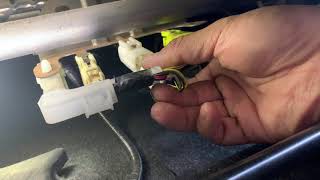
Slide the passenger seat fully forward and backward. Use a flashlight to inspect the wiring underneath for broken wires, disconnected yellow plugs, or foreign objects. With the scanner live data running (or a helper watching the airbag light), systematically wiggle the harness to pinpoint intermittent breaks.
Tools: Flashlight, Helper (optional) (Beginner) - SAFETY: Disconnect the Battery
Before touching any SRS components, disconnect the negative battery terminal and wait exactly 15 minutes. This de-energizes the system's capacitors and prevents accidental airbag or pretensioner deployment.
Tools: 10mm Wrench or Socket (Beginner) - Inspect and Clean Connectors
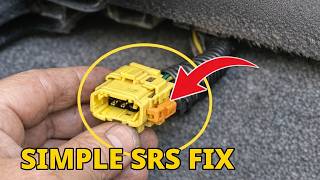
Locate the yellow buckle switch connector under the seat. Unplug it and inspect the pins for green/white corrosion or bent terminals. Clean the pins with electrical contact cleaner and a small brush. Ensure a snug fit when reconnected.
Tools: Electrical contact cleaner, small nylon brush (Intermediate) - [PRO TIP] Test the Buckle Switch with a Multimeter
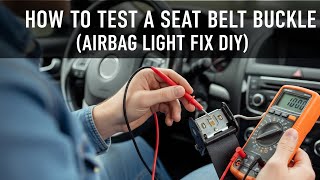
Disconnect the buckle harness connector. Set a multimeter to resistance (Ω). Probe the two pins on the buckle side. A healthy switch shows infinite resistance ('O.L.') unbuckled and under 3.0 Ω when latched. Readings above 3.0 Ω buckled, or continuity unbuckled, prove the buckle assembly is dead and requires replacement.
Tools: Digital Multimeter (Advanced) - [ADVANCED] Check for Short to Ground or Power
Test the vehicle harness side with the buckle unplugged. Set the multimeter to DC Volts. With ignition ON, probe each pin to a chassis ground. The signal wire shows a 5V reference; the ground shows 0V. A 12V reading indicates a short to power. With ignition OFF, check resistance to ground; near-zero ohms indicates a short to ground.
Tools: Digital Multimeter, vehicle-specific wiring diagram (Advanced)
When This Code Triggers (Freeze-Frame Conditions)
- System State: Ignition ON (The SRS module performs a self-check at every key-on event. The fault logs within seconds if the circuit fails this check.)
- Fault Detection Time: 2 seconds (The ECU must see a continuous open, short to power, or short to ground in the buckle switch circuit for this duration to set the code.)
- Vehicle Speed: Any (The fault triggers while parked or while driving at any speed.)
- System Voltage: 10-14V (The SRS module monitors system voltage. B1771 specifically points to a fault within the buckle circuit itself, not a general power supply problem.)
Related Codes
- B1795 — OCS ECU Malfunction. Service manuals explicitly state: if B1771 and B1795 are present, diagnose B1771 first. A faulty buckle circuit tricks the ECU into reporting an internal failure.
- B1650 — A general code for an Occupant Classification System fault. A deeper scan of the OCS module reveals B1771 as the specific root cause.
- B1780 / B1781 — These point to the weight sensors in the seat cushion. B1771 relates to the binary 'Buckled/Unbuckled' status. If the weight reading is faulty but the buckle status works, the issue is not B1771.
- B0070 / B0072 — Codes for the 'Passenger Seat Belt Pretensioner Deployment Control'. A wiring issue in the same under-seat harness triggers both types of codes, but they point to different components.
Climate & Environmental Factors
- High Humidity / Salty Air: Coastal climates accelerate corrosion on electrical pins. Moisture seeps into unprotected connectors under the seat or the buckle mechanism, causing resistance values to drift out of specification.
- Road Salt (Winter Climates): Salty water tracked into the vehicle wicks into the carpet and under-seat padding, creating a highly corrosive environment for the low-lying OCS wiring harness, leading to rapid shorts.
- Extreme Cold: Extreme cold makes wire insulation brittle. Repeated flexing of the under-seat harness by moving the seat causes the insulation and copper wire to crack, leading to an intermittent open circuit.
How to Talk to a Mechanic About This Code
Say this: "I have an airbag light on and my scanner shows code B1771. I know this points to the passenger seat belt buckle circuit. I'd like to schedule a diagnostic that specifically tests the under-seat wiring and connectors before we assume the buckle assembly needs to be replaced."
This signals you are an informed consumer. It directs the technician to check the most common and cheapest point of failure (wiring) first, and sets the expectation that you won't approve an expensive part replacement without proper electrical testing.
Avoid saying:
- 'My airbag light is on, can you just fix it?'
- 'Just do whatever you think is best.'
- 'I don't know anything about cars, just tell me the cost.'
Questions to ask before authorizing the repair:
- Did you test the buckle switch itself with a multimeter? What was its resistance when buckled and unbuckled?
- Were you able to find a specific break or corrosion in the under-seat wiring harness?
- If the buckle assembly needs to be replaced, can you provide me with a written estimate that breaks down the OEM part cost and the labor hours?
- What is the warranty on this specific repair, for both the parts and labor?
Where to Take It: Dealer vs Independent vs Chain
- Dealer:
Best choice if a recall applies or if you're under warranty. Otherwise, a good but expensive option.
Best for: Vehicles under warranty or with an active recall/TSB (like on Subarus)., Complex electrical problems where manufacturer-specific diagnostic tools are required.
Downsides: Highest labor rates., More likely to replace an entire assembly rather than perform a wiring repair. (Typical cost: +50% vs. baseline) - Independent Shop:
Excellent choice. An independent shop specializing in auto electrics is the ideal place to get a B1771 diagnosis, as they are most likely to find and fix a wiring issue, saving you money.
Best for: Out-of-warranty vehicles where cost is a factor., Electrical diagnostics, as they are more flexible in their approach than dealers.
Downsides: Quality and expertise vary greatly; look for shops specializing in electrical systems or with ASE-certified technicians. (Typical cost: +0% vs. baseline) - Chain Shop:
AVOID for diagnosis. They may replace a buckle assembly if told to, but they are not the right choice to diagnose an intermittent electrical fault in a safety system.
Best for: Simple, routine maintenance like oil changes and tires.
Downsides: Technician skill for complex diagnostics is inconsistent., Often lack the specific tools or training for in-depth SRS (airbag) system repairs. (Typical cost: -10% vs. baseline)
When to Walk Away From the Repair
If the estimated repair cost exceeds 40% of your car's private-party value (check Kelley Blue Book), sell or trade it in instead of repairing it.
- Car worth $4000, fix is $1800: Walk away. The repair cost is 45% of the car's value. Selling it as-is and putting the $1800 toward a replacement vehicle is a better financial move.
- Car worth $15000, fix is $1200: Fix it. The repair cost is only 8% of the vehicle's value and is necessary for passenger safety.
- Car worth $2500, fix is $1500: Walk away. At 60% of the car's value, this repair is not economically viable.
What Scan Tool You Need for This Code

Minimum: A scanner that reads and clears Supplemental Restraint System (SRS/Airbag) codes and displays live data. A basic engine-only code reader will NOT work.
A standard $20 code reader only communicates with the Engine Control Module (ECU). The B1771 code is stored in the separate SRS module. You need a tool specifically advertised with SRS/Airbag diagnostic capabilities.
Budget: Autel AutoLink AL619 / ML629 (~$90) — Reads and clears engine, ABS, and SRS codes for most major manufacturers. It displays live data, allowing you to watch the buckle switch status change.
Mid-range: BlueDriver Bluetooth Pro (~$120) — Connects to your smartphone and offers confirmed fix reports based on your specific vehicle and code. It reads and clears SRS codes and displays live data for the buckle switch.
Professional: Autel MaxiCOM MK808 / Innova 5610 (~$350-500) — Offers dealership-level diagnostics, including bidirectional control to test components directly. This level of tool is for the serious DIYer performing comprehensive diagnostics on all vehicle systems.
Rent vs buy: Most auto parts store loaner tools are basic engine code readers that cannot access the SRS module. Buying a budget pick with SRS capability is a worthwhile investment that saves diagnostic fees.
How to Clear the Code After You Fix It
- Ensure the physical repair is complete.
- Reconnect the negative battery terminal.
- Use an SRS-capable OBD-II scan tool to connect to the vehicle.
- Navigate to the SRS/Airbag module and select 'Clear/Erase DTCs'.
- Cycle the ignition off, then on, and confirm the airbag warning light turns off after its initial self-check.
Drive cycle (~10 minutes): A specific drive cycle is not required for an SRS code. After clearing the code with a scanner, a short 5-10 minute test drive confirms the fault does not immediately return.
Readiness monitors affected: This code does not affect emissions-related readiness monitors.
Watch out for:
- Disconnecting the battery will not clear a hard SRS code like B1771.
- A basic OBD-II scanner that only reads engine codes cannot communicate with or clear codes from the SRS module.
- If the root cause is not fixed, the code reappears immediately after being cleared.
Will This Fail Emissions / State Inspection?
No — by itself this code doesn't fail OBD inspection (but it can keep readiness monitors from setting, which causes a separate fail).
- California: Will NOT fail a smog check. California's inspection is emissions-focused, and the airbag system is separate.
- New York: Will FAIL the safety inspection. An illuminated airbag warning light is grounds for an automatic inspection failure in NY.
- Texas: Officially, the airbag light is NOT a failure item on the Texas safety inspection checklist. However, some shops refuse to pass it, so call ahead.
- Pennsylvania / Virginia: Will FAIL the safety inspection. These states have strict annual safety checks that include the SRS system.
Most Commonly Affected Vehicles
- Subaru Forester (2014-2018) — Extremely common. Caused by a faulty Occupant Detection System (ODS) sensor harness. Subaru issued recall WUM-98 and TSB 07-108-16R. Always check recall status first.
- Toyota Highlander (2008-2013) — Frequently reported. Detailed diagnostic procedures in official service manuals indicate a well-known fault in the under-seat wiring routing.
- Toyota RAV4 (2013-2018) — The 4th generation RAV4 is highly prone to this code due to wiring damage under the passenger seat from movement or stored items.
- Toyota Prius (2010-2015) — The Gen 3 Prius shares a similar OCS design with other Toyotas, making the passenger buckle switch circuit a common failure point.
- Toyota Sequoia (2018-2022) — Owners report this code frequently, with dealership quotes for buckle replacement often exceeding $750. The issue is usually a wiring problem.
- Hyundai Sonata, Elantra (2011-2019) — The wiring harness under the passenger seat routes with very little slack, causing wires to stretch and break internally from normal seat use.
- Nissan Altima, Rogue (2013-2020) — Susceptible to B1771 due to the buckle switch connector developing a poor connection from repeated seat movement.
- Chevrolet / GM Cruze, Malibu, Equinox, Verano, Impala (2011-2018) — GM issued Special Coverage Adjustments (N152023520, N192216430) for the Passenger Presence System (PPS) covering related wiring and sensor issues.
Manufacturer-Specific Notes
- Subaru: For 2014-2018 models, the cause is the ODS sensor harness, not the buckle. Recall WUM-98 and TSB 07-108-16R cover this. Do not replace the seat cushion without checking for this free fix.
- Toyota: Toyota service manuals advise unbolting and tilting the entire passenger seat backward to gain clear access to the wiring, hinting that this specific area is the primary failure point.
- Hyundai / Kia: The wiring harness routes with zero slack. Years of moving the seat stretches and breaks wires internally right at the connector. A 'wiggle test' is highly effective here.
- General Motors (GM): GM issues 'Special Coverage' programs acting as extended warranties. N192216430 covers wiring on 2014-2017 Impalas for 8 years/80k miles, and N152023520 covers the PPS module on 2012-2016 Veranos.
Real Owner Stories
2016 Subaru Forester with Intermittent Airbag Light
The airbag light illuminated intermittently for over a year. The passenger seatbelt chime activated with an empty seat, and the passenger airbag 'OFF' light stayed on even with an adult seated.
Outcome: The dealer blamed unproven water damage and quoted $1,200 for a backordered seat bottom. The owner declined and continued jiggling wires to keep the safety system active.
Lesson: An intermittent light guarantees a wiring issue. If a recall was performed but the issue returns, demand the dealer follow the TSB diagnostic steps to test the harness itself. A 'wiggle test' confirming the fault location is undeniable evidence.
2018 Toyota Sequoia with a 'Silent' B1771 Code
The owner scanned the vehicle's computers and discovered a stored B1771 code. There were no visible symptoms—no airbag light on the dash and no seatbelt chime warnings.
Outcome: The owner posted on a forum seeking advice on whether to proceed with the expensive repair given the lack of symptoms.
Lesson: SRS faults sometimes store without illuminating the main warning light initially. Clear the code, drive the vehicle, and see if it returns as a 'hard' fault with the airbag light on before authorizing an $800 repair.
2017 Hyundai Elantra After Interior Detailing
The airbag light illuminated immediately after a professional interior detailing.
Outcome: After reconnecting the plug and starting the car, the airbag light performed its normal self-check and turned off. The problem was solved for $0.
Lesson: If the code appears after cleaning, retrieving a lost item, or moving the seat, the cause is a disturbed connector or wire. Always perform a visual inspection before paying for a diagnostic.
How to Prevent This Code From Triggering
- Ban Under-Seat Storage (Daily habit) — Forcing items under the passenger seat snags, stretches, or disconnects the fragile SRS wiring harness. This is the primary physical cause of the B1771 code.
- Secure Under-Seat Wiring (Once, or after any under-seat work) — Ensure the wiring harness is secured in its factory clips with enough slack to move with the seat. Use zip ties or automotive cloth tape to secure loose sections away from the metal seat rails.
- Clean Spills Immediately (As needed) — Liquid spilled on the seat belt buckle seeps into the internal switch and under-seat connectors, causing instant corrosion and circuit failure. Clean the plastic casing with a damp cloth and use compressed air to blow out moisture.
- Supervise Interior Detailing (During every interior detail) — Aggressive vacuuming under the seat dislodges the main SRS connector. Instruct detailers to avoid the under-seat wiring, and verify the connections yourself after cleaning.
Frequently Asked Questions
Can I fix code B1771 myself?
Simple visual checks and cleaning connectors are DIY-friendly. However, any repair involving the SRS requires extreme caution and disconnecting the battery for 15 minutes. If you lack electrical diagnostic experience, take the vehicle to an auto electrical specialist.
Will my passenger airbag work with code B1771?
No. The system defaults to a fail-safe mode and completely disables the passenger airbag. The 'PASSENGER AIR BAG OFF' light illuminates to confirm this disabled state.
Why did the airbag light appear after moving the seat or cleaning under it?
Moving the seat stresses weak wires or dislodges the main yellow SRS connector. This confirms the buckle and ECU are functional, and the root cause is a physical wiring break.
What's the biggest misdiagnosis for B1771?
Shops frequently replace the entire $400+ buckle assembly or $800+ OCS ECU without exhaustively testing the under-seat wiring. A $10 wiring repair fixes the exact same code in most cases.
Is a $700+ dealership repair quote for B1771 reasonable?
Dealerships typically quote full buckle assembly replacements, driving the price over $700. An independent auto electrical shop can often find and repair a broken wire for $150 to $300. Always demand a multimeter test proving the buckle switch failed before authorizing replacement.
My seatbelt latches perfectly, so why is the airbag light on?
The mechanical metal latch is completely separate from the internal electronic microswitch. The belt secures you physically, but the broken switch prevents the computer from arming the airbag.
Can a weak car battery cause a B1771 code?
A weak battery triggers random electronic glitches, but rarely causes a specific B1771 circuit integrity code. This code points directly to an open or shorted wire in the buckle circuit. Test the battery if multiple SRS codes appear simultaneously.
Key Takeaways
- Code B1771 disables the passenger airbag entirely, requiring you to ban front-seat passengers until the circuit is repaired.
- Over 70% of B1771 codes stem from damaged wiring or loose connectors under the passenger seat, costing under $30 in parts to fix.
- Owners of 2014-2018 Subaru Foresters must check VINs for recall WUM-98 and TSB 07-108-16R to secure a free dealership wiring harness replacement.
- Disconnect the negative battery terminal and wait 15 minutes before touching any yellow SRS connectors to prevent accidental airbag deployment.
- Never authorize a $400+ buckle replacement without a mechanic providing multimeter proof that the internal switch resistance exceeds 3 ohms.
Helpful Videos

The information in this article is provided for general reference and educational purposes only. Vehicle specifications, procedures, and part compatibility can vary by production date, trim level, and region. Always consult your vehicle's factory service manual and verify part numbers before purchasing or performing repairs. Safety-critical components such as airbags, seat belts, and braking systems should be installed by a qualified professional.
- 🎬 Helpful Videos
- What Does B1771 Mean?
- Can I Drive With B1771?
- Common Causes
- Symptoms
- Diagnostic Flowchart
- Common Fixes & Costs
- Used vs. New Parts: Buying Guide
- What Happens If You Wait — Timeline
- Cost of Not Fixing It
- Diagnosis Steps
- When This Code Triggers (Freeze-Frame Conditions)
- Related Codes
- Climate & Environmental Factors
- How to Talk to a Mechanic About This Code
- Where to Take It: Dealer vs Independent vs Chain
- When to Walk Away From the Repair
- What Scan Tool You Need for This Code
- How to Clear the Code After You Fix It
- Will This Fail Emissions / State Inspection?
- Most Commonly Affected Vehicles
- Manufacturer-Specific Notes
- Real Owner Stories
- 2016 Subaru Forester with Intermittent Airbag Light
- 2018 Toyota Sequoia with a 'Silent' B1771 Code
- 2017 Hyundai Elantra After Interior Detailing
- How to Prevent This Code From Triggering
- Frequently Asked Questions
- Can I fix code B1771 myself?
- Will my passenger airbag work with code B1771?
- Why did the airbag light appear after moving the seat or cleaning under it?
- What's the biggest misdiagnosis for B1771?
- Is a $700+ dealership repair quote for B1771 reasonable?
- My seatbelt latches perfectly, so why is the airbag light on?
- Can a weak car battery cause a B1771 code?
- Key Takeaways
- 🎟️ Get 5% Off