

OBD-II Code B1697: Lost Communication With Left Side Airbag Sensor
What B1697 means, why it triggers, and how to fix it
- Code B1697 indicates a communication failure with the left side impact sensor, immediately disabling the driver's side airbags.
- On 2006-2014 GM and Ford trucks, B1697 often flags a shorted power mirror switch rather than an actual airbag fault.
- Damaged wiring in the door hinge boot or corroded connectors under the driver's seat cause over 70% of B1697 faults.
- Driving with an active B1697 code increases your risk of death in a driver-side crash by 37% due to disabled side airbags.
- You must use an SRS-capable OBD-II scanner costing $85 or more to read and clear this code; a standard $20 engine code reader will not work.
What Does B1697 Mean?

Code B1697 means the Airbag Control Module (RCM/SRS) lost connection to the left (driver's) side impact sensor. This sensor detects side collisions and triggers airbag deployment. Without this signal, the computer illuminates the airbag warning light and disables the left-side system as a precaution.
Technical definition: The SAE/ISO definition for B1697 is "Lost Communication with Door Side Airbag Sensor LH". The Restraint Control Module (RCM) is not receiving expected digital signals from the left side impact sensor due to an open circuit, short circuit, faulty sensor, or a specific manufacturer wiring quirk.
Can I Drive With B1697?
Yes, But With Caution. Yes, the vehicle operates normally, but it poses a severe safety risk. The system disables the left side airbags, preventing deployment in an accident. Studies show side airbags with head protection reduce driver death risk in side crashes by 37%, making this a critical fix.
Common Causes

- Damaged Wiring or Loose/Corroded Connectors (Very Common) — The wires leading to the side impact sensor are the most frequent failure point. Constant opening and closing of the door fatigues the wires in the door jamb harness. Moisture also enters connectors under the driver's seat, causing signal-interrupting corrosion.
- Faulty Power Mirror Switch (GM/Ford Truck Specific) (Very Common On Specific Models) — On many 2006-2014 Chevrolet, GMC, and Ford trucks, code B1697 is defined as 'Mirror Switch Circuit Short to Ground' and has nothing to do with the airbag system. Always verify the exact code definition for your specific vehicle.
- Faulty Side Impact Sensor (Common) — The side impact sensor fails internally over time. These sensitive electronic devices contain a G-sensor that breaks down from moisture, heavy vibration, or physical shock from a previous minor door impact.
- Faulty Occupant Detection System (ODS) Module (Common) — On specific Kia and Hyundai models, a separate ODS control module under the passenger seat fails due to water intrusion from spilled drinks or wet floor mats, triggering a B1697 code.
- Low Vehicle Battery Voltage (Less Common) — A weak or recently replaced battery causes temporary low voltage conditions. The sensitive SRS module interprets this voltage drop as a fault and stores a history code.
- Faulty Airbag Control Module (SRS/ECU) (Less Common) — The main computer controlling the airbag system develops an internal fault. This prevents communication with various components but is only suspected after eliminating wiring and sensor issues.
- CAN Bus Interference from Aftermarket Devices (Rare) — Aftermarket devices plugged into the OBD-II port, such as insurance trackers or performance tuners, interfere with the vehicle's CAN bus communication, falsely triggering a B1697 code.
Symptoms

- Airbag Warning Light On — A solid or flashing airbag warning light appears on the dashboard. The system locks this light on until the fault is repaired and cleared with a scanner.
- Power Mirrors Inoperative (GM/Ford Truck Specific) — If the code relates to the mirror switch on a GM or Ford truck, the primary symptom is an inability to adjust the power mirrors.
- Passenger Airbag 'OFF' Light Illuminated — A fault in the system forces the passenger airbag 'OFF' indicator to light up as a default safety measure, even if an adult occupies the seat.
- Heated Seat Inoperative — On Kia/Hyundai models where the ODS module fails, the heated seat function for the affected side stops working because the modules share power or ground circuits.
- Failed Safety Inspection — The vehicle automatically fails state safety inspections in jurisdictions that check for an illuminated airbag warning light.
Diagnostic Flowchart
Tap your situation to follow the diagnostic path that matches what you're seeing on this code.
Common Fixes & Costs
- Repairing Damaged Wiring or Connectors — Parts: $10-$50, Labor: $150-$450, ~2 hr book time (Intermediate)
- Replacing the Power Mirror Switch (GM/Ford Specific) — Parts: $20-$135, Labor: $50-$75, ~0.5 hr book time (DIY)
- Replacing the Side Impact Sensor — Parts: $70-$350, Labor: $75-$150, ~1 hr book time (DIY)
- Replacing the Airbag Control Module (RCM/SRS) — Parts: $200-$700, Labor: $150-$300, ~1.5 hr book time (Professional)
Used vs. New Parts: Buying Guide
When a used part is worth it: For a safety-critical part like an impact sensor, buying new is strongly recommended. A used sensor is only viable for older, low-value vehicles where the budget is extremely tight, sourced from a reputable dismantler with no accident history.
Donor-vehicle mileage cap: roughly under 60000 miles for the part to have meaningful remaining life.
Donor quality checklist:
- Verify the donor vehicle was not in an accident.
- Visually inspect the part for physical damage, stress, or corrosion.
- Match the OEM part number exactly; non-identical numbers for different locations are not interchangeable.
- Avoid parts from flood-damaged or rust-belt vehicles.
Decision logic:
- If The part is safety-critical (airbag sensor, module). → Strongly prefer a new OEM part for guaranteed performance and warranty.
- If The budget is the absolute primary constraint and you accept the risk. → A used sensor from a verified low-mileage, non-crashed donor is a possibility, but you risk paying for labor twice if it fails.
- If The fault is the GM/Ford power mirror switch. → A used or new aftermarket switch is perfectly acceptable as it is not a safety component.
Warranty tradeoff: Used parts typically have a 30-90 day warranty that does not cover labor. New OEM or high-quality aftermarket parts carry a warranty of 1 year or longer.
Worst-case if a used part fails: $150-$300 if a used sensor is faulty and you pay for diagnostic and replacement labor a second time.
What Happens If You Wait — Timeline
- Immediate: Airbag warning light illuminates. The SRS module detects communication loss and disables the left-side airbag system. The car drives normally. (MPG impact: 0%% · Added cost: $0)
- 0-6 months: The primary consequence is the ongoing safety risk. The left side airbags will NOT deploy in an accident. There is no mechanical damage. (MPG impact: 0%% · Added cost: $0)
- At next state inspection: The vehicle fails mandatory safety inspections in jurisdictions that check for an illuminated airbag light, preventing registration renewal. (MPG impact: 0%% · Added cost: $20-$100 (Failed inspection fee, re-test fee, and potential fines))
- In the event of an accident: The disabled left-side airbags fail to deploy, leading to a significantly higher risk of serious injury or death for the driver. (MPG impact: 0%% · Added cost: N/A (Cost is severe physical harm))
Cost of Not Fixing It
- Immediate: The left side airbags are disabled and will not deploy in an accident, significantly increasing the risk of serious injury or death. (Added cost: N/A)
- At Next State Inspection: The vehicle automatically fails its state safety inspection, preventing legal registration renewal. (Added cost: $20-$50 (for the failed inspection fee and re-test fee))
- Long-Term: There are no cascading mechanical failures. The primary cost is the ongoing and severe safety risk. (Added cost: N/A)
Diagnosis Steps
- Check for the GM/Ford Mirror Switch Fault
If diagnosing a GM or Ford truck/SUV, test the power mirrors first. If they are inoperative, the B1697 code indicates a short in the mirror switch circuit. Diagnose the switch and door wiring for a short to ground instead of touching the airbag system.
Tools: None (Beginner) - Scan and Attempt to Clear the Code
Use an SRS-capable OBD-II scanner to clear the B1697 code. If the code immediately returns, a 'hard fault' is present. If it stays off, the issue was a temporary bad connection or low voltage event.
Tools: SRS-capable OBD-II Scanner (Beginner) - Visually Inspect Wiring and Connectors
Look under the driver's seat and inside the driver's side door jamb boot for frayed wires, loose yellow connectors, or green/white corrosion. Disconnect the battery for 15 minutes, then unplug and replug the yellow airbag connectors to ensure a solid connection.
Tools: Flashlight, socket set (for battery), trim removal tools (Beginner) - Swap Sensors (If Applicable)
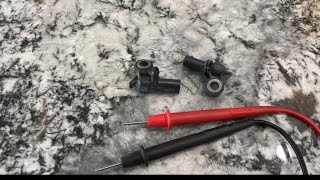
If the left and right side impact sensors share the same part number, swap them. Clear the codes. If the code changes to B1692 (right side), the sensor is definitively faulty. If B1697 remains, the problem is in the wiring or control module.
Tools: Basic hand tools (sockets, wrenches), SRS-capable OBD-II Scanner (Intermediate) - Check for Reference Voltage and Ground
With the battery disconnected, unplug the sensor. Reconnect the battery and turn the ignition 'ON'. Use a multimeter to verify the reference voltage (typically 5V or 12V) and a solid ground at the harness connector. Missing voltage or ground confirms a wiring failure.
Tools: Multimeter, vehicle-specific wiring diagram (Intermediate) - Test the Wiring Harness for Continuity
Disconnect the battery, sensor, and airbag control module. Use a multimeter set to ohms to check continuity on each wire between the sensor and module connectors. A reading of 'OL' indicates a broken wire. Test each wire against a chassis ground to rule out a short.
Tools: Multimeter, vehicle-specific wiring diagram (Intermediate) - [PRO TIP] Test Sensor Circuit with a Resistor Load
Purchase a resistor matching the sensor's specified resistance (typically 2.0-3.5 ohms). With the battery disconnected, plug the resistor into the harness-side connector. Reconnect the battery and clear codes. If B1697 changes to a 'circuit open' or 'high resistance' code, the wiring and module are intact, proving the original sensor is faulty.
Tools: SRS-capable OBD-II Scanner, Automotive-grade test resistors, Vehicle-specific wiring diagram (Advanced) - [PRO TIP] Analyze Sensor Waveform with Oscilloscope
Back-probe the signal wire at the airbag control module with an oscilloscope. A healthy sensor produces a steady square wave digital signal. A flat line or erratic signal confirms communication loss from the sensor or wiring, while a perfect signal points to a faulty control module.
Tools: Oscilloscope, vehicle-specific wiring diagram (Advanced)
When This Code Triggers (Freeze-Frame Conditions)
- System State: Key-On Self-Test (The SRS module performs a self-check of all components every time the ignition is turned ON.)
- Vehicle Speed: 0 mph (Fault is typically detected before the vehicle is in motion.)
- RPM: 0 (Fault is typically detected with ignition ON, engine OFF.)
- Battery Voltage: 11.5V - 14.5V (Normal operating voltage. A code sets if voltage drops too low during startup.)
Related Codes
- B1692 — This is the identical fault for the Right (passenger) side sensor. Swapping the left and right sensors is the definitive diagnostic step; if the code changes to B1692, the sensor is faulty.
- B1698 — Means 'Door Side Airbag Sensor LH Initialization Incomplete'. The control module cannot initialize a sensor it cannot communicate with. Fixing B1697 automatically resolves B1698.
- B1193 — Indicates crash data is stored in the airbag module. If a vehicle was in an accident, B1193 confirms the event, and B1697 indicates collateral damage to the left sensor circuit.
- B0092 — Translates to 'Left Side Restraints Sensor Fault' on various manufacturers. It points to the exact same family of issues: a bad sensor, wiring problems, or a faulty control module.
Climate & Environmental Factors
- High Humidity / Water Intrusion: Moisture seeps into connectors under seats or in door jambs, causing corrosion on pins and circuit boards. Spilled drinks frequently destroy ODS modules under the passenger seat.
- Road Salt (Rust Belt Regions): Salt spray penetrates the undercarriage and door bottoms, aggressively accelerating corrosion of wiring harnesses and connectors until wires break or lose connection.
How to Talk to a Mechanic About This Code
Say this: "I have an airbag light on and my scanner shows code B1697 for the left side impact sensor. Please check the wiring in the driver's door jamb and connectors under the seat before recommending a new sensor. If this is a GM or Ford truck, please confirm this code isn't for the mirror switch."
This signals you understand the common, less-expensive failure points (wiring) versus just replacing parts. It directs the technician to perform a proper diagnosis and helps avoid a quick, costly parts swap.
Avoid saying:
- My airbag light is on, can you just fix it?
- I need a new airbag sensor.
- Just do whatever it takes to turn the light off.
Questions to ask before authorizing the repair:
- How did you determine the component was the point of failure? Did you test continuity on the harness?
- If recommending a sensor replacement, did you try swapping it with the right-side sensor to see if the code changed?
- Can you show me the damaged wiring or the corroded connector?
- What is the warranty on this specific repair, for both the part and the labor?
- If the main SRS module needs replacement, does your estimate include the cost of programming it to my vehicle's VIN?
Where to Take It: Dealer vs Independent vs Chain
- Dealer:
Best for: Vehicles under warranty or with a known recall (e.g., Toyota Venza harness)., Repairs requiring replacement and programming of the main SRS control module., Complex manufacturer-specific issues where an independent shop is struggling.
Downsides: Significantly higher labor rates and parts costs., May default to replacing entire assemblies instead of performing detailed wiring repairs. (Typical cost: +50% vs. baseline) - Independent Shop:
Best fit for most scenarios. An experienced independent technician diagnoses and repairs common causes (wiring, connectors, sensor) more affordably than a dealer. Ensure they have an SRS-capable scan tool.
Best for: Out-of-warranty vehicles where the cause is likely wiring or a sensor., Cost-conscious owners who want a reliable repair without dealer overhead., Shops that specialize in automotive electronics.
Downsides: Shop quality and technician skill vary widely; look for ASE certification., May not have the specific tools to program a new SRS module if needed. (Typical cost: +0% vs. baseline) - Chain Shop:
AVOID. Airbag system repair is a critical safety function that should not be trusted to a generalist chain shop.
Best for: Simple, non-safety-critical jobs like oil changes or tires.
Downsides: Technicians lack specialized training for complex SRS diagnostics., High pressure to sell parts leads to misdiagnosis and unnecessary replacement of expensive components. (Typical cost: -10% vs. baseline)
When to Walk Away From the Repair
If the estimated repair cost exceeds 40-50% of your car's private-party value, and the car has other pending mechanical needs, consider replacing the vehicle. An active airbag light makes a car nearly impossible to sell privately and fails state inspections.
- Car worth $4000, fix is $1800: Walk away. The repair cost is 45% of the car's value. It's not financially sound to invest this much into an older vehicle for a single repair.
- Car worth $12000, fix is $750: Fix it. The repair cost is only 6% of the car's value and is essential for safety and retaining resale value.
- Car worth $2500, fix is $500: Borderline. A $500 repair on a $2500 car is 20% of its value. If the car is otherwise reliable, it's worth fixing. If it has other problems, sell or scrap it.
What Scan Tool You Need for This Code

Minimum: A scan tool that reads and clears Supplemental Restraint System (SRS/Airbag) codes. These are 'B' codes or 'U' codes, not standard 'P' engine codes.
A basic $20 OBD-II code reader will NOT see or clear airbag codes. It reports 'no codes found,' leading you to believe there is no issue. You will waste time and money without an SRS-capable tool.
Budget: Autel AutoLink AL619 / ML629 (~$85) — Reads and clears codes for Engine, ABS, and SRS systems. It correctly identifies the B1697 code and allows you to clear the light after the repair is complete.
Mid-range: Foxwell NT630 Plus / NT680 Pro (~$150) — Offers bi-directional controls to test components and graphs live sensor data, which helps diagnose intermittent wiring faults.
Professional: Autel MaxiCOM MK808S / Launch X431 Series (~$500-900) — Provides professional-level diagnostics, including OE-level functions and bi-directional control to command modules and definitively test the circuit.
Rent vs buy: Buy. Auto parts stores do NOT rent out SRS-capable scan tools due to liability concerns. Their free loaner tools are for engine codes only. Owning a budget SRS scanner is a worthwhile investment.
How to Clear the Code After You Fix It
- Ensure the underlying fault (wiring, sensor, or switch) has been properly repaired.
- Reconnect the vehicle battery if it was disconnected for the repair.
- Use an SRS-capable OBD-II scan tool to connect to the Airbag Control Module.
- Select the function to 'Clear DTCs' or 'Reset Codes'.
- Cycle the ignition off, then on, and verify the airbag warning light illuminates for 6 seconds, then turns off and stays off.
Drive cycle: No specific drive cycle is required. The SRS system performs a self-check upon every key-on event. If the light remains off after clearing the code and cycling the ignition, the repair is successful.
Watch out for:
- Using a basic engine code reader that cannot communicate with the SRS module.
- Assuming disconnecting the battery clears a hard fault from the SRS module's memory.
- Clearing the code without fixing the root cause, resulting in the light immediately returning.
Will This Fail Emissions / State Inspection?
No — by itself this code doesn't fail OBD inspection (but it can keep readiness monitors from setting, which causes a separate fail).
- California: An illuminated airbag warning light is considered a safety defect and causes an automatic safety inspection failure.
- New York: Per NYS vehicle and traffic law, an illuminated supplemental restraint system warning light is grounds for safety inspection failure.
- Texas: The Texas Administrative Code specifies a vehicle is rejected if the airbag warning lamp is on or flashing.
Most Commonly Affected Vehicles
- Toyota Corolla (2005-2012) — Wiring under the seat and in the door harness frequently fails. Verify VIN for multiple airbag-related recalls for this generation.
- Toyota Venza (2009-2015) — Subject to recall NHTSA 21V-192 for a driver's door wire harness that fractures, disabling the side airbag sensor and triggering the airbag light.
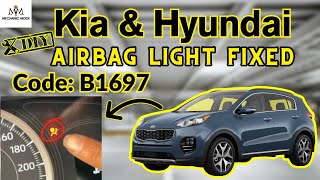
- Kia / Hyundai Sportage, Tucson, Sorento (2011-2020) — Often caused by a corroded Occupant Detection System (ODS) module under the passenger seat. This failure also disables the passenger heated seat.
- Chevrolet / GMC Silverado, Sierra (2006-2014) — CRITICAL: On these trucks, B1697 indicates a 'Mirror Switch Circuit Short to Ground' and is completely unrelated to the airbag system.
- Lexus IS 250 (2006-2013) — Often related to the side or rear airbag sensor communication circuit. Diagnosis requires checking connectors between the sensors and the central airbag ECU.
- Ford S-Max / Galaxy (2006-2014) — The code is frequently triggered by a short in the mirror switch circuit. Also check for corroded connectors under the driver's seat.
- Subaru Outback, Forester (2009-2018) — Indicates a loss of communication with the side impact sensor located in the door or B-pillar.
Manufacturer-Specific Notes

- Ford / Chevrolet / GMC: On many trucks and SUVs, B1697 does NOT relate to the airbag system. It indicates a 'Mirror Switch Circuit Short to Ground'. Always verify the code definition for your specific vehicle.
- Toyota / Lexus: A recall (21TA03) was issued for 2009-2015 Venzas for a faulty driver's door wiring harness that causes this code. Dealerships replace the harness free of charge.
- Kia / Hyundai: A warranty extension covers the front passenger Occupant Detection System (ODS) sensor pad for 15 years/unlimited mileage on many models. Dealers diagnose and repair this at no cost.
- Mitsubishi: For vehicles with a telematics unit, B1697 logs an event indicating the emergency call function activated after a collision. It is an informational code, not a component fault.
- General Motors: Aftermarket devices plugged into the OBD-II port cause widespread communication errors, setting false airbag codes. Unplug all devices before diagnosing communication faults.
Real Owner Stories
2009-2015 Toyota Venza with Airbag Light
Owner noticed the airbag warning light came on the dashboard with no other symptoms.
Outcome: The cause was a faulty driver-side door wiring harness covered under Toyota recall NHTSA 21V-192. The dealer replaced the harness free of charge.
Lesson: Always check for recalls. A problem that seems like a specific component failure is often a widespread design flaw covered by the manufacturer.
2018 Kia Sportage with Airbag Light and Inoperative Heated Seat
The airbag light was on, the passenger airbag 'OFF' light was illuminated, and the passenger-side heated seat stopped working.
Outcome: Visual inspection showed significant corrosion on the ODS control module from a spilled drink. Replacing the corroded module resolved all symptoms.
Lesson: On Kia/Hyundai vehicles, B1697 is often linked to the ODS module under the passenger seat. A non-working heated seat is a strong indicator of this specific failure.
2010 Jeep Wrangler with Intermittent Airbag Light
Airbag light came on and off randomly over months. Codes pointed to the left front impact sensor.
Outcome: The problem was an intermittent fault within the wiring harness. The owner had to replace the affected harness section to permanently resolve the issue.
Lesson: Intermittent electrical faults are difficult to diagnose. Simply parts-swapping the sensor is expensive and ineffective if the harness is the true culprit.
Chevy HHR with 'Service Airbag' Message
Owner bought a used HHR and the 'Service Airbag' message appeared.
Outcome: A proper diagnosis required an SRS-capable scan tool to read the specific B-codes. Without the correct tool, the owner was unable to pinpoint the faulty component.
Lesson: Cleaning connectors is a good first step, but airbag systems require a specific scan tool to read and clear codes. A basic engine code reader is useless here.
How to Prevent This Code From Triggering
- Clean and dry door jambs and under-seat areas (Every 6 months or after heavy rain/snow season) — Prevents moisture and road salt from seeping into critical wiring harnesses and connectors, which is a primary cause of corrosion and shorts.
- Apply dielectric grease to at-risk connectors (Anytime a connector is disconnected for service) — Dielectric grease seals out moisture and oxygen, preventing the pins inside electrical connectors from corroding.
- Inspect and secure the door-to-body wiring boot (Annually) — The flexible rubber boot protects wires that flex when the door opens. A damaged boot allows water in and accelerates wire fatigue.
- Be cautious with liquids inside the vehicle (Daily habit) — Spilled drinks destroy electronics under the seats, particularly the Occupant Detection System (ODS) module in Kia/Hyundai models.
- Maintain a healthy battery and clean terminals (Annually) — A weak battery causes low voltage conditions during startup, confusing sensitive electronics like the SRS module and setting false fault codes.
Frequently Asked Questions
Can I fix code B1697 myself?
Yes, if the cause is a loose connector, a faulty power mirror switch, or a bad sensor, a DIY-er can perform the repair. Always disconnect the battery for 15 minutes before touching yellow airbag components. Take it to a shop if the repair requires complex wiring diagnostics or module programming.
Is it safe to drive with the airbag light on for code B1697?
The car drives normally, but it is highly unsafe in a crash. The airbag light indicates the driver's side airbags are disabled and will not deploy. This significantly increases the risk of serious injury or death in a side-impact collision.
Will disconnecting the battery clear the airbag light?
No. Airbag codes are stored in the module's non-volatile memory. Even after fixing the fault, you must clear the code using an OBD-II scanner capable of accessing the SRS system.
How much does it cost to fix code B1697?
Costs depend entirely on the root cause. A GM/Ford mirror switch replacement costs $70-$210, while a wiring repair runs $150-$450. Replacing a side impact sensor typically costs $200-$500, and a new airbag control module exceeds $400 including programming.
Where is the B1697 sensor located?
The left side impact sensor is located inside the driver's door, in the B-pillar between the doors, or lower down on the floor near the pillar. You must remove interior trim panels to access it.
What are the most common misdiagnosis mistakes for B1697?
The biggest mistake is replacing the airbag sensor on a GM or Ford truck when the code actually points to a faulty power mirror switch. Another common error is replacing the sensor when the actual fault is broken wiring inside the flexible door boot.
Can a bad battery or changing the battery cause the B1697 code?
Yes, the SRS control module is highly sensitive to voltage drops. A dying battery or a recent replacement often triggers a low-voltage history code. Clear the code with an SRS-capable scanner; if it returns immediately, you have a hard fault.
Key Takeaways
- Code B1697 indicates a communication failure with the left side impact sensor, immediately disabling the driver's side airbags.
- On 2006-2014 GM and Ford trucks, B1697 often flags a shorted power mirror switch rather than an actual airbag fault.
- Damaged wiring in the door hinge boot or corroded connectors under the driver's seat cause over 70% of B1697 faults.
- Driving with an active B1697 code increases your risk of death in a driver-side crash by 37% due to disabled side airbags.
- You must use an SRS-capable OBD-II scanner costing $85 or more to read and clear this code; a standard $20 engine code reader will not work.
Helpful Videos

The information in this article is provided for general reference and educational purposes only. Vehicle specifications, procedures, and part compatibility can vary by production date, trim level, and region. Always consult your vehicle's factory service manual and verify part numbers before purchasing or performing repairs. Safety-critical components such as airbags, seat belts, and braking systems should be installed by a qualified professional.
- 🎬 Helpful Videos
- What Does B1697 Mean?
- Can I Drive With B1697?
- Common Causes
- Symptoms
- Diagnostic Flowchart
- Common Fixes & Costs
- Used vs. New Parts: Buying Guide
- What Happens If You Wait — Timeline
- Cost of Not Fixing It
- Diagnosis Steps
- When This Code Triggers (Freeze-Frame Conditions)
- Related Codes
- Climate & Environmental Factors
- How to Talk to a Mechanic About This Code
- Where to Take It: Dealer vs Independent vs Chain
- When to Walk Away From the Repair
- What Scan Tool You Need for This Code
- How to Clear the Code After You Fix It
- Will This Fail Emissions / State Inspection?
- Most Commonly Affected Vehicles
- Manufacturer-Specific Notes
- Real Owner Stories
- 2009-2015 Toyota Venza with Airbag Light
- 2018 Kia Sportage with Airbag Light and Inoperative Heated Seat
- 2010 Jeep Wrangler with Intermittent Airbag Light
- Chevy HHR with 'Service Airbag' Message
- How to Prevent This Code From Triggering
- Frequently Asked Questions
- Can I fix code B1697 myself?
- Is it safe to drive with the airbag light on for code B1697?
- Will disconnecting the battery clear the airbag light?
- How much does it cost to fix code B1697?
- Where is the B1697 sensor located?
- What are the most common misdiagnosis mistakes for B1697?
- Can a bad battery or changing the battery cause the B1697 code?
- Key Takeaways
- 🎟️ Get 5% Off