

OBD-II Code B1660: Passenger Airbag Status Light Circuit Failure & Keyless System Fault
The Ultimate 2026 Guide: What B1660 Means (Toyota vs. Honda vs. Hyundai) and How to Fix It
- A B1660 code completely disables your vehicle's airbag system, increasing the risk of frontal crash fatality by 29%.
- Manufacturer definitions dictate the repair: Toyota/Lexus vehicles require a passenger airbag indicator fix, while Honda/Acura models need a new keyless entry antenna.
- Over 80% of Toyota B1660 codes trigger after an aftermarket radio installation due to a forgotten or loose $0 passenger airbag indicator connector.
- Honda and Acura owners can resolve this code by replacing the front interior LF antenna (Part #38387-TVA-A31) located in the center console for under $80.
- Driving with an active B1660 code guarantees an automatic failure during mandatory state safety inspections in jurisdictions like New York and Texas, costing up to $150 in fees.
What Does B1660 Mean?

B1660 carries drastically different meanings depending on your vehicle's manufacturer. For Toyota, Lexus, and Scion, the Supplemental Restraint System (SRS) module detects an electrical circuit problem in the passenger airbag status indicator (the light showing 'ON' or 'OFF'). For Honda, Acura, and Nissan, this code points to an open circuit in the front interior Low-Frequency (LF) antenna, a critical component of the keyless entry and push-to-start system. Both faults disable a critical safety or convenience system and trigger a dashboard warning light.
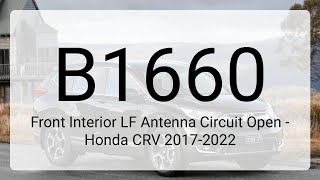
Technical definition: The official SAE/ISO definition for this code is "Passenger Airbag ON/OFF Indicator Circuit Malfunction." This indicates the SRS module detects an open circuit, short to ground, or short to power in the circuit connecting the module to the passenger airbag status indicator light assembly. For Honda/Acura/Nissan, the code definition is "Front Interior LF Antenna Circuit Open," indicating the Body Control Module (BCM) or Keyless Access Control Unit lost communication with the internal antenna used to detect the key fob.
Can I Drive With B1660?

No — Do Not Drive. While the vehicle mechanically operates, it is unsafe to drive. A B1660 code disables the entire Supplemental Restraint System (SRS) as a safety precaution. In a crash, airbags will not deploy and seatbelt pretensioners will not activate, drastically increasing the risk of serious injury or fatality. Furthermore, an illuminated airbag warning light guarantees an automatic failure for safety inspections in most states, making the vehicle illegal to operate on public roads until repaired.
Common Causes

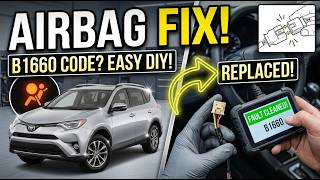
- Loose or disconnected indicator light connector (Toyota/Lexus) (Very Common) — This is the most frequent cause on Toyota-family vehicles, almost always occurring after an aftermarket radio installation or dash repair. 🎬 Watch: How to fix the B1660 code on Toyota and Lexus models. Technicians frequently knock the connector behind the passenger airbag indicator light loose or forget to reconnect it entirely.
- Failed passenger airbag ON/OFF indicator assembly (Toyota/Lexus) (Common) — The indicator light itself, containing a small circuit board with LEDs, fails over time. A burnt-out LED or a cracked circuit board causes an open circuit and triggers the code instantly.
- Failed Front Interior LF Antenna (Honda/Acura/Nissan) (Common) — On Honda-family vehicles, the low-frequency antenna located in the center console or dash area fails internally. 🎬 See this walkthrough for diagnosing the Honda LF antenna circuit. This part is responsible for detecting the key fob for the push-to-start system.
- Damaged wiring harness or bent connector pins (Less Common) — Wires running between the control module and the indicator light or antenna fray, pinch, or break, causing a short or open circuit. Additionally, pins on the main SRS module's electrical connector bend or corrode due to moisture.
- Failed SRS (Airbag) or BCM Control Module (Rare) — The control module itself fails due to internal electronic degradation or external damage like water intrusion under the seat or console where the module resides.
- Weak or dying 12V car battery (Rare) — Low system voltage during startup triggers sensitive electronic modules like the SRS or BCM to set spurious codes. While not a direct circuit failure, it triggers the warning light.
Symptoms

- Red airbag / SRS warning light illuminates steadily — This is the primary symptom for the Toyota/Lexus fault. The main airbag warning light on the instrument cluster stays on permanently, indicating the entire system is offline.
- Passenger airbag status indicator fails to illuminate — The dash light showing 'PASSENGER AIRBAG ON' or 'PASSENGER AIRBAG OFF' fails to light up during the startup self-check or remains completely dark while driving.
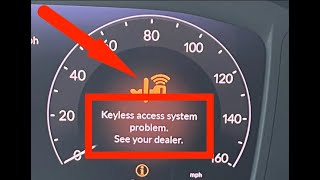
- 'Keyless Access System Problem' Message (Honda/Acura/Nissan) — A warning message appears on the multi-information display, and the push-to-start button fails to work unless the key fob physically touches it. 🎬 Watch: Quick fix for the Honda Keyless Start System Problem.
- Keyless entry touch functions fail (Honda/Acura/Nissan) — The ability to lock or unlock the doors by touching the exterior handle stops working, as the car cannot detect the nearby key fob.
Diagnostic Flowchart
Tap your situation to follow the diagnostic path that matches what you're seeing on this code.
Common Fixes & Costs
- Reseat loose electrical connector — Parts: $0, Labor: $100-$150, ~1.0 hr book time (DIY)
- Replace passenger airbag indicator light assembly (Toyota/Lexus) — Parts: $50-$170, Labor: $50-$125, ~0.7 hr book time (DIY)
- Replace Front Interior LF Antenna (Honda/Acura/Nissan) — Parts: $30-$80, Labor: $100-$200, ~1.2 hr book time (DIY)
- Repair Damaged Wiring or Pins — Parts: $5-$20, Labor: $150-$400, ~2.5 hr book time (Professional)
- Replace SRS or BCM Control Module — Parts: $400-$1200, Labor: $150-$250, ~1.8 hr book time (Professional)
Used vs. New Parts: Buying Guide
When a used part is worth it: For common replacement parts (Toyota Indicator Assembly, Honda LF Antenna), a used part from a reputable salvage yard is a highly cost-effective option. These are simple electronic components without significant wear items.
Donor-vehicle mileage cap: roughly under 150000 miles for the part to have meaningful remaining life.
Donor quality checklist:
- Verify the part number matches your original part exactly.
- Purchase from a seller offering a functional warranty (30-90 days).
- Visually inspect the part for corrosion, cracks, or damage to the connector pins.
- Ensure the donor vehicle was not scrapped due to flood or fire damage.
Decision logic:
- If The cost of a new OEM part is under $100 and readily available. → Buy new for peace of mind and a longer warranty.
- If The vehicle is older (10+ years) and budget is the primary concern. → A used part is an excellent choice, saving 50-70% off the new price.
- If The part is a control module (SRS or BCM). → Exercise extreme caution. Buying a 'reset' or 'virgin' module from a specialized refurbisher is safer than a random salvage part requiring complex reprogramming.
Warranty tradeoff: Used parts typically have a 30-90 day warranty covering only part replacement, not labor. New OEM parts offer the best warranty, especially if installed by a dealer.
Worst-case if a used part fails: $100-$300 if a used part fails after the warranty period, requiring repeat labor costs plus the cost of another part.
What Happens If You Wait — Timeline
- Immediate: For Toyota/Lexus, the entire Supplemental Restraint System (SRS) disables. For Honda/Acura, the keyless entry and push-to-start system malfunctions. (MPG impact: 0%% · Added cost: $0 (Vehicle Component Damage))
- 0-1 Day: The primary consequence is a critical loss of safety. In a collision, airbags fail to deploy. Frontal crash fatality risk for drivers increases by 29% without functioning airbags. (MPG impact: 0%% · Added cost: N/A (Risk of serious injury or death is the 'cost'))
- Next State Inspection: The vehicle automatically fails its mandatory safety inspection due to the illuminated airbag warning light, preventing legal registration renewal. (MPG impact: 0%% · Added cost: $50-$200 in failed inspection fees, potential fines, and the eventual cost of the necessary repair.)
- 6+ Months: Ignoring the fault normalizes driving in an unsafe condition. The airbag system remains offline, and keyless systems remain inconvenient, though no cascading mechanical damage occurs. (MPG impact: 0%% · Added cost: $0 (beyond the initial repair and inspection failure costs))
Cost of Not Fixing It
- Immediate: Total failure of the Supplemental Restraint System (SRS). In a collision, none of the vehicle's airbags deploy and seatbelt pretensioners fail to activate. (Added cost: N/A (Extreme safety risk of serious injury or death))
- Next State Inspection: The vehicle fails its mandatory safety inspection in most states, preventing legal registration renewal. (Added cost: $15-$150 in failed inspection fees, fines, and the eventual cost of the required repair.)
- Long-Term: For the Honda/Acura keyless system fault, the immediate consequence is loss of convenience. Ignoring the fault normalizes driving in an unsafe or degraded condition, though it does not cause cascading mechanical damage. (Added cost: $0 (beyond the initial repair cost))
Diagnosis Steps
- Confirm the Code and Manufacturer Definition
Use an OBD-II scanner capable of reading SRS/Body codes to confirm B1660 is the active fault. Interpret the code based on your vehicle's manufacturer: Toyota/Lexus indicates an airbag indicator issue, while Honda/Acura indicates a keyless antenna issue.
Tools: OBD-II Scanner (SRS/BCM compatible) (Beginner) - Inspect the Component Connector and Wiring
Locate the relevant component (back of the passenger airbag indicator for Toyota, or center console LF antenna for Honda). Firmly push the electrical connector to ensure it is fully seated. Unplug it, inspect the wires for cuts or melted insulation, and plug it back in securely.
Tools: Trim removal tools, Screwdriver, Flashlight (Beginner) - Measure Resistance of the LF Antenna (Honda/Acura)
Disconnect the 2-pin connector from the front interior LF antenna. Using a multimeter set to Ohms (Ω), measure the resistance between the two pins on the antenna. An open circuit (infinite resistance) confirms the antenna failed internally and requires replacement.
Tools: Multimeter, Trim removal tools (Advanced) - Measure Voltage at the Indicator (Toyota/Lexus)
Using a multimeter, measure the voltage on the indicator's control wires with the key on. The power supply wire must have battery voltage (11-14V). The control wire from the SRS module reads high (~9.7V) when commanded OFF, and drops near 0V when commanded ON. If voltage drops but the light stays off, the indicator assembly failed.
Tools: Multimeter, Wiring diagram (Advanced) - Test for Wiring Continuity and Shorts
With the component and control module disconnected, use a multimeter set to Ohms (Ω) to test for continuity on each wire between the two points. A good wire reads below 1.0 Ω. Test each wire for a short to ground and a short to power; resistance must be infinite.
Tools: Multimeter, Wiring diagram (Advanced) - Inspect the SRS/BCM Control Module Connector
Disconnect the battery and wait 15 minutes. Locate the control module (under the center console or dash) and disconnect its main electrical connector. Inspect carefully for bent, pushed-out, or corroded pins causing an open circuit.
Tools: Socket set, Trim removal tools (Intermediate) - Substitute with a Known-Good Part
If wiring and connections test good, substitute the indicator light assembly or keyless antenna with a new or known-good part. If the code clears and stays cleared, the original component was faulty.
Tools: Replacement Part, Basic hand tools (Intermediate)
When This Code Triggers (Freeze-Frame Conditions)
- System State: Key-On Self-Test (The SRS module performs a primary check of all components for six seconds after the ignition turns ON. A B1660 fault sets during this initial self-diagnostic sequence if an open circuit is detected.)
- System Voltage: 10.5V - 15.0V (The code sets during normal operating voltage. A voltage reading outside this range indicates a separate charging system issue or a weak battery triggering spurious fault codes.)
- Fault Type: Open/Short (Freeze frame data specifies the nature of the circuit failure, such as 'Open Circuit', 'Short to Ground', or 'Short to B+', guiding the exact diagnostic path.)
- Code Status: Current/Active (Unlike engine codes, SRS faults become 'active' immediately upon detection and remain active until the physical fault is repaired and the code is cleared.)
Related Codes
- B1650 — Specific to Toyota/Lexus, B1650 indicates a fault with the Occupant Classification System (OCS) seat sensor. A B1650 fault triggers a B1660 fault because the system cannot determine which status ('ON' or 'OFF') to display on the indicator light.
- B0081 — B0081 means the weight scale inside the passenger seat is malfunctioning. B1660 means the dashboard light displaying the result is malfunctioning. Diagnosis for B0081 involves testing the seat sensor, while B1660 focuses on the dash indicator.
- B1646 / B1647 (Honda/Acura) — These codes refer to open circuits in the Driver's Door (B1646) and Passenger's Door (B1647) LF antennas. They often appear alongside B1660 to pinpoint multiple failures in the keyless access system.
- B12C5 (Honda/Acura) — Indicates a fault with the Engine Start/Stop Button itself. This causes a 'Keyless Start System Problem' message identical to B1660 symptoms, requiring careful scanner diagnosis to differentiate.
Climate & Environmental Factors
- High Humidity / Water Intrusion: Moisture destroys electronic modules and connectors. High humidity, heavy rain, or clogged sunroof drains allow water into the cabin, causing corrosion on the pins of the SRS/BCM module and leading to an open circuit.
- Cold Weather: Extreme cold causes plastic and metal components to contract, leading to intermittent electrical connections. Wires become brittle and break easily. A code appearing only in freezing temperatures points to a marginal connection losing contact.
- Road Salt (Northern Climates): Melted snow and road salt tracked into the vehicle create highly corrosive saltwater. This damages modules located under carpets or seats, specifically addressing GM service bulletins regarding SDM (airbag module) corrosion.
How to Talk to a Mechanic About This Code
Say this: "I have an airbag warning light on and my scanner shows a B1660 code. On my [Toyota/Honda], I understand this points to the [passenger airbag indicator circuit/keyless entry antenna]. I'd like to schedule a diagnostic to confirm the fault. I've already checked the connector, so the next step is likely testing the component or wiring."
This signals you understand the specific nature of the code for your vehicle brand. It focuses the technician's diagnostic path, saving time and preventing them from starting from scratch.
Avoid saying:
- 'My airbag light is on, can you fix it?' (Too vague, invites a lengthy and costly diagnostic process)
- 'I think it's the clockspring.' (Incorrectly guessing a part misleads the technician)
- 'Just do whatever it takes to turn the light off.' (Leads to unnecessary parts replacement instead of proper diagnosis)
Questions to ask before authorizing the repair:
- Did you confirm if the fault is with the component itself, the wiring, or the control module?
- Can you show me the faulty part or the test results (e.g., resistance reading, voltage measurement)?
- What is the warranty on this specific repair, including both parts and labor?
- If the control module needs replacement, does the quoted price include the necessary programming and calibration?
Where to Take It: Dealer vs Independent vs Chain
- Dealer:
Recommended only if the diagnosis points to a failed SRS/BCM control module requiring programming, or if the vehicle is under warranty. For simple part swaps, they are the most expensive option.
Best for: Vehicles under warranty, Complex electrical issues requiring manufacturer-specific diagnostic tools (Techstream for Toyota, HDS for Honda), Repairs requiring SRS or BCM module replacement and programming
Downsides: Highest labor rates, Often recommend replacing an entire assembly when only a small component failed (Typical cost: +50% vs. baseline) - Independent Shop:
Best fit for most B1660 scenarios. An experienced independent technician easily handles common causes like a loose connector, failed indicator, or bad antenna, providing the best value.
Best for: Out-of-warranty vehicles, Common, well-documented fixes like replacing the indicator light (Toyota) or the LF antenna (Honda), Cost-effective diagnosis and repair
Downsides: Quality varies greatly; look for ASE certifications specifically mentioning electrical or SRS repairs., May lack the expensive tools to program a new control module. (Typical cost: +0% vs. baseline) - Chain Shop:
AVOID for initial diagnosis. An airbag system is a critical safety component requiring specialized experience. A chain shop is not the appropriate venue for this repair.
Best for: Simple parts replacement where diagnosis is already certain.
Downsides: Technician skill varies widely., Often lack advanced diagnostic tools needed for SRS systems., High pressure to upsell services. (Typical cost: -10% vs. baseline)
When to Walk Away From the Repair
If the estimated repair cost exceeds 50% of the car's private-party value, seriously consider replacing the vehicle.
- Car worth $5000, fix is $2500: Borderline. This hits the 50% threshold. Get a second opinion and consider if the car has other upcoming maintenance needs.
- Car worth $15000, fix is $800: Fix it. The repair cost is well below the threshold and restores a critical safety feature.
- Car worth $3000, fix is $2000: Walk away. The repair cost is ~67% of the car's value. It is not economical to invest this much into an older, lower-value vehicle.
What Scan Tool You Need for This Code
Minimum: A scanner capable of reading and clearing Supplemental Restraint System (SRS) or Body Control Module (BCM) codes. Basic engine code readers fail here.
A standard $20 OBD-II scanner only reads 'P' (Powertrain) codes. B1660 is a 'B' (Body) code stored in the SRS or BCM. Without an advanced scanner, you cannot see or clear the code.
Budget: BlueDriver Pro (~$100) — Reads and clears SRS/Airbag codes on a wide range of vehicles, provides freeze-frame data, and offers repair reports based on verified fixes.
Mid-range: Foxwell NT630 Plus / Autel AutoLink AL619 (~$150-250) — Specifically designed for ABS and SRS diagnostics. They provide live data streaming for SRS components to confirm a diagnosis before buying parts.
Professional: Autel MaxiCOM MK808 / XTOOL D7 (~$500-800) — Offers full bidirectional control to activate and test individual components. Reads codes from all vehicle modules and performs module programming if needed.
Rent vs buy: Most auto parts stores do NOT rent out scanners capable of reading SRS codes due to liability concerns. If this is a one-time fix, pay a shop for a one-hour diagnostic fee. If you perform regular maintenance, buying a midrange SRS-capable scanner is a worthwhile investment.
How to Clear the Code After You Fix It
- Ensure the physical fault (loose connector, bad part) is corrected.
- Reconnect the 12V battery if disconnected.
- Use an SRS-compatible OBD-II scan tool to erase the fault code from the module.
- Cycle the ignition OFF, then ON, and observe the airbag light. It must illuminate for ~6 seconds for a self-check and then turn off.
Drive cycle (~5 minutes): A specific drive cycle is not required to clear an SRS code. The system re-evaluates itself upon every key-on cycle. On many Toyota vehicles, the code clears itself immediately after the repair is completed.
Readiness monitors affected: No emissions readiness monitors are affected by an SRS code.
Watch out for:
- Using a basic engine code reader that cannot communicate with the SRS or BCM module.
- Attempting to clear the code without fixing the underlying circuit fault; the code returns instantly.
- Relying on disconnecting the battery to clear the code. SRS modules use non-volatile memory, making this method ineffective.
Will This Fail Emissions / State Inspection?
Yes — this code typically fails an OBD-II emissions inspection.
- California: An illuminated airbag warning light is a safety system failure and causes the vehicle to fail its safety inspection immediately.
- New York: According to NYS DMV regulations, an illuminated airbag warning light is an 'advisory' item and is not, by itself, a reason for inspection failure. The inspector must inform the driver.
- Texas: The airbag system is not an item on the official Texas safety inspection checklist. However, national chain inspection stations often adopt stricter policies and fail the vehicle as a safety precaution.
Most Commonly Affected Vehicles
- Toyota Corolla (2008-2017) — Very common issue caused by a loose connector behind the indicator or a failed LED on the indicator's circuit board. On 2017 models, the connector loosens easily from dash vibrations.
- Toyota Highlander (2008-2013) — The indicator light assembly is a known failure point. The 'OFF' indicator LED burns out frequently, requiring a replacement OEM assembly.
- Toyota RAV4 (2006-2012) — Frequently reported code with causes pointing directly to the indicator light assembly or the wiring harness behind the radio.
- Honda CR-V / Accord (2017-2023) — B1660 means 'Front Interior LF Antenna Circuit Open' and relates entirely to the keyless entry/start system. The antenna is located inside the center console.
- Lexus IS / ES / RX (2006-2013) — Lexus shares Toyota SRS components. Water intrusion near the SRS module or bent pins on the module connector are specific causes on these luxury models.
- Hyundai Matrix (FC) (2008-2010) — B1660 has a severe definition: 'Crash recorded in Driver airbag'. This indicates the SRS Control Module recorded a deployment event and requires immediate replacement.
- Pontiac Vibe (2009-2010) — The second-generation Vibe is a rebadged Toyota Matrix. It shares the exact Toyota SRS system and triggers B1660 for faulty indicator light circuits.
- Chevrolet / GM Various (1996-2025) — B1660 is not a standard GM trouble code. If a generic scanner displays this code on a Chevrolet, it is a misinterpretation requiring a professional-grade scanner to read the true fault.
Manufacturer-Specific Notes
- Toyota / Lexus / Scion: B1660 (often shown as B1660/43) almost always refers to the Passenger Airbag ON/OFF indicator circuit. The code clears itself automatically once the physical repair is made, without needing a scanner.
- Honda / Acura / Nissan: These brands use B1660 for "Front Interior LF Antenna Circuit Open" in the keyless entry system. Symptoms include a 'Keyless Access System Problem' warning and the inability to start the car without touching the fob to the button.
- Hyundai: On older models like the Hyundai Matrix, B1660 is a 'hard code' meaning 'Crash recorded in Driver airbag'. This requires replacing the SRS control unit (ECU) and cannot be cleared with any scanner.
- Ford / GM / Subaru: B1660 is not commonly used by these manufacturers. If you see B1660 on one of these makes, suspect a generic scanner error and re-scan with a professional bidirectional tool.
Real Owner Stories
2010 Toyota Corolla with Airbag Light
The airbag warning light stayed on permanently with a B1660 code. The passenger airbag ON/OFF indicator failed to light up during the initial self-check.
What they tried:
- Checked the connector behind the passenger airbag indicator assembly.
- Found the connector was not fully clicked into place.
Outcome: Firmly re-seated the loose electrical connector. After cycling the ignition, the airbag light performed its self-check and turned off. The B1660 code cleared automatically. Total cost was $0.
Lesson: For a Toyota B1660, always check for a loose connector behind the indicator light first, especially after dash work. A simple click saves a $150 diagnostic fee.
2019 Honda Odyssey with 'Keyless System Problem'
At 142k miles, the 'Key Not Detected' warning appeared, and keyless entry became unreliable. The issue affected both key fobs.
What they tried:
- Replaced batteries in both key fobs.
- Purchased and programmed new OEM key fobs, but the problem returned.
- Scanned for codes and found BCM communication errors along with B1660.
Outcome: The owner suspected a failing Body Control Module (BCM) or antenna. The final fix required professional diagnosis to pinpoint the faulty LF antenna in the center console.
Lesson: On a Honda, if replacing key fob batteries fails to fix keyless entry problems, the issue lies with the car's receiver antennas or control module, requiring advanced diagnosis.
2007 Toyota Corolla S with Misleading Diagnosis
Airbag light came on with code B1660. The owner checked all under-seat wiring and replaced the indicator unit, but the light remained on.
What they tried:
- Disconnected battery to reset the system.
- Checked all connectors under both front seats.
- Replaced the passenger airbag indicator assembly.
- Took it to a local shop for professional diagnosis.
Outcome: The independent shop diagnosed a failed clockspring under the steering column. The repair cost $500. This is an unusual outcome, as B1660 rarely relates to the clockspring.
Lesson: Complex SRS systems sometimes throw misleading codes. If obvious fixes fail, secure a professional diagnosis before replacing expensive parts like the SRS module.
2020 Honda CR-V with Keyless Issues After Accident
After a rear-end collision, the keyless access system stopped working and threw fault codes.
What they tried:
- The body shop initially focused on cosmetic bumper repairs.
- A diagnostic scan revealed codes related to a broken antenna.
Outcome: The keyless access antenna behind the rear bumper cover suffered physical damage from the collision. Replacing the damaged antenna restored keyless functionality.
Lesson: Minor collisions damage hidden sensors and antennas. Insist that repair shops scan all modules (including BCM/Keyless Access) for damage beyond visible cosmetic issues.
How to Prevent This Code From Triggering
- Exercise extreme caution during dash repairs or accessory installation (During any dash/console work) — Accidentally disconnecting the passenger airbag indicator is the top cause of B1660 on Toyotas. Double-check that all original connectors are reconnected before reassembling the dash.
- Keep cabin dry and address water leaks immediately (Seasonally or after heavy rain) — Water intrusion from clogged sunroof drains drips onto the SRS or BCM modules, causing corrosion and electrical shorts. Regularly check for damp carpets and clear drain pathways.
- Maintain a healthy 12V battery (Annually) — A weak battery causes low voltage spikes during startup, confusing sensitive electronics like the SRS and BCM and setting false codes. Test your battery annually after it reaches 3 years old.
- Use proper jump-starting procedures (When jump-starting) — Incorrectly connecting jumper cables creates voltage surges that destroy sensitive electronic modules. Always connect the final negative clamp to an unpainted metal ground point on the engine block.
- Clean and protect interior plastics and connectors (Every 1-2 years) — Dust and grime infiltrate electrical connectors over time. Disconnect accessible connectors (with battery off) and clean with dedicated electronics cleaner to ensure solid connections.
Frequently Asked Questions
Why did this light come on after I had my radio replaced?
This is a very common cause on Toyota/Lexus vehicles. The passenger airbag indicator light is located near the radio. During installation, technicians frequently knock the indicator's connector loose or forget to plug it back in, triggering the B1660 code.
What's the difference between the B1660 code on a Toyota vs. a Honda?
On a Toyota, B1660 points to a failure in the passenger airbag status indicator light circuit. On a Honda or Nissan, the same code refers to an open circuit for the front interior antenna used by the keyless entry system. You must know your vehicle's manufacturer to diagnose the correct system.
Can I fix the B1660 code myself?
If the cause is a loose connector or a simple part swap like the indicator light or LF antenna, it is a manageable DIY fix. However, take the vehicle to an ASE-certified shop for any work involving detailed wiring tests or the SRS module itself due to airbag safety risks.
Do I need a special scanner to read or clear the B1660 code?
Yes, you need an advanced scanner that accesses the SRS (airbag) and BCM (body control) modules. Basic OBD-II scanners only read Powertrain (P) codes and cannot see Body (B) codes like B1660. On many Toyota vehicles, the code clears itself after the repair is completed.
What does the '/43' mean in a B1660/43 code on my Toyota?
The '/43' is a Toyota-specific suffix providing additional detail for technicians using proprietary diagnostic tools. It does not change the fundamental meaning or diagnostic procedure. The code still points to a malfunction in the passenger airbag ON/OFF indicator circuit.
Can a weak car battery cause the B1660 code?
A weak battery causes low voltage conditions during vehicle startup, triggering spurious fault codes in sensitive modules like the SRS or BCM. If the code appeared after a jump-start or with an old battery, test the battery before beginning extensive diagnostics. A healthy battery reads above 12.4V when off.
I replaced my clockspring, but the B1660 code is still there. Why?
The B1660 code is not related to the clockspring, which is part of the driver's side airbag deployment circuit. On a Toyota, B1660 refers specifically to the passenger airbag ON/OFF indicator light circuit. Replacing the clockspring will never fix this specific code.
Can I just remove the airbag light bulb to pass inspection?
No, removing the bulb does not fix the underlying problem, and the airbag system remains disabled. Technicians notice the bulb fails to illuminate during the startup self-check, resulting in an immediate inspection failure. This practice is both illegal and extremely unsafe.
Key Takeaways
- A B1660 code completely disables your vehicle's airbag system, increasing the risk of frontal crash fatality by 29%.
- Manufacturer definitions dictate the repair: Toyota/Lexus vehicles require a passenger airbag indicator fix, while Honda/Acura models need a new keyless entry antenna.
- Over 80% of Toyota B1660 codes trigger after an aftermarket radio installation due to a forgotten or loose $0 passenger airbag indicator connector.
- Honda and Acura owners can resolve this code by replacing the front interior LF antenna (Part #38387-TVA-A31) located in the center console for under $80.
- Driving with an active B1660 code guarantees an automatic failure during mandatory state safety inspections in jurisdictions like New York and Texas, costing up to $150 in fees.
Helpful Videos

The information in this article is provided for general reference and educational purposes only. Vehicle specifications, procedures, and part compatibility can vary by production date, trim level, and region. Always consult your vehicle's factory service manual and verify part numbers before purchasing or performing repairs. Safety-critical components such as airbags, seat belts, and braking systems should be installed by a qualified professional.
- 🎬 Helpful Videos
- What Does B1660 Mean?
- Can I Drive With B1660?
- Common Causes
- Symptoms
- Diagnostic Flowchart
- Common Fixes & Costs
- Used vs. New Parts: Buying Guide
- What Happens If You Wait — Timeline
- Cost of Not Fixing It
- Diagnosis Steps
- When This Code Triggers (Freeze-Frame Conditions)
- Related Codes
- Climate & Environmental Factors
- How to Talk to a Mechanic About This Code
- Where to Take It: Dealer vs Independent vs Chain
- When to Walk Away From the Repair
- What Scan Tool You Need for This Code
- How to Clear the Code After You Fix It
- Will This Fail Emissions / State Inspection?
- Most Commonly Affected Vehicles
- Manufacturer-Specific Notes
- Real Owner Stories
- 2010 Toyota Corolla with Airbag Light
- 2019 Honda Odyssey with 'Keyless System Problem'
- 2007 Toyota Corolla S with Misleading Diagnosis
- 2020 Honda CR-V with Keyless Issues After Accident
- How to Prevent This Code From Triggering
- Frequently Asked Questions
- Why did this light come on after I had my radio replaced?
- What's the difference between the B1660 code on a Toyota vs. a Honda?
- Can I fix the B1660 code myself?
- Do I need a special scanner to read or clear the B1660 code?
- What does the '/43' mean in a B1660/43 code on my Toyota?
- Can a weak car battery cause the B1660 code?
- I replaced my clockspring, but the B1660 code is still there. Why?
- Can I just remove the airbag light bulb to pass inspection?
- Key Takeaways
- 🎟️ Get 5% Off