

OBD-II Code B1650: Occupant Classification System Malfunction
The Ultimate 2026 Guide to Diagnosing and Fixing B1650
- Code B1650 disables the passenger airbag due to an Occupant Classification System (OCS) fault, increasing frontal collision fatality risk by 32%.
- The top three causes are a damaged under-seat wiring harness, a failed seat sensor mat, or a lost zero-point calibration requiring a professional scan tool.
- On GM, Hyundai, and Kia vehicles, B1650 specifically indicates stored crash data, requiring a $50-$150 mail-in module reset rather than a sensor replacement.
- Always verify your VIN against the NHTSA database before authorizing repairs, as Toyota and Subaru have issued massive recalls for B1650-related sensor failures.
- Standard $20 code readers cannot clear B1650; you must use an advanced bidirectional scanner to read SRS sub-codes and perform mandatory post-repair calibrations.
What Does B1650 Mean?

Code B1650 indicates the Airbag Control Module (ACM) detected a critical fault in the Occupant Classification System (OCS). The OCS uses a seat cushion weight sensor to classify the passenger and determine if the airbag should deploy. When B1650 triggers, the system defaults to disabling the passenger airbag as a safety precaution and illuminates the dashboard warning light.
Technical definition: The SAE definition for B1650 is "Occupant Classification System Malfunction." It triggers when the Restraints Control Module (RCM) detects an open, short, or data error in the OCS circuit, which includes the sensor mat, under-seat control unit, and wiring harness. On Hyundai, Kia, and General Motors vehicles, B1650 specifically indicates the module has stored crash data following a collision and remains locked until professionally reset.
Can I Drive With B1650?

Yes, But With Caution. You can physically drive, but it poses a severe safety risk. Code B1650 disables the passenger airbag, preventing deployment in a frontal collision. Because frontal airbags reduce front-seat fatalities by 32%, do not carry front passengers until the system is repaired and the warning light turns off.
Common Causes

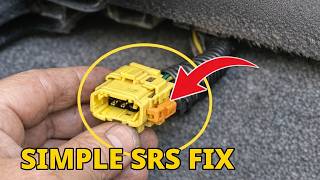
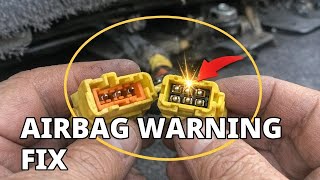
- Damaged Wiring or Loose Connections (Common) — The under-seat wiring harness is highly vulnerable. Stored items, aggressive vacuuming, or repeated seat movement pulls connectors loose or frays wires. 🎬 See how to fix under-seat connectors after a car detail. Rodents also frequently chew these specific wires.
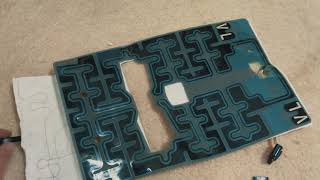
- Faulty Occupant Classification System (OCS) Sensor Mat (Very Common) — The pressure-sensitive mat embedded in the passenger seat cushion is the most frequent hardware failure point. Age, liquid spills, or physical stress like kneeling on the seat breaks the internal circuitry.
- Stored Crash Data in Airbag Control Module (Manufacturer Specific) — On Hyundai, Kia, and GM vehicles, B1650 specifically means the airbag module recorded a crash event. Even without airbag deployment, the module locks and requires a professional reset or replacement. 🎬 Watch: How to clear crash data from Kia airbag modules.
- System Needs Zero Point Recalibration (Less Common) — The system loses its baseline 'empty seat' calibration after a battery replacement, seat removal, or minor collision. The code remains until recalibrated using a bidirectional scan tool.
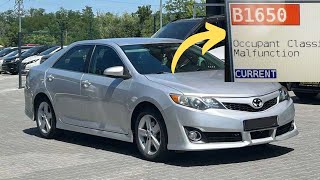
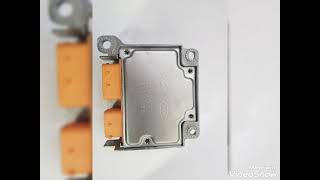
- Faulty Occupant Classification System (OCS) ECU (Less Common) — The dedicated OCS control module under the passenger seat fails from internal electrical faults or water damage. Some 2009-2016 Toyota Corollas feature a top vent hole making them highly susceptible to liquid spills. 🎬 Watch: Why it’s not always the seat sensor on Toyotas.
- Interference from Electronic Devices (Rare) — Highly sensitive capacitive OCS systems, particularly in Subarus, trigger false faults when electronic devices (laptops, cell phones) charge on the passenger seat.
- Incorrectly Installed Seat or Aftermarket Accessories (Rare) — Improperly reinstalled seats, aftermarket seat covers, or seat heaters interfere with the sensor's weight readings, triggering a fault.
- Faulty Seatbelt Buckle Pretensioner (Rare) — Because the OCS integrates with the seatbelt system, a failed passenger buckle switch or pretensioner sometimes forces the RCM to set a general B1650 OCS fault.
Symptoms

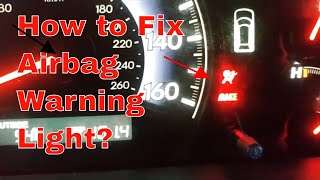
- Airbag Warning Light is On — A dashboard light showing a person with an airbag, 'SRS', or 'AIRBAG' remains illuminated continuously while driving.
- Passenger Airbag 'OFF' Light Stays On — The center console indicator shows the passenger airbag is deactivated, even when a full-sized adult occupies the seat.
- Passenger Seatbelt Warning Flashes Persistently — The passenger seatbelt reminder light flashes continuously, even when the seat is empty or buckled, due to occupant status confusion.
- Cruise Control System is Disabled — Some vehicles automatically disable non-essential systems like cruise control as a safety precaution when an active SRS fault exists.
- Code Cannot Be Cleared with a Standard Scanner (scan-tool only — no driver-felt sign) — B1650 is a 'hard' Supplemental Restraint System (SRS) code. Basic engine code readers cannot erase it; it requires an advanced scanner and often a system recalibration.
Diagnostic Flowchart
Tap your situation to follow the diagnostic path that matches what you're seeing on this code.
Common Fixes & Costs
- Repair Damaged Wiring or Connectors Under Seat — Parts: $10-$30, Labor: $125-$250, ~1.5 hr book time (Intermediate)
- Recalibrate the OCS System (Zero Point Calibration) — Parts: $0, Labor: $100-$200, ~1.0 hr book time (Professional)
- Reset or Replace the Airbag Control Module (after a crash)
— Parts: $50-$150 (mail-in reset), $400-$1000+ (new module), Labor: $100-$250, ~1.8 hr book time
(Professional)
: OEM
: OEM - Replace Occupant Classification Sensor (Seat Cushion Mat)
— Parts: $250-$900, Labor: $200-$500, ~2.5 hr book time
(Professional)
: OEM
: OEM - Replace Occupant Classification System (OCS) ECU
— Parts: $150-$500, Labor: $100-$200, ~1.2 hr book time
(Intermediate)
: OEM
Used vs. New Parts: Buying Guide
When a used part is worth it: For the OCS ECU, a used part from a reputable recycler is cost-effective but requires professional calibration. For the main Airbag Control Module, a professional mail-in reset service on your original module is safer and avoids VIN-locking issues.
Donor-vehicle mileage cap: roughly under 100000 miles for the part to have meaningful remaining life.
Donor quality checklist:
- Verify the donor vehicle was not involved in a flood or fire.
- Match the part number exactly; SRS components are highly specific.
- Avoid buying used main airbag modules, as they are VIN-locked and contain donor crash data.
Decision logic:
- If The fault is stored crash data in the main airbag module → Use a mail-in reset service for your original module. It's cheaper than new and avoids VIN-locking issues.
- If The fault is the OCS sensor mat in the seat cushion → Buy new (OEM or high-quality aftermarket). This part is labor-intensive to replace, and the risk of a used sensor failing is too high.
- If The fault is the OCS ECU under the seat → A used part is a reasonable option, but budget for professional calibration, as it is required for the part to work.
Warranty tradeoff: Used parts typically have a 30-90 day warranty. Aftermarket new parts offer 1-year to lifetime warranties. OEM new parts carry a 1-year warranty.
Worst-case if a used part fails: $300-$600 if a used sensor or module fails after installation, requiring repeat labor costs plus the price of another part.
What Happens If You Wait — Timeline
- Immediate: The passenger airbag is disabled. The 'Passenger Airbag OFF' indicator stays illuminated. (MPG impact: 0%% · Added cost: $0)
- First State Inspection: The vehicle fails mandatory state safety inspections, preventing legal registration renewal. (MPG impact: 0%% · Added cost: $50-$200 in potential fines and re-inspection fees.)
- At time of resale/trade-in: Vehicle value drops by 20-40%. Dealers and private buyers heavily discount cars with active airbag lights. (MPG impact: 0%% · Added cost: $500-$2,500+ reduction in vehicle value.)
- In the event of an accident: The passenger airbag will not deploy, drastically increasing the risk of serious or fatal injury. (MPG impact: 0%% · Added cost: N/A (Immeasurable cost of injury or death))
Cost of Not Fixing It
- Immediate: The passenger airbag remains disabled, drastically increasing the risk of serious or fatal injury to a front passenger in an accident. (Added cost: N/A)
- 0-12 months: Failure to pass mandatory state safety inspections, resulting in fines or inability to legally register the vehicle. (Added cost: $50-$200 in fines or re-inspection fees.)
- Ongoing: Significantly reduced vehicle resale value. Dealerships and private buyers heavily discount cars with known safety defects. (Added cost: $500-$2000+ reduction in value.)
Diagnosis Steps

- Visual Inspection Under the Passenger Seat
Before using any tools, perform a thorough visual inspection. Look for disconnected yellow airbag connectors, damaged wires, or objects lodged under the seat pinching the harness. Check for moisture or corrosion on the OCS ECU.
Tools: Flashlight (Beginner) - Scan for Manufacturer-Specific SRS Codes
Use an advanced scan tool capable of reading SRS/airbag system codes. B1650 is a generic code; the OCS ECU stores proprietary codes (like B1785 on a Toyota) that pinpoint the exact failure, such as a calibration issue or specific sensor circuit fault.
Tools: Advanced OBD-II Scanner (with SRS/OCS capability) (Beginner) - Check for Manufacturer Recalls and Warranty Extensions
Before replacing parts, check for open recalls. Toyota and Subaru have issued massive recalls and warranty extensions for faulty OCS sensors. A VIN check on the NHTSA database saves thousands of dollars if your vehicle is covered.
Tools: Vehicle VIN, Internet Access (Beginner) - Analyze Live OCS Data
Navigate to the OCS live data stream on your scan tool. With the passenger seat empty, observe the 'Occupant Status' PID. It should read 'Empty'. Have an adult sit in the seat; the status must change to 'Occupied'. If the status doesn't change, it confirms a hardware problem with the sensor mat or wiring.
Tools: Advanced OBD-II Scanner (with Live Data) (Intermediate) - Attempt Zero Point Calibration
If no physical faults are found, attempt recalibration. The vehicle must be on a level surface with absolutely nothing on the passenger seat. Follow the specific on-screen prompts from the scan tool. A 'Calibration Failed' message indicates a persistent hardware fault.
Tools: Advanced OBD-II Scanner (e.g., Autel, Techstream, Snap-on) (Advanced) - Check Harness for Open/Short Circuits
Disconnect the battery and wait 15 minutes. Disconnect the main airbag module and OCS ECU connectors. Following a wiring diagram, check for continuity and shorts. A reading of 'Below 1 \u03a9' indicates continuity; '10 k\u03a9 or higher' indicates an open circuit.
Tools: Multimeter, Vehicle-Specific Wiring Diagram (Advanced) - Check Seat Belt Buckle Switch Status
While in the live data stream, monitor the PID for the 'Passenger Buckle Switch'. Buckle and unbuckle the passenger seatbelt. If the status doesn't change from 'Unbuckled' to 'Buckled', the fault lies in the buckle assembly.
Tools: Advanced OBD-II Scanner (with Live Data) (Intermediate) - Perform OCS Sensitivity Check (Honda)
For Honda systems, perform a sensitivity check. After initialization, place a calibrated 30 kg (66 lb) weight in the center of the passenger seat. The scan tool's live data should read approximately half the applied weight. Significant deviation indicates a faulty sensor.
Tools: Advanced OBD-II Scanner (with SWS functions), Calibrated 30 kg / 66 lb Weight (Advanced)
When This Code Triggers (Freeze-Frame Conditions)
- System State: Ignition ON (The SRS module performs a primary self-check for about six seconds every time the ignition is turned ON.)
- Fault Detection Time: Continuous (After the initial 6-second check, the module continuously monitors the OCS circuit for opens, shorts, or data errors.)
- Battery Voltage: 9-16 Volts (The code triggers if battery voltage drops too low during startup, causing the module to lose calibration.)
- Event Trigger: N/A (SRS codes are not tied to engine RPM or speed; they are set by system self-diagnostics or a collision event.)
Related Codes
- B1785 / B1786 / B1787 / B1788 — Toyota/Lexus codes confirming a collision was detected by OCS sensors, making Zero Point Calibration mandatory.
- B1193 — Ford/Mazda equivalent for 'Crash Data Stored'. The airbag module needs a reset or replacement.
- B0081 — GM code for 'Passenger Presence System'. If present with B1650, it indicates a genuine sensor/wiring fault rather than just stored crash data.
- B00C1 — Generic code specifically isolating the OCS Sensor Mat in the seat cushion as the failure point.
Climate & Environmental Factors
- High Humidity / Moisture: Moisture from spills, detailing, or high humidity penetrates the OCS sensor mat or ECU, causing short circuits. This is heavily documented on Subaru models.
- Extreme Cold: Freezing temperatures cause metal contacts in older airbag connectors to contract, creating temporarily loose connections that trigger intermittent faults.
How to Talk to a Mechanic About This Code
Say this: "I have an airbag light on and my scanner shows code B1650. Based on my vehicle's make, this is often a calibration issue, stored crash data, or a faulty sensor. Can you read the manufacturer-specific SRS codes and check for related TSBs before quoting a part replacement?"
This directs the technician toward a logical diagnostic process (scan, check TSBs, calibrate) rather than immediately quoting an expensive seat sensor replacement.
Avoid saying:
- 'My airbag light is on, can you fix it?'
- 'Just do whatever it takes to turn the light off.'
- 'I think I need a new airbag sensor.'
Questions to ask before authorizing the repair:
- Did you find any manufacturer-specific codes in the SRS or OCS modules, or just the generic B1650?
- Have you checked my VIN for any open recalls or warranty extensions related to the OCS system?
- If you're recommending a part replacement, can you confirm that you attempted a Zero Point Calibration and it failed?
- For my GM/Hyundai/Kia, have you confirmed the fault is with the seat sensor itself, and not just stored crash data in the main airbag module?
- What is the warranty on the recommended parts and labor?
Where to Take It: Dealer vs Independent vs Chain
- Dealer:
Recommended if your vehicle is a Toyota/Lexus needing calibration, is under warranty, or if you prefer OEM-level expertise despite the 50% cost premium.
Best for: Vehicles under warranty or covered by a recall/warranty extension., Complex Zero Point Calibrations requiring manufacturer-specific software (e.g., Toyota Techstream)., Diagnosing brand-new models or very obscure faults.
Downsides: Highest labor rates, typically 1.5-2x more than independent shops., Defaults to replacing entire assemblies (e.g., full seat cushion) instead of smaller components. (Typical cost: +50% vs. baseline) - Independent Shop:
Best overall fit for out-of-warranty vehicles, provided the shop owns a high-level bidirectional scanner capable of SRS diagnostics and OCS calibration.
Best for: Out-of-warranty vehicles where cost is a major factor., Straightforward part replacements (like an OCS ECU) or wiring repairs., Shops that own a high-level bidirectional scanner (Autel, Snap-on) capable of SRS diagnostics and calibration.
Downsides: Quality and equipment vary widely; you must vet the shop., Lacks access to the very latest proprietary software updates. (Typical cost: +0% vs. baseline) - Chain Shop:
AVOID. Chain shops lack the specialized training and bidirectional scan tools required for SRS diagnosis and calibration, leading to expensive misdiagnoses.
Best for: Simple maintenance like oil changes and tires.
Downsides: Technicians lack the training and specialized tools for SRS diagnosis and calibration., High risk of misdiagnosis, leading to unnecessary and expensive part recommendations. (Typical cost: -10% vs. baseline)
When to Walk Away From the Repair
If the estimated repair cost for the B1650 code exceeds 40-50% of your car's current private-party value, consider selling the car as-is. An active airbag light reduces a car's trade-in value by 20-40%.
- Car worth $4000, fix is $2200: Walk away. The repair cost is over 50% of the car's value. The money is better put towards a replacement vehicle.
- Car worth $15000, fix is $1800: Fix it. The repair cost is only 12% of the vehicle's value and is a critical safety repair that restores significant value.
- Car worth $2500, fix is $150: Fix it. If the fix is a simple module reset for a GM/Hyundai/Kia, the low cost makes it an obvious repair to restore safety and value.
What Scan Tool You Need for This Code
Minimum: A scanner that can read and clear Supplemental Restraint System (SRS) / Airbag codes. A basic engine-only code reader will not work.
A standard $20 OBD-II scanner only reads codes from the engine control unit (ECU). The B1650 code is stored in the separate Airbag/SRS module, which basic readers cannot access.
Budget: BlueDriver Pro (~$99) — Reads and clears SRS/Airbag codes for most major brands. It provides live data but CANNOT perform Zero Point Calibrations.
Mid-range: Foxwell NT510 Elite (~$180) — Provides OE-level diagnostics for a single car make. Reads SRS codes, views live data, and performs critical OCS Zero Point Calibrations for many models.
Professional: Autel MaxiCOM MK808 / MaxiSYS Series (~$500-1200) — Full bidirectional control. Reliably performs OCS Zero Point Calibration and sensitivity checks on a wide range of vehicles.
Rent vs buy: Auto parts stores scan check engine lights for free, but their tools do not read SRS codes, and they do not rent out advanced scanners. You must buy a capable scanner.
How to Clear the Code After You Fix It
- Perform the required physical repair (e.g., replace sensor, fix wiring).
- If required by the repair, perform Zero Point Calibration using a compatible scan tool.
- With the repair complete, use an SRS-capable OBD-II scan tool to clear the B1650 code.
- Turn the ignition off, wait 10 seconds, then turn it back on. The airbag light should illuminate for ~6 seconds and then turn off.
Drive cycle (~10 minutes): A specific drive cycle is not required for the SRS system. After clearing the code, a 10-minute test drive confirms the light does not return, which would indicate an unresolved issue.
Readiness monitors affected: None. SRS/Airbag system status does not affect engine emissions readiness monitors.
Watch out for:
- Disconnecting the battery will not clear SRS codes.
- Basic engine code readers cannot access or clear SRS module faults.
- If the code stems from stored crash data (GM/Hyundai/Kia), scan tools cannot clear it; the module requires a hard reset or replacement.
Will This Fail Emissions / State Inspection?
No — by itself this code doesn't fail OBD inspection (but it can keep readiness monitors from setting, which causes a separate fail).
- California: An airbag light will NOT cause a failure of the emissions (smog) test. However, a technician may refuse to test the vehicle for safety reasons.
- New York: An illuminated airbag warning light is an advisement only and is NOT cause for rejection in a NYS safety inspection, though some shops incorrectly fail vehicles for it.
- Texas: Texas requires an annual safety inspection that includes checking the airbag warning light. An illuminated light results in a failed inspection.
- Virginia: In Virginia's annual safety inspection, an airbag warning light that is on or inoperative causes the vehicle to be rejected.
Most Commonly Affected Vehicles
- Toyota Tacoma, Corolla, Prius, Sienna, RAV4, Highlander (2005-2022) — Prone to losing calibration after battery changes. 2009-2016 Corolla OCS ECUs fail from liquid spills. 2020-2022 models have a warranty extension (ZLA) for faulty sensors.
- Subaru Forester, Outback, Legacy, Impreza (2010-2018) — OCS sensor mat failures are extremely common due to moisture. Recall WUM-98 covers 2015-2018 Foresters for ODS sensor harness replacement.
- Lexus IS, ES, RX (2006-2022) — Frequently require Zero Point Calibration. Rodent damage to under-seat wiring is common. 2020-2022 ES/RX models fall under Toyota's ZLA warranty program.
- Chevrolet Cruze, Malibu, Equinox (2010-2018) — B1650 almost exclusively indicates crash data stored in the Sensing and Diagnostic Module (SDM), requiring a module reset rather than sensor diagnosis.
- Ford Fusion, Focus (2013-2018) — While Ford often uses B1193 for crash data, B1650 appears for genuine OCS sensor or wiring faults. Sensor replacements average $550.
- Honda Accord, Civic, CR-V (2008-2017) — SWS (Seat Weight Sensor) failures require a dealer-level scan tool (HDS) for initialization after replacement. Parts alone cost $800+.
- Kia/Hyundai Various Models (2010-2024) — B1650 means 'Crash Recorded in 1st Stage Only Frontal.' The airbag control module stored crash data and must be reset or replaced.
- Pontiac Vibe (2005-2008) — Shares the Toyota Matrix platform. Diagnosis and Zero Point Calibration requirements mirror Toyota models of the same era.
Manufacturer-Specific Notes
- Toyota/Lexus: Requires a 'Zero Point Calibration' for almost any SRS repair, seat removal, or minor collision. Cannot be cleared without Techstream or a high-end scanner.
- Subaru: OCS sensor mats are hyper-sensitive to moisture. TSB 07-108-17R mandates the seat must be 100% dry before diagnosis.
- Kia/Hyundai: B1650 signifies crash data stored in the airbag module (SRSCM). It requires a professional module reset, not a seat sensor repair.
- General Motors (GM): B1650 indicates the Sensing and Diagnostic Module (SDM) locked after detecting a crash. Requires a specialist reset service.
Real Owner Stories
2007 Toyota Tacoma with an intermittent airbag light.
The B1650 code appeared after the owner repeatedly moved the bench seat. The light would sometimes go off and come back on.
What they tried:
- The owner suspected the clock spring, which had been previously replaced.
- After forum advice, he performed a visual inspection under the passenger seat.
Outcome: The owner found a loose yellow connector under the passenger seat. After reconnecting the battery and securing the plug, the airbag light went out. The fix cost $0.
Lesson: Always start with the simplest physical check. A loose connector under the seat is a common, no-cost fix, especially if the seat has been moved frequently.
2005 Pontiac Vibe (Toyota Matrix platform) after a minor rear-end collision.
The vehicle was hit from behind, causing no airbag deployment but triggering code B1650. Scanning revealed an additional B1785 code.
What they tried:
- The owner attempted to clear the code with an Autel scanner, but it came back immediately.
- He visually inspected the under-seat wiring and found no obvious damage.
- He tried to perform a 'Zero Point Calibration' with two consumer-grade scan tools, but both failed.
Outcome: The code could not be cleared without a dealer-level scan tool capable of performing the OCS Zero Point Calibration required after a collision event.
Lesson: On Toyota-platform vehicles, any collision triggers a B1650 requiring recalibration. Standard scanners cannot perform this; a dealer or equipped shop must do it for $100-$200.
2012 Subaru Impreza with an intermittent B1650.
The airbag light only came on when a passenger was in the car or when a charging cell phone was placed on the seat.
What they tried:
- The owner suspected the system needed to be 'zeroed'.
- Forum research pointed to Technical Service Bulletin (TSB 17-16-12).
Outcome: The TSB confirmed the capacitive OCS sensor is highly sensitive. Interference from electronic devices triggers the fault. The permanent fix is replacing the Occupant Control Unit with an updated part.
Lesson: For Subaru owners, B1650 is often caused by moisture or electronic interference. Ensure the seat is completely dry and test without electronic devices before replacing parts.
Kia or Hyundai vehicle with code B1650 after an accident.
The vehicle was in a minor frontal collision, and though no airbags deployed, the airbag light is on with code B1650.
What they tried:
- The owner tried to clear the code with a high-end scan tool, but received an error: 'cannot execute routine'.
Outcome: On Kia and Hyundai vehicles, B1650 specifically means 'Crash Recorded in 1st Stage Only Frontal.' The Airbag Control Module (SRSCM) must be physically removed and sent to a specialized service for a reset.
Lesson: If you have a GM, Kia, or Hyundai and see B1650, the problem is stored crash data in the main airbag module. A mail-in reset service is the most cost-effective solution.
How to Prevent This Code From Triggering
- Be extremely careful with liquids near the passenger seat. (Daily habit) — Liquid spills seep into the seat cushion and short out the OCS sensor mat or ECU.
- Do not place heavy, sharp, or pointed-force objects on the passenger seat. (Daily habit) — Kneeling on the seat breaks the delicate traces within the OCS sensor mat, causing an immediate open circuit.
- Periodically check and clear debris from under the passenger seat. (Every 3-6 months) — Water bottles or umbrellas snag and sever the fragile yellow airbag wiring harness.
- Avoid placing charging electronics on the passenger seat. (Daily habit) — Capacitive OCS systems misinterpret the electronic field from a charging laptop as a fault.
- Use a battery maintainer if the vehicle is stored for extended periods. (During storage > 30 days) — Low battery voltage during startup causes SRS modules to lose calibration.
Frequently Asked Questions
Can I fix a B1650 code by just disconnecting the battery?
No. Disconnecting the battery will not clear this code. The SRS performs a self-check at every ignition cycle. If the fault persists, the code immediately returns.
My car was in a minor accident with no airbag deployment, why do I have this code?
On many vehicles (Hyundai, Kia, GM, Toyota), the airbag module stores B1650 to 'lock' the system after any collision event. This ensures the system is professionally inspected. The module must be reset or replaced to clear the code.
What is Zero Point Calibration and can I do it myself?
Zero Point Calibration is an electronic procedure setting the baseline 'empty seat' weight for the OCS. It is mandatory after replacing a sensor, removing the seat, or a collision. It requires a professional bidirectional scan tool.
Can I install a used OCS sensor or airbag module?
Using used SRS components is highly discouraged. Used OCS sensors still require professional calibration, and used airbag modules are VIN-locked to the donor vehicle, preventing communication with your car.
Why did the airbag light come on after cleaning my car's interior?
The OCS sensor mat is highly sensitive to moisture. Liquid from shampooing, detailing, or spilled drinks interferes with electrical readings and triggers a B1650 code. Thoroughly dry the seat before attempting further diagnosis.
My car has a recall for the OCS sensor. Is this related?
Yes. Toyota and Subaru have issued major recalls and warranty extensions for faulty OCS sensors triggering B1650. Check your VIN on the NHTSA website to see if you qualify for a free repair.
Can I use an OCS emulator or bypass module to fix this?
OCS emulators trick the system into thinking an adult is always present, keeping the airbag permanently armed. This causes catastrophic injury or death to a child or small adult during deployment. They are extremely dangerous and illegal in many jurisdictions.
What is the difference between the OCS ECU and the main Airbag Control Module (RCM/SDM)?
The OCS ECU processes signals from the seat weight sensor and determines occupant size. It sends this data to the main Airbag Control Module, which makes the final deployment decision during a crash.
Key Takeaways
- Code B1650 disables the passenger airbag due to an Occupant Classification System (OCS) fault, increasing frontal collision fatality risk by 32%.
- The top three causes are a damaged under-seat wiring harness, a failed seat sensor mat, or a lost zero-point calibration requiring a professional scan tool.
- On GM, Hyundai, and Kia vehicles, B1650 specifically indicates stored crash data, requiring a $50-$150 mail-in module reset rather than a sensor replacement.
- Always verify your VIN against the NHTSA database before authorizing repairs, as Toyota and Subaru have issued massive recalls for B1650-related sensor failures.
- Standard $20 code readers cannot clear B1650; you must use an advanced bidirectional scanner to read SRS sub-codes and perform mandatory post-repair calibrations.
Helpful Videos


The information in this article is provided for general reference and educational purposes only. Vehicle specifications, procedures, and part compatibility can vary by production date, trim level, and region. Always consult your vehicle's factory service manual and verify part numbers before purchasing or performing repairs. Safety-critical components such as airbags, seat belts, and braking systems should be installed by a qualified professional.
- 🎬 Helpful Videos
- What Does B1650 Mean?
- Can I Drive With B1650?
- Common Causes
- Symptoms
- Diagnostic Flowchart
- Common Fixes & Costs
- Used vs. New Parts: Buying Guide
- What Happens If You Wait — Timeline
- Cost of Not Fixing It
- Diagnosis Steps
- When This Code Triggers (Freeze-Frame Conditions)
- Related Codes
- Climate & Environmental Factors
- How to Talk to a Mechanic About This Code
- Where to Take It: Dealer vs Independent vs Chain
- When to Walk Away From the Repair
- What Scan Tool You Need for This Code
- How to Clear the Code After You Fix It
- Will This Fail Emissions / State Inspection?
- Most Commonly Affected Vehicles
- Manufacturer-Specific Notes
- Real Owner Stories
- 2007 Toyota Tacoma with an intermittent airbag light.
- 2005 Pontiac Vibe (Toyota Matrix platform) after a minor rear-end collision.
- 2012 Subaru Impreza with an intermittent B1650.
- Kia or Hyundai vehicle with code B1650 after an accident.
- How to Prevent This Code From Triggering
- Frequently Asked Questions
- Can I fix a B1650 code by just disconnecting the battery?
- My car was in a minor accident with no airbag deployment, why do I have this code?
- What is Zero Point Calibration and can I do it myself?
- Can I install a used OCS sensor or airbag module?
- Why did the airbag light come on after cleaning my car's interior?
- My car has a recall for the OCS sensor. Is this related?
- Can I use an OCS emulator or bypass module to fix this?
- What is the difference between the OCS ECU and the main Airbag Control Module (RCM/SDM)?
- Key Takeaways
- 🎟️ Get 5% Off