

OBD-II Code B1631: Mirror Driver Left Circuit Failure & Manufacturer-Specific Meanings
What B1631 means, why it triggers, and how to fix it on any vehicle
- Code B1631 primarily indicates a driver's side mirror circuit failure, but on GM vehicles, it triggers a no-start condition due to a theft deterrent system lockout.
- The most common cause of a true mirror fault is broken wiring inside the flexible rubber door jamb boot, requiring a $150-$300 wiring repair.
- Before buying a replacement mirror assembly, test the $25-$150 power mirror switch and inspect the 10-amp mirror fuse, as both fail frequently.
- If B1631 appears alongside an illuminated SRS light on a Toyota or Mitsubishi, stop DIY diagnosis immediately; this indicates a critical airbag circuit short requiring professional repair.
- Driving with a non-functional driver's side mirror creates a massive blind spot and results in a $50-$250 'fix-it' ticket in states like California and New York.
What Does B1631 Mean?
B1631 is a Body Diagnostic Trouble Code (DTC) indicating the Body Control Module (BCM) or Door Control Module (DCM) detected an electrical fault in the driver's side power mirror circuit. The computer flags this when it commands the mirror to move but receives no electrical response. Crucially, for manufacturers like General Motors, Dodge, Toyota, and Mitsubishi, B1631 signifies entirely different problems: theft system failures, headlight faults, or airbag issues.
Technical definition: The SAE standard definition is "Mirror Driver Left Circuit Failure," indicating an open circuit, short to ground, or short to power in the driver's mirror assembly. Manufacturer-specific definitions override this, linking B1631 to theft deterrent, lighting, or supplemental restraints.
Can I Drive With B1631?
Yes. B1631 does not affect engine operation or primary safety systems. However, losing driver's side mirror adjustment creates a significant blind spot, compromising safety during lane changes. Driving without a functional driver's mirror is illegal in many jurisdictions and results in a 'fix-it' ticket or fine. Repair it promptly for safety and legal compliance.
Common Causes
- Broken or Chafed Wires in Door Jamb (Very Common) — The wiring harness inside the flexible rubber boot between the door and body flexes constantly. Over time, copper wires fatigue and break, creating an open circuit that disables the mirror, windows, or locks. 🎬 See how to fix broken wires in a car door
- Faulty Power Mirror Switch (Common) — Internal electrical contacts wear out from use. Spilled liquids or rain from an open window cause corrosion and short circuits within the switch assembly.
- Failed Mirror Motor Assembly (Common) — The electric actuator inside the mirror housing burns out or fails mechanically. Water intrusion from car washes shorts the motor's internal electronics. 🎬 Watch: How to diagnose mirror switches and motors
- Blown Fuse (Less Common) — A short circuit in the mirror wiring or motor causes the protective fuse to blow. If the fuse is blown, the entire circuit receives no power.
- Corroded or Damaged Electrical Connectors (Less Common) — Moisture corrodes the plastic multi-pin connectors linking the door harness to the switch and mirror, leading to high resistance and signal failure.
- Faulty Door Control Module (DCM) (Less Common) — The dedicated computer managing door electronics fails internally, preventing it from processing switch commands or sending power to the mirror.
- Improperly Installed Aftermarket Accessories (Rare) — Poorly installed alarms or speakers tap into the mirror circuit incorrectly, causing shorts or overloading the circuit.
Symptoms
- Driver's side mirror will not adjust — The mirror completely fails to move up, down, left, or right using the control switch.
- Engine starts and dies immediately (GM Vehicles) — On GM vehicles, B1631 indicates a theft deterrent lockout. The engine fires but shuts off within 2 seconds. 🎬 Watch: GM Passlock and security relearn procedure walkthrough
- Intermittent mirror operation — The mirror works sporadically, often cutting out when the door is opened or closed, indicating a broken wire in the door jamb.
- Mirror only adjusts in some directions — The mirror moves left/right but not up/down, indicating a failure within the power mirror switch contacts.
- Other driver's door electronics malfunctioning — Power windows and locks fail simultaneously because their wires share the same damaged door jamb harness.
Diagnostic Flowchart
Tap your situation to follow the diagnostic path that matches what you're seeing on this code.
Common Fixes & Costs
- Repair Broken Wires in Door Jamb — Parts: $10-$30, Labor: $150-$300, ~2.0 hr book time (Intermediate)
- Replace Power Mirror Switch — Parts: $25-$150, Labor: $50-$75, ~0.6 hr book time (DIY)
- Replace Blown Fuse — Parts: $1-$5, Labor: $0, ~0.1 hr book time (DIY)
- Replace Driver's Side Mirror Assembly — Parts: $75-$1900, Labor: $75-$150, ~1.5 hr book time (Intermediate)
- Replace Door Control Module (DCM) — Parts: $150-$500, Labor: $100-$200, ~1.5 hr book time (Advanced)
DIY vs Professional
- Replace Blown Fuse — Beginner:
- Replace Power Mirror Switch — Beginner:
- Repair Broken Wires in Door Jamb — Beginner:
- Replace Driver's Side Mirror Assembly — Beginner:
- Replace Door Control Module (DCM) — Beginner:
Used vs. New Parts: Buying Guide
When a used part is worth it: Buy a used OEM mirror assembly from an auto recycler for vehicles over 7 years old to ensure perfect fit and color match on a budget.
Donor-vehicle mileage cap: roughly under 100000 miles for the part to have meaningful remaining life.
Donor quality checklist:
- Verify the exact part number and pin count. Mirrors have variations (heated, power-fold, blind-spot) that must match.
- Avoid wiring harnesses from rust-belt donors or vehicles with water damage.
- Inspect for cracked plastic, broken glass, or corroded connector pins.
Decision logic:
- If The part is a simple mirror switch or fuse → Buy new aftermarket. The cost is low and reliability is high.
- If The part is a complex mirror assembly on a newer vehicle (<5 years old) → Buy new OEM or high-quality aftermarket to ensure camera and sensor functions work correctly.
- If The part is a basic mirror assembly for an older vehicle (>7 years old) → Buy a used OEM part from a low-mileage donor for the best value.
Warranty tradeoff: Used parts carry a 30-90 day replacement warranty. New aftermarket parts offer 1-year to lifetime warranties. New OEM parts carry a 1-year warranty.
Worst-case if a used part fails: $150-300 if a used mirror fails after the warranty period, requiring repeat labor and parts.
What Happens If You Wait — Timeline
- 0-4 weeks (Standard Mirror Fault): Mirror is dead or intermittent. B1631 is stored. Safety is compromised by the blind spot.
- 1-3 months (Standard Mirror Fault): Law enforcement issues a 'fix-it' ticket for defective safety equipment.
- 3-6+ months (Standard Mirror Fault): A continuous short circuit damages the Door Control Module (DCM).
- Immediate (Manufacturer-Specific Fault): GM vehicles immobilize. Toyota/Mitsubishi airbag faults disable critical safety restraints.
Cost of Not Fixing It
- Immediate: Standard mirror fault: Creates a massive driver-side blind spot and risks a traffic citation. (Added cost: $50 - $250 (traffic fine))
- Immediate: GM theft system fault: The vehicle immobilizes and will not run, requiring a tow. (Added cost: $75 - $200 (towing charge))
- Immediate: Toyota/Mitsubishi airbag fault: The specific airbag is disabled and will not deploy in a crash. (Added cost: N/A (Severe injury risk))
- Ongoing: Dodge headlight fault: The right low-beam headlight fails, reducing night visibility. (Added cost: $50 - $250 (traffic fine))
Diagnosis Steps
- Check the Fuse
Locate the power mirror fuse in the owner's manual. Pull it and inspect the metal strip. If broken, replace it with the exact same amperage rating. If it blows immediately, you have a short circuit.
Tools: Fuse puller or needle-nose pliers (Beginner) - Visually Inspect and Wiggle the Door Jamb Wiring
Pull back the flexible rubber boot between the driver's door and the body. Inspect wires for cracked insulation or breaks. Have an assistant operate the mirror switch while you wiggle the harness. If the mirror moves, the fault is in that wiring section.
Tools: Flashlight, an assistant (Beginner) - Test the Power Mirror Switch
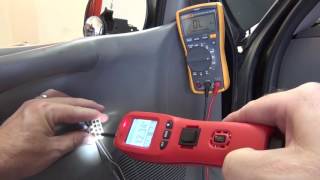
Pry the mirror switch panel from the door and unplug it. Set a multimeter to continuity. Test the switch's internal contacts according to a wiring diagram. Pressed directions should show near 0 Ohms; released should show OL (open loop).
Tools: Trim removal tool, multimeter, wiring diagram (Intermediate) - Test for Power and Ground at the Switch Connector
With the ignition ON, set the multimeter to DC Volts. Connect the black probe to chassis ground and the red probe to the power supply pin on the harness connector. It should read ~12V. Switch to Ohms and test the ground pin to chassis; it should read under 1 Ohm.
Tools: Multimeter, wiring diagram (Intermediate) - Test for Power at the Mirror Connector
Remove the interior door panel and unplug the mirror. Have an assistant press the switch while you measure DC Volts across the harness pins. If you see ~12V but the mirror doesn't move, the mirror motor is dead.
Tools: Trim removal tools, socket set, multimeter, an assistant (Advanced) - Bypass the Circuit to Test the Motor Directly
Apply 12V directly from the battery to the power and ground pins on the mirror assembly using fused jumper wires. If the mirror moves, the wiring or switch is bad. If it doesn't, the mirror assembly is faulty.
Tools: Fused jumper wires, 12V power source (Advanced) - Pro Tip: Load Testing the Circuit (Voltage Drop)
Back-probe the power pin at the connected mirror with the red lead, and the positive battery terminal with the black lead. Operate the mirror. A reading over 0.5V indicates excessive resistance in the power wire. Repeat for the ground side.
Tools: Multimeter with back-probe pins (Expert)
When This Code Triggers (Freeze-Frame Conditions)
- Battery Voltage: 11.5V - 14.5V (The code sets when the ignition is on and battery voltage is normal. A severe voltage drop during cranking causes spurious body codes.)
- Ignition Status: ON or RUN (The BCM or DCM actively monitors circuits when the ignition is on. The fault logs during a self-test or active command.)
- Mirror Switch Command: Active (Up, Down, Left, or Right) (The fault triggers the instant the driver presses the mirror switch and the module detects incorrect voltage or current draw.)
- Circuit Status: Open, Short to Ground, or Short to Power (Advanced scan tools explicitly state the exact electrical fault type detected by the module.)
Related Codes
- B1632 — Specifies 'Mirror Driver Left Circuit Open.' A precise version of B1631 indicating a broken wire, confirmed by infinite resistance (OL) on a multimeter.
- B1634 — Indicates 'Mirror Driver Left Circuit Short to Ground.' The power wire is touching the metal chassis, confirmed by continuity between the power wire and ground.
- B1635 — The identical code for the passenger side: 'Mirror Passenger Right Circuit Failure.' Diagnostics are identical but performed on the passenger door.
- P1631 (GM) — A powertrain code ('Theft Deterrent Password Incorrect') that appears alongside B1631 on GM vehicles, confirming the start-and-die symptom is a security issue.
Climate & Environmental Factors
- Cold Weather: Low temperatures make PVC wire insulation stiff and brittle. Repeated door flexing cracks the insulation, exposing wires and causing shorts in the door jamb harness.
- High Humidity / Rain / Salt: Water intrusion corrodes metal pins in connectors, switches, and mirror motors. Road salt accelerates this corrosion, increasing electrical resistance and causing complete circuit failure.
How to Talk to a Mechanic About This Code
Say this: "For a mirror fault: 'My driver's side mirror isn't working, and my scan tool shows a B1631 code. Please diagnose the door jamb wiring and mirror switch before quoting a full mirror replacement.' For a GM no-start: 'My Chevy starts and dies immediately with a B1631 code. I believe this is a security system issue. Please perform the security relearn procedure.' For a Toyota/Mitsubishi airbag light: 'My airbag light is on with code B1631. I need an SRS system diagnostic.'"
This directs the technician to the most likely fixes first, preventing them from immediately jumping to expensive part replacements. It correctly identifies GM and Toyota/Mitsubishi quirks, saving diagnostic time.
Avoid saying:
- 'My car has a B1631 code, please fix it.' (Too vague).
- 'Just replace the mirror.' (Leads to wasted money if the wiring is bad).
- 'My check engine light is on.' (B1631 is a Body code, not a powertrain code).
Questions to ask before authorizing the repair:
- Did you perform a wiggle test on the door harness and test the switch for power?
- Will you use solder and heat shrink for wiring repairs?
- Can you provide the specific SRS code definition from your professional scan tool?
- Can you provide a written estimate breaking down parts and labor?
- Will you show me the old parts after the repair?
Where to Take It: Dealer vs Independent vs Chain
- Dealer:
Best for: Vehicles under warranty., GM security relearns and Toyota/Mitsubishi SRS faults., VW door wiring harness recalls.
Downsides: Highest labor rates ($150-$250/hr)., Prone to replacing full assemblies rather than repairing single wires. (Typical cost: +50% vs. baseline) - Independent Shop:
Best fit for the common mirror fault. For GM security or Toyota/Mitsubishi airbag faults, a dealer is more efficient.
Best for: Standard mirror circuit failures., Electrical diagnostics and door jamb wiring repairs.
Downsides: May lack advanced SRS scan tools for Toyota/Mitsubishi airbag faults. (Typical cost: +0% vs. baseline) - Chain Shop:
AVOID for diagnosing B1631. The code's complexity requires diagnostic expertise not found at chain shops.
Best for: Simple fuse replacements.
Downsides: Incapable of deep electrical or SRS diagnostics., High pressure to upsell. (Typical cost: -10% vs. baseline)
When to Walk Away From the Repair
If the estimated repair cost exceeds 40% of the car's private-party value, consider selling it as-is.
- Car worth $4000, fix is $250: Fix it. A wiring repair is well below the threshold and restores safety.
- Car worth $5000, fix is $1900: Walk away. The cost of a high-feature OEM mirror assembly is too high.
- Car worth $2500, fix is $1200: Walk away. A major module replacement exceeds 40% of the car's value.
What Scan Tool You Need for This Code
Minimum: A scanner that reads Body Control Module (BCM) and Supplemental Restraint System (SRS) codes. $20 engine readers cannot see B1631.
Basic engine code readers cannot communicate with the body or safety modules where this code is stored, leading to wasted diagnostic time.
Budget: Ancel BD310 (~$60) — Reads and clears B-codes from the Body Control Module on many models.
Mid-range: Foxwell NT510 Elite (~$180) — Reads BCM and SRS codes, provides manufacturer-specific definitions, and views live data from switches.
Professional: Autel MaxiCOM MK808S (~$450) — Offers full bidirectional control to command the mirror motor directly and performs GM security relearns.
Rent vs buy: For a one-time diagnosis, rent a capable scanner from AutoZone's Loan-A-Tool program. Buy a mid-range scanner if you diagnose vehicles annually.
How to Clear the Code After You Fix It
- Fix the underlying electrical or mechanical problem.
- Use an OBD-II scan tool capable of reading Body (B) codes to clear the fault from the BCM.
- For GM theft system faults, perform the 30-minute security relearn procedure.
- For SRS/Airbag faults, clear the code with a professional scan tool; the airbag light will not reset automatically.
Drive cycle (~5 minutes): Body codes do not require a drive cycle. Clear the code and operate the mirror; if it moves and the code stays away, the repair is successful.
Readiness monitors affected: None. Body codes do not affect emissions readiness monitors.
Watch out for:
- Clearing the code without fixing the hardware fault causes it to return instantly.
- Disconnecting the battery clears the code temporarily but resets all vehicle modules and is not a proper diagnostic procedure.
- Basic $20 engine code readers cannot communicate with the Body Control Module to read or clear B1631.
Will This Fail Emissions / State Inspection?
No — by itself this code doesn't fail OBD inspection (but it can keep readiness monitors from setting, which causes a separate fail).
- California: B1631 does not fail OBD-II emissions tests. However, California requires a functional driver's side mirror to pass salvaged or commercial vehicle safety inspections.
- New York: A non-functional or broken driver's side mirror causes an automatic failure of the annual state safety inspection.
- Texas: Vehicles must have at least one mirror providing a clear 200-foot rear view. Law enforcement issues citations for defective safety equipment like broken mirrors.
Most Commonly Affected Vehicles
- Chevrolet / GMC Silverado, Suburban, Sierra, Corvette (1998-2007) — B1631 is a 'Theft Deterrent Start Enable Signal Not Correct' code. It causes a start-and-die condition due to a BCM/PCM password mismatch. Fix it with a 30-minute security relearn.
- Ford F-150, F-250/350 Super Duty, Explorer (2008-2024) — Prone to standard mirror circuit failures. Replacement costs on newer F-150s exceed $1,900 due to integrated cameras and power-folding mechanisms.
- Dodge / Ram Ram 1500/2500/3500 (2010-2018) — B1631 indicates a 'Right Low Beam Control Circuit Open' fault managed by the TIPM. Diagnose the headlight bulb, wiring, and TIPM outputs.
- Volkswagen / Audi Jetta, Golf, Atlas, A3, A4 (2005-2023) — Notorious for brittle door jamb wiring. 2019-2023 Atlas models have a known harness issue covered by NHTSA recall 22V-152 (VW Campaign 97GF).
- Hyundai Genesis, Sonata (2014-2024) — Triggered by failures in the main front door wiring harness, consistent with the broken door jamb wire cause.
- Toyota Camry, RAV4, Sienna (2005-2024) — B1631 is defined as 'Open in Curtain Shield Squib Rear (RH) Circuit', indicating a serious side airbag system fault requiring professional diagnosis.
- Mitsubishi Outlander Sport / RVR (2011-2018) — TSB-19-52B-006 clarifies B1631 relates to the SRS system, indicating a short circuit in the driver's knee airbag squib.
- Jeep Grand Cherokee, Wrangler (2011-2021) — Similar to Dodge/Ram, B1631 on Jeeps often points to a Right Low Beam Control Circuit Open fault managed by the TIPM or BCM.
Manufacturer-Specific Notes
- General Motors (Chevrolet, GMC, Corvette): B1631 means 'Theft Deterrent Start Enable Signal Not Correct.' The BCM and PCM lose security synchronization, preventing the engine from running. Fix this with a 30-minute security relearn procedure.
- Dodge / Ram / Chrysler: B1631 means 'Right Low Beam Control Circuit Open.' This is a headlight issue detected by the TIPM. Diagnose the bulb, connector, and TIPM.
- Toyota: B1631 is an SRS/Airbag code for 'Open in Curtain Shield Squib Rear (RH) Circuit'. This is a critical safety fault requiring professional diagnosis.
- Volkswagen: On 2019-2023 Atlas models, B1631 is caused by a defective door wiring harness covered under NHTSA recall 22V-152 (VW Campaign 97GF).
- Mitsubishi: TSB-19-52B-006 states B1631 indicates a short circuit in the driver's knee airbag squib. This requires professional SRS service.
Real Owner Stories
2006 Chevy Silverado, 155K miles - The Misdiagnosis
Truck started but died immediately. A basic scan tool showed B1631, 'Mirror Driver Left Circuit Failure.' The mirror worked fine.
What they tried:
- Checked the mirror fuse and wiggled the door harness with no effect.
- Searched online for 'Silverado B1631 no start' and discovered the code's true GM meaning.
Outcome: Performed the 30-minute security relearn procedure. The truck started and ran normally. The root cause was a weak battery that desynchronized the BCM and PCM.
Lesson: Always consider symptoms first. For GM trucks, a 'start and die' symptom with B1631 means it's a theft system problem, not a mirror fault.
2012 VW Jetta, 110K miles - The Easy Fix
Driver's mirror stopped working completely. Power windows and locks on the same door worked fine.
What they tried:
- Checked the fuse, which was intact.
- Pried off the driver's master switch panel and found sticky residue from a coffee spill.
- Ordered a new aftermarket switch assembly for $45.
Outcome: The new switch took 10 minutes to install. Mirror function was fully restored. The old switch was corroded internally from liquid damage.
Lesson: For isolated mirror failure, the switch is a common and inexpensive failure point. Inspect it visually before buying expensive parts.
2013 Mitsubishi Outlander Sport, 85K miles - The Unusual Cause
SRS/Airbag light came on. An independent mechanic scanned the codes and found B1631.
What they tried:
- The mechanic's generic scan tool defined B1631 as a mirror fault, but the mirror worked perfectly.
- A professional scan tool correctly identified it as 'Driver's Knee Air Bag Squib Short-Circuited'.
Outcome: Following Mitsubishi TSB-19-52B-006, the mechanic reconnected the SRS-ECU and knee airbag module connectors, clearing the fault without replacing parts.
Lesson: On Toyota and Mitsubishi vehicles, B1631 is a critical airbag system fault. Ignore the generic 'mirror' definition and seek professional diagnosis.
How to Prevent This Code From Triggering
- Apply dielectric grease to electrical connectors (During any repair involving connectors) — Seals out moisture and oxygen, preventing pin corrosion that leads to high resistance and intermittent signals.
- Lubricate the door jamb harness (Once per year) — Applying silicone spray inside the rubber boot reduces friction as wires flex, preventing chafing and shorts.
- Keep door panel switches clean and dry (Daily habit) — Spilled drinks and rain cause corrosion and sticky contacts. Avoiding spills prevents a $50-$150 switch replacement.
- Gently operate mirror and window switches (Daily habit) — Avoid holding the switch after the mirror reaches its limit. This strains the motor and overheats switch contacts.
Frequently Asked Questions
Can I fix a B1631 code myself?
It depends on the cause. Replacing a blown fuse or a faulty mirror switch is a straightforward DIY repair. Repairing a broken wire in the door jamb requires intermediate electrical skills.
Why does my scan tool say B1631 is a mirror problem, but my Chevy truck won't start?
Generic scan tools default to the 'Mirror Circuit' definition, but GM uses B1631 for a security password mismatch between the BCM and PCM. The 'start and immediately die' symptom confirms a theft system issue. Perform the 30-minute security relearn procedure to fix it.
I replaced the mirror assembly, but it still doesn't work. What now?
This indicates the fault is 'upstream' from the mirror motor. Re-verify the fuse, meticulously inspect the door jamb wiring for breaks, and test the mirror control switch. Use a multimeter to confirm the Door Control Module is outputting the correct voltage.
Could a dead battery or a jump-start cause a B1631 code?
Yes, especially on GM vehicles where B1631 relates to the theft deterrent system. A low voltage event from a dead battery causes the security modules to lose synchronization, triggering the code and a no-start condition. A 30-minute security relearn resolves this.
How much does it cost to fix code B1631?
Costs range from $5 for a fuse to over $1,900 for a high-feature OEM mirror assembly. A typical door jamb wiring repair costs $150-$300 at an independent shop. If the cause is a faulty Dodge TIPM or Toyota SRS module, repairs easily exceed $1,000.
Will clearing the code fix the problem?
No, clearing the code only erases the fault from the computer's memory temporarily. The moment you try to use the mirror or start the car, the computer detects the electrical fault again. The code returns instantly until the underlying hardware issue is fixed.
Is it illegal to drive with a non-working driver's side mirror?
Yes, federal regulations mandate a functional driver's side mirror on all vehicles. Driving without one creates a dangerous blind spot and violates state safety laws. Law enforcement will issue a traffic stop and a $50-$250 'fix-it' ticket or fine.
What is the GM '30-minute relearn' procedure for a B1631 no-start?
This procedure resynchronizes the GM security modules after a battery drain or module replacement. Turn the ignition to 'ON' for 10 minutes until the security light turns off, then 'OFF' for 30 seconds, and repeat this cycle three times. Ensure your battery is fully charged or on a tender during this 30-minute process.
Key Takeaways
- Code B1631 primarily indicates a driver's side mirror circuit failure, but on GM vehicles, it triggers a no-start condition due to a theft deterrent system lockout.
- The most common cause of a true mirror fault is broken wiring inside the flexible rubber door jamb boot, requiring a $150-$300 wiring repair.
- Before buying a replacement mirror assembly, test the $25-$150 power mirror switch and inspect the 10-amp mirror fuse, as both fail frequently.
- If B1631 appears alongside an illuminated SRS light on a Toyota or Mitsubishi, stop DIY diagnosis immediately; this indicates a critical airbag circuit short requiring professional repair.
- Driving with a non-functional driver's side mirror creates a massive blind spot and results in a $50-$250 'fix-it' ticket in states like California and New York.
Helpful Videos


The information in this article is provided for general reference and educational purposes only. Vehicle specifications, procedures, and part compatibility can vary by production date, trim level, and region. Always consult your vehicle's factory service manual and verify part numbers before purchasing or performing repairs. Safety-critical components such as airbags, seat belts, and braking systems should be installed by a qualified professional.
- 🎬 Helpful Videos
- What Does B1631 Mean?
- Can I Drive With B1631?
- Common Causes
- Symptoms
- Diagnostic Flowchart
- Common Fixes & Costs
- DIY vs Professional
- Used vs. New Parts: Buying Guide
- What Happens If You Wait — Timeline
- Cost of Not Fixing It
- Diagnosis Steps
- When This Code Triggers (Freeze-Frame Conditions)
- Related Codes
- Climate & Environmental Factors
- How to Talk to a Mechanic About This Code
- Where to Take It: Dealer vs Independent vs Chain
- When to Walk Away From the Repair
- What Scan Tool You Need for This Code
- How to Clear the Code After You Fix It
- Will This Fail Emissions / State Inspection?
- Most Commonly Affected Vehicles
- Manufacturer-Specific Notes
- Real Owner Stories
- 2006 Chevy Silverado, 155K miles - The Misdiagnosis
- 2012 VW Jetta, 110K miles - The Easy Fix
- 2013 Mitsubishi Outlander Sport, 85K miles - The Unusual Cause
- How to Prevent This Code From Triggering
- Frequently Asked Questions
- Can I fix a B1631 code myself?
- Why does my scan tool say B1631 is a mirror problem, but my Chevy truck won't start?
- I replaced the mirror assembly, but it still doesn't work. What now?
- Could a dead battery or a jump-start cause a B1631 code?
- How much does it cost to fix code B1631?
- Will clearing the code fix the problem?
- Is it illegal to drive with a non-working driver's side mirror?
- What is the GM '30-minute relearn' procedure for a B1631 no-start?
- Key Takeaways
- 🎟️ Get 5% Off